Old munitions: what to do
By Augustin, founder of Athena Militaria Published
This is the one subject in these guides that concerns immediate physical safety. A Great War munition is still a munition: time has not defused what it contains, it has made it less stable. And the sentence that comes up in almost every accident is always the same: “my grandfather said it was empty”.
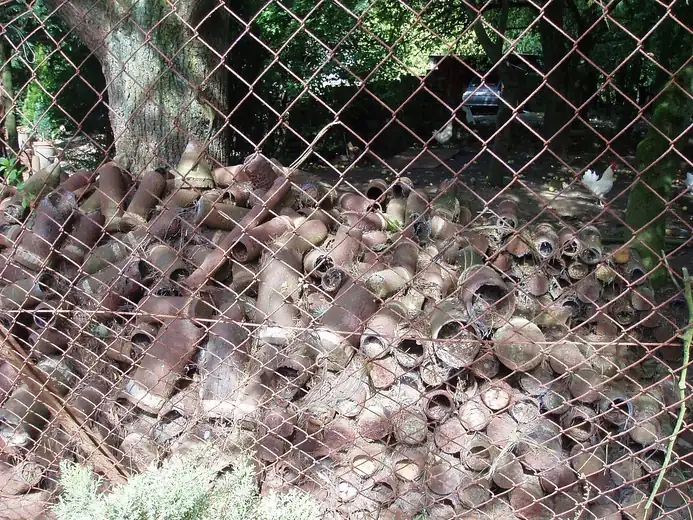
The rule, in three lines
If you find an object that might be a munition: do not touch it, do not move it, do not transport it. Move away, keep children and animals away, and call the gendarmerie or the police. They will call in the bomb disposal service.
The call-out is free. It brings no proceedings against you, including if the object has been in your home for decades and including if there are several pieces. This is the most important point in this guide: the fear of getting into trouble is the leading cause of bad decisions here, and it is unfounded.
What counts as a munition
More than people imagine:
- Shells of every size, including those turned into vases or lamp bases, known as trench art.
- Grenades, defensive and offensive, including those with no visible lever or pin.
- Mines and buried devices.
- Fuzes and detonators on their own, which are among the most sensitive items although the smallest.
- Complete cartridges, of every calibre, including those for antique weapons.
- Flares, smoke pots, signalling devices.
- Any sealed container of military origin whose contents you do not know, including cans and sealed crates.
Chemical shells exist in numbers in some areas of the front and cannot be told by eye from an explosive shell. That is one more reason never to handle anything.
Why “it is empty” means nothing
Three reasons, and they compound.
Nobody can see inside. A shell with its nose in place is a shell whose contents are unknown. A bright, clean case says nothing about the projectile it carries.
Time makes explosives less stable, not more. Some compounds crystallise as they age and become sensitive to shock, to friction, sometimes to simple handling. A device that failed to function on impact in 1916 failed for a mechanical reason, and that reason may no longer hold today.
Family memory is not expertise. The grandfather who said the piece had been emptied had often been told so by someone else. Nobody in the chain ever opened the object.
This point comes up again in inheriting military items, because it is almost always in an estate that these pieces are found.
What to do, step by step
- Do not handle it. If it is already in your hands, put it down gently on a stable surface, where it is, and move away.
- Do not clean, scrape or unscrew. Brushing and stripping are exactly the actions to avoid.
- Do not transport it. Not to the police station, not to a gunsmith, not to a neighbour who “knows about these things”. The journey is the most dangerous phase, and moving a munition in a vehicle also raises a legal problem.
- Secure the surroundings and prevent access, particularly by children.
- Call the gendarmerie or the police, or 17 in France. In case of immediate danger, 112.
- Photograph from a distance, without flash and without moving anything, if that helps describe the object over the telephone.
- Wait for the bomb disposal team on site, or as they instruct.
What you may legitimately keep
Not everything has to be removed, and collecting trench objects has its place.
Empty cases, once the projectile and the primer have been removed, are ordinary metal objects. They are the ones engraved or raised in trench art. Be careful, though: a case whose primer is still in place at the base is not empty.
Deactivated pieces with a document attesting it, issued by a professional. The document is part of the piece: without it, deactivation is a claim, not proof. An old deactivation does not amount to a certificate valid today.
Items inert by nature: fragments, fins, empty boxes, tools, accessories.
When in doubt, treat the piece as live. It is the one rule that never turns against you.
On this site
Listing munitions is prohibited, without exception. Our terms and conditions say so, and a listing of that kind is removed without discussion. The full framework of what may be sold is in selling militaria in France.
This is not a token precaution. A munition sent through the post endangers people who asked for none of it, from the counter clerk to the postman.
If you are clearing a house
Begin with this sorting before anything else, before even photographing or inventorying. Bring things out of the cellar and the attic carefully, and immediately set aside, without gathering or stacking them, every heavy metal object, cylindrical or egg-shaped, that you cannot identify.
Once that is settled, the rest of the process is described in inheriting military items: where to start.
What I cannot tell you here
I cannot tell you whether your piece is inert, and no photograph allows it. Nobody can state it from a distance, and anyone who does is doing you a disservice.
This page does not replace the judgement of the bomb disposal service, who alone are competent. Call them: it is free, it has no consequences for you, and it is the only answer that counts.
Frequently asked questions
I have found a shell or a grenade, what should I do?
Do not touch it, do not move it and do not transport it. Move away, keep children and animals from it, then call the gendarmerie, the police or 17 in France, who will call in the bomb disposal service. The call-out is free and brings no proceedings against you, even if the object has been in your home for decades.
Can a 1914-1918 munition still explode?
Yes, and time makes matters worse rather than better: some compounds crystallise as they age and become sensitive to shock or friction. A device that failed to function on impact failed for a mechanical reason, and that reason may no longer hold today.
My grandfather said the shell had been emptied, is that enough?
No, and it is the sentence that comes up in almost every accident. Nobody in the chain ever opened the object: the information passed from mouth to mouth without ever being verified. A shell with its nose in place is a shell whose contents are unknown.
Can I take a munition to the police myself?
No. The journey is the most dangerous phase, and moving a munition in a vehicle also raises a legal problem. Leave the object where it is, secure the surroundings and call: it is the bomb disposal team who travel, not you.
Can empty cases and trench art be collected?
Yes. A case whose projectile and primer have been removed is an ordinary metal object, and it is on such cases that trench art was made. Check, though, that the primer is no longer in place at the base: a primed case is not empty.
Can munitions be sold on Athena Militaria?
No, without exception. Listing munitions, shells, grenades, detonators and pyrotechnic items is prohibited by our terms and conditions, and such a listing is removed without discussion. A munition sent through the post endangers people who asked for none of it.