Identifying a French First World War medal
By Augustin, founder of Athena Militaria Published , updated
Decorations from 1914-1918 are among the military objects most often found in French families. They are also among the most often misidentified: a Croix de guerre separated from its papers, a commemorative medal taken for a gallantry award, a ribbon replaced long ago. This guide presents the decorations you are most likely to meet, then the method for placing a piece and understanding what makes its value.
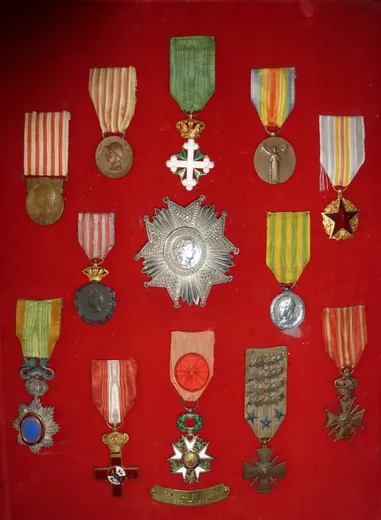
The decorations you meet most often
The 1914-1918 Croix de guerre
Created by the law of 8 April 1915, it rewards a citation, that is, an act of war officially recognised. It is a 37 mm four-armed cross in Florentine bronze, with two crossed swords. The obverse bears the head of Marianne wearing the Phrygian cap and the inscription "République française".
The reverse bears dates that help place the manufacture: "1914-1915", then "1914-1916", "1914-1917" and finally "1914-1918". The ribbon is green, edged and striped with red.
Devices pinned on the ribbon show the level of each citation:
- bronze star: citation at brigade or regiment level;
- silver star: at division level;
- silver-gilt star: at army corps level;
- bronze palm: at army level, a silver palm replacing five bronze palms.
Palms and stars can be combined. They are also very easy to remove and add: only the citation documents confirm what they say.
The Médaille militaire
Created on 22 January 1852 by Louis-Napoléon Bonaparte, it rewards enlisted men and non-commissioned officers, and exceptionally some general officers. The model in use during the Great War is the Third Republic type: a laurel-crowned profile of the Republic with the inscription "République française 1870", the motto "Valeur et discipline" on the reverse, and a trophy of arms above the medallion. The ribbon is yellow, edged with green.
Models, dating, holder and value: the full detail is in the Médaille militaire guide.
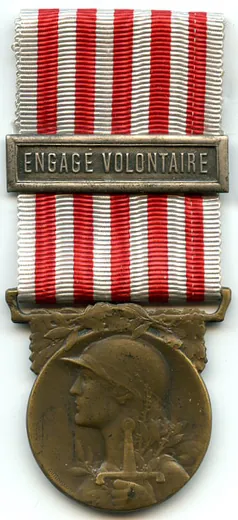
The Great War commemorative medal
Created by the law of 23 June 1920, it was awarded very widely to servicemen under arms between 2 August 1914 and 11 November 1918, and to some civilians. It was designed by the engraver Pierre-Alexandre Morlon: the obverse shows helmeted France, the reverse reads "Grande Guerre 1914-1918". The ribbon alternates white and red stripes. An "Engagé volontaire" clasp may accompany it. It has its own guide, together with the Victory medal: recognising, dating and tracing the recipient.
It is a service medal, not a gallantry award: it says nothing about a particular act, which explains how often it turns up in estates.
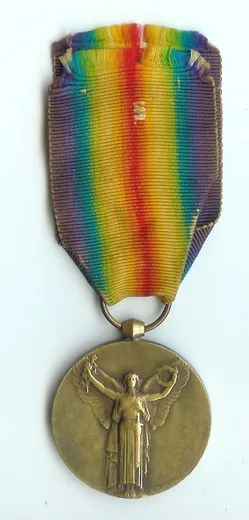
The Inter-Allied "Victory" medal
The French version was created by the law of 20 July 1922. The official model, also by Morlon, shows a winged Victory; the reverse reads "La Grande Guerre pour la civilisation". Its double-rainbow ribbon is shared by all the Allied countries.
There are also unofficial models, engraved notably by Charles, Pautot or Mattei. They are not fakes: they circulated at the time, and some are more sought after today than the official model.
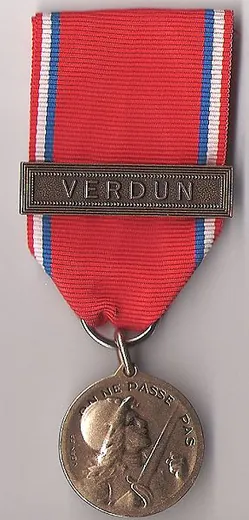
The Verdun medal
Created by the town of Verdun on 20 November 1916, it is not an official decoration but the badge of the "soldiers of Verdun". It bears the motto "On ne passe pas". Several engravers produced different models, among them Vernier, Prudhomme, Révillon, Augier, Pautot and Steiner. Identifying the engraver is the first step in placing a piece, because rarity varies greatly from one model to another.
The Croix du combattant
Created by the law of 28 June 1930, it was first intended for Great War combatants. It is a bronze cross pattée whose reverse reads "Croix du combattant", on a horizon-blue ribbon striped with madder red. Although later than the war, it often appears in the same groups.
Placing a piece: the method
1. Read the reverse and the inscriptions
Dates, mottos, engravers' signatures, makers' marks: record everything exactly as it is, before any interpretation. On a Croix de guerre, the date on the reverse places the manufacture; on a Verdun medal, the signature points to the identification.
2. Look at the manufacture
Decorations of this period were produced by the Paris Mint and by many private makers. Differences in size, sharpness of strike, ring or suspension are normal and part of the identification. Silver pieces, such as the Médaille militaire, may carry hallmarks: read them with a magnifier.
3. Be wary of the ribbon
A ribbon is easy to change, and often has been: period ribbons wear and fade, and families replaced them. A recent ribbon does not disqualify a medal, but it proves nothing either. Conversely, an old ribbon whose wear matches that of the medal is a good sign.
4. Look for the documents
Diploma, citation text, service record book, photograph of the recipient in uniform: these are what turn an anonymous medal into an attributed piece. A group of decorations accompanied by the documents of the same soldier tells a verifiable story, and that is what matters most to a collector.
To trace the recipient's service, the "registre matricule" can be consulted at the departmental archives of the place of enlistment, often online. For soldiers who died for France, the Ministry of the Armed Forces' Mémoire des hommes website is another resource.
What makes the value of a WWI decoration
- Documented attribution: a medal linked to an identified soldier, with his documents, is worth far more than the same medal on its own.
- The rarity of the model: some engraver or maker variants are much less common than others.
- Condition: sharp strike, original patina, no repairs.
- The consistency of the whole: ribbons, devices and original case that agree.
- Current demand for that type of piece.
The most common medals, such as the commemorative medal or the official Victory medal, were awarded in very large numbers: on their own, they remain affordable pieces. To value a decoration, rely on sales actually concluded for comparable pieces, never on asking prices.
The most common traps
- Recent reproductions, often too sharp, too light, or made of metal with a uniform look.
- Added devices: a palm or stars pinned on a ribbon to "enhance" a Croix de guerre.
- Later engraving: a name engraved on the reverse counts as attribution only if documents confirm it.
- Assembled groups that bring together decorations from different recipients.
For the general method, see our guide to spotting a reproduction or a fake. If these medals come from an estate, start with what to do with an inheritance.
First World War decorations offered between collectors are gathered in the catalogue: First World War medals.
Frequently asked questions
How do you recognise a 1914-1918 Croix de guerre?
A 37 mm four-armed bronze cross with two crossed swords, Marianne in a Phrygian cap and the inscription "République française" on the obverse, dates on the reverse (1914-1915, 1914-1916, 1914-1917 or 1914-1918), and a green ribbon edged and striped with red. The palms and stars on the ribbon show the level of the citations.
What do the stars and palms on a Croix de guerre mean?
Each one stands for a citation: bronze star at brigade or regiment level, silver star at division level, silver-gilt star at army corps level, bronze palm at army level. A silver palm replaces five bronze palms. Only the citation documents confirm what the devices indicate.
Is the Verdun medal an official decoration?
No. It was created by the town of Verdun on 20 November 1916 as a badge for soldiers who served in that sector. Several engravers produced different models, whose rarity varies greatly.
Is a WWI commemorative medal worth anything?
It was awarded very widely to mobilised men and some civilians: on its own it is an affordable piece. Its value rises clearly when it belongs to a group attributed to an identified soldier, with his documents.
How can you trace the soldier who received a medal?
Start with family documents (service record book, diplomas, citations), then consult the registre matricule at the departmental archives of the place of enlistment, often digitised. For soldiers who died for France, the Ministry of the Armed Forces' Mémoire des hommes website is another resource.
Should a damaged medal ribbon be replaced?
No. A period ribbon, even a tired one, is part of the piece: replacing it loses information and part of the value. Keep the medal as it is, away from light and humidity.