Spotting a reproduction or a fake: the seven-point method
By Augustin, founder of Athena Militaria Published , updated
Doubt is the collector's most common feeling, and the healthiest one. Historical reenactment has been producing well-made reproductions for decades, which age, change hands and eventually reach the market with nobody knowing where they came from. No single detail proves anything on its own. It is the combination that decides.
This guide will not teach you to authenticate a piece from a distance; nobody can. It gives you the order in which to look, and the seven points which, taken together, tip the balance.
Before the seven points: the right question
The question is not “is it genuine”. It is “what am I looking at, and is it consistent”. A piece can be authentic in its structure and reassembled with recent components. It can be an honest copy sold as such twenty years ago, then resold in good faith as a period piece. Between the intact original and the deliberate forgery lies a whole grey area that accounts for most of the market.
Three families to distinguish: the reproduction, made for re-enactment and often marked as such when produced, the composite piece, assembled from components of different periods, and the fake, manufactured or aged in order to deceive. The first is common, the second more common still, and the third is rarer than people think on ordinary pieces, being concentrated on what fetches high prices.
1. The consistency of wear
This is the hardest point to falsify and the one that most often gives away a piece that has been artificially aged.
An object that has genuinely been worn wears where it rubs: edges, ridges, points of contact with the body, areas that are gripped, the underside of a buckle, the inside of a collar. Wear is directional and uneven. A piece aged in a chemical bath or with an abrasive shows, by contrast, homogeneous wear, spread evenly everywhere, including where nothing ever rubs.
Ask yourself the question every time: this wear, what action produced it? If you cannot find the action, be wary.
2. What can be seen on the inside
The forger takes care of the outside. The inside is almost always the weak link, because it is not meant to be seen.
Look at linings, the reverse of seams, the inside of a liner, the underside of a rivet, the back of a badge. Look for materials that did not exist in the supposed period: shiny synthetic thread, hot-melt glue, modern adhesive, plastic foam, office staples, acrylic paint.
One simple and often decisive point: the thread. Old cotton and linen threads do not catch the light in the same way as polyester. A seam that catches the light sharply deserves close examination.
3. Regularity, that false friend
Older industrial production is regular, but not perfect. Stitches vary slightly, pressed parts show small asymmetries, and no two stamp strikes are ever identical.
A piece of flawless regularity, with crisp angles and exact spacing, suggests modern manufacture, computer-controlled or done on an electronic sewing machine. That is the paradox: too good is suspect.
4. Markings and their logic
Proof marks, acceptance stamps, makers’ names, sizes, batch numbers. Three anomalies come up constantly.
- A marking that is too crisp on a worn piece. If the object has seen use, its markings have seen use as well. A stamp of perfect freshness on tired leather is inconsistent.
- The complete absence of any marking on a type of piece that always carried one.
- The marking that is too good to be true, the one that ticks exactly the rare box the market is looking for. Forgers produce what sells.
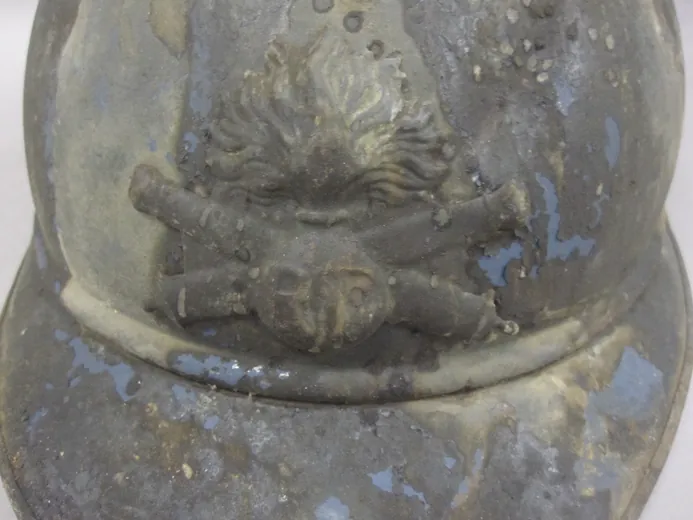
For the families of pieces copied most often, the identification guides set out what you should find: the Adrian helmet, the German helmet, insignia and First World War medals.
Always record markings character by character before interpreting them. Transcribe first, understand afterwards: one misread letter points to a different maker, a different year, sometimes a different country.
5. Weight and material in the hand
This is the sense that trains fastest and that transmits least well in writing. Old steels, leathers and wools do not have the density or the suppleness of their modern equivalents.
Old leather is dry, rigid in places, supple at the folds created by use. Modern leather that has been artificially aged stays uniformly supple. Period wool is dense and slightly coarse. Handle pieces you know to be sound whenever you get the chance: it is the only training that counts.
6. Traces of manufacture and repair
Military pieces were repaired, recut and refurbished by military workshops. These period interventions are a sign of life, not a defect.
A piece with no trace of maintenance at all, when its type nearly always carried some, deserves a question. Conversely, a repair made with modern thread on an old piece indicates recent work, without meaning for all that that the piece is a fake.
7. Provenance and the story
The last point is not on the object, it is around it.
A verifiable provenance, however modest, is worth more than a spectacular story. Be wary of accounts that are too perfect, of the kind where the piece was brought back by a forebear from a prestigious unit, without a single document. Such a story adds perceived value and costs nothing to invent.
Conversely, a seller who writes “I have not managed to identify this stamp” is giving you accurate information and telling you something about the way they work.
The papers that establish provenance, and how to read them, are covered in reading and keeping military photographs and documents. Proven provenance also weighs heavily on the price: see valuing a military item.
What you can do before buying
Ask for additional photographs, in particular of the inside, the markings and the areas of wear. A serious seller supplies them without difficulty. A refusal, or photographs that are consistently blurred on the useful areas, is an answer in itself.
Have the listing looked over by other collectors before you decide: put a question to the community. On ordinary pieces, a few opinions are often enough to settle the doubt.
Finally, compare with pieces of the same type and the same period, which the catalogue allows you to do period by period: First World War, Second World War, Cold War.
If you are selling, transparency is your best protection
Describe what you see, not what you assume. Photograph the flaws as much as the qualities. State explicitly what you have not been able to determine. A cautious listing sells for slightly less than an assertive one, and it protects you if the sale is disputed.
On Athena Militaria, reproductions and deactivated pieces are accepted, provided they are clearly identified as such in the listing. That is a rule of the terms of sale, and it is also what allows a marketplace between private individuals to hold up over time.
To go further on the first sorting of a group of pieces: inheriting militaria, where to begin.
Frequently asked questions
Can a seller refuse to provide additional photographs?
They can, but that is information in itself. On a collectable piece, photographs of the inside, the markings and the areas of wear are exactly the ones that allow you to make up your mind. A serious seller supplies them without difficulty. Photographs that are consistently missing or blurred on the useful areas are good grounds for walking away.
Does a reproduction have any value?
Yes, but a practical value, for re-enactment or display, unrelated to that of a period piece. The problem is not the reproduction, it is the reproduction sold as something it is not. A copy clearly stated as such is a perfectly legitimate transaction.
How can artificial wear be recognised?
Look at whether the wear is directional. An object that has been worn wears at the real points of friction: edges, ridges, areas of contact with the body. Homogeneous wear spread everywhere, including where nothing rubs, suggests chemical or abrasive ageing. Ask yourself what action would have produced that mark.
Are markings enough to authenticate a piece?
No. A marking can be copied, and forgers reproduce sought-after markings first. A marking that is too crisp on a worn piece, or that corresponds exactly to the rare variant the market is looking for, calls for more caution, not less. The marking is one indication among seven, never a proof on its own.
What is a composite piece?
A piece assembled from components of different periods or origins: a helmet fitted with a replacement liner, a tunic with replaced buttons, a medal remounted on a recent ribbon. It is very common and often with no intention to deceive. It changes the value, so it must appear in the description.
Should you have a piece expertly examined before buying?
For an ordinary piece, the opinion of experienced collectors is generally enough. For a large sum or a piece presented as rare, a paid appraisal by a professional is proportionate to the risk. The cost of an appraisal is always lower than the cost of a mistake on an expensive piece.