Reading and keeping military photographs and documents
By Augustin, founder of Athena Militaria Published , updated
This is the part of an estate thrown out first and regretted afterwards. A box of papers is often worth more, for history as for a collector, than the object it came with: it is what gives a name, a unit, a date. It is also the most fragile part, which three well-meant actions are enough to spoil.
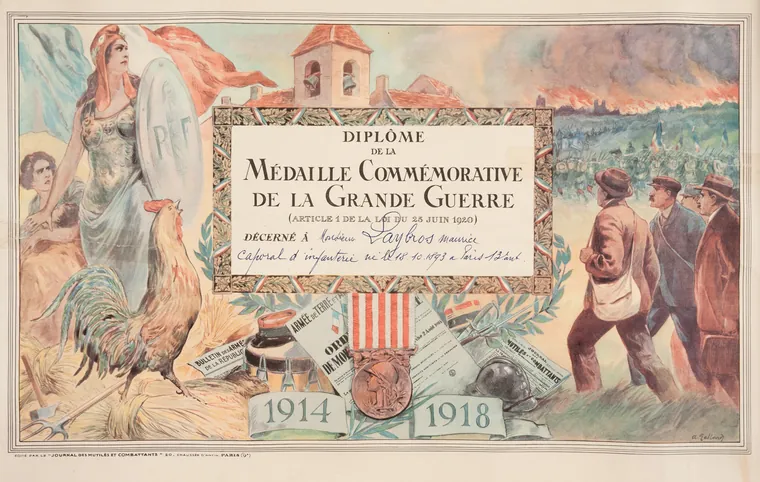
Throw nothing away, and do not write on it
Papers, envelopes, funeral notices, record books, certificates, notebooks, labels: keep everything, including what looks uninteresting. Documentary context is rarely reconstructed, and a stamped envelope carries a date and an address that the letter inside does not always have.
Never write in ballpoint on the back of a photograph: the ink goes through and marks the image over time. If you must annotate, use a soft graphite pencil, in the margin, without pressing.
Dating a photograph
The support says more than the image
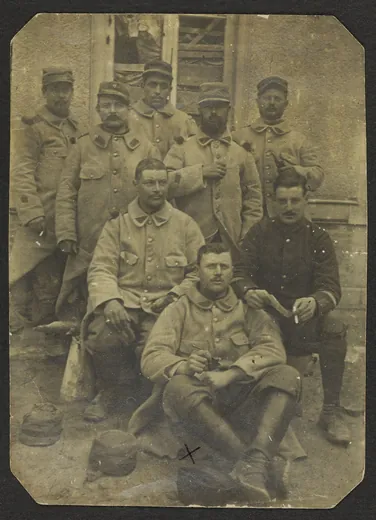
A print mounted on thick card, with a studio name printed below, belongs to the last third of the nineteenth century or the beginning of the twentieth. A thin, flexible print the size of a postcard corresponds to the Great War and the interwar years, when the soldier's portrait sent home was the usual format.
Turn the card over. A back given entirely to the address, with no division, points to the very first years of the postcard; a back divided in two, message on the left and address on the right, corresponds to the period that follows. The photographer's name and address, often printed, can be dated through trade directories.
The uniform and the headdress date the moment
This is where photograph and object answer one another. The apparent shade of the cloth in a black and white print, the cut, the headdress, the collar tabs and their number: all of it is read by the method in dating a French military uniform.
Beware of the setting: many portraits were taken in a studio, against a painted backdrop, sometimes with props lent by the photographer. An object visible in a photograph did not necessarily belong to the soldier.
The papers that open the archives
Four documents count more than the others, because they give the keys to a search.
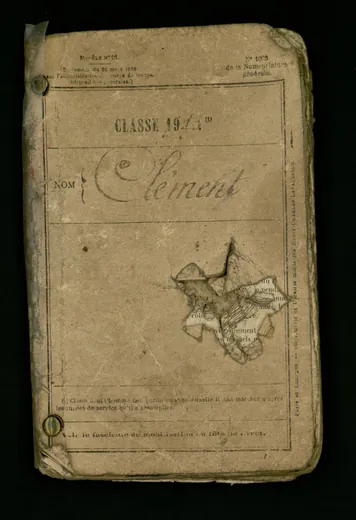
- The service record book: surname, forenames in their exact order, date and place of birth, class, enlistment number and recruitment office. It is the key item.
- The mobilisation booklet, which gives the intended posting.
- Certificates and qualification badges, which date a skill.
- Citations, which give the exact text of a deed and the level of command that pronounced it. Reading them is covered in reading a Croix de guerre 1914-1918.
Tracing the service record
With the full name, the date and place of birth and the recruitment department, you can reach the conscript's enlistment record, kept at the departmental archives of the place of recruitment, very largely digitised and consultable online free of charge. It gives the postings, the wounds, the citations and often the exact dates.
For servicemen who died for France, the Ministry of the Armed Forces' Mémoire des hommes site is the reference resource. Citations at army level appear in the digitised collections of the Journal officiel.
Note your sources as you go, including the dead ends. A documented search can be picked up again; a search held in memory has to be done over entirely.
For a specific decoration, the steps are set out in tracing a French WW1 soldier's decorations, in the Médaille militaire guide and in the First World War medals guide.
Keeping without destroying
- No soft plastic. PVC sleeves release compounds that attack ink and make prints stick. Prefer polyester or polypropylene sleeves, or simply neutral paper.
- No adhesive tape, no glue, no lamination. Lamination is irreversible and disqualifies a document.
- No staples or metal paper clips, which rust and mark paper permanently.
- Flat, not rolled. A certificate rolled up for forty years cracks if unrolled quickly; let it relax under a light weight, over several days.
- Away from light, in a normally heated room. Neither attic nor cellar.
- Do not restore. A tear repaired with tape is worth less than a tear left alone.
Digitise, it is the only backup
Scan at 600 dots per inch, the document flat, without forcing a fold. Save without lossy compression, name the files with what you know, and keep a copy somewhere other than the computer you used. Paper can burn, be lost, be divided between heirs; the file cannot.
What makes a documentary group valuable
A single document is worth little. A coherent named group, where the record book, the photographs, the citations and possibly a decoration all point to the same person, changes category. It is the one case in militaria where the whole is worth markedly more than the sum of its parts.
The consequence is practical: do not split it up. Selling one man's record book, cross and photograph separately destroys what made all three valuable, and makes the group impossible to reconstruct ever again.
The method for placing a group within a price range is the same as for an object: valuing a military item.
What I cannot tell you here
I cannot identify a soldier from an unannotated photograph. Without a name, the search starts from a uniform and a collar number, which gives a unit, sometimes a period, never a person.
Photograph or scan the front and back of every item, including blank backs, and write down what the family still knows. Then ask the community: reading old handwriting or a faded stamp is often a matter of several pairs of eyes. Documents for sale are in the catalogue, in particular First World War pieces.
Frequently asked questions
How can a photograph of a soldier be dated?
Start with the support: a print mounted on thick card with a studio name points to the last third of the nineteenth century or the early twentieth, a thin postcard-sized print to the Great War and the interwar years. Turn the card over: a back given entirely to the address is older than a divided back. The uniform and the collar tabs then date the moment.
How can a soldier's service record be traced from his papers?
Note the surname, the forenames in their exact order, the date and place of birth and the recruitment office, usually given on the service record book. Then consult the enlistment record at the departmental archives of the place of recruitment, very largely digitised and free. For those who died for France, the Mémoire des hommes site completes the search.
Can you write on the back of an old photograph?
Not in ballpoint: the ink goes through the paper and marks the image over time. If an annotation is necessary, use a soft graphite pencil, in the margin, without pressing. Better still, note the information on a separate sheet kept with the photograph.
How should old military documents be stored?
Not in PVC sleeves, which release compounds that attack ink and make prints stick: prefer polyester, polypropylene or simply neutral paper. Flat, with no staples or metal clips, no tape and no lamination, away from light and in a normally heated room.
Should a torn document be restored?
Not by yourself, and certainly not with tape: a tear repaired with adhesive is worth less than a tear left alone, because the repair is irreversible. Digitise the document as it is, then ask a paper conservator if the piece warrants it.
Should a soldier's record book, medal and photograph be sold separately?
No. A coherent named group, where every element points to the same person, is worth markedly more than the sum of its parts, and it is the one case in militaria where that is so pronounced. Splitting it destroys that value and makes reconstruction impossible for good.