Reading a military identity disc and tracing the soldier who wore it
By Augustin, founder of Athena Militaria Published , updated
It is the smallest thing in the box, it fits in the hollow of your hand, and it says the most. An identity disc tells you nothing of deeds or rank. It tells you who, where and when, in three lines stamped letter by letter. For the heir it is the key that opens the archives; for the collector it is the piece that only makes sense once it is tied to a name. Here is how to read the French models and those of other armies, and what to do with the number you will find on it.
What a disc is for, and why there are often two
Set it on the table. It was made for one purpose, simple and terrible: so that a body could be recognised. France issued discs to its soldiers from 1881. The Great War soon forced a second one: one disc stays on the body, the other is taken away for the civil register and the administration. So from 1915 (the decision dates from 14 May) a soldier wore one disc at the neck and a second that the men soon took to wearing at the wrist, a habit the regulations endorsed in 1918. Many other armies drew the same lesson at the same moment, and adopted double or breakable tags.
For you, holding one today, the consequence is plain: a lone disc is not an anomaly. The soldier who came home kept it, or gave it to his family, or its twin went missing a century ago. In all three cases it is waiting for you with the same three lines.
The 1881 model: the oval disc
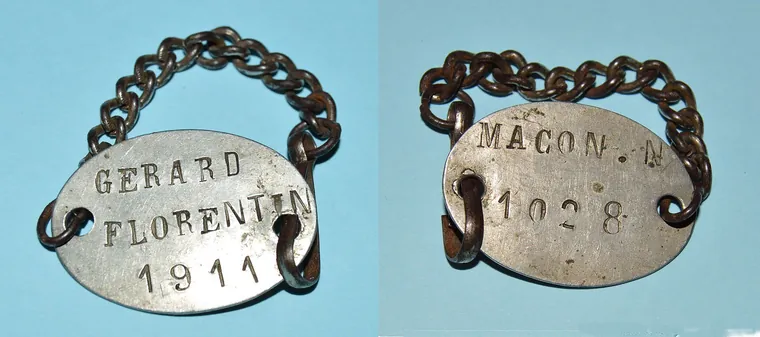
This is the disc of the poilus. A small oval of white metal, pierced for a cord at the neck or a chain at the wrist, stamped letter by letter with a more or less steady hand. Spread across its two faces, a few markings always come back:
- the surname and first name, often in capitals, sometimes abbreviated;
- a year: the recruitment class, that is the year the soldier turned twenty. Discs engraved before the circular of 12 October 1883, and many bought privately, carry the full date of birth instead;
- the recruitment office, usually the name of a town, sometimes followed by a letter or a figure when the town had several;
- the service number at recruitment, running from 1 to a few thousand depending on the size of the office.
Do not look for a fixed layout: which face carries what changes from one disc to the next, because they were stamped in the unit or ordered by the soldier from a craftsman. What matters comes down to three words: class, office, number. Together they point to one man and one only in the registers. Many poilus had a second disc made at their own expense, more legible or sturdier, and you will find them mounted on chain bracelets, curb chains and leather cords.
The 1918 model: the breakable tag
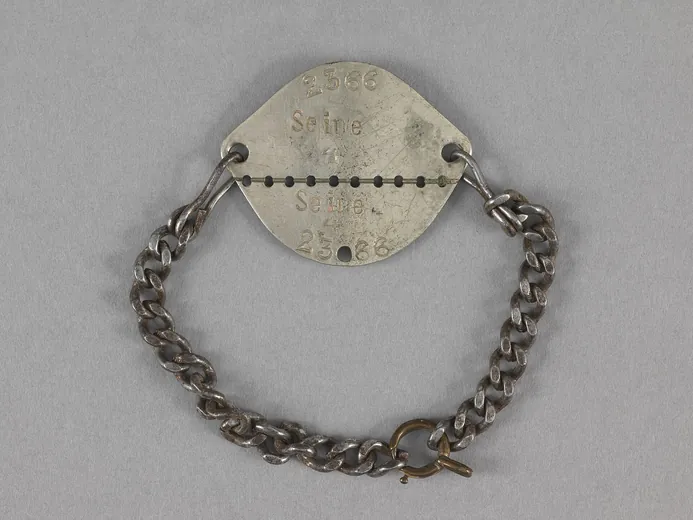
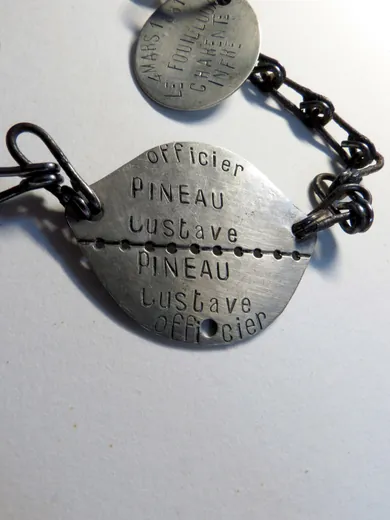
This one you will know at first glance. Adopted at the end of the Great War and worn throughout the Second, the 1918 model is wider, mounted on a chain bracelet by two side eyelets, and crossed through the middle by a line of small holes along which it snaps in two. Those holes are the whole meaning of the object. The markings are repeated on either side of the line: on one side the surname, first name and class (date and place of birth for officers); on the other the recruitment office or mobilisation centre and the service number. Some carry the unit, and those engraved at the Liberation sometimes add the blood group. One half stays at the wrist, the other goes with the papers.
The tag you find whole, never broken, is the most common case: most never had to serve. A single half tells another story. It deserves a search.
The tags of other armies
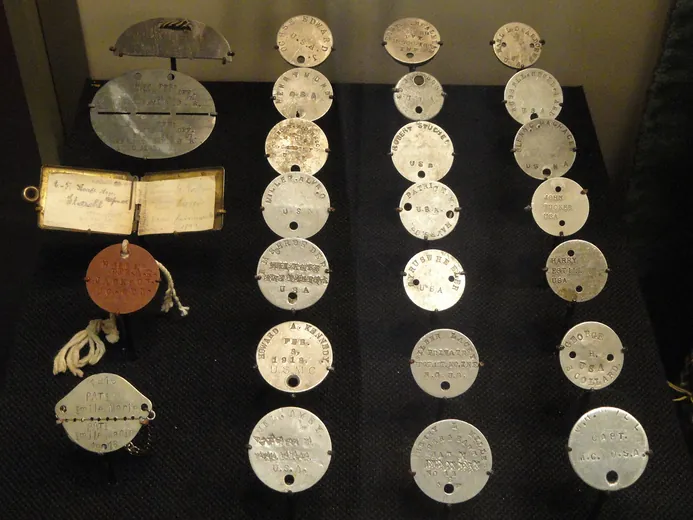
French family boxes also hold foreign tags, brought back or swapped. I am often asked which country a given disc comes from: the shape alone is often enough to answer.
- Germany. The Erkennungsmarke is an oval of zinc or aluminium. The Great War version bears the name, date of birth, home address, unit and roll number, with no break line before the model of September 1917. The Second World War version no longer carries the name: only the unit, the number in the company roll and the blood group, repeated on both halves of a breakable tag.
- United States. Two round aluminium discs during the Great War, stamped with the name, serial number and unit. From 1940, the rectangular tag with rounded corners and a notch, carrying the name, serial number and the address of a next of kin; from late 1941 the tetanus vaccination dates, blood type and religion are added, and the next of kin's address disappears in 1943.
- United Kingdom and Empire. Two discs of compressed fibre on a cord, a round red one and an octagonal green one, bearing the name, number, unit and religion in stamped letters. The red one was taken off, the green one stayed on the body.
- Italy. A rectangular metal case holding an identity slip during the Great War, then a breakable tag.
On a foreign tag, each marking points to the archives of the country concerned, and many are online: German unit rolls, American service records, Commonwealth records for British soldiers.
Tracing the soldier
For a French disc the road is short. The disc carries exactly the keys to the registers; you only have to read them in the right order.
- Read everything, both ways. Turn the disc over, tilt it under the lamp. A stamped letter sometimes reads upside down; a lone year may be the class (the birth year plus twenty) or the birth itself. Note every marking as it stands before you interpret anything.
- Open the service register (registre matricule) of the recruitment office shown, for the class shown, at the departmental archives of that office's département: most are online. The service number takes you straight to the record. And the record is the man: full civil status, description, units, campaigns, wounds, citations and decorations.
- Check consistency. The name on the record must be the name on the disc. In the same office and the same class, two namesakes never share a service number; but numbering starts again from one each year, which is why the class read on the disc matters.
- For a soldier who died during the war, the French Ministry of the Armed Forces' database of those who died for France, on Mémoire des hommes, gives the death record; the "Sépultures de guerre" database, on the same site, often gives the burial place.
The full method, sources and order of search, is laid out in the guide on tracing a French WW1 soldier's decorations, and the guide on military photographs and papers shows you how to read a service book and a postcard of the same man.
A disc found in the ground
A disc that comes out of the ground, during works or on a walk across a former battlefield, calls for a different reflex. If bones lie with it, these are human remains: you notify the gendarmerie, which refers the find to the services responsible for identification and burial. It is no longer a find; it is a man. A lone disc belongs first to that man's story; several associations devote themselves to finding the families and returning it, and that is what most serious field researchers do. Remember, finally, that metal detecting and digging on these sites are regulated, and that anything that looks like ammunition stays where it lies.
What drives the value, and what should
Alone, an identity disc is a modest object, and its price stays low. Its real value lies elsewhere: it is the piece that ties everything else to a man. Lay side by side a disc, a service book, a photograph and two medals of the same soldier and you have an attributed group, whose historical and market interest has nothing in common with that of the same pieces scattered. Never separate it from what goes with it. And if you buy a lone disc, walk the archive road first, before judging what it is worth: the guide on valuing a military item explains why.
Reproductions are rare, for lack of financial stakes. Re-stamped or "improved" discs do exist, however. Lettering that is too crisp, metal that is too clean, stamping as regular as a machine on a disc supposed to date from 1915: each is a reason to doubt. Do not clean an old disc. Its patina and wear are part of its proof.
What I cannot tell you here
I cannot tell you, from a photograph, who the man was. The service record will, and it is within your reach in an evening, at your own screen. Nor can I decide for you whether a lone disc should go back to a family or stay in your cabinet. That is a matter of conscience more than of rules. But the right answer, either way, begins the same: by knowing who he was.
Frequently asked questions
What do the markings on a French WW1 identity disc mean?
The soldier's surname and first name, a year that is most often his recruitment class (the year he turned twenty), the name of his recruitment office and his service number in that office. Those last three markings designate one man and one only in the service registers of the departmental archives.
How do I trace a soldier from his identity disc?
Open the service register of the recruitment office shown on the disc, for the class shown, at the corresponding departmental archives, most of them online. The service number leads to his record: civil status, units, campaigns, wounds, decorations. For a man who died for France, the Mémoire des hommes database completes the search.
Why are some military tags perforated across the middle?
So that they can be snapped in two. The markings are repeated on each side of the line of holes: one half stays on the body, the other is removed for the civil register. That is the principle of the French 1918 model and of the German Erkennungsmarke.
What is the difference between the French 1881 and 1918 models?
The 1881 disc is a small oval plate, whole, worn at the neck or wrist. The 1918 tag is wider, mounted on a chain bracelet, and breakable along a line of perforations, with the markings repeated on both halves. The two could be worn together.
What should I do with an identity disc found in the ground?
If bones are with it, these are human remains: notify the gendarmerie, which refers the matter to the competent services. A lone disc belongs first to a man's story: associations trace the families to return it. Metal detecting and digging on former battlefields are, moreover, regulated.
Is a military identity disc valuable?
On its own, very little. Its value is to tie a group to a man: together with the service book, photographs and medals of the same soldier, it changes the nature of the lot. Never separate it from what goes with it.