The French Great War commemorative medal and the Inter-Allied Victory medal
By Augustin, founder of Athena Militaria Published , updated
Open a family box, almost any family box. The odds are it holds these two: a white ribbon striped with red, and a rainbow one. The Great War commemorative medal, and the Inter-Allied medal that everyone calls the Victory medal. Nearly every French soldier of 1914-1918 received them. That makes them common, and it is exactly what makes them precious: they say that a man served, and often where. Here is how to recognise them, tell them from their copies, and trace him.
Two medals for everyone who served
Lay the decorations of the Great War out on a table and they sort themselves into two families. On one side, those that reward an act or a record. The Croix de guerre goes with a citation, the Médaille militaire with exceptional conduct. On the other, those that simply record a presence. The commemorative medal and the Inter-Allied medal belong to the second family. Nobody earned them through a feat. A man was entitled to them because he had been there.
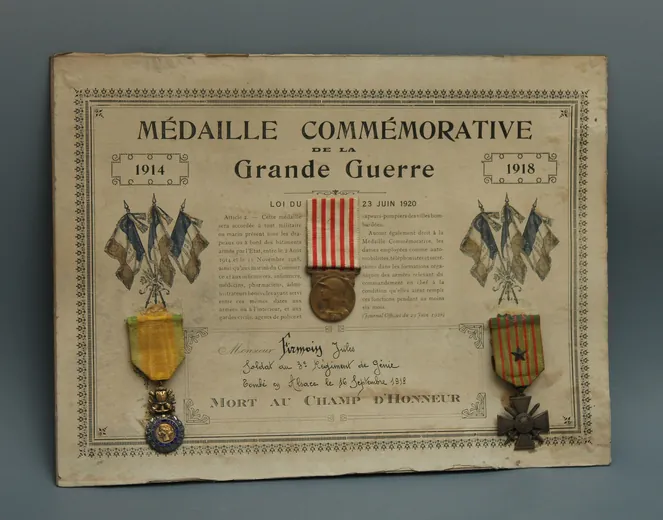
The 1914-1918 War Commemorative Medal was born of the law of 23 June 1920. Its article 2, which souvenir frames of the period often reproduce in full, grants it to every soldier or sailor serving with the colours between 2 August 1914 and 11 November 1918. Then the list grows: merchant seamen, nurses, doctors and pharmacists who served with the armies or at home, civil guards, policemen and firemen of bombed towns, and women employed for at least six months as drivers, telephonists or secretaries in army units. In other words, almost everyone.
The Inter-Allied medal, which everyone calls the Victory medal, came from a joint decision of the Allied nations in 1919: each country struck its own medal, but all of them hang from the same rainbow ribbon. The French version was instituted by the law of 20 July 1922. Its conditions are narrower. As a rule, three months in a combat unit, or eighteen months in the zone of the armies, between 2 August 1914 and 11 November 1918; the wounded, holders of the Croix de guerre and prisoners qualified regardless of length. A man who served only at home therefore has the commemorative medal without the Victory medal. That absence, on its own, is already a piece of information.
Recognising the commemorative medal
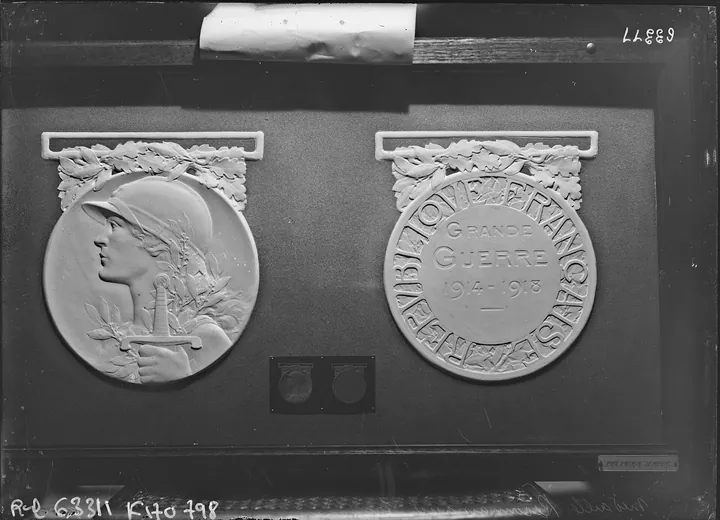
Take it in your hand. Bronze, about thirty millimetres across: it sits in the hollow of the palm. On the obverse, the head of the Republic in profile, wearing a helmet decorated with laurel, a sword before her, and not a letter of legend: only the engraver's signature appears there. On the reverse, "Grande Guerre 1914-1918" on several lines, surrounded by the legend "République française". Now look at how it hangs from the ribbon. By a rectangular suspension of oak branches, as wide as the ribbon, not a plain ring. The engraver was Pierre-Alexandre Morlon, his name is on the obverse, and that is why collectors speak of the "Morlon model" for the official type.
The ribbon is white, watered, striped with red across its full width. It is what catches the eye first in a box. It is also what must not be confused with other red and white ribbons, foreign ones in particular.
The official model and the others
The Paris Mint struck the medal. So did private makers, in large numbers and for decades, for veterans replacing a lost piece or completing a medal bar. You will therefore meet:
- the official Morlon model, with fine relief and the engraver's signature;
- an unofficial model known as the "Charles type", slightly smaller in diameter, with minor differences on both faces, recognisable above all by its suspension in the form of a broad ring of oak leaves;
- miniatures for civilian dress, and late strikes with softer relief.
Turn the piece over and put the rim under a loupe. Paris Mint strikes carry its hallmark, a cornucopia; private makers put their own mark there, or nothing at all. A private strike is not a flaw. It is information about the piece, and about its price.
The "Engagé volontaire" clasp
Only one bar has official standing on this ribbon: the "Engagé volontaire" clasp, reserved for those who enlisted without being required to. Everything else, a battle or a sector name, is a private addition, fitted by the veteran himself or by a dealer. I am often shown a ribbon heavy with bars and asked what the army meant by them. Nothing. Battle names have their place on other pieces, such as the Verdun medal, but not here.
Recognising the Inter-Allied medal
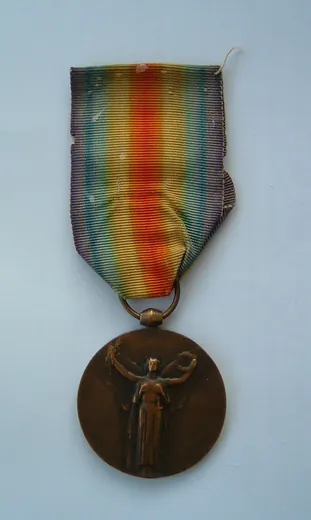
The French Victory medal is slightly larger, also in bronze. On the obverse, a winged Victory, standing, facing forward, arms raised. On the reverse, "La Grande Guerre pour la civilisation, 1914-1918". The design is again by Pierre-Alexandre Morlon. And then there is the ribbon, the famous double rainbow, red in the centre shading to violet at the edges. It is shared by all the Allied nations. That is exactly what misleads.
For the other countries' Victory medals hang from the same ribbon. French family boxes hold British, Belgian, American or Italian Victory medals, brought back by a relative or swapped between soldiers. Each country has its own figure and its own reverse. Remember this: the winged Victory facing forward, arms raised, and the words "pour la civilisation" in French identify the French version, and it alone.
Here too, the market produced its variants. Two unofficial types are well known to collectors, the "Charles type" and the "Pautot-Mattei type", recognisable by a Victory drawn differently. They are not fakes. They are period private strikes, bought by the men themselves. A recent reproduction, on the other hand, shows other signs, described in the guide on spotting a fake.
Dating a strike
Neither medal carries a date of manufacture. The years they display are those of the war, not of the striking. Three clues nevertheless help to place a piece.
- The ribbon. A watered silk ribbon, often faded, frayed, its colours unevenly gone, is an old ribbon. A synthetic ribbon with bright, uniform colours was fitted after the 1950s, which says nothing about the medal itself.
- The marks. The Paris Mint hallmark and the engraver's signature point to an official strike. A maker's mark identifies a private strike, which may be of the period or later.
- The relief. Early strikes have crisp modelling and well-separated lettering. Late strikes, from worn dies or from casts, have soft relief and lost detail.
One last point, easily forgotten in front of a frame. A medal instituted in 1920 and on sale only from February 1922 cannot have been worn by a man killed at the front. The families of the fallen acquired it on his behalf, and often placed it in a frame next to the Croix de guerre.
The certificate and the souvenir frame
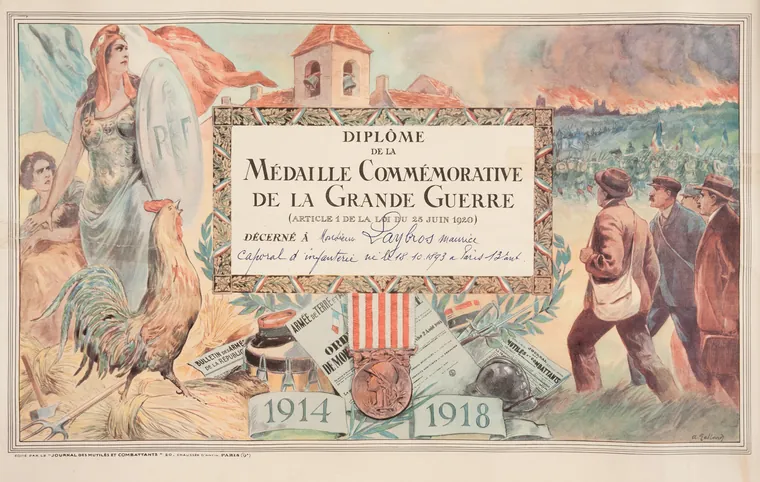
The medal is not named. What ties it to a man is the paper that goes with it. The award could come with a certificate, and private publishers, often linked to veterans' associations, sold splendid illustrated ones on which the name, rank and unit were written by hand. Many families also bought, in the 1920s and 1930s, a souvenir frame, oval or rectangular: the soldier's photograph, his medals sewn in place, and a few lines about his service.
These frames often show three pieces side by side: the commemorative medal, the Victory medal and the Croix du combattant, created in 1930 for holders of the combatant's card. It is the trio of the ordinary veteran, the one who was neither cited nor otherwise decorated. It already tells a great deal.
Never separate the certificate, the frame or the photograph from the medals. Sold apart, they are worth almost nothing. Together, they make an attributed object whose value and historical interest have nothing in common with those of an anonymous medal. The guide on military photographs and papers explains how to read and keep these documents.
Tracing the recipient
Without a paper, a commemorative medal leads to nobody: several million were issued. With a name, on the other hand, the search is simple. The soldier's service record, kept at the departmental archives of his recruitment district and usually online, summarises his campaign: dates of presence, units, wounds, citations, and sometimes a note of his decorations. The full method, sources and order of search, is described in the guide on tracing a French WW1 soldier's decorations.
The record also lets you check that the box holds together. A man whose record shows three months in a combat unit, or eighteen months in the zone of the armies, was entitled to the Victory medal. Another, who stayed at the depot, was not, and the Victory medal beside his comes from elsewhere.
What drives the value
Let us say it plainly: taken alone, these are among the most common French decorations, and their market value is modest. What separates two examples comes down to a few points.
- The strike. An official model with crisp relief is worth more than a late strike; a Charles or Pautot-Mattei type interests the collector of variants.
- Condition and original ribbon. A piece with intact patina on its period silk ribbon, even faded, is preferred to a polished piece on a new ribbon. Clean nothing: the guide on caring for militaria explains why.
- The clasp. "Engagé volontaire" is sought after, provided the bar is old and not added later.
- Attribution. This is the deciding factor. Certificate, frame, photograph, service book: anything that names the soldier turns a common medal into a document.
- Foreign Victory medals. Some nations struck very few, and their version is sought after; the French and British ones, struck by the million, are the most common.
To get from these criteria to an order of magnitude, the method is the same as for any military item: record sales actually concluded, never asking prices. It is described in the guide on valuing a military item.
What I cannot tell you here
I cannot tell you, from a photograph, whether your medal is an official strike or a period private strike. That takes the piece in hand and the rim under a loupe. Nor can I tell you who wore it if no paper goes with it. What this guide gives you is a way to read the family box in the right order: recognise what it holds, understand what the presence or absence of each medal says about a man's service, and know what must never be separated.
Frequently asked questions
Who received the French 1914-1918 commemorative medal?
Every soldier or sailor serving with the colours between 2 August 1914 and 11 November 1918, as well as merchant seamen, medical staff who served with the armies or at home, civil guards, policemen and firemen of bombed towns, and women employed for at least six months in army units. It was created by the law of 23 June 1920.
What is the difference between the commemorative medal and the Inter-Allied medal?
The commemorative medal records presence with the colours during the war, whatever the post. The Inter-Allied medal, known as the Victory medal, requires as a rule three months in a combat unit or eighteen months in the zone of the armies, except for the wounded, the cited and prisoners. A soldier who stayed at home has the first without the second.
How do I recognise the French Victory medal among the others?
All the Allied Victory medals hang from the same rainbow ribbon, but each country has its own figure and reverse. The French version shows a winged Victory standing, facing forward, arms raised, and its reverse reads "La Grande Guerre pour la civilisation 1914-1918" in French.
What does the "Engagé volontaire" clasp on the commemorative medal mean?
It is the only official bar on this ribbon: it marks those who enlisted without being obliged to. The battle names sometimes seen on this ribbon are private additions with no official standing.
Is the French WW1 commemorative medal valuable?
On its own, it is one of the most common French decorations and its value is modest. It rises with an official strike in fine condition on its original ribbon, an old clasp, and above all a certificate, frame or photograph that ties it to an identified soldier.
How can I find out whose commemorative medal this was?
The medal itself is not named. You need a document that goes with it: certificate, souvenir frame, service book. With a name, the service record at the departmental archives retraces the soldier's career and lets you check that he was entitled to each medal in the box.