Reading a Croix de guerre 1914-1918
By Augustin, founder of Athena Militaria Published , updated
It is the French decoration found most often in families, and the one read worst. A Croix de guerre is not a campaign medal: it was not given for having served, but for having been mentioned in dispatches. What the cross carries, stars, palms and reverse date, therefore says something precise, provided you read it in the right order.
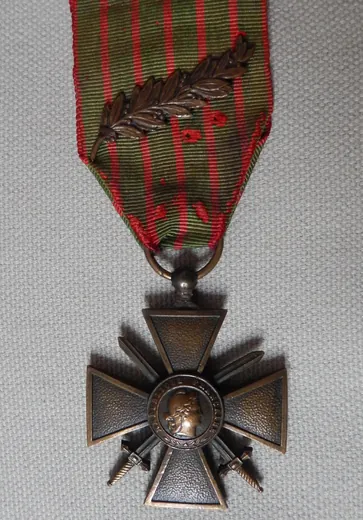
What a Croix de guerre is, and what it is not
The Croix de guerre was created by the law of 8 April 1915 to give material form to the individual and collective mentions in dispatches obtained during the war. It is not a medal for presence: it accompanies a citation, that is, a specific act, recorded by a commander and written into an order.
The practical consequence matters. A Croix de guerre without its citation certificate has lost half of what it said, and the value of a cross rests largely on being able to find that text again. The rest of the method follows from this.
If you have several decorations in front of you and cannot yet tell them apart, start with identifying a French medal of the Great War, which sets the main decorations of the period side by side.
Recognising the right cross
The obverse
A bronze cross with four arms, with two crossed swords between the arms. At the centre, a medallion bearing a helmeted head of the Republic, surrounded by the legend “République française”.
The shape and the arrangement of the swords are constant. Differences in relief, patina and finish come from the makers, of which there were several: there is no systematic maker's mark, and the absence of a signature is in no way abnormal.
The reverse, which carries the date
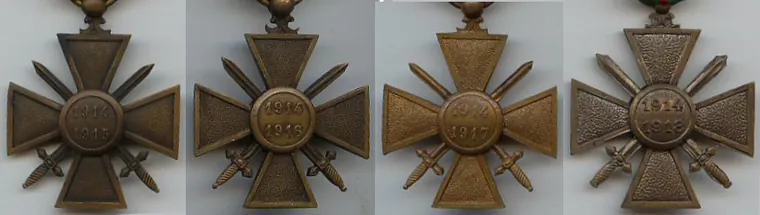
This is the most useful point and the most misunderstood. The reverse medallion carries a date: 1914-1915, 1914-1916, 1914-1917 or 1914-1918.
That date corresponds to the period in which the cross was made and awarded, not necessarily to the date of the act cited. A soldier mentioned in 1915 may have physically received his cross later, with a later date. The reverse therefore gives a boundary, not the date of an event.
An early date is rarer than “1914-1918”, by far the most widespread. That relative rarity bears on value, without ever being the only criterion.
The ribbon
A green watered ribbon, edged in red and striped with fine red lines. It was easily replaced, and it very often was: a fresh ribbon on an old cross says nothing suspicious, it simply says nothing at all.
Never change a period ribbon, however tired. It is part of the decoration, not a consumable, and losing it costs information as well as value.
The crosses it gets confused with
Three neighbours come up constantly in estates:
- The Croix de guerre des théâtres d'opérations extérieurs, created after the war for operations outside metropolitan France. Its reverse carries that wording, and its ribbon is light blue striped with red.
- The Croix de guerre 1939-1945, very close in shape, whose reverse carries a date beginning with 1939 and whose ribbon is red striped with green.
- Commemorative and association crosses, produced later for anniversaries or veterans' groups: they often imitate the general shape without having the same status.
Look at the reverse and the ribbon together: between them, they almost always settle the matter.
Reading the stars and palms
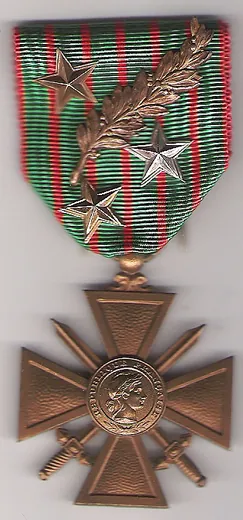
The devices fixed to the ribbon are not decorative. Each one stands for a citation, and the metal indicates the level of command that pronounced it.
- Bronze star: citation at regiment or brigade level.
- Silver star: citation at division level.
- Silver-gilt star: citation at army corps level.
- Bronze palm: citation at army level, the highest.
- Silver palm: it replaces five bronze palms.
A cross carrying several devices therefore corresponds to several distinct citations, and a silver palm to a remarkable record. At unit level, citations at army level opened entitlement to a fourragère, worn collectively: which is why a fourragère says nothing about the individual record of the man wearing it in a photograph.
What the devices do not prove
Stars and palms are fitted and removed in seconds. On the market, a ribbon loaded with devices is an easy assembly, and it is frequent without there necessarily being any intention to deceive: a family may have recomposed a ribbon bar from memory.
Only the documents confirm. A citation certificate, a service record book, an extract from an order: that is what turns a supposition into a fact.
Tracing the recipient
This is the most rewarding part, and it succeeds more often than people think.
Start with the family
Service record book, certificates, annotated photographs, letters, funeral notices. Note the surname, the forenames in their exact order, the date and place of birth, and the recruitment department. Those four elements open almost every door that follows.
The registre matricule
Every conscript has an enlistment record, kept at the departmental archives of the place of recruitment, very largely digitised and consultable online free of charge. It gives the service record, the postings, the wounds and often the citations.
Citations at army level
Citations at the highest level were published officially and can be consulted in the digitised collections of the Journal officiel. For servicemen who died for France, the Ministry of the Armed Forces' Mémoire des hommes site is the reference resource.
The full method, source by source and decoration by decoration, is set out in tracing a French WW1 soldier's decorations.
Keep a copy of what you find with the cross. A decoration accompanied by a documented file is nothing like the same cross left anonymous, either for the family history or for a future owner.
What makes a Croix de guerre valuable
Croix de guerre 1914-1918 were awarded in very large numbers: a cross on its own, with no document, remains an affordable piece. What opens the gap comes down to four elements.
- Documented attribution, and the content of the citation itself.
- The date on the reverse, the earliest being the least common.
- The devices, when they are confirmed by the documents.
- Condition and originality, period ribbon included.
As everywhere in militaria, there is no official price guide: an honest range is built by recording sales actually concluded on comparable pieces. The full method is set out in valuing a piece, and the site's sales archive shows real prices with their dates.
Mistakes to avoid
- Polishing the cross. Bronze takes on a patina that is part of the piece; buffing removes it and rounds off the relief.
- Replacing the ribbon. Faded or frayed, it is still the original.
- Separating the cross from its papers to sell them apart. The whole is worth more than the sum of its pieces.
- Adding devices to “complete” what you believe you know. That is a falsification, even an unintentional one.
- Storing the cross in a sealed plastic sleeve. Moisture builds up inside and attacks the ribbon.
Good conservation habits are gathered in caring for militaria without destroying its value.
What I cannot tell you here
I cannot tell you who wore your cross: no decoration of this type carries an individual number. The name is found through the documents, never through the object alone.
Photograph the obverse, the reverse, the ribbon and each device separately, then have the whole looked at: ask the community. To compare with pieces for sale, the catalogue gathers First World War medals and decorations.
Frequently asked questions
What do the stars and palms on a Croix de guerre 1914-1918 mean?
Each device stands for a citation, and the metal indicates the level of command that pronounced it: bronze star for regiment or brigade, silver star for division, silver-gilt star for army corps, bronze palm for army level. A silver palm replaces five bronze palms. Since these devices are fitted and removed easily, only the citation documents confirm them.
What does the date on the reverse of a Croix de guerre mean?
The reverse carries 1914-1915, 1914-1916, 1914-1917 or 1914-1918. That date corresponds to the period in which the cross was made and awarded, not to the date of the act cited: a soldier mentioned in 1915 may have received his cross later. The earliest dates are the least common.
How can a 1914-1918 cross be told from a 1939-1945 one?
Look at the reverse and the ribbon together. The 1939-1945 cross carries a date beginning with 1939 and a red ribbon striped with green, while the 1914-1918 one carries a date beginning with 1914 and a green ribbon edged and striped with red. The Croix de guerre for overseas theatres, different again, carries that wording on the reverse and a light blue ribbon.
Should a damaged Croix de guerre ribbon be replaced?
No. A period ribbon, however faded or frayed, is part of the decoration: changing it loses information and part of the value. Keep the cross as it is, flat, away from light and damp, and certainly not in a sealed plastic sleeve.
How can the soldier who received a Croix de guerre be traced?
First note the full name, the date and place of birth and the recruitment department from the family papers, then consult the enlistment record at the departmental archives of the place of recruitment, which are very largely digitised. Citations at army level appear in the digitised collections of the Journal officiel, and the Mémoire des hommes site lists servicemen who died for France.
What is a 1914-1918 Croix de guerre worth?
It was awarded in very large numbers: on its own and without documents, it remains an affordable piece. The value rises markedly when the attribution is documented, with the citation certificate and the recipient's record, and according to the date on the reverse, the confirmed devices and the original condition, ribbon included.
Who was entitled to the 1914-1918 Croix de guerre?
Servicemen, French or Allied, who had earned an individual citation, and units cited collectively, whose flag then received the cross. Towns badly hit by the fighting also received it. It is the citation, found in the archives, that proves entitlement to the cross, not the object itself.