Militaria glossary
By Augustin, founder of Athena Militaria Published
A militaria listing is written in a language taught nowhere. You read that a helmet is “matching”, that an insignia is “a restrike”, that a cross carries “a palm”: three phrases that decide the price, and that nothing explains. Here are those words, one by one, with the guide that develops them where there is one.
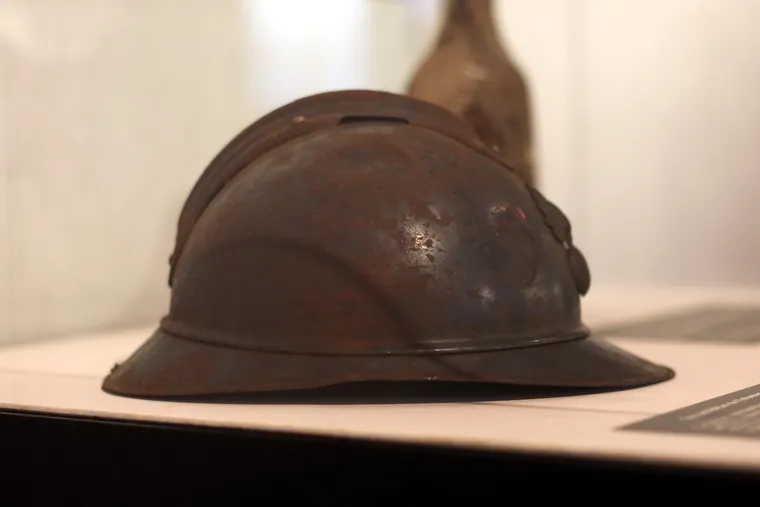
Le casque
- Shell
- The steel dome of a helmet, without its liner or fittings. A bare shell is one whose leather has gone. the guide
- Crest
- The ridge fitted on top of an Adrian helmet. Its shape and fixing separate the models. the guide
- Liner
- The inner fitting, of leather on older models, that holds the head away from the steel. It is the part that suffered most. the guide
- Chinstrap
- The strap passing under the chin. It often carries a maker's mark on its inner face. the guide
- Front badge
- The emblem fixed to the front of a helmet, denoting the arm or service. A rare badge on a common helmet is the most frequent assembly on the market. the guide
- Rolled rim
- A lower edge folded inwards, smooth to the touch. On German helmets it separates the 1935 and 1940 models from the 1942, which has a raw rim. the guide
- Skirt
- The lower part of a German helmet, coming down over the neck and ears. Its inner faces carry the maker's code, the size and the lot number. the guide
- Decal
- The transfer applied to the side of a helmet. It is the most faked element in militaria, because the price gap it creates is considerable. the guide
Marquages et fabrication
- Stamp
- A mark struck into the metal by the maker or the inspection service. Polishing erases it, which is why a buffed piece is often impossible to identify. the guide
- Acceptance mark
- A mark applied by the service that took the piece into store, distinct from the maker's. the guide
- Approval number
- A number preceded by a letter on the back of a unit insignia, referring to the validation of the design by the army's services. It dates the model, never the example. the guide
- Restrike
- A later official manufacture of a piece, years after the first. It is genuine, but does not have the value of a period striking. the guide
- Fired enamel
- Coloured glass baked at high temperature. Hard and deep, it chips away in clean flakes, where cold-applied resins scratch. the guide
- Spring clip
- A sprung bar on the back of an insignia, sliding behind a pocket flap. The type of fastening is a marker of period. the guide
- Patina
- The slow oxidation covering old metal. It is part of the piece: removing it costs value, permanently. the guide
Médailles et décorations
- Citation
- A deed recorded by a commander and written into an order. It is what a Croix de guerre stands for, not the simple fact of having served. the guide
- Palm
- A device on the ribbon of a Croix de guerre marking a citation at army level. A silver palm replaces five bronze ones. the guide
- Star
- A ribbon device marking a citation below army level: bronze for regiment or brigade, silver for division, silver-gilt for army corps. the guide
- Reverse date
- The years on the reverse of a Croix de guerre. They date the manufacture and the award, not the deed cited. the guide
- Fourragère
- A cord worn collectively by a unit cited several times at army level. It says nothing about the record of the man wearing it. the guide
- Mounting
- How a decoration is mounted on its ribbon. A recent remounting shows in the thread, the folds and the state of the ribbon. the guide
Armes blanches
- Quillon
- The curved lug of the guard. On the Lebel bayonet, its removal during the war separates two regulation variants. the guide
- Cruciform blade
- A cross-sectioned blade with no cutting edge, made to pierce. It is the signature of the Lebel rifle bayonet, nicknamed Rosalie. the guide
- Socket
- The hollow part fitting over the barrel. Its diameter separates models that the blade alone does not. the guide
- Matching
- Said of a piece whose blade and scabbard carry the same number, so have never been separated. It is rarer than people think. the guide
- Deactivation
- The operation making a weapon unable to fire. Its status depends on the date, the standard applied and the certificate: an old deactivation does not amount to a certificate valid today. the guide
Uniformes
- Tunic
- The uniform jacket. It is the inner label, not the cut, that gives a precise date. the guide
- Greatcoat
- The regulation long coat, in thick wool cloth. the guide
- Collar tab
- The cloth rectangle sewn to the collar, carrying a unit number and coloured piping. It is the combination of the two that places it, not either alone. the guide
- Horizon blue
- The pale blue-grey of the French army from the middle of the Great War onwards. the guide
Documents
- Enlistment record
- The conscript's register, kept at the departmental archives of the place of recruitment and very largely digitised. It is the key to tracing a service record. the guide
- Service record book
- The soldier's individual booklet. It gives the name, the date and place of birth and the recruitment office, that is, everything needed to search. the guide
- Real photo postcard
- A photographic print the size of a postcard, the usual format of the soldier's portrait sent home. The back dates as much as the image. the guide
- Trench art
- Objects worked at the front from cases and fragments. An engraved case is an ordinary object once the primer has been removed. the guide
Le marché
- Provenance
- The documented history of a piece: who it came from, which unit, where it was brought back from. It is the one element that is never reconstructed after the event. the guide
- Recomposed piece
- An assembly of elements of different origins. Very frequent, not always with bad intent, but nothing like a homogeneous piece. the guide
- Reproduction
- A modern copy, often made for historical re-enactment, which ages and ends up turning up in an estate without anyone knowing where it came from. the guide
- Named group
- A group of pieces all pointing to the same person, documents included. It is the one case in militaria where the whole is worth markedly more than the sum of its parts. the guide
- Price guide
- No official one exists. An honest range is built on sales actually concluded, never on asking prices. the guide
Frequently asked questions
What does “matching” mean in a listing?
That the blade and scabbard of an edged weapon carry the same number, so they have never been separated since manufacture. It is rarer than people think and it commands a price. Different numbers do not disqualify a piece, but must be stated.
What is the difference between a restrike and a reproduction?
A restrike is a later official manufacture of the same model: it is genuine, it simply was not worn during the period concerned. A reproduction sets out to imitate a sought-after piece, with no official character at all. The back of an insignia usually gives either away.
Why should an old piece not be polished?
Because buffing removes the patina and, with it, the stamps and markings that allowed the piece to be identified and dated. A polished piece has often become impossible to identify, and the loss is permanent.
What is a named group?
A set of pieces all pointing to the same person, documents included: record book, photographs, citations, decorations. It is the one case in militaria where the whole is worth markedly more than the sum of its parts, and splitting it destroys that value for good.
Is there an official price guide in militaria?
No, none. No body publishes a scale and the reference works give ranges too wide to settle anything. An honest valuation is built by recording sales actually concluded on comparable pieces, never asking prices.
What does “deactivated” mean for a weapon?
That the weapon has been made unable to fire. Its status depends on the date of deactivation, the standard applied and the certificate that accompanies it: an old deactivation does not amount to a certificate valid today. If in doubt, have it confirmed by a gunsmith.