Identifying a French bayonet
By Augustin, founder of Athena Militaria Published , updated
A bayonet is recognised by its blade before anything else: the cross-section alone often separates two families fifty years apart. Then come the numbers, which do not give the model but something rarer, namely whether blade, hilt and scabbard have always travelled together.
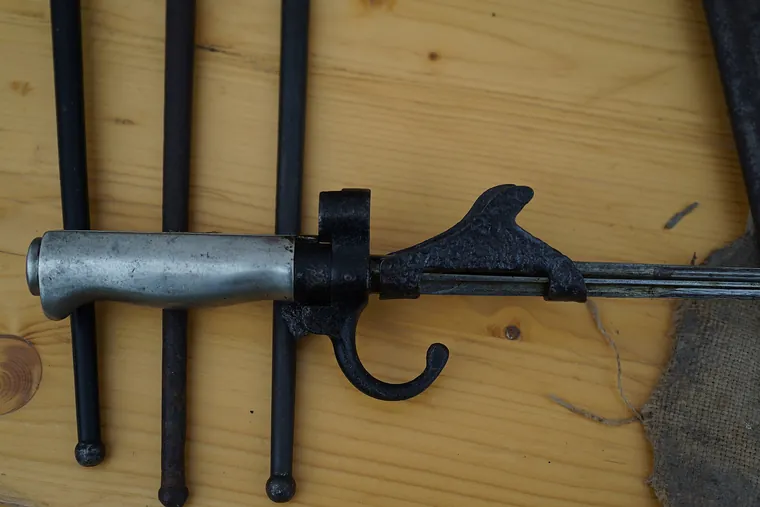
Start with the section of the blade
Look at the blade end-on, as a slice. Three families stand out immediately.
- A cruciform blade, cross-shaped, very long and thin, with no cutting edge: this is the Lebel rifle family, the famous “Rosalie” of the Great War nickname.
- A flat single-edged blade, sometimes curved and of considerable length, with a sword hilt: you are among the sword bayonets of the last third of the nineteenth century.
- A short spike, cross- or square-sectioned, with no developed hilt: you are in the later twentieth-century models, stowed in the rifle's forestock or in a housing.
This first sort settles half the work. The rest turns on the hilt and the attachment.
The main families, in order
Nineteenth-century sword bayonets
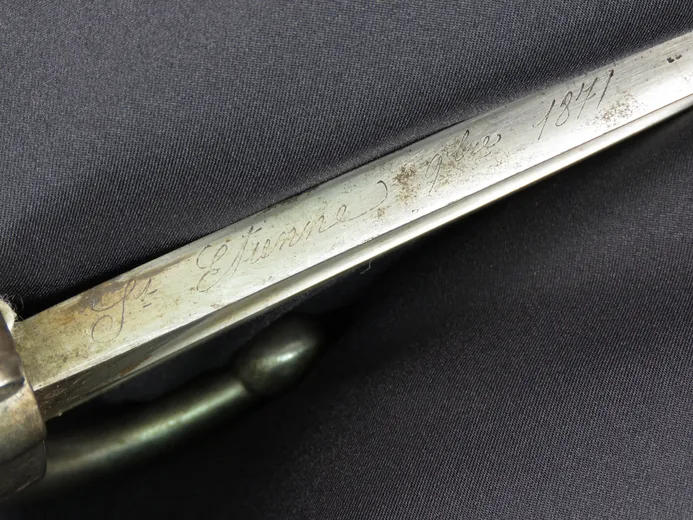
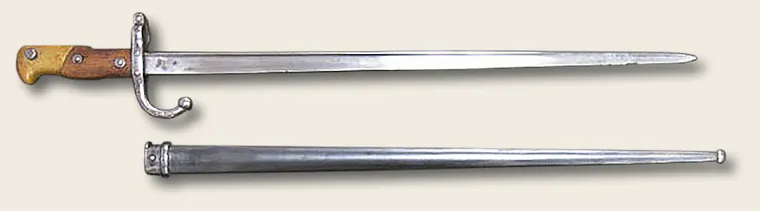
A flat, long, often slightly curved blade, a ribbed brass hilt, a pronounced quillon. These are the bayonets of the Chassepot and then the Gras rifles. The back of the blade frequently carries a factory inscription and a date, spelled out in full: one of the rare cases where a piece dates itself without research.
The Lebel bayonet
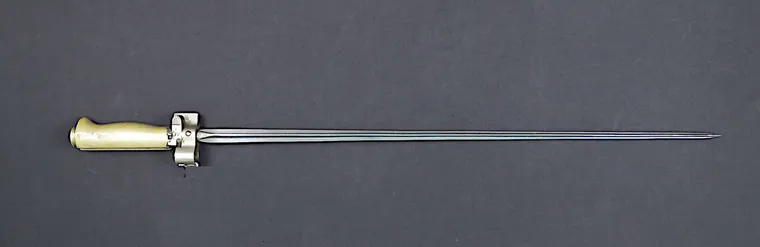
A cruciform blade about half a metre long, with no cutting edge, made to pierce. The hilt is first in German silver, a white alloy, then brass, then steel: the metal of the hilt is a clue to the period. The curved quillon of the first model was removed during the war, and some blades were shortened between the wars.
The practical consequence: a Lebel bayonet with no quillon, or with a shorter blade, is neither a damaged piece nor a fake. It is a regulation variant, and it is described as such.
The Berthier carbine bayonet
Shorter than the Lebel one, of the same spirit, fitted to the carbines. It is easily confused with a shortened Lebel blade: look at the overall length and the diameter of the socket rather than at the blade alone.
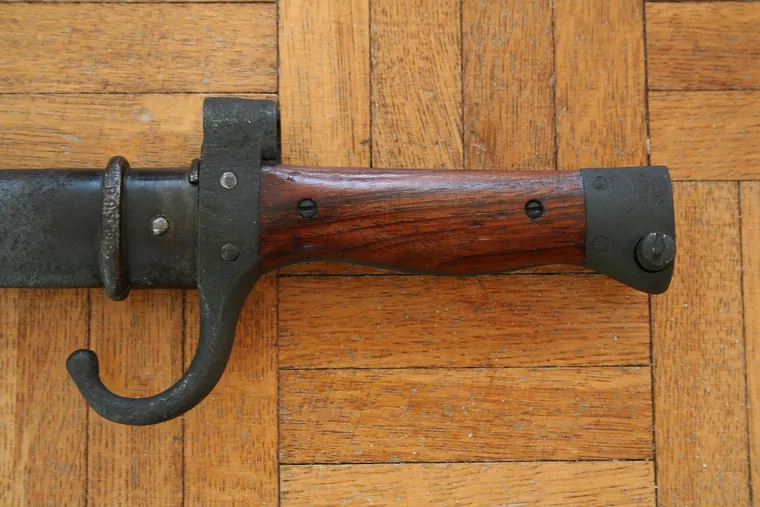
Twentieth-century models
With the MAS 36 rifle comes a spike bayonet, stowed reversed in the forestock, with no separate scabbard. The post-war models, fitted to later weapons, have their own scabbard and a more developed hilt. These pieces are far more common and easily found in good condition.
Reading the numbers
This is where the difference between an ordinary piece and a complete one is decided.
Many bayonets carry a number on the blade, near the hilt or on the tang, and the same number on the scabbard. When the two match, the piece is said to be “matching”: it has come through time without being split up, which is rarer than people think and commands a price.
Factory markings, inspection letters and acceptance stamps are found on the back of the blade, on the ricasso, sometimes under the grips. Copy them out character by character without trying to interpret them: transcription first, understanding afterwards. The method is the same as for a military insignia.
Spotting an assembly
A bayonet assembled from parts of different origins is frequent, and not always with bad intent: pieces were stored, mixed and re-matched in arsenals as much as in flea markets.
- Different numbers between blade and scabbard: very common, to be stated, not disqualifying.
- Inconsistent patina between blade and hilt, or between hilt and scabbard.
- Visibly recent screws, rivets or grips on an old piece.
- A resharpened or reprofiled blade: the original edge has gone, the width is no longer even along its length.
- Engravings added afterwards, too crisp, misaligned, or whose depths shine while the rest is patinated.
The general checks, valid for every piece, are gathered in spotting a militaria fake.
What the law says
Edged weapons come under a regime distinct from that of firearms, and generally more relaxed. But possession, transport and carrying follow different rules: being allowed to own a bayonet does not mean being allowed to carry it freely in a vehicle without legitimate reason.
The framework applying to sale is set out in selling militaria in France and in our terms and conditions. Check rather than assume, particularly before travelling to a fair or posting an item.
Keeping it without spoiling it
Three mistakes are enough to lose most of a bayonet's value.
- Polishing the blade. The shine obtained erases the patina, the stamps and sometimes the numbers. A grey, even blade is worth more than a mirror one.
- Stripping the scabbard. Its original paint or bluing is part of the piece.
- Heavily oiling the leather of a scabbard or a frog with a modern product.
A dry cloth, storage flat, away from damp, and certainly not in a sealed plastic sleeve. The detail is in caring for militaria without destroying its value.
What I cannot tell you here
I cannot give you the exact model from a single photograph of the blade. The regulation variants are numerous, and two models twenty years apart can look alike but for a length.
Photograph the whole blade with a ruler, the ricasso, the hilt from both sides, the socket end-on, the scabbard and every number. Then ask the community. Pieces for sale are in the catalogue, in particular First World War weapons.
Frequently asked questions
How do you recognise a Lebel bayonet, the “Rosalie”?
By its cruciform blade, cross-shaped, about half a metre long, with no cutting edge, made to pierce rather than to cut. The hilt is German silver on the earliest production, then brass, then steel. The curved quillon of the first model was removed during the war: a blade with no quillon is a regulation variant, not a damaged piece.
What is a French bayonet worth?
There is no price guide: value depends on the model and its variant, the condition of the blade, whether the scabbard is present, above all with a matching number, and how legible the markings are. Common twentieth-century models are easy to find, which weighs on their price; a rare variant, complete and original, is another matter. Identify the model first, then compare with completed sales of equivalent pieces.
Is the Rosalie bayonet illegal?
No. Owning an old bayonet, the Rosalie included, is not prohibited. It is carrying and transporting it without legitimate reason that is regulated: check the rules before travelling to a fair or posting one.
What does a “matching” bayonet mean?
That the number on the blade and the number on the scabbard agree, so that the two have never been separated. It is rarer than people think and it commands a price. Different numbers are very common and do not disqualify a piece, but they must be stated in the listing.
Where are the markings on a French bayonet?
On the back of the blade, on the ricasso near the hilt, sometimes under the grips, and on the scabbard. Nineteenth-century sword bayonets often carry a factory inscription and a date spelled out in full on the back of the blade. Copy everything out character by character before trying to interpret it.
Can a bayonet be owned and transported in France?
Edged weapons come under a regime distinct from that of firearms, generally more relaxed, but possession, transport and carrying follow different rules: being allowed to own a bayonet does not mean being allowed to carry it freely without legitimate reason. Check before travelling to a fair or posting one.
Should a bayonet blade be polished before selling it?
No, it is the most expensive mistake. Polishing erases the patina, the stamps and sometimes the numbers, that is, everything that identified the piece. A grey, even blade is worth more than a mirror one. A dry cloth is enough.
How can a Berthier carbine bayonet be told from a shortened Lebel blade?
Do not look only at the blade, which can have the same appearance. Compare the overall length and the diameter of the socket that fits over the barrel: it is those dimensions, not the general look, that separate the two models.