Starting a militaria collection without getting it wrong
By Augustin, founder of Athena Militaria Published
Collections rarely begin with a method. A helmet found at a flea market, an inherited medal, an intriguing trench photograph: the first piece often arrives by chance. The next ones are worth choosing. Here are the rules that make the difference between a pile of objects and a coherent collection, in which every piece is known and keeps its value.
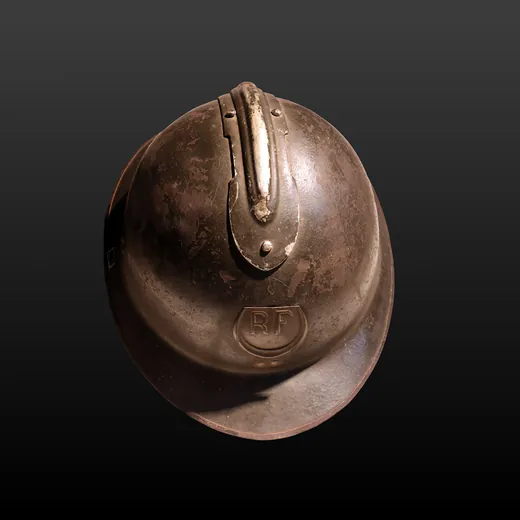
1. Choose a theme before buying
Militaria spans two centuries, dozens of armies and thousands of types of objects. Nobody can know everything, and trying to buy everything is precisely how people buy badly.
A theme is usually defined by combining three criteria:
- a period: the First Empire, the Great War, the Second World War, the wars of decolonisation, the Cold War;
- an army or a branch: French infantry, aviation, the navy, a specific unit;
- a type of object: helmets and headgear, insignia, decorations, uniforms, documents and photographs.
Starting narrow does not lock you in: you can widen the field later, knowing what you are doing. Above all, a precise theme lets you learn quickly, because you compare comparable pieces, and lets you spot anomalies that a scattered eye misses.
2. Set a budget, and split it
Not every collection calls for the same means. Uniform buttons, common insignia, military documents and photographs can often be found for modest sums, and they are an excellent school: they force you to read markings, to date, to compare.
A few principles avoid regrets:
- one good piece is worth more than ten doubtful ones: condition and authenticity make the value, quantity compensates for nothing;
- keep part of the budget for books: a good reference work prevents mistakes that cost far more than it does;
- set a ceiling per piece before you look, not while you look: desire is a poor adviser in front of a listing.
3. Learn before you buy
Knowledge is built by looking at many genuine pieces in good conditions. Museums are the first school: the Musée de l'Armée at Les Invalides, the Musée de la Grande Guerre in Meaux or the Historial de la Grande Guerre in Péronne let you study safe, documented pieces and memorise shapes, materials and colours.
Then come the reference books devoted to your theme, digitised archives and exchanges between collectors. An experienced collector often answers in a few messages a question that would otherwise have cost you a mistake: the Athena Militaria community exists for exactly that.
Finally, handle pieces as soon as you can, at a fair or at a collector's home. The weight of an object, the texture of a wool, the quality of a strike cannot be read from a photograph.
4. Buy with method
In front of a listing, the same checks come back:
- Photographs of everything: overall view, back, inside, and sharp close-ups of every marking. A serious seller provides them willingly.
- A factual description: condition, defects, replaced parts, and what the seller does not know.
- The provenance, when known: where the piece comes from, with which documents.
- A consistent price: a rare piece offered far below its usual value calls for more questions, not fewer.
- Protected payment, released to the seller only after delivery.
Reproductions are numerous, and many are resold in good faith after years in circulation. Our guide to spotting a reproduction or a fake sets out the seven checks to make before buying.
5. Document every piece
This is the habit that most clearly separates a collection from a stock. For each piece, write down:
- the date and place of acquisition, the price and the seller;
- what you know of its history, and the documents that come with it;
- the markings you have read, copied exactly as they are;
- its condition on arrival, with photographs.
A simple spreadsheet is enough. This record will help you insure the collection, pass it on or sell it one day: documented provenance is part of a piece's value, and it cannot be rebuilt after the event.
6. Preserve without damaging
Pieces deteriorate mostly through swings in temperature and humidity, light and clumsy handling. A normally heated room, out of the sun, is better than an attic or a cellar. The most useful rule is also the simplest: clean nothing before you have identified it.
The details, material by material, are in our guide to caring for leather, textile and metal.
7. Know the legal framework
Collecting militaria is legal in France, but some families of objects follow precise rules: weapons, including deactivated ones, depending on their category and certificate; ammunition and explosive devices, which may not be sold on the site, including inert items without certification; and objects bearing emblems of dissolved regimes, whose public display is regulated.
Before buying a piece from these families, read our guide to selling militaria in France: it applies to buyers too.
Where to find your first pieces
Militaria fairs let you see many pieces and meet sellers. Auction houses publish descriptions that are often detailed. Estates hold surprises, provided nothing is cleaned before it is understood. Between collectors, finally, listings let you ask your questions before buying.
The Athena Militaria catalogue is organised by period: First World War, Second World War, Cold War. Every listing lets you write to the seller before buying, and payment reaches the seller only after delivery.
Frequently asked questions
How should you start a militaria collection?
With a theme: a period, an army or a type of object. A precise theme lets you learn quickly by comparing comparable pieces, and avoids scattered purchases. Buttons, common insignia, documents and photographs are a good school on a modest budget.
What budget do you need to start?
There is no minimum. Many common pieces, such as buttons, insignia, documents or photographs, can be found for modest sums. What matters is setting a ceiling per piece before looking at listings, and keeping part of the budget for reference books.
How do you avoid buying a fake as a beginner?
By learning before buying: study genuine pieces in museums, read reference books, ask the seller for sharp photographs of every marking and be wary of an unusually low price for a rare piece. Protected payment, released to the seller only after delivery, also limits the risk.
Should you clean a piece you have just bought?
No, not before identifying it. Polishing, washing or a modern care product often destroy the patina, the markings and part of the value. Most pieces keep very well with simple dry dusting.
Is it legal to collect militaria in France?
Yes. Some families of objects are regulated, however: weapons according to their category and deactivation certificate, ammunition, and objects bearing emblems of dissolved regimes, whose public display is regulated. If in doubt about a specific piece, check before buying.