What is militaria? Definition, periods, rules
By Augustin, founder of Athena Militaria Published , updated
The word is on the poster for the fair, in the listing, in the solicitor's letter, and nobody stops to define it. Militaria means the military objects people keep and trade for what they tell: what a soldier wore, received, used or wrote. This page sets out the basic bearings, whether you have inherited a trunk or are thinking about a first collection.
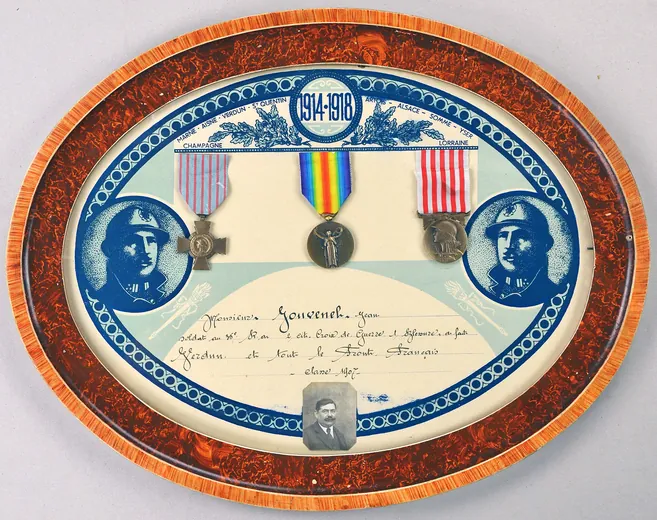
The word and the thing
Take one medal, a single one, and set it on the table. That is already militaria. "Militaria" is a Latin plural, formed on militaris, "relating to the soldier". The word passed unchanged into French and English to name the whole range of military objects that have become collectors' items. It has no plural and no singular.
It covers objects, not weapons of war in firing condition, which fall under their own regulations, nor recent military kit sold to be used again, which is called surplus. The boundary shifts, and we come back to it below.
What people collect
Open an attic trunk. I have done it often enough to say this: what comes out almost always falls into one of these families, which are also the categories of the catalogue:
- Headgear: helmets, kepis, side caps, berets. The French Adrian helmet and the German helmet are the most sought-after pieces, and so the most copied.
- Uniforms and clothing: tunics, greatcoats, trousers, footwear, everything that can be dated by its cloth and its label (see dating a uniform).
- Equipment: belts, ammunition pouches, canteens, haversacks, gas masks, mess tins, entrenching tools. Everything that hung from the belt or weighed on the back.
- Decorations and insignia: medals, crosses, qualification badges, regimental insignia, buttons and collar tabs. Small, light, and often the most telling.
- Edged weapons and deactivated firearms: bayonets, sabres, daggers, and firearms permanently rendered incapable of firing.
- Documents and photographs: service books, postcards, letters, certificates, unit diaries. These are what give the objects their story, and sometimes a name (see military photographs and papers).
- Everyday objects: trench art, lighters, cups, canteen items. A dented cup tells of life more than of combat.
These objects have their own vocabulary, and listings use it without explaining it: shell, crest, stamp, restrike, named. The militaria glossary defines each word in one sentence.
The periods
Few people collect "militaria" in general. You collect a period, an army, a type of object, and you end up knowing that object better than most of the people selling it. In France, the main groups are the following.
- Revolution and First Empire: rare and expensive pieces, copied since the nineteenth century already. Not a field to enter without knowledge.
- Franco-Prussian War of 1870: thinly represented, and often confused with the years that followed.
- First World War: the heart of French militaria. Eight million men mobilised, objects in almost every family, abundant documentation, online archives to trace the men behind the objects.
- Second World War: the most sought-after period worldwide, and therefore the most faked. Pieces from 1933 to 1945 call for particular care, on authenticity as on the law.
- Indochina and Algeria: rarer groups, often still in the families, only now beginning to be documented.
- Cold War: plentiful material, low prices, few copies. The safest way in for a beginner.
Militaria, surplus, re-enactment: three neighbouring markets
Three words share the same shops, sometimes the same rail, and do not mean the same thing.
- Military surplus is decommissioned kit, recent or current, sold to be used: a jacket for the garden, a rucksack for hiking. It becomes militaria on the day people stop wearing it out and start keeping it, and that day takes decades to come.
- Re-enactment uses reproductions, made today to be worn at commemorations and living-history events. Nothing wrong with them, as long as they are sold for what they are. The trouble starts when they age and change hands: a twenty-year-old copy, soiled and worn, easily passes for a period piece. The guide on spotting a fake gives the method for telling them apart.
- Militaria proper means period pieces, with their wear and their history. It is the only one of the three markets where authenticity sets the price.
What the law regulates
Most military objects can be collected and sold freely in France: helmets, uniforms, decorations, insignia, papers, equipment. Three areas are exceptions. Learn them before you buy or sell, not after.
- Weapons. A firearm, even an old one, falls under the categories of the French internal security code. Those whose model predates 1900, Chassepot, Gras, Lebel, are in category D: an adult may buy them freely, except for a few models reclassified by decree such as the 1892 revolver. The others circulate only once deactivated by the national proof house, with their certificate, and since 2018 their acquisition is declared through a gunsmith. Edged weapons may be sold freely to adults, with rules on carrying them.
- Ammunition. A shell or a grenade found in an attic is not a decorative object: it is a matter for the bomb-disposal services. The guide on old munitions says what to do and whom to call.
- Emblems of 1933-1945. The French penal code punishes the public wearing and display of the uniforms, insignia and emblems of organisations declared criminal, outside a historical context. Serious collectors treat these pieces as documents: described, dated, never staged. That is the rule on this site.
The detail, category by category, is in the guide selling militaria in France: what the law says.
Is militaria an investment?
No. Better to know it beforehand. I am asked the question often, usually by someone with a trunk within reach, and the answer disappoints: the market is narrow, prices follow collectors' fashions, resale takes time and costs fees. Some pieces have gained a great deal in twenty years, others have fallen, and nobody knew in advance which. Those who do well know their subject better than the seller does, and that knowledge is paid for in hours, not in money.
Collect for the history; if value follows, so much the better. And when a question of price does arise all the same, for an inheritance, an insurance or a sale, the only reliable method is described in the guide on valuing a military item: sales actually concluded, never asking prices.
Where to start
Militaria is bought at specialist fairs and shows, from dealers, at auction, at flea markets, and on collector-to-collector listing sites such as this one. It is sold the same way. Before a first purchase, three readings will spare you the most expensive mistakes: starting a collection, spotting a fake, and, if you are starting from a family trunk, inheriting military items: where to start.
Frequently asked questions
What does the word militaria mean?
It is a Latin plural, formed on militaris, "relating to the soldier". It covers the military objects kept and traded for their historical interest: headgear, uniforms, equipment, decorations, insignia, edged weapons, deactivated firearms, documents and photographs. The word is invariable: one writes "le militaria", "du militaria", never "des militarias".
What is the difference between militaria and military surplus?
Surplus is recent decommissioned kit, sold to be used. Militaria means period pieces kept for their history. The same object moves from one to the other with time, on the day it stops being worn and starts being collected.
Is collecting militaria legal in France?
Yes for the vast majority of objects: helmets, uniforms, decorations, insignia, equipment, papers. Firearms fall under the categories of the internal security code: those from before 1900 may be bought freely by an adult, the others circulate only deactivated and declared; ammunition is a matter for bomb disposal; and the insignia and emblems of the Nazi organisations declared criminal at Nuremberg, or anything recalling them, may not be worn or displayed in public, except for a film, a show or an exhibition of a historical nature.
Which period should a beginner choose?
The Cold War, for its low prices and scarcity of copies, or the First World War, for the abundance of pieces, documentation and online archives. The Second World War and the First Empire are the most faked periods: enter them after learning, not before.
Is militaria a good investment?
A piece sometimes gains value, but militaria is not an investment: the market is narrow, tastes change, resale is slow and costly. One collects for the history. To know what a piece is worth, record sales actually concluded on comparable pieces, never asking prices.
Where do you buy and sell militaria?
At specialist fairs and shows, from dealers, at auction, at flea markets, and on collector-to-collector listing sites. In every case, identification comes before price, and it is authenticity that sets the price.