Identifying a German helmet from 1935 to 1945
By Augustin, founder of Athena Militaria Published
It is the most collected piece in militaria, and by far the most faked. The good news is that the model can be determined in a minute, from three details of manufacture that nobody bothers to reproduce. The bad news is that everything else, paint and decals included, is reproduced very well.
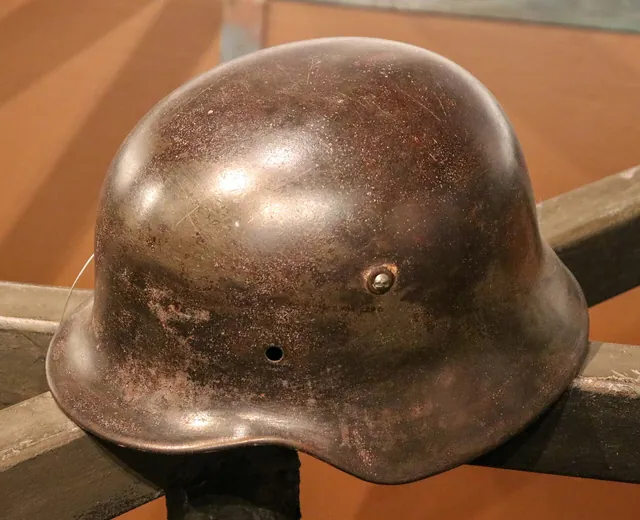
A word before starting, because it shapes how this guide is written. Helmets from this period sometimes carry emblems of regimes that no longer exist. They are treated here as historical documents: dated, described, placed in context. They are neither staged nor glamorised, and any listing departing from that would be removed, as our terms and conditions set out.
1. The rim of the shell: M42 or not
This is the quickest test, and you do it with a fingertip. Run it along the lower edge of the helmet.
- A rolled rim, folded inwards, smooth to the touch: model 1935 or 1940.
- A raw rim, flared outwards, where you can feel the thickness of the steel: model 1942.
Rolling the rim was dropped in 1942 to save production time. It is a change of process, and therefore one that cannot be imitated by retouching a piece: the whole shell would have to be remade.
2. The vents: M35 or M40
If the rim is rolled, look at the two ventilation holes, one on each side.
- A separate grommet, a small fitted piece distinct from the shell, visible inside and out: model 1935.
- A hole pressed directly into the steel, with no added part and a slight raised lip: model 1940.
Here again, it is the manufacture that speaks. With the rim, these two points are enough to place a helmet in one of the three models without reading anything.
3. The skirt stamps
Turn the helmet over and look inside the two skirts, the lower part that comes down over the neck and ears.
On one, a maker's code followed by a number: the number is the shell size. On the other, a lot number, usually longer. Concordance tables published by collectors link each code to its factory and its production periods; copy the stamp out character by character before searching, since a misread letter points to another factory.
A helmet with no skirt stamp at all is not necessarily fake: stamps disappear under rust and under stripping. But a stamp that is too crisp, too regular, on an otherwise heavily worn piece deserves a second look.
4. The liner and the chinstrap
The liner is built on a metal band carrying leather tongues. The band is aluminium on the earliest production and steel afterwards: a clue to the period, to be cross-checked with the model of the shell.
The leather tongues are often dated and maker-marked, and the chinstrap almost always is, on its inner face. These three sets of markings, shell, liner and chinstrap, should tell a consistent story. A perfect liner in a heavily worn helmet, or the reverse, is not disqualifying, but an honest listing says so.
5. The decals: the most reproduced part of the market
It has to be said plainly: this is the single most faked element in all of militaria. The reason is economic, the price gap between a bare shell and the same shell decorated being considerable, and applying a modern decal needs neither equipment nor particular skill.
What to look at, in order:
- The wear of the surface. A period decal has aged with the paint around it: the same scratches run across it, the same chips, the same dulling.
- The edge. A recent application often leaves a slightly raised film, a sharp outline, sometimes a glossy sheen visible under raking light.
- The layer. A decal applied over repainted paint has no chance of being period, however well made.
- The history of the piece. Verifiable provenance weighs more than any visual examination.
Faced with a doubt, the rule is simple: do not buy the decal, buy the helmet. If the price asked is justified only by it, the risk is entirely yours. The general checks are gathered in spotting a militaria fake.
6. The paint
As with any helmet, worn period paint is worth more than neatly redone paint, and repainting permanently costs a large part of the value. Shades and finishes changed through the war, and some field applications, camouflage, added sand or wire wool, are met with.
Never strip a helmet to “see underneath”. What is underneath is often what dated the piece. The principle holds for the whole collection: caring for militaria without destroying its value.
What makes the value, in order
- The originality of the whole, shell, liner, chinstrap and paint consistent with one another.
- The state of the original paint, chipped but genuine rather than redone.
- The presence and authenticity of the decals, which weigh heavily and are checked all the more.
- The completeness of the liner and the condition of the leather.
- Documented provenance, the one element that is never reconstructed.
There is no official price guide. The method for building a defensible range is the same as for any piece: valuing a piece, and the sales archive gives prices actually paid.
What may not be sold
Wearing and displaying certain emblems of dissolved regimes in public is punishable under article R645-1 of the French code pénal, which provides for an exception linked to historical evocation. Applying that framework to possession and to sale between collectors calls for a case-by-case check with a legal professional.
On this site the rule admits no exception: any item glorifying war crimes, crimes against humanity, Nazism or terrorism is barred. The full framework is set out in selling militaria in France.
What I cannot tell you here
I cannot authenticate a decal from a photograph, and be wary of anyone who does it in one line. It is the point that demands the most experience and the most light.
Photograph the shell from several angles, the rim close up, both vents, both skirts, the liner and the chinstrap, in daylight and in raking light for the decals. Then have it looked at: ask the community. Comparable pieces are in the Second World War catalogue.
Frequently asked questions
How can a German M35, M40 and M42 helmet be told apart?
Two gestures are enough. The rim first: rolled inwards and smooth to the touch for an M35 or M40, raw and flared for an M42. Then the vents: a separate grommet fitted into the steel means M35, a hole pressed directly into the shell means M40. These are differences of process, impossible to imitate without remaking the shell.
Where are the markings on a German helmet?
Inside the skirts, the lower part that comes down over the neck and ears. On one, a maker's code followed by the shell size; on the other, a longer lot number. Published concordance tables link each code to its factory. Copy the stamp out character by character before searching.
Can the decals on a German helmet be trusted?
They are the most faked element in all of militaria, because the price gap between a bare shell and the same shell decorated is considerable. Look at whether the decal has aged with the paint around it, whether the scratches run across it, whether its edge forms a raised film under raking light. If in doubt, do not buy the decal, buy the helmet.
Is a German helmet with no markings necessarily fake?
No. Skirt stamps disappear under rust and vanish when a helmet is stripped. The absence of markings simply makes identification harder and weighs on the value. Conversely, a very crisp stamp on an otherwise heavily worn piece deserves a second look.
Can a 1939-1945 German helmet be sold in France?
These pieces circulate between collectors, but some carry emblems of dissolved regimes whose wearing and public display are punishable under article R645-1 of the French code pénal, which provides for an exception linked to historical evocation. Applying it to possession and sale calls for a case-by-case check. On Athena Militaria, any item glorifying Nazism or crimes against humanity is barred.
Should a helmet be stripped to see the original paint?
Never. What is underneath is often what allowed the piece to be dated, and stripping also destroys the markings. Chipped period paint is worth more than neatly redone paint, and repainting permanently costs a large part of the value.