Cold War militaria for sale
Listings for sale
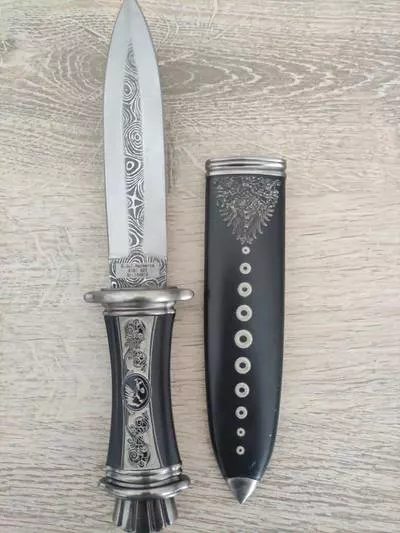
Beautiful dagger by C.Jul. Herbetz, with a stainless steel blade featuring Damascene patterns
100 €
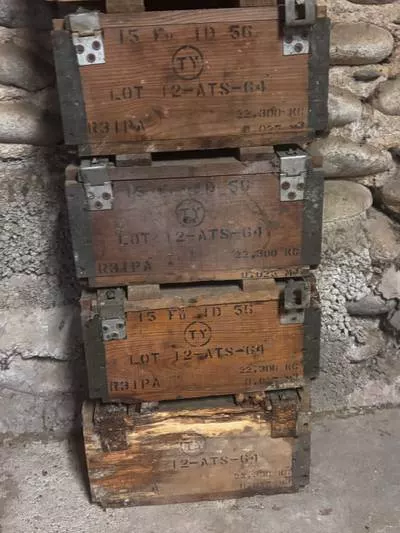
Original French military crates, 1956 model
250 €
Guides for these pieces
- What is militaria? Definition, periods, rulesMilitaria means military objects turned collectors' items: helmets, uniforms, medals, insignia, papers. What people collect, and what French law regulates.
- Identifying and dating a French military insigniaThe back of an insignia says more than its face: maker, fastening, approval number. How to place a striking and spot a recent restrike.
- Dating a French military uniformThe cloth gives the period, the inner label gives the year, the collar tabs give the unit. The four places to look, in order.
- Spotting a reproduction or a fake: the seven-point methodAn aged reproduction fools the eye, not the method. Seven concrete checks to tell a period piece from a copy before you buy.
Have pieces from this period? List them for free: they will be seen by the collectors browsing this page.
Collecting Cold War militaria
From 1947 to 1991, Europe lived through forty years of confrontation without a general war. The Atlantic Alliance on one side and the Warsaw Pact on the other maintained and re-equipped, without interruption, conscript armies numbering millions of men. For the collector, the period has a direct consequence: equipment was produced in considerable quantities and, for the most part, never saw combat. That is what makes the Cold War more affordable than the two world wars, and why it is often a first collection.
What circulates today
The opening of the Eastern bloc after 1989 poured entire stocks, still in their crates, onto the Western market. Uniforms, field equipment, gas masks, helmets, headgear and unit documents circulate in abundance today, alongside Western equipment struck off as issue changed, from the French model 1951 helmet to American items replaced in the 1980s.
Reading markings, avoiding traps
The first reflex with a piece from this period is to look for markings. Eastern bloc production is almost always marked, but each country has its own code: the USSR and Poland usually stamp the full year next to the factory mark, Czechoslovakia two crossed swords followed by the last two digits of the year, while East Germany used a year letter from 1968, which is confusing when you are looking for figures. These marks are found inside the headgear, under a flap or on the back of a strap. Western issue equipment frequently carries, from the 1960s, a thirteen-digit NATO stock number that identifies the item precisely.
Two traps to know. Wear says nothing about age: a large share of what is sold is new old stock, never worn, and an immaculate object is not therefore recent. And the most sought-after pieces, insignia and headgear first, are widely reproduced. Our guide to spotting fake militaria details the checks to make before buying. For regulated items, deactivated weapons included, see the guide to selling militaria legally in France.