Valuing an Adrian helmet
By Augustin, founder of Athena Militaria Published
It is the question asked most often, and the one answered worst. “What is an Adrian helmet worth?” has no general answer: between two helmets of the same model and the same year, the gap in price can be tenfold. This guide sets out what opens that gap, and how to reach an order of magnitude you can defend.
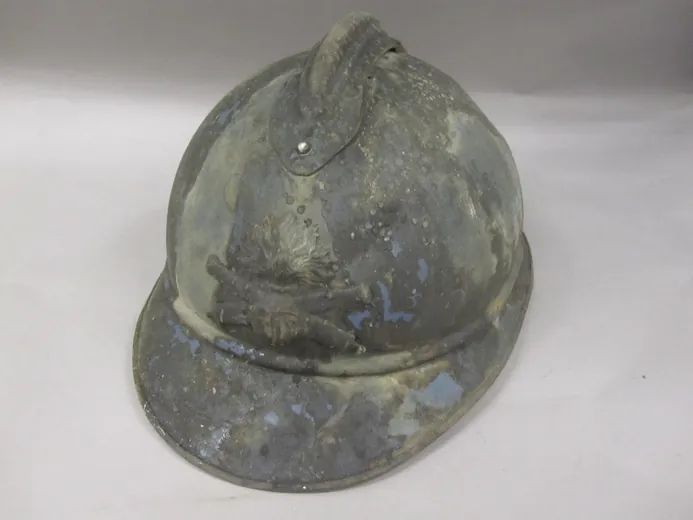
Why you will not find a figure here
There is no official price guide in militaria. No body publishes a scale, no law governs prices, and the reference works give ranges so wide that they settle nothing.
A figure quoted without having seen the piece is not a valuation, it is an impression. And an impression costs you twice: if it is low, you sell at a loss; if it is high, your listing stays up for months and you end up giving the piece away.
What you can obtain, on the other hand, is a range built on real sales and on the exact condition of your helmet. It takes longer than a one-line answer, and it is the only thing that stands up in front of a buyer.
The six criteria that open the gap
Before valuing, you have to identify. If you are not certain of the model, start with identifying an Adrian helmet model 1915: the criteria below assume that step has been taken.
1. The model and its period
A model 1915 from the Great War, a model 1926 from the interwar years and a Second World War helmet do not sit on the same market, even when they look alike from a distance. The number of parts making up the shell, the shape of the crest and the type of liner separate these families.
The most expensive confusion is selling a 1926 as a 1915, or the other way round. In both cases the dispute eventually arrives.
2. The front badge
This is often the criterion that weighs most. The infantry grenade is by far the most widespread. The badges of the other arms and services are met with less often, and some badges of specialised troops or foreign corps are frankly rare.
Two precautions. First, a rare badge fitted to a common helmet is the most frequent assembly on the market: the badge alone does not make the piece, the whole has to be consistent. Second, a badge added recently usually shows at the fixing, in the traces under the plate and in the state of the paint around it.
3. The original paint
Period paint, however worn, however chipped, is worth more than paint neatly redone. This is counter-intuitive for anyone new to the field, and it is nonetheless one of the most stable rules in militaria.
A repainted helmet loses a large part of its value immediately, and loses it for good: there is no going back. If you inherit a dull helmet, leave it dull. The subject is covered in caring for militaria without destroying its value.
4. The liner and the chinstrap
The leather is the part that has suffered most. A complete, supple liner with its original chinstrap and fittings is markedly less common than a bare helmet. A missing, replaced or dried-out liner weighs on the price, without making the piece uninteresting.
Look at consistency too: a liner in perfect condition inside a heavily worn helmet raises a question, and so does the reverse.
5. The consistency of the whole
A helmet recomposed from elements of different origins is an ordinary piece, which nobody will pay for at the price of a homogeneous one. The wear has to match up: rubbed edges, contact points, the inside of the crest, the areas that were handled.
Wear that is too even, or present where it has no reason to be, is a signal. The standard checks are gathered in spotting a militaria fake.
6. The name, the unit, the story
A name written under the liner, a unit number, a photograph of the soldier wearing this helmet, a service record book: this is the only criterion that can never be reconstructed. A documented piece changes category, provided the documentation is verifiable and supplied with it.
If you hold these elements, do not sell them separately. The helmet and its papers are worth far more together than the sum of their separate prices.
The method: record sales actually concluded
What an asking price is not worth
A price asked is not a market price. It is a request, sometimes maintained for years without a buyer. Basing a valuation on current listings means comparing yourself with people who have sold nothing.
What counts is the price at which a piece changed hands. Auction results are public and usable. On this site, the sales archive shows the pieces sold with their price and date, for the same reason: a collector who wants to place a piece needs real figures, not estimates.
Compare what is comparable
For a comparison to be of any use, it must cover the same model, the same badge, a similar condition, a liner of equivalent completeness and the same presence or absence of documentation. Four or five recent sales are worth more than twenty mismatched results.
Note each sale with its date. The militaria market moves slowly, but a result from 2015 no longer says much today.
Build a range, not a price
You should end up with a bottom and a top, and be able to say why your piece sits nearer one than the other. That is exactly what a serious buyer expects: not a figure, but a line of reasoning they can follow and challenge.
If the bottom and the top are very far apart, it usually means a point of identification is still open. Have it settled before you publish: asking the community costs a few messages and avoids an error by a factor of three.
What destroys value just before a sale
- Repainting or retouching. The first destroyer of value, and the most frequent.
- Polishing exposed metal. Buffing erases the patina and sometimes the markings.
- Feeding the leather with a modern product. Silicone greases and coloured polishes stain permanently.
- Taking the liner out to photograph underneath. The original fittings cannot be put back exactly as they were.
- Replacing a tired chinstrap with a new one. A damaged original part is worth more than a neat replacement.
- Throwing away whatever came with the helmet. Box, label, papers, photograph: often the most valuable part.
When to call in a professional
For a single, common piece, the method above is enough. For a substantial group, a piece you suspect to be rare, an estate to be divided or an insurance file, a written valuation by an auctioneer or an expert carries quite another weight. It is usually charged for, and that is precisely what gives it its value.
Be wary, on the other hand, of a free valuation offered by the person who wants to buy the piece from you. It is not necessarily dishonest, but it is not neutral.
What I cannot tell you here
I cannot give you a price without seeing the helmet, its markings, its liner and its wear. Nobody honestly can. This guide gives you the framework; the figure comes out of comparison with real sales on genuinely similar pieces.
When you are ready to sell, describe the piece as it is, photograph every marking, and write down what you do not know. A listing that admits its grey areas inspires more confidence than a confident attribution: create a listing.
Frequently asked questions
What is an Adrian helmet worth?
There is no official price guide, and the gap between two helmets of the same model can be tenfold. The price depends on the exact model, the front badge, how far the original paint survives, the liner and chinstrap, the consistency of the whole and the documentation that comes with it. The only reliable method is to record four or five sales actually concluded on genuinely comparable pieces.
Does a repainted Adrian helmet lose much value?
Yes, and permanently. Worn or chipped period paint is worth more than paint neatly redone: repainting removes information that nothing restores. If you inherit a dull helmet, leave it dull until it has been identified.
Is the front badge enough to make a helmet valuable?
No. A rare badge fitted to a common helmet is the most frequent assembly on the market. What counts is the consistency of the whole: the fixing, the traces under the plate, the state of the paint around the badge, the general wear. An added badge almost always shows.
Can a helmet be valued from current listings?
No. An asking price is a request, sometimes maintained for years without a buyer, not a market price. Use sales actually concluded: public auction results, or sales archives showing price and date.
Is a helmet without its liner still worth anything?
Yes, but markedly less than a complete piece. The leather liner and chinstrap are what suffered most, and a complete, supple example is far less common than a bare helmet. A missing liner is not disqualifying, it simply has to be stated.
Should a helmet be valued by a professional?
For a single, common piece, a serious comparison with recent sales is enough. For a substantial group, a piece you suspect to be rare, an estate to be divided or an insurance file, a written valuation by an auctioneer or an expert carries quite another weight, and it is usually charged for.