Identifying a 1915 Adrian helmet
By Augustin, founder of Athena Militaria Published , updated
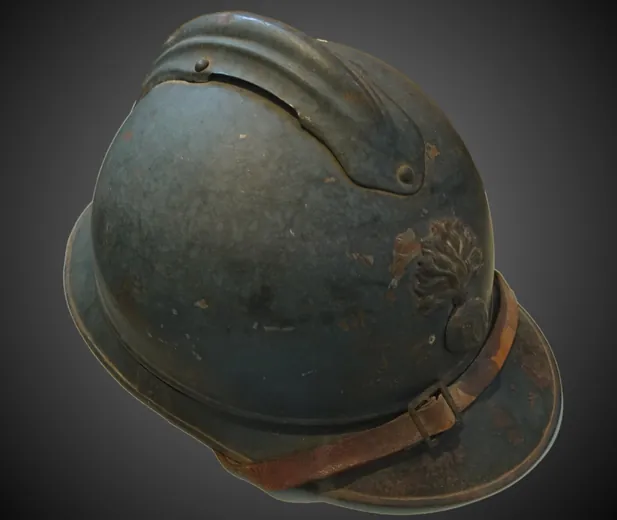
It is the piece most often found in a French estate, and the one about which the most loose claims circulate. An Adrian helmet can nonetheless be identified methodically, by looking at four things in order: how many parts it is made of, its crest, its front badge and its liner.
Mostly want to know what your helmet is worth? Valuation has its own guide: how to value an Adrian helmet. This one is about knowing exactly what you are holding, which is what any valuation starts from.
Adopted by the French army in 1915, the Adrian helmet replaced the metal skullcap worn under the képi in the early part of the conflict. It is the first mass-produced French combat helmet, and it was worn well beyond 1918 and well beyond France.
This guide is no substitute for a specialist's eye on a rare variant. It allows you to place a piece, describe it correctly and avoid the costliest mistakes.
1. Count the parts: this is the point that settles it
This is the most decisive check, and the simplest.
The 1915 model is an assembled helmet. The shell, the brim and the crest are separate elements, joined by rivets and crimping. Look at the join between the skull and the brim: on a Great War Adrian, that junction is visible.
The 1926 model, which succeeded it, is by contrast pressed from a single piece, the applied crest aside. Its outline is heavier and its skull-to-brim junction is continuous, with no seam.
Confusing the two is the most frequent error in listings, and it has a real effect on value as well as on dating. If you were to remember only one point from this guide, it would be this one.
2. The crest
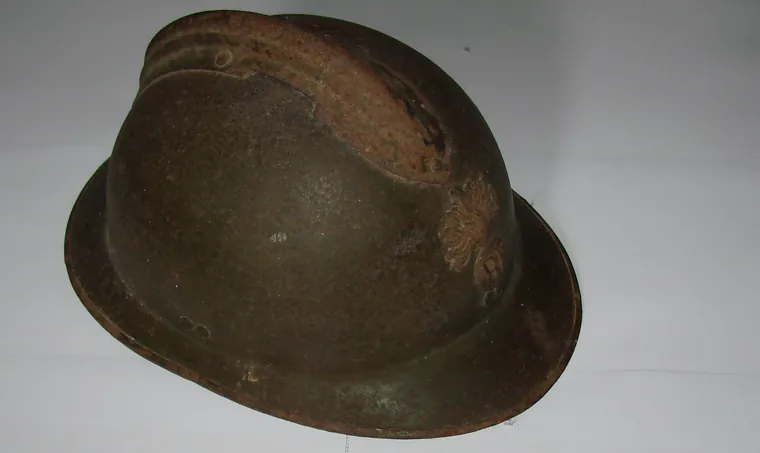
The metal crest fixed to the top is not decorative: it covers ventilation openings cut into the skull.
Check that it is present, that it has not been re-glued, and look underneath. A crest that has been removed and refitted, a crest fixed by some means other than the original one, or a crest whose shape does not match the rest of the piece are signs of reassembly.
It is also one of the places where the original paint survives best, protected from rubbing. A repainted crest on a helmet where the rest is not repainted points to intervention.
3. The front badge
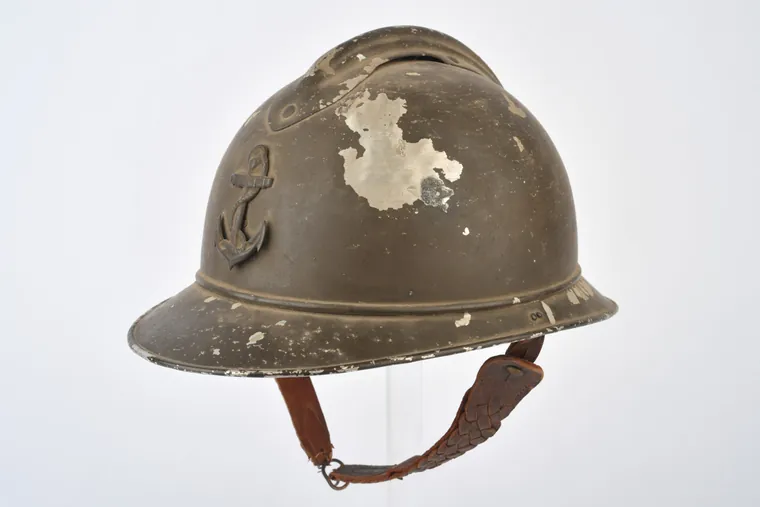
The badge fixed to the front indicates the branch of service. It is what gives the helmet its identity and, often, most of its value.
The most common badges correspond to the main branches: the flaming grenade for the infantry, crossed cannons for the artillery, other emblems for the engineers, the cavalry, the medical service or the colonial troops. Some are very common, others distinctly rarer.
Three concrete checks:
- The method of attachment and how it tallies with the holes in the shell. Extra holes, or a badge fixed to piercings that do not match, indicate a change.
- The comparative wear of the badge and the helmet. Two pieces that have lived together age together.
- The sharpness of the relief. A badge with very crisp relief on a tired helmet is probably a recent addition.
It is precisely on the badge that substitutions are concentrated, because a rare badge changes the price without changing the helmet. Be as cautious as the claimed rarity warrants.
4. The liner and the chinstrap
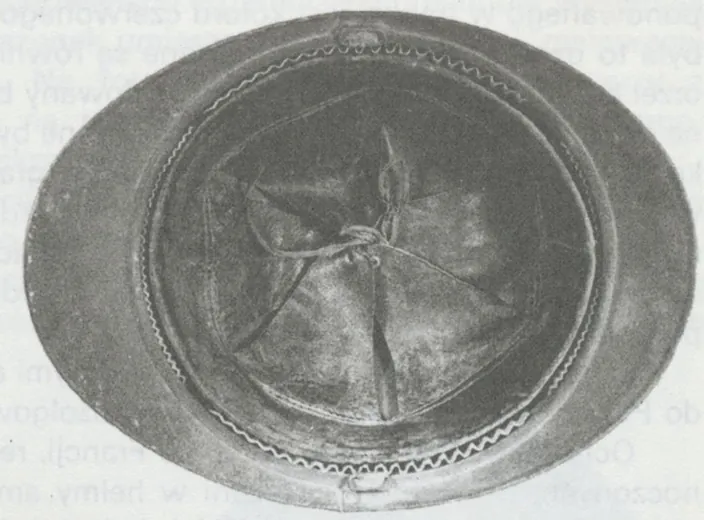
Turn the helmet over. The inside often tells you more than the outside.
The period liner is leather, cut into adjustable tongues, fixed to the helmet and gathered by a drawstring. It is almost always dry, cracked, sometimes partly missing. A complete, supple and unaltered liner on an otherwise worn helmet is a replacement liner, often a modern one.
Look at the leather of the chinstrap, its buckles, the way it is attached. Replacing a chinstrap is extremely common and does not disqualify the piece, provided it is stated.
Markings, where there are any, are most often found under the liner or inside the shell. Record them character by character before interpreting them.
The paint, on no account to be touched
The original paint is an element of dating and part of the value. It is not to be cleaned, not to be touched up, not to be revived.
A helmet stripped and repainted, however neatly, loses most of its interest to a collector. If the paint is flaking, leave it flaking. If rust is active, halting it is a matter of careful conservation, not stripping: see caring for military leather, textile and metal.
One helmet, several armies
The Adrian was not worn by France alone. Several Allied armies adopted or received it during and after the First World War, with their own badges. A helmet of Adrian form bearing a non-French emblem is therefore neither an anomaly nor necessarily a fake.
This point matters for the description: it is the badge, not the shape, that places the army of use.
What I cannot tell you here
Close dating from maker's marks, attribution to a specific unit and identification of production variants require specialised documentation and examination of the piece in hand. No online guide replaces that.
Good practice, if you are selling: describe what you observe, publish sharp photographs of the interior, the crest, the badge and the markings, and state what you have not been able to determine. That inspires more confidence than a confident attribution, and it protects you.
For an opinion, the community is the quickest way in. To compare with pieces from the same period, see the First World War listings.
And if your helmet comes from an inherited group you have not yet sorted through, start here: inheriting militaria, where to begin. On the signs of reproduction in general, see recognising fake militaria.
Frequently asked questions
What is the difference between the 1915 and the 1926 Adrian helmet?
Look at the join between the skull and the brim. The 1915 model is assembled from separate elements, and the junction is visible. The 1926 model is pressed from a single piece, its junction is continuous and its outline heavier. This is the most reliable and the quickest check, and confusing the two is the most frequent error in listings.
How do you recognise a genuine Adrian helmet?
Check four points in order: a shell assembled from several parts for the 1915 model, a crest fixed without later rework, a front badge whose fixing matches the holes in the shell and which has aged with it, a leather liner whose wear is consistent with that of the helmet. A supple, intact liner in a heavily worn helmet is almost always a replacement.
Why is it called the Adrian helmet?
It bears the name of the military intendant Louis Adrian, who led its design and production in 1915 to protect soldiers from the shell splinters that caused a large share of head wounds.
What does the badge fixed to the front of the helmet mean?
It indicates the branch of service: flaming grenade for the infantry, crossed cannons for the artillery, and other emblems for the engineers, the cavalry, the medical service or the colonial troops. Some badges are very common, others distinctly rarer, which makes the badge the part most often substituted on a helmet.
Should an Adrian helmet be cleaned or repainted?
No. The original paint is an element of dating and an important part of the value. A helmet stripped and repainted, even neatly, loses most of its interest to a collector. If the paint is flaking, leave it as it is. Only active rust justifies intervention, and that is then a matter of careful conservation, not stripping.
Is the original liner essential?
It is not essential but it counts. The period liner is leather cut into tongues, almost always dry and cracked. A complete, supple liner on an otherwise worn helmet is a replacement. A replacement does not disqualify the helmet, provided it is stated in the description.
Is an Adrian helmet with a foreign emblem a fake?
Not necessarily. Several Allied armies adopted or received this helmet during and after the First World War, with their own badges. It is the badge, and not the shape, that places the army of use. A helmet of Adrian form bearing a non-French emblem is therefore a piece to be described as such.
Where are the markings found on an Adrian helmet?
Most often under the liner or inside the shell, where there are any. Record them character by character before trying to interpret them: a misread letter points you towards a different maker or a different year. Close dating from markings requires specialised documentation.