Where to buy militaria, and how to go about it in each place
By Augustin, founder of Athena Militaria Published , updated
A folding table in a village hall at eight on a Sunday morning; a saleroom where you raise your hand; a listing read on a screen late in the evening. You will not find the same pieces in each, nor at the same prices, nor with the same guarantees. Each channel has its rules, its bargains and its traps. This guide gives no calendar and no addresses, which change; it gives what does not change: how to buy in each place without going wrong.
Militaria fairs and shows
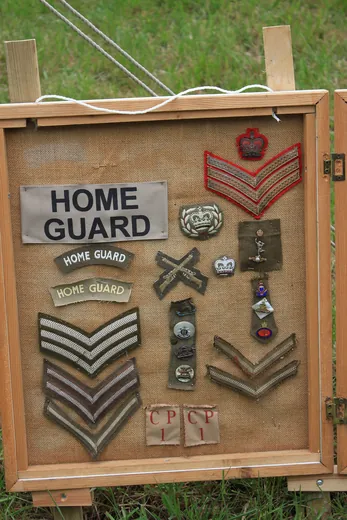
Eight in the morning, rows of tables under strip lights and, on them, helmets, medals pinned in lines on squares of velvet, crates of belt buckles you can sink a hand into. This is where you learn fastest. For one weekend, professional dealers and collectors who have rented a table to clear their duplicates stand under the same roof. You see hundreds of pieces in a few hours. You pick them up, turn them over, set two examples side by side, and the sellers, among themselves, talk readily about what is on their tables.
Dates are found through the organisers, usually collectors' associations, in the specialist magazines, and on the posters of previous fairs. Regulars arrive at opening time, sometimes before it. The best pieces go in the first hour, and often from dealer to dealer, while the tables are still being laid out, before the public has even come through the door.
How to buy there
- Come with a loupe and a precise idea of what you are looking for. Without a theme you go home with anything; with a theme the eye trains itself within a few visits, and soon you will spot what interests you from three tables away.
- Prices are negotiable, within reason. A dealer knows the value of what he sells; a private collector clearing his duplicates may be wrong, in either direction.
- Ask for the piece's history. A precise answer, or an honest "I don't know", is worth more than a story that is too good. The stories that are too good all sound alike.
- There is no cooling-off period and no written guarantee on most tables. What you carry away is yours, flaws included. One exception: the piece is not what you were told it was. The law then opens a remedy, far easier to exercise with a professional's invoice than with a private seller's word. Hence the value of knowing how to spot a reproduction before you go, not after.
- Bring cash and a sturdy bag; card payments remain the exception. Keep the legal ceiling in mind all the same: a cash payment to a professional may not exceed 1,000 euros, on pain of a fine shared between buyer and seller. Between private individuals the law sets no ceiling, but a written receipt remains useful for a large sum.
Auctions
A lot number, an estimate, the fall of a hammer. Auction houses, in Paris and in the regions, hold sales devoted to historical souvenirs and militaria, and many general sales include a few lots, slipped in between a chest of drawers and a dinner service. The auctioneers' online platforms let you bid from your own sitting room. This is the channel for attributed groups, rare pieces and entire estates: a lifetime's cabinet, dispersed in an afternoon.
What to know before bidding
- The hammer price is not the price paid: the buyer's premium is added, often between a fifth and a third, plus online platform fees and shipping. Set your ceiling with fees included, and work it out before the sale, not during it.
- The catalogue describes, the viewing shows. The description commits the auction house to what it states, but a photograph is not the piece in your hand. Go to the viewing, or ask for a condition report and additional photographs.
- Bidding fever exists. Two bidders fighting over a piece pay above the market, and each goes home convinced he was right. A ceiling written on a scrap of paper before the sale protects you from yourself.
- Results are public, and that is their second interest: they are the best references for valuing a piece, because they are prices actually paid, not prices asked.
Dealers, antique shops and gunsmiths
The specialist dealer, in a shop or online, sells for more than the fair, and rightly so: he has found the piece, identified it, and guarantees it. His invoice describes the object, and a professional is liable for what he writes. I am often asked whether that difference in price is justified. For an important piece, or for a beginner who does not want to get it wrong, it is: the guarantee is worth the difference. It is the price of a quiet night's sleep.
Gunsmiths sell deactivated firearms and edged weapons with the papers that go with them, and know what the law allows to whom: see what the law says. General antique dealers are not specialists. You find misidentified pieces there, in both directions: the bargain sitting next to the mistake, and your eye is what sorts them.
Flea markets, car-boot sales and estates
A cardboard box under a table, a blanket over it, and inside, a crushed kepi. This is the lottery, and that is what people like about it. Pieces coming out of an attic have not yet been sorted by a trained eye; they are also mixed with reproductions bought long ago as decoration, which nobody in the family can tell apart any more. Go early. Look at everything. Buy only what you can identify. A complete family trunk, with its papers and photographs, is worth more together than dispersed: if you come across one, buy the lot, and read the guide on military photographs and papers before separating anything. What is separated does not go back together.
Online: listing sites and platforms
General listing sites are full of militaria, each with its own rules on weapons, ammunition and emblems. Specialist collector-to-collector platforms, such as this site's catalogue, address a public that knows what it is looking at. Buying at a distance has one constraint, only one, but it changes everything: you do not handle the piece. Everything therefore rests on the photographs and on the conversation with the seller.
- Insist on sharp photographs of everything: the inside of a helmet, the back of an insignia, the rim of a medal, the markings, the flaws. A serious seller provides them without argument; one who drags his feet is already telling you something.
- Ask precise questions and read the answers: the person holding the piece can answer; the one who copied another listing cannot. I read a great many listings, and the replies that dodge the question are nearly always the ones whose photographs come from somewhere else.
- Read the terms of payment, shipping and return before buying, and keep the exchanges in writing.
- Be wary of prices that are too low on sought-after pieces, and of photographs that are too good: an image search often finds the original photograph elsewhere, under another listing.
What to check everywhere
Whatever the channel, the order is the same: identify, then judge the condition, then look at the price. Never the other way round. The guides devoted to each family of pieces say what to check, from the Adrian helmet to WW1 medals, from bayonets to insignia. Check too that the piece may legally be bought, transported and kept, which is not true of everything laid out on a table. And clean nothing when you get home, however much your fingers itch: the minimum rule applies from day one.
And to sell?
The same channels work in the other direction, with the same price logic: the fair and the collector-to-collector listing give the market price, the dealer buys below it to resell, the auction house takes its fees on both sides. The guide on selling militaria in France details what may be sold freely, and listing a piece is free on this site.
Frequently asked questions
Where can I find the dates of militaria fairs?
Through the organisers, most often collectors' associations, in the specialist militaria magazines, on the posters of previous editions and in town halls' event listings. This guide keeps no calendar: dates change every year.
Can prices be negotiated at a militaria fair?
Yes, within reason. A dealer knows the value of what he sells and will make a gesture, rarely a large discount. A private seller clearing duplicates may have misjudged in either direction. Bear in mind that there is no cooling-off period at a fair or show: you do not bring a piece back because you changed your mind. Only a false description, a reproduction sold as a period piece for instance, opens a remedy, far easier to pursue with a professional's invoice than with a private seller's word.
Are auctions cheaper than dealers?
Not necessarily. The buyer's premium is added to the hammer price, often between a fifth and a third, plus platform and shipping fees. And two bidders fighting over a piece pay above the market. Set your ceiling with fees included before the sale, and hold to it.
Can a deactivated firearm be bought online?
Yes, but not hand to hand. Since 2018 a deactivated firearm falls, with few exceptions, into category C: it must be declared, and its acquisition, even at a distance, goes through a gunsmith or licensed broker who checks the buyer's identity and age and records the sale. No hunting or shooting licence is required for this category. The deactivation certificate travels with the weapon, and transport and shipping have their own rules. A gunsmith or a specialist dealer is the safest route for a first purchase.
How do I avoid fakes when buying at a distance?
Insist on sharp photographs of the areas that give a copy away: inside, back, rim, markings. Ask precise questions and judge the answers. Check by image search that the photographs do not come from elsewhere. And learn the checkpoints of the family of pieces before buying, not after.
What is the best place for a beginner?
The fair: you see hundreds of pieces in a few hours, handle them, compare, and talk with collectors. For a first important piece, a specialist dealer who guarantees his invoice avoids the costly mistake.