The French Médaille militaire: recognising it, dating it, tracing its holder
By Augustin, founder of Athena Militaria Published , updated
It is the decoration of the private soldier and the NCO, the one French families like to call "the soldier's Legion of Honour". It is recognised in an instant but dated badly: its Republican model, which bears the date 1870, is still awarded today. Here is how to place one, trace the man who received it and understand what makes its value.
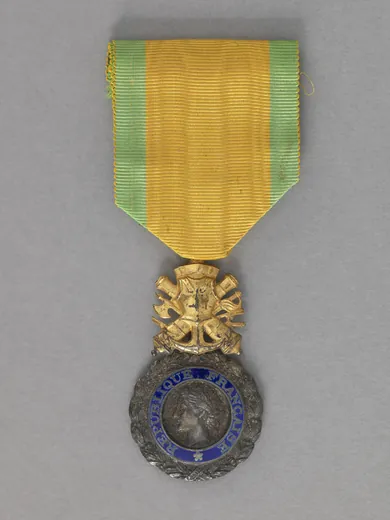
What the Médaille militaire is
Created by a decree of 22 January 1852, under the presidency of Louis-Napoléon Bonaparte, the Médaille militaire rewards NCOs and other ranks: for an act of war, for wounds received in combat, or for the length and quality of their service. It may also be awarded, exceptionally, to general officers who held supreme command in the face of the enemy. A junior officer does not receive it: if he wears one, he earned it before being commissioned.
Among French decorations it ranks immediately after the Legion of Honour and the Order of Liberation, and it comes under the Grand Chancellery of the Legion of Honour. Hence its nickname, often heard in families.
It is still awarded today. This is the point that most often misleads: a Médaille militaire found in an estate is not necessarily from the Great War, and its inscription is not enough to date it.
Recognising it
The obverse
A gilt central medallion bears a profile of the Republic, crowned with laurel, on every model made after 1870. It is surrounded by a blue enamelled band carrying the legend "République française 1870", the whole set within a wreath of laurel leaves.
The date 1870 is that of the proclamation of the Republic, not of the medal. It appears on examples presented in 1916 just as on those awarded decades later.
The reverse
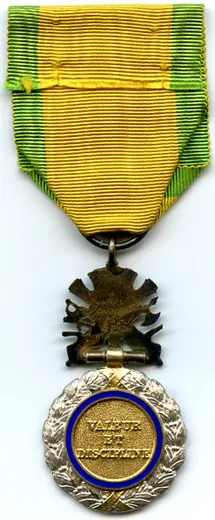
In the centre, the motto "Valeur et discipline". It is what identifies the Médaille militaire beyond doubt among decorations of similar appearance.
The top
Above the medallion, the piece that joins the medal to its ribbon changes with the regime. Under the Second Empire it is an imperial eagle. Under the Republic, a trophy of arms. That single detail separates the two main families at a glance.
The ribbon
Yellow, edged with green. As with every decoration, it has often been replaced: a new ribbon does not make the medal suspect, it simply tells you nothing about its age.
Dating it
Second Empire, 1852 to 1870
Effigy of Louis-Napoléon, legend bearing his name, eagle at the top. These are the least common and most sought-after examples, and for that very reason the ones most often copied.
Third Republic, including the Great War
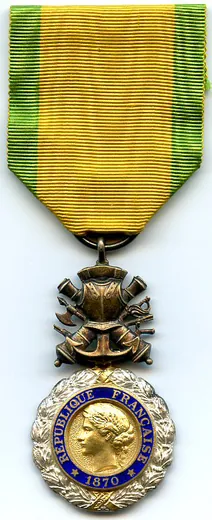
From 1870 the effigy of the Republic and the trophy of arms replace the sovereign and the eagle. Several variants followed one another, told apart mainly by the design of the trophy, the relief of the effigy and the finish. This is the model presented during the 1914-1918 war, in very large numbers.
After 1945
The Republican model went on being made and awarded, with the same legend. Telling a 1916 example from one of the 1960s means comparing the manufacture with pieces whose date is certain: relief, quality of the enamel, shape of the ring and suspension. None of these criteria is enough on its own.
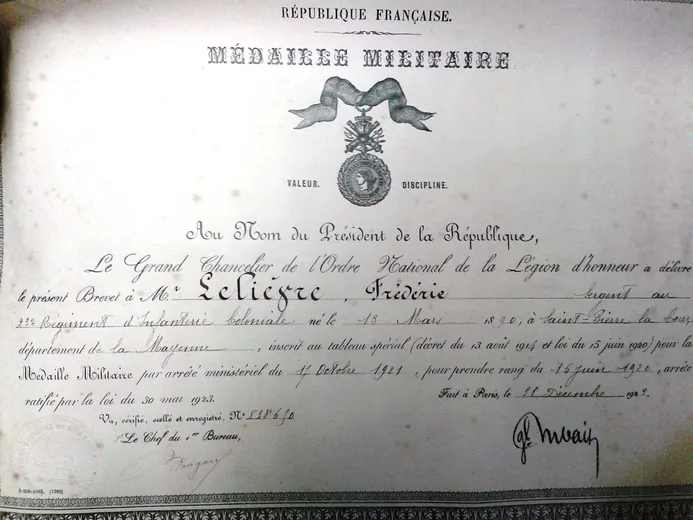
The surest method remains documentary. A medal accompanied by its award document, a citation or a service record that mentions it is dated by those papers far better than by any examination of the object.
Hallmarks
Silver examples often carry a small assay mark, frequently on the ring or the suspension. It is a clue to the metal, not proof of period or authenticity: such marks also appear on later manufacture, and their absence is nothing unusual.
Miniatures, copies and confusions
- The miniature. A small version worn on civilian dress. It is not a fake: the holder bought it himself, and it often accompanies the full-size medal in families.
- The Croix de la Valeur militaire. Created in 1956, it rewards actions carried out outside declared wars. It is a cross, not a round medallion: the confusion comes only from the word "valeur".
- Copies. They mostly target the Second Empire. A cast rather than struck piece gives itself away through a grainy surface, soft relief and blurred lettering; its enamel is often too even and too glossy.
The general approach, valid for every piece, is set out in spotting a reproduction or a fake.
The Médaille militaire and the Croix de guerre
During the Great War, a Médaille militaire awarded for an act of war came with a citation in army orders, and therefore with a Croix de guerre with palm. The two decorations are often found together, on the same bar or in the same box.
Many Médailles militaires were also awarded posthumously, during and after the conflict, to soldiers who died for France. The medal was then handed to the family: in that case, the absence of wear is not suspicious at all.
To read the cross that accompanies it, with its stars and palms, see reading a Croix de guerre 1914-1918.
Tracing the holder
A Médaille militaire carries neither a name nor an individual number. The holder is traced through documents, in this order.
- Family papers. The award document, the military service book, citation certificates. Note the surname, the first names in their exact order, the date and place of birth, and the recruitment class.
- The service record. Kept in the departmental archives of the place of recruitment and very widely available online, it usually mentions the medal, its date and often the text of the citation.
- The Journal officiel. Awards were published there, often with the text of the citations. Old issues are digitised and freely available on Gallica, the digital library of the Bibliothèque nationale de France.
- Mémoire des hommes. For a soldier who died for France, the Ministry of the Armed Forces database gives the death record, which cross-checks the rest.
One point that saves time: the Léonore database, often recommended, holds the files of the Legion of Honour. Someone who held only the Médaille militaire does not appear in it; for a Legion of Honour, see dating a Legion of Honour cross.
For every Great War decoration, the method is set out in tracing a French WW1 soldier's decorations.
Reading the papers themselves is covered in reading and keeping military photographs and documents.
What makes the value of a Médaille militaire
There is no official price guide, and a Republican medal on its own, without documents, remains a common piece. The difference comes from five things.
- The model: Second Empire, early Republican variants, later manufacture.
- Documented attribution: award document, citation, service record. This is the factor that weighs most.
- The group: a Médaille militaire with its Croix de guerre, its papers and a photograph of the holder forms a group, which sells as such.
- The condition of the enamel: chips in the blue band are common and weigh on the price.
- The original ribbon, however worn.
To build an honest range, record sales actually completed on comparable pieces, not asking prices. The method is set out in valuing a piece, and the site's sales archive shows real prices and their dates.
A Great War ancestor's Médaille militaire is sold routinely. The precautions to take, particularly for a recent decoration awarded to an identifiable person, are gathered in selling military items in France.
Mistakes to avoid
- Cleaning the enamel or the metal. Silver polish attacks the gilding of the medallion and dulls the enamel for good.
- Replacing the ribbon, however faded.
- Separating the medal from its papers or from the cross that accompanies it.
- Storing it in a sealed plastic pouch, where moisture builds up.
Good conservation habits are gathered in caring for military leather, textile and metal.
What I cannot tell you here
From a description, I cannot tell you which exact variant your medal belongs to, nor to whom it was presented. The first needs a close look at the piece, the second needs documents.
Photograph the obverse, the reverse, the top and the ring, with a ruler alongside for scale, then have the whole thing looked at: ask the community. To compare with pieces for sale, the catalogue gathers First World War medals and decorations.
Frequently asked questions
How can I tell whether a Médaille militaire dates from the First World War?
The legend "République française 1870" appears on every Republican model, including the most recent: it does not date the medal. The clues come from the manufacture (design of the trophy, relief, enamel, ring) compared with dated examples, and above all from documents: an award document, a citation or a service record that mentions the medal.
Who could receive the Médaille militaire?
NCOs and other ranks, for an act of war, wounds or the quality of their service, and exceptionally general officers who held supreme command in the face of the enemy. A junior officer does not receive it: if he wears one, he earned it before being commissioned.
How do I trace the holder of a Médaille militaire?
The object carries neither name nor number. Start with family papers, then consult the service record in the departmental archives, the Journal officiel digitised on Gallica, and Mémoire des hommes for a soldier who died for France. The Léonore database covers only the Legion of Honour.
What is a Médaille militaire worth?
There is no official price guide. A Republican medal on its own remains a common piece; the Second Empire model, a documented attribution, a group with a Croix de guerre and papers, intact enamel and the original ribbon make the difference. An honest range is built from sales actually completed on comparable pieces.