The Legion of Honour: recognising the grade, dating the cross, tracing the holder
By Augustin, founder of Athena Militaria Published , updated
A white five-armed cross with double points, a red ribbon, often a case: the Legion of Honour is the decoration families keep most carefully, and the one they most often get wrong. It is not necessarily military, not necessarily old, and its value lies far less in the object than in what is known of the person who received it.
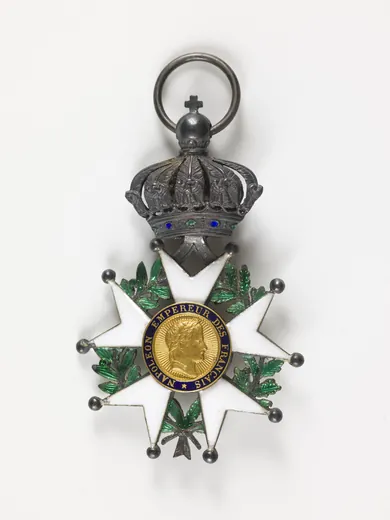
What the Legion of Honour is
Created on 19 May 1802 by Napoleon Bonaparte, then First Consul, the Legion of Honour is France's highest distinction. Its grand master is the head of state, and it comes under the Grand Chancellery of the Legion of Honour.
It rewards eminent merit, military or civilian. That is the first thing to keep in mind in front of a family cross: an engineer, doctor, mayor or industrialist forebear may have received it without ever wearing a uniform. Only the papers will tell.
Recognising the grade
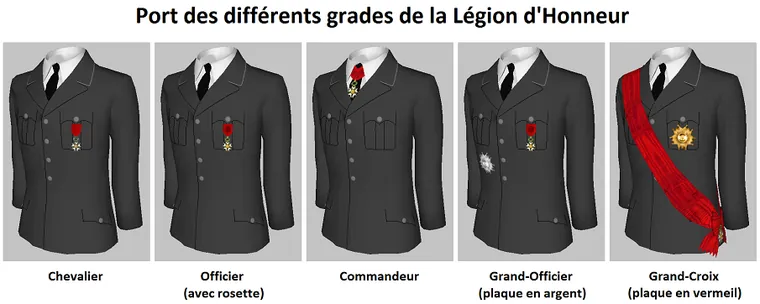
The order has three grades, knight, officer and commander, and two dignities, grand officer and grand cross. Each has its own insignia and its own way of being worn.
- Knight: the cross in silver, on a plain red ribbon. By far the most common.
- Officer: the same cross in silver-gilt or gold, with a rosette on the ribbon.
- Commander: a larger cross, worn on a ribbon around the neck.
- Grand officer and grand cross: a star worn on the chest, and for the grand cross a sash. These insignia are rare in estates.
The metal is checked through the assay marks, often struck on the ring or suspension. A gilt cross is not necessarily an officer's cross: gilding alone proves nothing.
Dating the cross: what changes with each regime
The general shape has hardly changed in two centuries: a five-armed star with double points in white enamel, a wreath of oak and laurel between the arms, a central medallion surrounded by a band of blue enamel. What changes is the effigy in the medallion, the legend around it and the piece at the top of the cross.
- First Empire: effigy of Napoleon, imperial crown at the top.
- Restoration and July Monarchy: effigy of Henri IV, royal crown.
- Second Republic: effigy of Bonaparte.
- Second Empire: effigy of Napoleon surrounded by the legend "Napoléon empereur des Français", imperial crown.
- Third Republic and after: effigy of the Republic surrounded by the legend "République française 1870", wreath of foliage at the top.
On the reverse, the motto "Honneur et Patrie" goes with a central motif that also changes: an imperial eagle under the Empire, flags under the Republic. Look at both sides: together they almost always place the regime.
As with the Médaille militaire, the date 1870 is that of the Republic, not of the cross: a Republican model may have been presented in 1880 or in 1960.
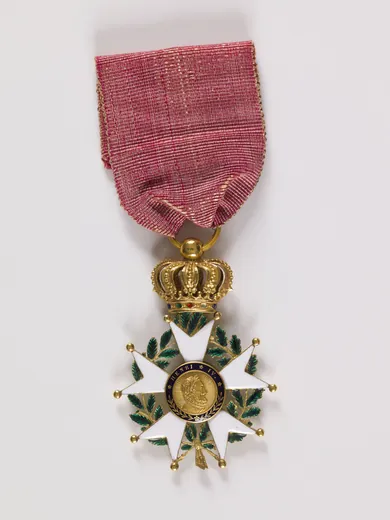
Why two crosses of the same grade do not look alike
Holders bought their insignia from jewellers and decoration makers, which explains the wide variety of crosses from the same period: sizes, finishes, quality of enamel. Some, known as luxury pieces, are in gold or finely made. These differences are not anomalies, and they affect value.
You will also find miniatures, small crosses worn on civilian dress, and the ribbon or rosette alone worn in the buttonhole. They are not fakes: they often accompany the cross in families.
Tracing the holder
A cross carries neither name nor number. But for the Legion of Honour, one resource changes everything: the Léonore database, kept by the French National Archives and freely available online, which gives access to the files of members of the order who died before 1977. It often includes the birth certificate, the appointment decree and sometimes a record of service.
- Start with family papers: the order's certificate, correspondence, death notices, a photograph in which the cross is worn.
- Search for the name in Léonore, checking the date and place of birth.
- For a soldier, complete the picture with the service record in the departmental archives; reading and keeping military photographs and documents explains how to read it.
For a Great War soldier, the other sources, service record, Journal officiel and Mémoire des hommes, are set out in tracing a French WW1 soldier's decorations.
Keep a copy of what you find with the cross. A cross tied to a Léonore file is no longer an anonymous object.
What makes the value of a Legion of Honour
There is no official price guide. A Third Republic knight's cross, on its own and without papers, remains a common piece. The difference comes from six things.
- The regime: the older the cross, the rarer it is, and First Empire models are the most sought after.
- The grade: an officer's or commander's insignia is worth more than a knight's cross.
- Metal and manufacture: gold, luxury finish, quality of work.
- The condition of the enamel: chips on the white arms are common and weigh on the price.
- Documented attribution: a certificate, a Léonore file, a holder whose story is known. This is often the deciding factor.
- The group: the cross with its case, its miniature, its other decorations and its papers.
Copies are numerous, particularly of early models: soft relief, overly even enamel, abnormal weight. The approach is set out in spotting a reproduction or a fake, and building a price range in valuing a military item.
Wearing, keeping, selling
In France, wearing a decoration you have not received is an offence under the Penal Code, including a forebear's. Keeping it, displaying it in a frame or selling it is lawful. What to check before listing is gathered in selling military items in France.
Do not clean the enamel or the metal: silver polish attacks the gilding of the medallion and dulls the enamel for good. Good habits are set out in caring for military leather, textile and metal.
What I cannot tell you here
From a description, I cannot tell you whether your cross is a period piece or to whom it was presented: the first needs a look at the piece, assay marks included, the second needs a search in the archives.
Photograph both sides, the top, the ring and the marks, then have the whole thing looked at: ask the community. To compare with pieces for sale, the catalogue gathers First World War medals and decorations.
Frequently asked questions
How can I tell what period a Legion of Honour cross dates from?
Look at the effigy in the medallion, the legend around it and the piece at the top of the cross. Napoleon with an imperial crown indicates the Empire, Henri IV with a royal crown the Restoration or July Monarchy, the effigy of the Republic with "République française 1870" and a wreath of foliage the Third Republic and after. The reverse, with the motto "Honneur et Patrie", confirms it.
How do I trace the holder of a Legion of Honour?
Start with family papers, then search for the name in the Léonore database of the French National Archives, freely available online, which gives access to the files of members of the order who died before 1977. Check the date and place of birth to avoid namesakes.
What is a Legion of Honour cross worth?
There is no official price guide. A Third Republic knight's cross on its own remains a common piece. The regime, the grade, the metal, the condition of the enamel and above all documented attribution make the difference. An honest range is built from sales actually completed on comparable pieces.
Is it legal to sell a forebear's Legion of Honour?
Yes. Owning and selling a decoration is lawful in France. What the Penal Code punishes is wearing one you have not received.