Tracing a French WW1 soldier's decorations
By Augustin, founder of Athena Militaria Published
The question comes up in almost every family: "my great-grandfather had the Croix de guerre, where can I find the list?" The answer is surprising: there is no such list. Great War decorations are traced soldier by soldier, in four or five public sources, free and almost all online. Here they are, and the order in which to consult them.
Why there is no single list
The 1914-1918 Croix de guerre, created by the law of 8 April 1915, was not awarded by a central authority. It came with a citation, an act officially recognised, and citations were issued at every level: regiment, brigade, division, army corps, army. Each was recorded in the orders of the unit that issued it. No national register ever brought them together.
The Médaille militaire and the Legion of Honour work differently: their awards were published in the Journal officiel, and the Legion of Honour has a named database. But for all three decorations, the method starts in the same place: the soldier's exact identity.
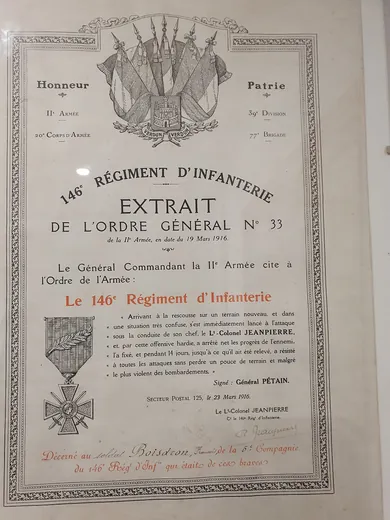
A frequent confusion, finally. A collective citation honours a whole unit: its flag receives the cross, and two citations in army orders earn it the fourragère. It is not an individual citation for each of its men, even when a souvenir certificate was handed to them, like the one shown above.
1. Gather the soldier's exact identity
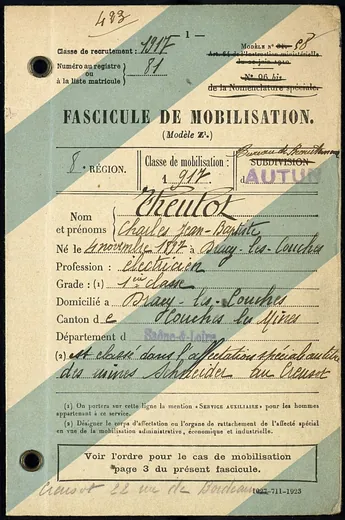
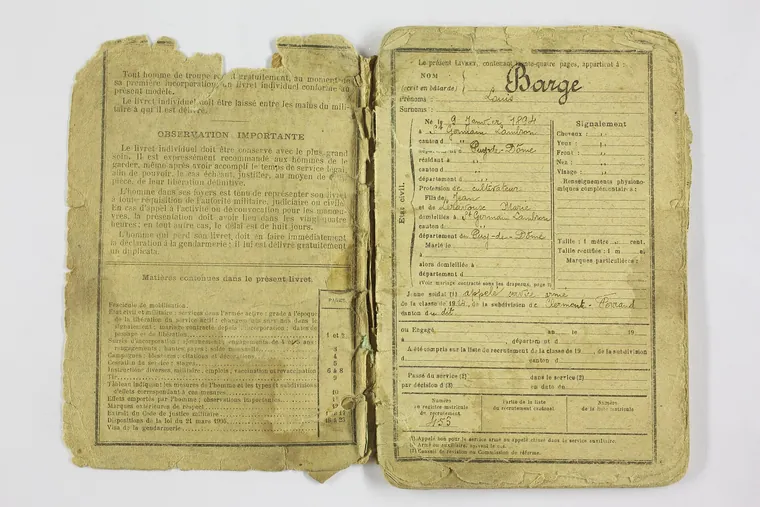
You need four elements: surname, first names in civil-register order, date and place of birth. They are found on the service book, the mobilisation booklet, a certificate, a death notice, a birth or marriage record. Without the date of birth, namesakes make any search unreliable.
Two details save a great deal of time. The recruitment class, usually the year the man turned twenty: a man born in 1897 belongs to the class of 1917. And the recruitment office with the registration number, often written at the top of the service book or booklet: they lead straight to the right page of the register.
2. The service record, the main source
Every man registered for service has a sheet in the registre matricule of his recruitment office, kept in the departmental archives. Most French départements have digitised it and offer it free online, searchable by name, class or office.
It is the most complete source on a soldier's service: successive postings, wounds, captivity, and in the section on decorations, citations with their level and often their text, the Croix de guerre, the Médaille militaire. If the sheet records an individual citation, the soldier received the Croix de guerre, and the level of the citation tells you which device his ribbon carried.
If you do not know where the man was recruited, the Grand Mémorial, a national platform, lets you search a name across the registers of the départements that take part.
3. The Journal officiel
Citations in army orders, awards of the Médaille militaire and appointments to the Legion of Honour were published in the Journal officiel, often with the text of the citation. The issues of the period are digitised on Gallica, the digital library of the French national library, where the search runs on the text: try spelling variants of the name, as automatic reading of old pages produces many.
Citations at lower levels, regiment, brigade, division or army corps, are generally not there. For those, the service record and the unit's archives remain the only sources.
4. Mémoire des hommes: soldiers who died for France and unit diaries
The French Ministry of the Armed Forces site gives an individual record for every soldier who died for France. It also publishes the war diaries kept day by day by each unit. Once the regiment is known from the service record, the diary lets you date and place the action cited; citations are sometimes copied into it.
For an officer, the Service historique de la Défense, at Vincennes, also keeps an individual file.
For a soldier of another Allied army, including Americans awarded the French Croix de guerre, the award was recorded in that army's own records.
5. The Léonore database, for the Legion of Honour only
Kept by the French National Archives and free to consult, it gives access to the files of members of the order who died before 1977: birth certificate, appointment decree, sometimes a record of service. It covers the Legion of Honour only: a holder of the Croix de guerre or the Médaille militaire alone is not in it. The details are in dating a Legion of Honour cross.
What each decoration lets you trace
- 1914-1918 Croix de guerre: the service record first, then the unit diary; the Journal officiel only for citations in army orders, those of the palm.
- Médaille militaire: the service record and the Journal officiel. See the Médaille militaire, dating it and tracing its holder.
- Legion of Honour: the Léonore database, the Journal officiel, the service record.
- Commemorative medal and Inter-Allied medal: awarded very widely, they cannot be traced in a named list. Their trace is in the family papers, the certificate in particular.
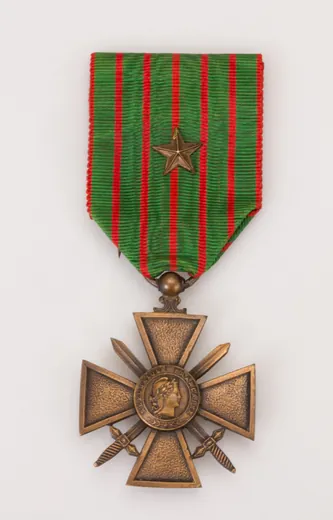
To read the stars and palms on a family cross, see the 1914-1918 Croix de guerre, reading and dating it.
Mistakes that waste time
- Looking for the Croix de guerre in Léonore. It is not there, unless the soldier was also a member of the Legion of Honour.
- Trusting the devices on the cross. Stars and palms come off and go on easily: only the documents say how many citations a soldier received.
- Settling on the first namesake found. Always check the date and place of birth.
- Taking a collective citation for an individual one. See above.
- Separating the medal from its papers. Once brought together, they form a group to keep as it is.
Once the holder is found
Keep a copy of the service record and of the citation text with the decoration. A cross linked to an identified soldier forms a named group: for the family, a memory to hand down; for a collector, what sets a piece apart from thousands of anonymous examples. If selling ever becomes a question, first read what to do with an ancestor's military items and valuing a military item.
Reading and keeping the papers themselves is covered in reading and keeping military photographs and papers.
What I cannot tell you here
I cannot do the research for you, nor tell you whether a particular soldier was cited: that takes his exact identity and a search of his département's archives. A service record that is hard to read, obscure abbreviations, a unit you cannot find: Great War enthusiasts' forums are a great help, and you can also ask the community. Decorations for sale on the site are gathered under First World War medals.
Frequently asked questions
Is there a list of 1914-1918 Croix de guerre recipients?
No. The cross came with a citation, and citations were issued at every level, from regiment to army, then recorded in each unit's orders. No national register brought them together. A soldier's cross is traced through his service record, and through the Journal officiel for citations in army orders.
How can I find out whether a soldier received the Croix de guerre?
Look up his service record, in the departmental archives of the place he was recruited, usually online. If the decorations section records an individual citation, he received the Croix de guerre, and the level of the citation gives the device: bronze star for regiment or brigade, silver for division, silver-gilt for army corps, palm for army.
Where can I find the list of WW1 Médaille militaire recipients?
Awards of the Médaille militaire were published in the Journal officiel, digitised on Gallica, and they generally appear on the service record. There is no dedicated named database: Léonore covers the Legion of Honour only.
Does the Léonore database list Croix de guerre recipients?
No. Léonore holds the files of members of the Legion of Honour who died before 1977. A soldier who received only the Croix de guerre or the Médaille militaire is not in it.
Does a collective regimental citation give each soldier the Croix de guerre?
No. A collective citation honours the unit: its flag receives the cross, and two citations in army orders earn it the fourragère. Souvenir certificates handed to the unit's men are not individual citations.
What if the service record mentions no citation?
First check it is the right man, date and place of birth included. If so, the cross kept in the family may have belonged to another relative, or been bought or given as a keepsake. The unit diary on Mémoire des hommes may add to the picture, but without a document a cross cannot be attributed to a particular soldier.