The French soldier's canteen: identifying the 1877 model bidon of the Great War
By Augustin, founder of Athena Militaria Published 13 min read
The French WW1 canteen that families call a gourde is, in French military language, a bidon: for the French soldier of the Great War, it is the 1877 model bidon, with two spouts, under a cloth cover. It came in a one-litre and a two-litre size, and the larger one became general issue during the war. It looks ordinary, but it can be read: its capacity, stoppers, cover, markings and repairs tell where it comes from and what it went through. Here is how to recognise it, tell it from German and British canteens, and judge it without talking about price, from the records of the museums that hold examples.
Get a piece identified from photos Valuing a piece: the method
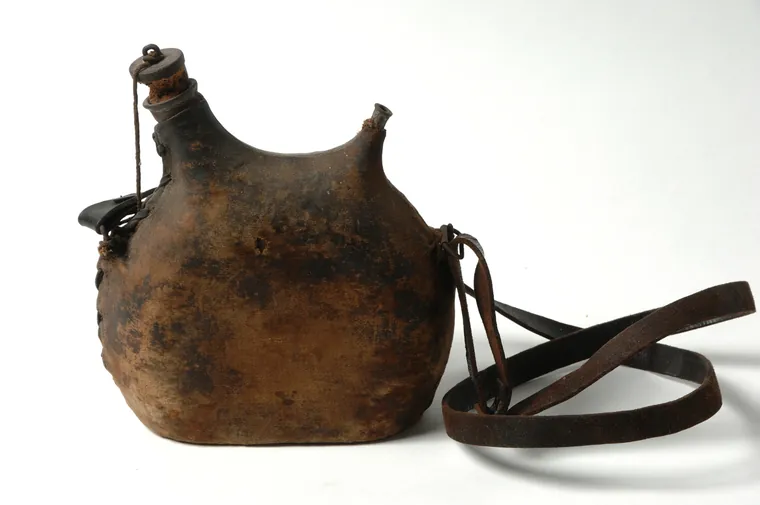
In brief
- A bidon rather than a canteen. French families say gourde, French military language says bidon: the one carried by the French soldier in the Great War is the 1877 model bidon.
- Two spouts. A wide one for filling, a narrow one for pouring or drinking: that is the first sign that sets it apart from German and British canteens, which have only one.
- One litre or two. In 1914 the one-litre bidon equipped troops in mainland France and the two-litre one troops in hot countries; during 1915 the larger one was gradually issued to the whole army.
- A cover and a strap. The body, of tinned iron and sometimes of aluminium, is covered in wool cloth or canvas and carried on the right on a leather strap.
- Inscriptions to check. An engraved name or service number can lead to a man, if the archives confirm who it refers to.
Bidon or gourde: one object, two French words
For the French dictionary Trésor de la langue française, a bidon in the military sense is a metal flask used by soldiers to carry their supply of drink. It distinguishes the large, shared bidon from the small, individual one. A gourde, in the same dictionary, is a wicker-covered or leather-covered bottle, usually worn on the belt or across the body.
In French families the two words mean the same object: the Morvan ecomuseum describes its pair as a military gourde known as a bidon. Bidon remains the word of equipment lists: the mobilisation booklet of Jean Marie Guilloux lists among his kit a bidon de 1 litre, a one-litre bidon. The Musée de la Grande Guerre in Meaux calls the bidon integral to the silhouette of the French soldier of the Great War.
The 1877 model bidon, part by part
One litre or two litres
In 1914, according to the Meaux museum, two sizes existed side by side: one litre for troops in mainland France, two litres for troops stationed in hot countries, the colonial infantry and the Armée d'Afrique. During 1915, because of the difficulty of supplying the front with water, the two-litre model was gradually issued to the whole army.
The uniforms presented by museums show the change. The 1914 infantryman at the Musée de l'Armée carries a one-litre bidon and its cup. The 1916 sapper at the Musée du Génie in Angers carries a two-litre one, and the infantryman in 1918 assault dress at Meaux, two. In October 1916 Amédé Fleury, who photographed his war and captioned the pictures, humorously presented a two-litre bidon as a wife, adding that one litre would not be enough. To place the uniform that goes with it, see dating a French military uniform.
As a guide, the Morvan ecomuseum measures its two-litre bidons at 22 cm high, 20 cm long and 7.5 cm wide.
Two spouts and their stoppers
For the Meaux museum and the Musée du Génie, the wide spout is for filling and the narrow one for pouring; for the Morvan ecomuseum, the small one is for drinking and the large one for filling or emptying. The Imperial War Museum in London describes, on a crushed French bidon, a wide drinking spout and a narrow air spout. The records agree on the shape, not on what the small spout was for.
The stoppers are cork, according to the Musée du Génie. On the one-litre bidon that Sergeant Walter Brown, of the Australian 20th Battalion, collected in France, the large neck has a cork stopper and the small one a wooden stopper, each tied with string to the nearby loop: a wooden stopper is therefore not necessarily a recent repair.
The cover
Since the Second Empire, the Meaux museum notes, a cover has kept the liquid cool and stopped the metal clanking on the move. The records describe wool cloth at Meaux, canvas with an identification label at the Musée du Génie, and a dark blue woollen cover on the aluminium bidon at the Imperial War Museum. None of this guide's sources sets the regulation colour of covers during the war: compare the material and the making with a museum example.
The records of the Australian War Memorial and the Morvan ecomuseum describe no cover. An old cover, even a worn one, is part of the object: do not take it off.
Body, strap and wearing it on the right
Sergeant Brown's bidon is pressed steel, made of two halves soldered together and hot-dipped in tin; the tinning is rubbed by use. The Morvan one is tinned iron, the Imperial War Museum one aluminium. A loop soldered on each side takes a brown leather strap.
The bidon was worn on the right: according to the Musée du Génie, that way it did not knock against the bayonet.
The cup, the mess tin and the rest of the mess kit
For the Meaux museum, the French regulation round cup, the quart, was the bidon's indispensable companion: the soldier drank his ration of coffee, wine or water from it. The Trésor de la langue française describes it as a metal beaker with a handle, usually of twenty-five centilitres, used above all in the army. The Musée du Génie adds that the cup was sometimes tied to the bidon with string.
The mess tin travelled on the pack. The Imperial War Museum holds a French Army 1852 model mess tin: round, metal, with a lift-off lid and hooks to attach it to the pack.
A cup or a mess tin sold with a bidon did not necessarily travel with it: judge each piece, then the group.
Telling it apart from German and British canteens
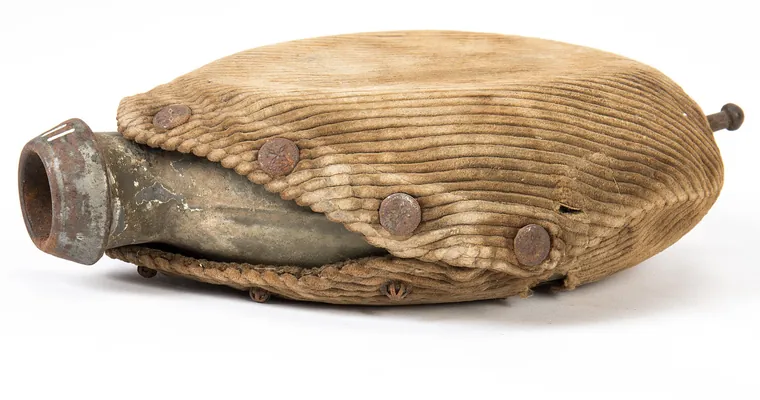
The first sort comes down to the number of spouts. The German canteen of 1915, in tinned steel instead of the aluminium of the 1907 model, has a single neck, made longer and narrower to hold its strap. The Australian War Memorial's was found near Villers-Bretonneux; the Auckland Museum's, found on Mount Kemmel in 1918, still has its corduroy cover with four press studs.
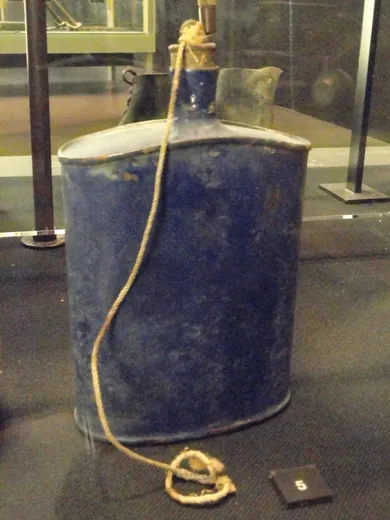
The British water bottle also has a single neck. For the British 1903 pattern equipment, the Australian War Memorial describes a blue enamel bottle in a drab grey cloth cover. According to the Imperial War Museum, the British Army's standard water bottle in the Great War held two pints and was carried on the 1908 pattern web equipment; the one worn by the infantryman of the King's Royal Rifle Corps at Meaux is sheet metal covered with khaki cloth.
| Feature | French 1877 model bidon | German canteen of 1915 | British water bottle |
|---|---|---|---|
| Spouts | Two: one wide, one narrow | One, long and narrow | One |
| Stopper | Cork; sometimes wood on the small spout | Cork with a ribbed metal top | Cork on a string |
| Body | Tinned iron, or aluminium | Tinned steel, with a khaki green surface or painted grey-green | Blue enamel bottle in 1903 |
| Cover | Wool cloth or canvas | Brown corduroy, four press studs down one side | Drab grey cloth in 1903, khaki cloth in 1908 |
| Carried by | Leather strap, on the right | Neck strap and clip, or leather carrier with a snap hook | Leather carrier in 1903, web equipment in 1908 |


Markings, stamps and makers
A bidon may say nothing about its maker. The Morvan ecomuseum records no marks on its pair, and neither the Australian War Memorial nor the Imperial War Museum names a maker for their French bidons.
Look for a mark on the side or near the neck. The Science Museum in London holds a French pewter bottle shaped like a goatskin water container, with two openings, the larger one corked, and two rings for the strap: a different type from the iron bidon, and older than the Great War. Punched on its side it bears “J. CARNAUD / BTE S.C.D.G. / PARIS”, as the museum transcribes it, and the museum ties it to a maker active from 1841 to 1890. Note and photograph such a name, without rubbing.
On some German canteens, a tag soldered near the neck carries a name and a year. The Australian War Memorial reads “ULLRICH17” on the one Sergeant Brown also collected and takes it for the maker's mark; the Auckland Museum reads “WESTERMAN [E] 1916” on another and takes it for its first owner's name. The year can be read; the name has to be interpreted with care.
On a French bidon, look at the cover too: the Musée du Génie mentions an identification label on it. I know of no public list of the makers of French bidons of the Great War, nor of any rule that dates a bidon from its mark.
Reading wear and repairs
A bidon that was used shows it. Sergeant Brown's has rubbed tinning; the crushed bidon at the Imperial War Museum is split in two places along the bottom seam. A stopper could be replaced: the aluminium bidon in the same museum closes its side spout with an improvised wooden stopper.
The army repaired them too. On 21 December 1915, at Vierzon, the French Army Photographic Section photographed a workshop where prisoners were repairing camp equipment, “bidon, gamelle, etc.”: canteens, mess tins and more. A reworked seam, a resewn cover or a replaced stopper may therefore be of the period: they tell the object's story without proving its date. Remove nothing, and follow the precautions in caring for leather, textile and metal.
After 1918: reuse, souvenirs and reproductions
The bidon went on being used. The Morvan ecomuseum, which gives its two bidons a period of use from 1900 to 1970, notes that they turn up on farms, where they could serve as water bottles during field work. The same record warns that nothing shows these two flasks were those of the donors' grandfather, although he owned them: a bidon found in a house is not, for that reason alone, the ancestor's.
Others were transformed during the war itself. The canteen violin at the Meaux museum, dated 1915-1918, is a French regulation bidon fitted with a factory-made neck and pierced with two S-shaped sound holes, a cork serving as its bridge: it belongs to trench art and is judged as such.
The Missouri History Museum even holds an 1877 model bidon bearing the American Red Cross emblem, used by William Milner Donovan, an ambulance driver with the American Field Service: a foreign mark is not necessarily a later addition.
That leaves the bidon that looks too new, with no wear, no repair, no mark. A piece that stayed in store, a later make or a recent copy: the object alone does not always settle it. Compare every detail with a museum example and follow the method in spotting fake militaria.
What an engraved or marked bidon can tell you
The cup was a personal object that some soldiers personalised, the Meaux museum notes. The one in its collection was engraved by a soldier named Rollin, who signed it near the handle. He copied the drawings of a postcard, Le Périscope de l'amour, and engraved under the base a dedication to his Jeanne, a New Year's gift for 1917. Such an inscription gives a name, a first name, a year; on its own, it is not enough to trace a man.
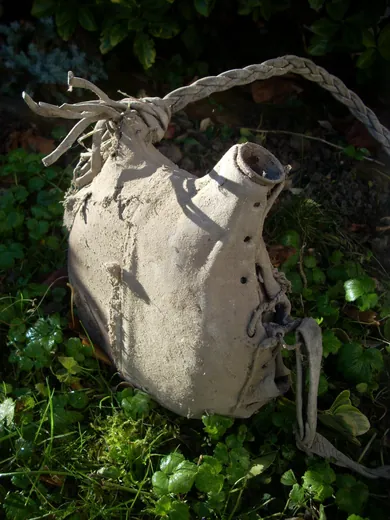
Jean Colinot's flask, contributed by his family to the Europeana 1914-1918 collection, shows what a family story adds to an engraving. A second lieutenant in the 354th Infantry Regiment who died for France on 22 May 1916 at the Thiaumont farm in the Meuse, he had engraved it with a tower, fir trees, houses, a cannon, the years 1914 and 1915 and the dedication “A mon fils Gabriel”, to my son Gabriel. It has only one spout: a French soldier's canteen is not always a regulation bidon.
The Auckland Museum canteen with the “WESTERMAN [E] 1916” tag also has “R.W. Gossett 26829 NZE Messines 1917” scratched on its metal: the name, service number and unit of the New Zealand corporal who collected it, then the place and the year. So an engraved name may be the carrier's or a souvenir hunter's; only the archives can tell.
With a name, a regiment or a service number, look for the service record in the departmental archives and, for a soldier who died in the war, his record on Mémoire des hommes. The method is set out in tracing a French WW1 soldier from a family object.
Judging a bidon without talking about price
Four questions place a piece:
- Is it really a French 1877 model bidon? Two spouts, a loop on each side, one or two litres. A canteen with a single spout is something else: German, British, or a personal flask like Jean Colinot's.
- Is it complete? Cover, stoppers, strap, and the cup if it comes with it. Each element may have been added later.
- What story does it tell? A checked inscription, a documented provenance or a mark such as the American Red Cross emblem changes what the object means.
- What condition is it in? Tinning, dents, splits, repairs: note them without correcting them. A transformed bidon is judged as a piece of trench art.
To place the piece against comparable sales afterwards, see valuing a military item.
What I cannot tell you here
I cannot tell you, from a photograph, in which year a bidon was made, or whether it served at the front or after 1918: the model lasted, and none of the French bidons described by the museums cited here bears a date of manufacture. Nor can I tell for certain a period bidon from a copy made for re-enactment: none of this guide's sources describes such copies. This guide relies on museum and archive records, not on the regulations of the time. And I give no prices.
For a particular piece, photograph both faces, the spouts, the stoppers, the loops, the cover and any inscription, then ask for free identification help. To compare with other pieces of the period, see the First World War category.
Frequently asked questions
How do you recognise a French WW1 canteen?
The French soldier's canteen in the Great War is the 1877 model bidon: a body of tinned iron or aluminium, two spouts on top, a wide one for filling and a narrow one for pouring, a cover of wool cloth or canvas and a leather strap. It was worn on the right. A canteen with a single spout is not an 1877 model bidon.
What was the capacity of the French WW1 canteen?
One or two litres. In 1914, according to the Musée de la Grande Guerre in Meaux, the one-litre bidon equipped troops in mainland France and the two-litre one troops in hot countries, the colonial infantry and the Armée d'Afrique. During 1915, because of the difficulty of supplying the front with water, the two-litre model was gradually issued to the whole army.
Why does the French bidon have two spouts?
The wide one is for filling and the narrow one for pouring or drinking, according to the records of the Meaux museum, the Musée du Génie and the Morvan ecomuseum; the Imperial War Museum sees the small spout as an air vent. Both were stopped with cork, sometimes with wood for the small one. The two spouts set it apart at a glance from German and British canteens of the same war.
How do you identify a German WW1 canteen?
It has a single spout, long and narrow, closed by a cork stopper with a ribbed metal top. The 1915 model, in tinned steel instead of the aluminium of the 1907 model, was carried by a neck strap and clip, and its brown corduroy cover closes with four press studs. A tag soldered near the neck sometimes carries a name and a year, such as “ULLRICH17”.
How do you identify a British WW1 water bottle?
It has a single neck, stopped with a cork on a string. With the British 1903 pattern equipment it is a blue enamel bottle in a drab grey cloth cover, in a leather carrier. In the Great War the standard two-pint water bottle was carried on the 1908 pattern web equipment, and the one at the Meaux museum is covered in khaki cloth.
What is the 1877 model bidon?
It is the French soldier's canteen of the Great War: a metal container of one or two litres, with two spouts, under a cover and carried on the right by a leather strap. The Musée de la Grande Guerre in Meaux calls it integral to the silhouette of the French soldier. It went on being used after 1918, even on farms.
How can I find out which soldier a WW1 canteen belonged to?
Look for an inscription: a name, regiment, service number, dedication, or a label on the cover. With a name and a regiment, the service record in the French departmental archives and, for a soldier who died in the war, the Mémoire des hommes database let you check. Stay cautious: an engraved name may belong to a man who picked the object up as a souvenir.
What is a French WW1 canteen worth?
This guide gives no prices. A piece is placed by four questions: is it really an 1877 model bidon, is it complete with its cover, stoppers and strap, what does it tell through a checked inscription or provenance, and what condition is it in. The method for then comparing it with sales is in our guide to valuing a military item.
Sources
This guide draws on the texts, databases and pages below, accessed on unless otherwise stated. Most of them are in French.
- Trésor de la langue française informatisé (CNRTL), entry “bidon”: military sense, large shared bidon and small individual bidon
- Trésor de la langue française informatisé (CNRTL), entry “gourde”: wicker-covered or leather-covered bottle, worn on the belt or across the body
- Morvan ecomuseum, Morvan Regional Nature Park, record “Bidon du poilu (série de 2)” (inv. 2017.1.43.1): two-litre 1877 model in tinned iron, unmarked, found on farms
- Europeana 1914-1918, “Fascicule de mobilisation de Jean Marie Guilloux”: equipment issued to the soldier, including a one-litre bidon
- Musée de la Grande Guerre, Meaux, record “Bidon français modèle 1877” (inv. 2006.1.6017): two spouts, a cover since the Second Empire, one and two litres in 1914, two litres for the whole army during 1915
- Musée de l'Armée, teachers' sheet on the French infantryman's uniform in 1914 and 1916 (primary level): one-litre bidon and cup in 1914, bidon and cup in late 1916
- Musée du Génie, Angers, sheet on the mannequin of a French soldier of 1915-1918: belt, cartridge pouches, pack, haversacks and water bottle in 1916, accessed
- Musée de la Grande Guerre, Meaux, record on an infantryman of the 23rd Infantry Regiment in assault dress, France, 1918: two two-litre bidons
- Europeana 1914-1918, “Amédé Fleury photographe de la Grande Guerre - 1916”: album of captioned photographs, including the one of the two-litre bidon, October 1916
- Imperial War Museums, “water bottle, French”, EPH 3247: crushed bottle with a wide drinking spout and a narrow air spout, split along the bottom seam, associated with William Duke, Army Service Corps
- Australian War Memorial, French water bottle, RELAWM09117: one-litre 1877 model in tinned pressed steel, cork and wooden stoppers, collected in France by Sergeant Walter Brown, Australian 20th Battalion
- Imperial War Museums, “Waterbottle, M1877: French Army”, EQU 3801.5: aluminium bottle in a dark blue woollen cover, side spout closed with an improvised wooden stopper, brown leather strap
- Musée de la Grande Guerre, Meaux, record “Un quart” (inv. 2006.1.959): regulation round cup engraved by a soldier named Rollin, dedicated as a New Year's gift for 1917
- Trésor de la langue française informatisé (CNRTL), entry “quart”: metal beaker with a handle, usually of twenty-five centilitres, used above all in the army
- Imperial War Museums, “Mess Kit, M1852: French Army”, EQU 3801.3: round metal mess tin with a lift-off lid and hooks for the pack
- Australian War Memorial, German model 1915/17 canteen, RELAWM00725: tinned steel instead of the aluminium of the 1907 model, longer neck, ribbed metal-topped stopper, corduroy cover, found near Villers-Bretonneux, at the farthest point of the German attack of 24 April 1918
- Auckland War Memorial Museum, German M1915 field water bottle, 1920.2: found on Mount Kemmel in 1918, tinned steel, corduroy cover with four press studs
- Australian War Memorial, British pattern 1903 water bottle and carrier, REL22212: blue enamel bottle, drab grey cloth cover, cork stopper on a string
- Imperial War Museums, “Water bottle, British”, EQU 3857: British Army standard water bottle of the Great War, two pints, carried on the 1908 pattern web equipment
- Musée de la Grande Guerre, Meaux, record on an infantryman of the King's Royal Rifle Corps, United Kingdom, 1914: 1908 pattern equipment and sheet-metal water bottle covered in khaki cloth
- Science Museum Group, “Water bottle”, A638287: French pewter bottle shaped like a goatskin water container, with two openings, by J. J. Carnaud of Paris, stamped on the side, dated 1841-1890 by the museum
- Science Museum Group, record “J.J. Carnaud”: French manufacturer of pewter bottles, active 1841-1890
- Australian War Memorial, German water bottle, REL/01051.002: tinned pressed steel painted grey-green, maker's tag stamped “ULLRICH17”, collected in France by Sergeant Walter Brown
- Auckland War Memorial Museum, German water bottle, 1927.204: collected at Messines in 1917 by Corporal Ralph Wayth Gossett, New Zealand Engineers, tag “WESTERMAN [E] 1916” and the collector's name scratched on the metal
- Plateforme ouverte du patrimoine (POP), photograph by Édouard Brissy, French Army Photographic Section, Vierzon, 21 December 1915: prisoners repairing camp equipment (bidons, mess tins), APD0001250
- Musée de la Grande Guerre, Meaux, record “Bidon-violon 1915-1918” (inv. 2013.12.1): factory-made neck fitted to a French regulation bidon
- Missouri Over There, Missouri History Museum, “French Canteen”: 1877 model bidon with the American Red Cross emblem used by William Milner Donovan, American Field Service ambulance driver
- Europeana 1914-1918, “FRAMPO-019 Jean COLINOT”, contributed by the Colinot family: second lieutenant of the 354th Infantry Regiment, who died for France on 22 May 1916 at the Thiaumont farm, and his engraved flask
- Europeana 1914-1918, “Gourde gravée par Jean COLINOT”: photograph of the single-spout flask, engraved with a dedication to his son Gabriel and the years 1914 and 1915
- Mémoire des hommes, French Ministry of the Armed Forces: First World War databases (soldiers who died for France, unit war diaries), accessed