Collector's guide Records and research
Tracing a French First World War soldier from a name or a family heirloom
By Thomas, contributor to Athena Militaria Published 13 min read
Finding a French WW1 soldier almost always starts with three things: a name, a date of birth, a place. With them, public archives, mostly online and free, retrace a man's path: his service record, his regiment's war diary, his grave if he died, his prisoner card if he was captured. A family object, whether a service book, an identity tag or a medal, often supplies the missing key. Here is the order in which to search, and how to read what you find.
Get a piece identified from photos Valuing a piece: the method
In brief
- Everything starts with the service record. Every recruited soldier has his page in the register of his recruitment office, the registre matricule, kept in the French departmental archives. The registers for the wartime classes are open to all, often online.
- Three keys open the right page. The class, that is the year he turned twenty, the recruitment office and the service number.
- Did he die in the war? Mémoire des hommes, the French Ministry of the Armed Forces' website, publishes more than 1.3 million records of soldiers who died for France, and a war graves database.
- The regiment tells the rest. Its war diary and its regimental history say where the unit was, rarely what the man himself did there.
- Captivity, pension. The ICRC card indexes and the pension files complete the picture.
Before you start: gather the identity and the keys
The Ille-et-Vilaine departmental archives, in their guide to Great War sources, set a minimum for getting started: surname, first name, date and place of birth. The date of birth is what separates namesakes.
Then work out the class. According to the Service historique de la Défense, the French defence archives, from 1905 every man had to register with the recruitment office covering his home; he joined the class of the year he turned twenty and was given a service number. A man born in 1895 therefore belongs to the class of 1915. Find out, too, where he lived at twenty, with some trial and error if the family moved.
What family objects tell you
The same guide lists the papers a family may have kept: the individual service book, the veteran's card, citations, decorations, war notebooks, letters.
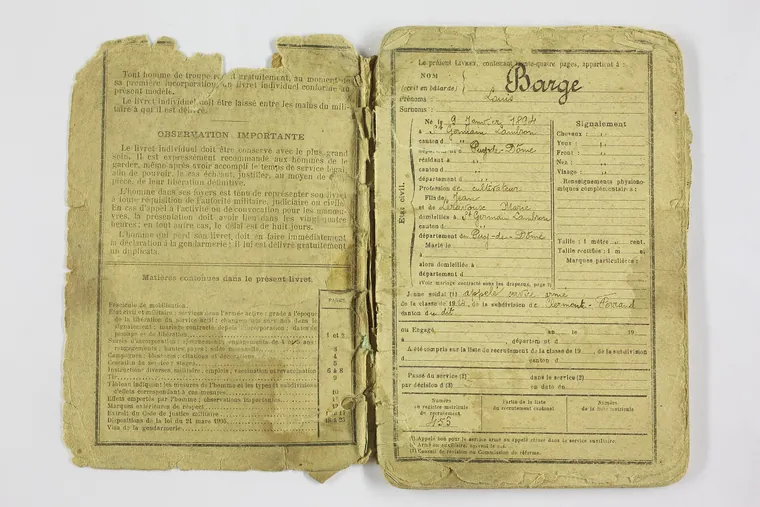
- The military service book carries the three keys. On Louis Barge's, contributed to the Europeana 1914-1918 collection, you can read the class of 1914, the Clermont-Ferrand recruitment subdivision and his number in the recruitment register. See reading and keeping military photographs and papers.
- The identity tag was there to identify the dead: according to the French National Library (BnF), the death report recorded everything the tag provided. See reading a French military identity disc.
- A Croix de guerre points to a citation. According to the Ille-et-Vilaine archives, the texts of individual citations can be found in the service registers, the war diaries and the regimental histories: see finding Croix de guerre 1914-1918 recipients.
- A photograph in uniform can be dated from the dress: see dating a French tunic or greatcoat. A fourragère on the shoulder points to his unit, not to the man himself: see the French fourragère.
- The veteran's card points to a file that the guide to the Croix du combattant explains how to trace.
The service record, the key document
The service registers form a continuous series from 1867. In the Great War years each man has a page of his own, his feuillet, which traces his whole military career. Transferred by the recruitment offices to the departmental archives, the registers are filed there in sub-series 1 R. An exempted man is not in them: he appears only in the census lists and in the list of the medical board, the conseil de révision.
To find out where these registers can be read online in each département, which classes are digitised and whether a name search exists, see the directory of French service registers online, département by département.
Long restricted because of their medical and judicial details, the registers were opened by an order of the French Ministry of Culture of 20 December 2012 for every class that could have served in the First World War. That is why the Ille-et-Vilaine archives publish the records online up to the class of 1921.
Finding the right page in the register
- Choose the office covering his home at twenty. Its area does not always follow the département boundary: according to the Ille-et-Vilaine archives, the Dinan district, now in Côtes-d'Armor, came under the Saint-Malo subdivision until 1930.
- Look up the alphabetical index for his class and office: it gives his service number.
- Open the register that covers that number: the volumes run in blocks, from 1 to 500, from 500 to 1000, and so on.
If you do not know where he was recruited, use the Grand Mémorial. This database of the French Ministry of Culture brings together the service registers of many departmental archives, for the classes of 1887 to 1921, and the database of soldiers who died for France; you can search for a man by his place of birth, residence or recruitment. A man could also ask to register elsewhere.
Reading the record, box by box
According to the Ille-et-Vilaine archives and Jean-François Moufflet, a record brings together the following details; the last column says where each one leads you.
| What you are looking for | What the record says | Where it leads |
|---|---|---|
| Identity | Surname, first names, birth, parents, home, occupation | To civil registration records |
| Appearance | Hair, eyes, forehead, nose, face, height, distinguishing marks | To a family photograph |
| Schooling | A figure from 0 to 5, or the letter X | To his level of education |
| Career | “Détail des services et mutations diverses” (details of service and transfers): postings, ranks, wounds, citations, decorations, convictions | To dates to follow in his regiment's war diaries |
| Units | The units he was assigned to, one after another | To each regiment's history |
| Addresses | The places he lived in one after another, recorded since 1878 | To the département to search next |
| Campaigns | Single or double: a period at the front counts as a double campaign | To the periods spent at the front |
During the war, classes were called up early: according to Michaël Bourlet and Alain Morgat, the class of 1915 was called eleven months ahead, the classes of 1916 to 1919 more than a year and a half ahead, so that recruits were only eighteen or nineteen.
Abbreviations you will meet
The index published by the Côte-d'Or archives explains several dozen; these are the most useful:
- RI, RIT, RAC, RAL, BCA: infantry regiment, territorial infantry regiment, field artillery regiment, heavy artillery regiment, battalion of chasseurs alpins.
- BDG, EO, EV: war wound, shell splinter, voluntary enlistee.
- CD, CS: double campaign, single campaign; the difference counts in the calculation of years of service and in entitlement to decorations.
- %: “by order of” or “in the orders of”, in a citation.
- Réformé n° 1: discharged with a right to a pension, for a wound or illness contracted in service; réformé n° 2: discharged without one. CR: medical board; PT, PP: temporary, permanent pension.
- 0 to 5, X: the level of schooling, from 0, can neither read nor write, to 5, holder of the baccalauréat or a degree; X: a level that could not be checked.
Mémoire des hommes, for a soldier who died in the war
If the man died in the war, start with Mémoire des hommes. Its database of soldiers who died for France in the First World War holds more than 1.3 million servicemen granted the official status of Mort pour la France and, since 11 November 2014, 95,000 records of soldiers who were not. Created by the law of 2 July 1915, the status is written, according to the BnF, in the margin of the death certificate.
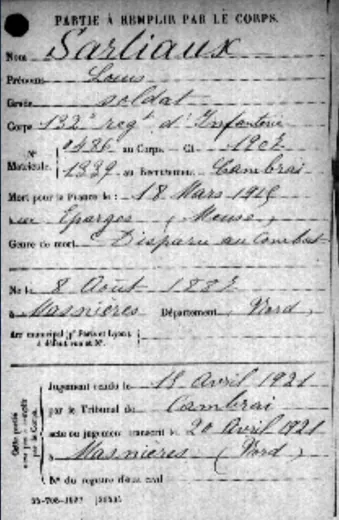
Drawn up from 1921 by the Ministry of Pensions, for deaths from 2 August 1914 to 1919, these records give, according to Sandrine Aufray, the man's civil details; his class, recruitment office and number; his rank and unit at the time of death; the date, place and cause of death; the place where the death certificate was drawn up or transcribed and, where needed, the court that issued the declaratory judgment.
Read the record as a set of leads: the recruitment details lead to the service record, the unit to its war diary, the place of transcription to the death certificate. The database makes no claim to be complete, and members of the public can ask for a record to be corrected.
Where he lies
The “Sépultures de guerre” database on the same site lists some 700,000 names recorded when the national war cemeteries were created: soldiers buried in those cemeteries, in the military plots of town cemeteries or in the military cemeteries abroad that the ministry maintains. The ministry warns that its cards contain errors, particularly in the spelling of names: try several spellings.
A soldier missing from this database is not lost for all that: Article 106 of the finance law of 31 July 1920 provided for bodies to be returned to families at the State's expense. According to Annette Becker and Manonmani Filliozat-Restif, about 30% of identified bodies were returned in this way. Yours may lie in a family grave.
Following his regiment in the war diaries
The record has given you units and dates; the war diary, the journal des marches et opérations or JMO, tells you what the unit was going through on those days. Created by an instruction issued by General de Cissey on 5 December 1874, these diaries record, without comment or personal opinion, the events experienced by every staff and unit: actions, fighting, reconnaissance, routes, billets, sometimes maps and orders.
Names in them are often limited to officers. So do not look first for your ancestor's name: read the day on which his record says he was wounded, went missing or was cited. The diaries of most French army units, sub-series 26 N of the Service historique de la Défense, have been online on Mémoire des hommes since 11 November 2008, arranged by type of unit, then by unit.
Regimental histories
In 1919 the French general headquarters, then the Minister of War, ordered units to write the history of their campaign. These booklets were also meant, according to the ministry, to teach traditions to young soldiers: read them as an official account. Nearly 1,500 are kept in the library of the Service historique de la Défense, and they can be read on Gallica. Some, like that of the 16th Territorial Infantry Regiment, give the list of the regiment's dead by name.
Prisoner, wounded, pensioned: the records that fill the gaps
Two sets of records often complete the picture: the ICRC card indexes and the pension files.
The ICRC card indexes for prisoners
On 21 August 1914 the International Committee of the Red Cross set up the International Prisoners-of-War Agency in Geneva, to restore family links. The warring states sent it the lists of their prisoners: notices of capture, of transfer, of death in captivity. For each name the Agency made a card referring to the list. The collection, online on the ICRC's First World War website, holds 5 million cards concerning 2 million people.
The site's FAQ sets out the method:
- Choose the index “Français ou Belge” (French or Belgian), military status: there is no central index.
- Search by name only. The order is not strictly alphabetical: silent letters and double consonants are ignored, letters easily confused are grouped together, so that Dubreuil and Duprenil sit side by side; then come the first names, then the unit number.
- Have his regiment to hand. The French index holds more than 600 men named Jean Martin.
- Note the reference on the card, a letter followed by figures, and open the list: its first page sometimes gives the camp and the date.
These records are incomplete: more than 7 million people were taken prisoner during the war, and some lists never reached Geneva. The ICRC is not answering requests for the time being: the search is done online.
Pension files
The law of 31 March 1919 recognised a right to compensation for the war's servicemen, and for the widows, orphans and parents of the dead. If the record reads “réformé n° 1” or mentions a pension, look for the file: according to the Ille-et-Vilaine guide, it may contain the application, the statement of service, medical certificates, the report of the medical board and the decision.
These files are scattered according to the applicant's status and the date of the application. The oldest are with the Service historique de la Défense, whose Caen centre holds the records produced since 1915 by the Ministry of Pensions and its successors; its military disability pension collection is still being processed, and the reading room admits visitors by appointment only.
If the soldier died or came back badly maimed, his children may have been adopted by the Nation as pupilles de la Nation: according to Olivier Faron and Georges Rech, the law of 27 July 1917 made this adoption a matter for the civil court, and the files are in the departmental archives, in sub-series 3 U.
Officer, sailor, airman: other registers
- An officer also has an individual file at the Service historique de la Défense in Vincennes: see its research guide on officers.
- A sailor appears in the registers of the crew depots, archived by the Service historique de la Défense in Brest, Cherbourg, Lorient, Rochefort and Toulon; his service number contains the code of his port.
- An airman belonged to the army, which military aviation was then part of: its personnel index, more than 74,000 cards, is online on Mémoire des hommes.
What I cannot tell you here
I cannot do the research for you, or tell you, from a photograph or an object alone, that it belonged to a particular soldier: without papers, an engraved name is not enough. Nor is there any guarantee that a trace survives: some files were not kept, some lists never reached Geneva, and the war diaries often say nothing of private soldiers. This guide gives no prices: see valuing a military item.
For an object, photograph it from every side, with its inscriptions and its papers, then ask for free identification help. On the site, Great War decorations are under WW1 medals, and papers and keepsakes under WW1 miscellaneous items.
Frequently asked questions
How do I find a French WW1 soldier?
First gather his surname, first names, date and place of birth, and where he lived at twenty. Add twenty to his year of birth to get his class, then look for his service record in the recruitment registers held by the French departmental archives; the Grand Mémorial lets you search many départements at once. The record gives his units and dates, which the war diaries on Mémoire des hommes let you follow day by day.
How do I find a French soldier who died for France in WW1?
Search for his name in the database of soldiers who died for France on Mémoire des hommes, the French Ministry of the Armed Forces' website, which holds more than 1.3 million records. The record gives his unit, the date, place and cause of death, and his class, recruitment office and number, which lead to his service record. The “Sépultures de guerre” database on the same site shows whether he lies in a national war cemetery, a military plot in a town cemetery or a military cemetery abroad.
Where can I find French WW1 service records?
In the registers of the recruitment offices, the registres matricules, kept by the departmental archives of the place where the man lived at twenty. Work out his class, the year he turned twenty, open the alphabetical index for that class and office to find his number, then the volume of the register that covers it. An order of 20 December 2012 opened the registers of every class that could have served in the war, and they are often online.
What is the difference between a fiche matricule and a registre matricule?
The registre matricule is the register kept by a recruitment office, class by class; the fiche matricule, or feuillet, is the page a man has in it. It gives his civil details, his physical description, his level of schooling, then the details of his service: units, ranks, wounds, citations, decorations, successive addresses. The registers form a continuous series from 1867 and are kept in the French departmental archives, in sub-series 1 R.
What is a JMO in French WW1 records?
The journal des marches et opérations is the war diary each unit kept day by day, under an instruction of 5 December 1874: actions, fighting, routes, billets, sometimes maps and orders. Those of most French army units have been online on Mémoire des hommes since 2008. They mostly name officers: for a private soldier, they tell you where his unit was, rarely what he did there himself.
What can you find on Mémoire des hommes?
For the Great War, the French Ministry of the Armed Forces' website publishes the database of soldiers who died for France, the books of remembrance known as livres d'or, a database of those executed by firing squad, the military aviation personnel index, the units' war diaries and the regimental histories. Its “Sépultures de guerre” database lists some 700,000 names recorded when the national war cemeteries were created: soldiers buried in those cemeteries, in the military plots of town cemeteries or in military cemeteries abroad.
How can I find out whether a French WW1 soldier was taken prisoner?
Search the card indexes of the International Prisoners-of-War Agency, online on the ICRC's First World War website: choose the nationality “Français ou Belge” and the military status, then search by name. The card carries the reference of a list sent by the country holding him, whose first page sometimes gives the camp and the date. The indexes are not complete: they concern 2 million people, out of more than 7 million prisoners.
Where can I find a French WW1 soldier's pension file?
The files are scattered according to the applicant's status and the date of the application. The oldest are with the Service historique de la Défense, whose Caen centre also holds pensions for widows, orphans and parents; its military disability pension collection is still being processed. The service record tells you whether the man was discharged with a right to a pension, marked “réformé n° 1”.
Sources
This guide draws on the texts, databases and pages below, accessed on unless otherwise stated. All of them are in French.
- Ille-et-Vilaine departmental archives, “L'Ille-et-Vilaine et la Grande Guerre” sources guide, orientation sheet on researching a soldier (Gwladys Longeard, Michaël Bourlet): minimum identity, class and home at twenty, service record, units, prisoners, pensions, soldiers who died
- Service historique de la Défense, research guide on tracing NCOs, airmen, soldiers and sailors, accessed
- Europeana 1914-1918, “FRAD063-100 Louis BARGE”: military service book of a soldier recruited at Clermont-Ferrand, class of 1914, with its boxes for class, subdivision and number in the recruitment register
- BnF Essentiels, on how the dead of the Great War were identified and recorded, accessed
- Ille-et-Vilaine departmental archives, “L'Ille-et-Vilaine et la Grande Guerre” sources guide, sheet on the citations and decorations awarded during the war: where lists of men cited and decorated, and the texts of citations, are found, accessed
- Jean-François Moufflet, “Les registres de matricules militaires” (French military service registers), in Philippe Nivet, Coraline Coutant-Daydé and Mathieu Stoll (eds), Archives de la Grande Guerre, Presses universitaires de Rennes, 2014, on OpenEdition Books
- Ille-et-Vilaine departmental archives, “Registres matricules militaires” (military service registers): content of the records, alphabetical indexes, recruitment subdivisions, Grand Mémorial, the order of 20 December 2012 and online publication up to the class of 1921
- Grand Mémorial, French Ministry of Culture: military service registers for the classes of 1887 to 1921, accessed
- Michaël Bourlet and Alain Morgat, “Le recrutement” (recruitment), in Philippe Nivet, Coraline Coutant-Daydé and Mathieu Stoll (eds), Archives de la Grande Guerre, Presses universitaires de Rennes, 2014, on OpenEdition Books
- Côte-d'Or departmental archives, index of the abbreviations found in the military service registers, with the scale of schooling levels
- Mémoire des hommes, French Ministry of the Armed Forces: First World War databases (soldiers who died for France, unit war diaries), accessed
- Mémoire des hommes, French Ministry of the Armed Forces, database of soldiers who died for France in the First World War: more than 1.3 million records, 95,000 records of soldiers not granted the status, requests for correction
- Sandrine Aufray, “Le fichier des Morts pour la France” (the card index of soldiers who died for France), in Philippe Nivet, Coraline Coutant-Daydé and Mathieu Stoll (eds), Archives de la Grande Guerre, Presses universitaires de Rennes, 2014, on OpenEdition Books
- Mémoire des hommes, French Ministry of the Armed Forces: the “Sépultures de guerre” war graves database, accessed
- Annette Becker and Manonmani Filliozat-Restif, “Le retour des corps” (the return of the bodies), in Philippe Nivet, Coraline Coutant-Daydé and Mathieu Stoll (eds), Archives de la Grande Guerre, Presses universitaires de Rennes, 2014, on OpenEdition Books
- Chemins de mémoire, French Ministry of the Armed Forces, on the war diaries (journaux des marches et opérations) of the First World War, by Benoît Lagarde and Frédéric Queguineur, Service historique de la Défense
- Sandrine Aufray, Benoît Lagarde and Michel Roucaud, “Les journaux des marches et opérations des unités de l'armée de Terre” (the French army's unit war diaries), in Philippe Nivet, Coraline Coutant-Daydé and Mathieu Stoll (eds), Archives de la Grande Guerre, Presses universitaires de Rennes, 2014, on OpenEdition Books
- Mémoire des hommes, French Ministry of the Armed Forces, diaries of the units engaged in the First World War: war diaries of most army units (sub-series GR 26 N)
- Mémoire des hommes, French Ministry of the Armed Forces, regimental histories of the units engaged in the First World War: histories ordered in 1919, the collection of the Service historique de la Défense library, digitisation by the BnF
- Service historique de la Défense, list of documents digitised and available on Mémoire des hommes (updated 13 September 2024): army regimental histories on Gallica, accessed
- Digital libraries of the French Ministry of the Armed Forces (CLADE.net), record for the history of the 16th Territorial Infantry Regiment in the war of 1914-1918: list by name of the officers, NCOs, corporals and soldiers who died in the war
- International Committee of the Red Cross, on the ICRC and the Great War: the International Prisoners-of-War Agency, set up on 21 August 1914 to restore family links
- International Committee of the Red Cross, Prisoners of the First World War: card indexes and lists of the International Prisoners-of-War Agency, searchable by nationality and status
- International Committee of the Red Cross, FAQ of its Great War website: index cards and lists, indexes by army and status, phonetic order, list references, gaps in the records
- Ille-et-Vilaine departmental archives, “L'Ille-et-Vilaine et la Grande Guerre” sources guide, sheet on the recognition and compensation of veterans (Anne-Lise Mikes): the law of 31 March 1919, where pension files are kept and what they contain
- Service historique de la Défense, on its Caen archives centre: records of war victims since the First World War, pensions for widows, orphans and parents, military disability pensions, how to request a search
- Olivier Faron and Georges Rech, “Pensions et pupilles de la Nation” (pensions and wards of the Nation), in Philippe Nivet, Coraline Coutant-Daydé and Mathieu Stoll (eds), Archives de la Grande Guerre, Presses universitaires de Rennes, 2014, on OpenEdition Books
- Service historique de la Défense, research guide on tracing an officer, accessed