Collector's guide Decorations
The French fourragère: reading its colours, knowing who wears it
By François, contributor to Athena Militaria Published , updated 13 min read
In a family photograph, a braided cord on the left shoulder; in a box, a green and red braid ending in a metal tip. The fourragère puzzles people because it looks like no medal, and it is easily misread because it rewards a unit, not a man. Its colours tell how many times that unit was cited in army orders; the way it is fitted sometimes tells who was entitled to keep it. Here is how to read it, from the texts that governed it.
Get a piece identified from photos Valuing a piece: the method
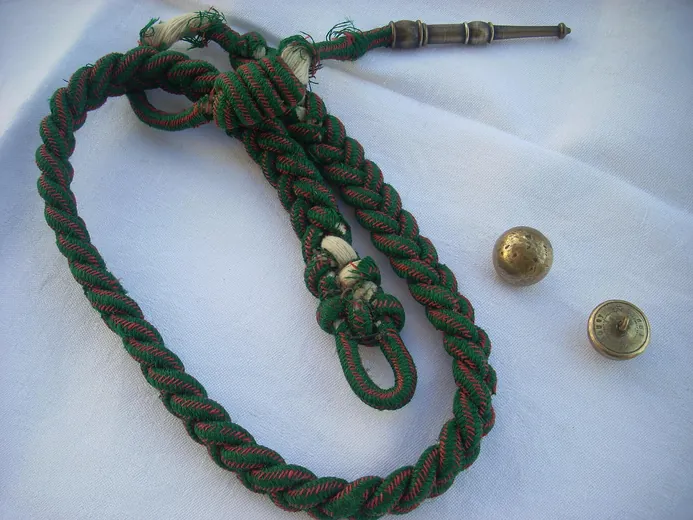
In brief
- A collective award. The fourragère recalls the citations in army orders earned by a unit. All its men wear it, on the left shoulder; it does not mean that the man wearing it was cited himself.
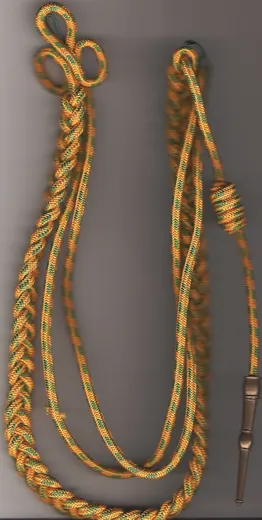
- Three colours in 1918. Green and red, the colours of the Croix de guerre, for two or three citations; yellow and green, the colours of the Médaille militaire, for four or five; red, the colour of the Legion of Honour, for six to eight. Beyond that, it becomes double.
- A date: April 1916. Created in the colours of the Croix de guerre alone, it was regulated by a circular of 22 February 1918, published in the War Ministry's official bulletin and still available on Légifrance.
- A sign to read on the piece. Under the 1918 rules, a metal regimental number above the metal tip marks a man entitled to keep it after changing units; an olive points to a later campaign.
- It is still worn. Units that inherited the traditions of the cited ones still wear it, as do, in the United States, the 5th and 6th Marine Regiments.
A collective award born in the Great War
A unit can be cited just as a man can. The Croix de guerre, created by the law of 8 April 1915, gives material form to both kinds of citation, and a regiment's cross is pinned to the cravat of its colour. What was missing was a sign that each of its soldiers could wear: the fourragère was created in April 1916, on the 21st according to the Musée du Génie, the French army engineers' museum, in the colours of the Croix de guerre, for units cited two or three times in army orders.
Circular no. 2156/D of 22 February 1918 took it up and set out its purpose, which later texts have kept: to recall, visibly and permanently, the feats of arms of the regiments and independent units cited in army orders. It added two colours, those of the Médaille militaire and the Legion of Honour, for units with more citations, and made the fourragère part of the regiment's uniform.
"Independent unit", unité formant corps, is not an empty phrase. Because they fought on their own, the circular placed in this category, among others, engineer companies, air squadrons, trench artillery batteries, heavy artillery groups, the tank units of the assault artillery and the armoured car groups. A fourragère is therefore not necessarily an infantry regiment's: according to the Musée du Génie, some 780 fourragères were awarded during the war, 75 of them to engineer units.
Units were designated by the commanders-in-chief, subject to ratification by the minister, and each designation was to be announced in the Journal officiel and in the War Ministry's official bulletin. That, not family memory, is where a regiment's entitlement to the fourragère can be checked.
You will sometimes read that it goes back much further: to a hangman's rope worn by Flemish soldiers under the Duke of Alba, or to Napoleon. The website of a battalion of the US 6th Marine Regiment repeats both stories. None of the official texts this guide relies on supports them: the fourragère it deals with begins in 1916.
Where the word “fourragère” comes from
The word is older than the award of 1916. The Trésor de la langue française records it in a military sense as early as 1850. It sees in the word the adjective fourrager (“fit to be used as forage for livestock”), put in the feminine and used as a noun. It adds that this sense may come from an unattested meaning of “corde à fourrage” (forage rope). For the military sense, the dictionary of the Académie française dates the word to the nineteenth century and gives its origin as uncertain.
Spelt the same way, the French word also means a plot of land near a farm, kept for growing forage. It also means the wagon used to carry forage and, by extension, for various kinds of transport. In Le Feu (1916), Barbusse describes a fourragère carrying a coffin wrapped in a flag: the wagon, not the cord. In a text from the Great War, then, read the whole sentence before taking the word for an award.
The colours, decoration by decoration
A fourragère takes the colours of a decoration's ribbon, and the number of citations in army orders decides which. Only that level counts: it is the one that earns a palm on the Croix de guerre ribbon, whereas a citation in regimental, divisional or corps orders earns a star. The devices themselves are explained in reading a Croix de guerre 1914-1918.
This table follows the 1918 circular for the Great War, then two fourragères created since for more recent campaigns: the one for overseas theatres of operations and the one for the Cross for Military Valour.
| Fourragère | Colours | Citations in army orders | Text |
|---|---|---|---|
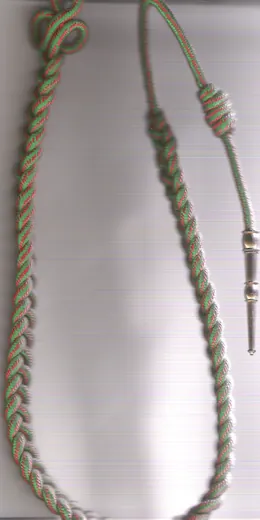
| In the colours of the Croix de guerre 1914-1918 | Green and red: the ribbon is green, edged with red on each side and crossed by five red stripes | 2 or 3 | Created April 1916; circular of 22 February 1918 |
| In the colours of the Médaille militaire | Yellow and green: the ribbon is yellow edged with green | 4 or 5 | Circular of 22 February 1918 |
| In the colour of the Legion of Honour | Red | 6, 7 or 8 | Circular of 22 February 1918 |
| Double, Legion of Honour and Croix de guerre | Red for the base and the loop round the arm, green and red for the upper branch | 9, 10 or 11 | 1918 circular, supplemented on 11 September 1918 |
| Double, Legion of Honour and Médaille militaire | Red for the base and the loop round the arm, yellow and green for the upper branch | 12, 13 or 14 | 1918 circular, supplemented on 11 September 1918 |
| Double, Legion of Honour colour only | Red for both branches and the loop round the arm | 15 or more | Same circular; never awarded, according to the Musée du Génie |
| In the colours of the Croix de guerre for overseas theatres of operations | Red and pale blue | 2 or 3, within one period of operations after 11 November 1918 | Circular of 9 July 1925, restated by that of 27 November 1954 |
| In the colours of the Cross for Military Valour | The ribbon is scarlet, with three white stripes: a broad one in the middle and a narrow one near each edge | At least 2 in one theatre, or 3 across different theatres | Created in 2011; order of 27 October 2015 |
Fourragères were also awarded for the war of 1939-1945; they are not covered here.
Single, double, and what the olives mean
A single fourragère is one cord, in the colours of one decoration. The double fourragère was born of a gap: some units went beyond eight citations in army orders, and the system of February 1918 had no colour left to give them. It combines two cords: the Legion of Honour cord forms the base and the loop round the arm, and the second, in the colours of the Croix de guerre or the Médaille militaire, the upper branch.
The olive is something else: a small piece in the colours of a ribbon, placed above the metal tip. The 1918 circular provides for none. Olives appear in later texts, and the Musée du Génie places them after the Second World War, to distinguish theatres of operations and the number of citations earned in each.
- Overseas theatres of operations (circular of 27 November 1954): an olive in the colours of the overseas Croix de guerre, above the tip, on the Médaille militaire fourragère for four or five citations, and on the Legion of Honour one for six to eight.
- Military Valour (instruction of 16 November 2015): no olive for two or three citations; an olive in the Médaille militaire colours for four or five; a half-and-half olive, Médaille militaire below and Legion of Honour above, for six or seven; a red olive for eight or nine; and for ten or more, the same half-and-half olive with a white line between its two colours.
For anyone holding a fourragère, the consequence is clear: an olive points to a campaign after 1918. A fourragère that carries one is not, in that state, a Great War fourragère, even if the unit first earned it in 1914-1918.
Wearing it collectively or individually
The 1918 circular is plain: the fourragère is worn by all officers and men and is part of the regiment's uniform. At the front, every soldier on the unit's rolls was entitled to it; at home, those who wore the regiment's number and had been on its rolls at the front, however briefly. It was withdrawn if they changed regiment. That is collective wear: you wear your unit's fourragère, not a personal award.
Individual wear is the exception. Men who had actually taken part in the cited actions, two for the Croix de guerre fourragère, four for the Médaille militaire one, six for the Legion of Honour one, could keep it on leaving their regiment, with a certificate from their commanding officer. It then carried, on a slide above the metal tip, the metal number of their original regiment. Each man kept the colour of his own actions: the circular gives the example of a man who leaves a regiment with the yellow and green fourragère after only three actions, and is entitled only to the green and red one.
Later texts kept this division. In 1954, for overseas theatres, the unit badge was pinned above the tip when there was no number; in 2015, for Military Valour, the certificate is issued by the unit's awards office and the cited unit's badge is worn on the four-turn knot.
The fourragère belongs to the unit more than to its men. For Military Valour, the 2015 instruction hangs it on the unit's colour. It also passes to the formations that inherit the unit's traditions: the Musée du Génie displays the uniform of a soldier of the 21st company of the French army engineering school, who wears the Médaille militaire fourragère earned by a unit of the 7th Engineer Regiment, whose traditions her company inherited.
In a family photograph, then, a fourragère says that a man belonged to a cited unit, or had earned the right to keep it on leaving; it does not say that he was cited himself. For that you need his service record: the method is in tracing a French WW1 soldier's decorations, and reading the photographs in reading and keeping military photographs and documents.
The American units that wear it
Several American units were cited in French army orders in 1918, and some still wear the fourragère in the colours of the Croix de guerre. I name a few of them here, from their official records; the list is not complete:
- The 5th and 6th Marine Regiments. The Marine Corps describes them as its only units authorised to wear it, for their fighting in 1918. The website of a 6th Marines battalion names Belleau Wood, Soissons and the Champagne, and details three citations, two in army orders and one in corps orders, that is a Croix de guerre with two palms and a silver-gilt star. Since November 2020, 1st Battalion, 8th Marines, placed under the 6th Marines, has worn it too.
- The 9th and 23rd Infantry Regiments of the US Army, assigned in September 1917 to the 2nd Division: the US Army Center of Military History credits each with three Croix de guerre with palm, for Château-Thierry, Aisne-Marne and Meuse-Argonne, and with the Croix de guerre fourragère of the First World War.
The rule there is the same as in France: according to the 6th Marines' website, the fourragère is part of the cited unit's uniform, and its members wear it on the left shoulder for as long as they serve in it. The details of wear belong to each American service's own regulations, on which I do not comment.
Recognising an old fourragère: braid, tips, fastening
A fourragère is a round cord, braided along part of its length, in the colours of the decoration's ribbon. It ends at the top in a trefoil, a three-lobed loop, and at the bottom in a metal tip, the ferret, which hangs free. The first ones, in 1916, had no trefoil: a fabric tab in the colour of the uniform, with a buttonhole in it, held them in place. The Musée du Génie shows a reconstruction of one in its note on the fourragère.
In 1918 the circular fixed it at the edge of the left shoulder: in walking-out dress it was buttoned to the second button of the greatcoat; in field dress it went round the arm and was hooked onto the shoulder. Today it is still worn on the left shoulder, and, at parades, en bataille, with the tip hooked to a button of the tunic or shirt.
Three clues can be read on the piece itself:
- The fastening. A fabric tab with a buttonhole points to the first, 1916 type. A trefoil dates nothing: it is still there today.
- The numbered slide. A metal regimental number on a slide above the tip marks, under the 1918 circular, a fourragère worn individually by a man who had left his original regiment.
- The olive. Its absence is the 1918 rule; its presence points to a later campaign.
Nothing else dates a fourragère with certainty. I know of no serious source that lets you say, from the material of the cord, the shade of green or the shape of the tip, that a fourragère is from 1918 rather than 1960. It ages like a ribbon: it fades, frays and shows its core, without that fixing a date. What dates it is what surrounds it: the tunic it is fitted to, a photograph of the man who wore it, his papers. If it is still attached to a uniform, leave it there, and place the tunic with dating a French military uniform.
Do not confuse it with the aiguillette, made of several cords, gold or silver, white in the Gendarmerie and gold and red in the Republican Guard, and reserved for certain functions: aides-de-camp, defence attachés, gendarmes in ceremonial dress.
What I cannot tell you here
I cannot tell you, from a photograph, how old a cord is, or whether a fourragère sold on its own was worn during the Great War: without a uniform, papers or a numbered slide, nothing proves it. Nor can I give you the list of French units that received one: it is long, it grew with every campaign, and only the Journal officiel and the official bulletins give it reliably. I give no prices: the method for placing a piece is in valuing a military item.
For a particular regiment, its war diary, the journal des marches et opérations, online at Mémoire des hommes, says where and when it was engaged. For an object, photograph the trefoil, the braid, the tip and anything fixed above it, then have the whole looked at: ask the community. Decorations for sale on the site are gathered in First World War medals and decorations.
Frequently asked questions
What is a French fourragère?
A braided cord worn on the left shoulder, in the colours of a decoration's ribbon: the Croix de guerre, the Médaille militaire or the Legion of Honour. It is a collective award: it recalls the citations in army orders earned by a unit, and every member of that unit wears it. Created in April 1916, it was regulated by a French circular of 22 February 1918.
Why do Marines wear the French fourragère?
Because the 5th and 6th Marine Regiments were cited three times by the French in 1918, for Belleau Wood, Soissons and the Champagne, two of those citations being in army orders. A unit cited twice in army orders was entitled to the fourragère in the green and red of the Croix de guerre, and it became part of the regiments' uniform. Marines serving in them wear it on the left shoulder.
What Marine units wear the French fourragère?
The 5th and 6th Marine Regiments, which the Marine Corps describes as its only units authorised to wear it. Since November 2020, 1st Battalion, 8th Marines has worn it too, after being placed under the 6th Marines.
What Army units wear the French fourragère?
The US Army Center of Military History lists the First World War Croix de guerre fourragère among the honours of the 9th and 23rd Infantry Regiments, each credited with three Croix de guerre with palm, for Château-Thierry, Aisne-Marne and Meuse-Argonne. Other Army units received French decorations in 1918: check the unit's official lineage and honours record.
Who can wear the French fourragère?
Every member of a unit that holds it, for as long as they serve in it: that is collective wear. Under the French rules of 1918, only men who had actually taken part in the cited actions could keep it after leaving the unit, with a certificate from their commanding officer, and a slide above the metal tip then carried their original regiment's number. American units apply their own uniform regulations.
How to wear the French fourragère?
On the left shoulder. The French circular of 1918 fixed it at the edge of the left shoulder, buttoned to the second button of the greatcoat in walking-out dress, or looped round the arm and hooked onto the shoulder in field dress. The exact way it is fitted today depends on the uniform and on each service's regulations.
What does the word fourragère mean?
In the army, it is the braided cord, in the colours of a decoration, worn by the men of a cited unit. Spelt the same way, the French word also means a plot of land kept for growing forage and a forage wagon, like the one Barbusse describes in Le Feu (1916). The Trésor de la langue française records the word in a military sense from 1850, and the Académie française calls that sense of uncertain origin.
Sources
This guide draws on the texts, databases and pages below, accessed on unless otherwise stated. Most of them are in French.
- Circular no. 2156/D of 22 February 1918 on distinctions: the fourragère and service chevrons, with its amendments, on Légifrance
- Circular no. 53350/CAB/DECO/F of 27 November 1954 on the fourragères for overseas theatres of operations, on Légifrance
- Instruction no. 10707/DEF/CAB/SDBC/DECO/A of 16 November 2015 on the fourragère in the colours of the Cross for Military Valour, on Légifrance
- Decree no. 56-371 of 11 April 1956 creating the Cross for Military Valour, on Légifrance
- Code of the Legion of Honour, the Médaille militaire and the Ordre national du Mérite, book II: Médaille militaire, articles R136 to R159-1, on Légifrance
- French National Assembly, on the law of 8 April 1915 creating the Croix de guerre
- Chemins de mémoire, French Ministry of the Armed Forces, on the Croix de guerre (archived copy of 28 May 2026, the site no longer responding on 31 Oct. 2026), accessed
- Musée de l'Armée, “Les Invalides during the Great War, tenth episode: presentation of decoration in the main courtyard”
- Musée du Génie, Angers, sheet no. 71 on the fourragère, a collective award of the Great War
- United States Marine Corps, “A Battalion and the Croix de Guerre” (30 November 2020)
- 6th Marine Regiment, 2nd Battalion, “Honors & Lineage” page
- U.S. Army Center of Military History, lineage and honors of the 23rd Infantry (copy archived by the Internet Archive)
- U.S. Army Center of Military History, lineage and honors of the 9th Infantry (copy archived by the Internet Archive)
- Mémoire des hommes, French Ministry of the Armed Forces: First World War databases (soldiers who died for France, unit war diaries)
- Trésor de la langue française informatisé (CNRTL), entries “fourrager, ère” and “fourragère”: meanings of the word, military use dated 1850, etymology, example from Barbusse's Le Feu, accessed
- Dictionnaire de l'Académie française, 9th edition, entry “fourragère”: the military sense (honorific insignia), a nineteenth-century word of uncertain origin, accessed