French Indochina War decorations: reading a cross, a medal and a service record
By Augustin, founder of Athena Militaria Published 13 min read
French Indochina War decorations are told apart first by their ribbons: light blue between two red bands for the Croix de guerre for overseas theatres of operations, striped yellow and green for the commemorative medal, white and sky-blue stripes for the Colonial Medal. They are not the same age: the cross dates from 1921, the Colonial Medal from 1893, the commemorative medal from 1953. Each follows its own rule, a citation for the cross, taking part in operations for the medals, and it is the paper that comes with it that ties it to a man. This guide shows how to identify them, establish what a veteran was entitled to and work back to his service record, relying on the official texts.
Get a piece identified from photos Valuing a piece: the method
In brief
- The Croix de guerre TOE. Created by the law of 30 April 1921 for operations outside France, it always goes with a citation; its reverse reads “Théâtres d'opérations extérieurs” instead of a date.
- The commemorative medal. Founded in 1953, it requires, according to the ministry, at least ninety days of operations, up to the ceasefire of 11 August 1954.
- The Colonial Medal. Older than the war, it is read by its clasp: for the Indochina War, “Extrême-Orient”.
- Veterans' titles. The combatant's card entitles its holder to the Croix du combattant, and the titre de reconnaissance de la Nation to a medal whose “Indochine” clasp covers service up to 1 October 1957.
- One rule to remember. A decoration on its own does not say who received it; the citation extract and the service record do.
Decorations of different ages
Two of the Indochina War's decorations are older than the war itself: the Colonial Medal, instituted in 1893, and the Croix de guerre TOE, created in 1921. The commemorative medal dates from 1953.
The war ended with the Geneva Accords, signed on 20 July 1954, but two other dates matter for its decorations. According to an answer published on 9 October 2012 by the ministry, the fighting stopped on 11 August 1954, and a decree of 9 September 1957 set 1 October 1957 as the official end of hostilities. The first date closes the commemorative medal, the second the titre de reconnaissance de la Nation.
France fought it without its conscripts: it committed its own forces, legionnaires included, and colonial troops, as the French Ministry of the Armed Forces recalls in Les Chemins de la mémoire.
The Croix de guerre for overseas theatres of operations
The law of 30 April 1921 created a special Croix de guerre for operations conducted outside France since 11 November 1918; a decree of 12 September 1921 set out how it applied, detailed by instruction no. 25161/M of the same day. It does not reward presence: it gives material form to a citation, which must state expressly that it confers the cross. For Indochina, the ministry no longer plans any new citations.
How it differs from the 1914-1918 cross
It follows the 1915 model: a cross of Florentine bronze, 37 mm, with four arms and two crossed swords, and in the centre the effigy of the Republic wreathed with laurel and the words “République française”. Its reverse reads “Théâtres d'opérations extérieurs”, where the Great War cross carries a date. Its ribbon is a light blue central band between two red bands half as wide; the 1914-1918 ribbon is green, edged with red and crossed by five red stripes, according to the Musée de l'Armée. For the rest, see our guide to reading a Croix de guerre 1914-1918.
Stars, palms and the order extract
The device pinned to the ribbon shows the level of the citation, on the same scale as the 1914-1918 cross: a bronze palm for army orders, a silver-gilt star for corps, a silver star for division, a bronze star for brigade or regiment; a silver palm can replace five bronze palms. A cross “with palm” therefore means at least one citation in army orders. Several citations for the same deed earn only one cross, with the highest device.
The decisive point for families: no certificate is issued for this cross, the 1921 instruction specifies. The extract of the order, certified as a true copy, takes its place; that is the paper to look for, because it names the man, the level and the deed. A collective citation earns the cross for each soldier it names.
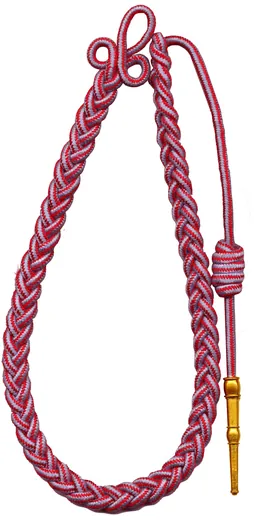
A unit cited two or three times in army orders during one period of operations receives the fourragère in the cross's colours, red and pale blue. Because of the growth of operations in the Far East, the circular of 27 November 1954 added a fourragère in the colour of the Legion of Honour for six to eight citations; see our guide to the French fourragère.
Decorations of the Associated States
Vietnam, Cambodia and Laos, Associated States of the French Union since the agreements of 1949, also decorated French servicemen; a decree of 24 February 1954 governed how these awards were worn. The decree of 14 November 1955 opened the Croix de guerre TOE to French nationals and members of the French Union who had received one for their conduct in combat in the Far East. It required a citation text, and the action must not already have earned the cross. According to an answer published on 23 September 2008, holders of Vietnamese citations had until 1 July 1956 to apply, and individual citations for acts of war in Indochina ceased to be awarded as of 3 December 1958. A decree of 10 October 2012 reopened applications for six months: a Croix de guerre TOE earned in Indochina may have been presented years after the events.
The Indochina campaign commemorative medal
Created by decree no. 53-722 of 1 August 1953, it is awarded, according to the ministry, to servicemen who took part in operations in Indochina for at least ninety days. The instruction of 29 January 1958 set its deadline at 11 August 1954, the day of the ceasefire, not 1 October 1957; the ministry, in an answer published on 21 July 2009, declined to move it. It is also one of the conditions for the volunteer combatant's cross with the “Indochine” bar, together with the combatant's card for this campaign and an enlistment for Indochina (article D352-9 of the French military pensions code).
Obverse, reverse, suspension
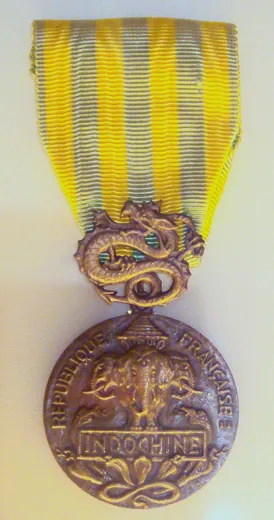
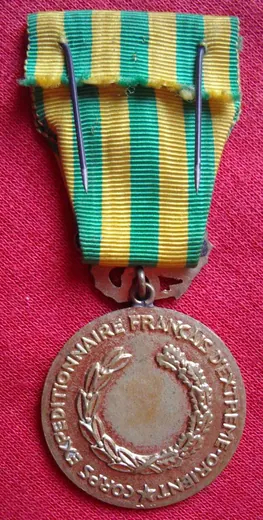
The Australian War Memorial's record describes it this way: on the obverse, the legend REPUBLIQUE FRANÇAISE and the word INDOCHINE, with the naga, a seven-headed cobra standing for Cambodia, and the Erawan, a three-headed elephant standing for Laos; on the reverse, a wreath and the inscription CORPS EXPEDITIONNAIRE FRANÇAIS D'EXTREME-ORIENT; for a suspension, a coiled dragon standing for Vietnam. It was issued unnamed. The ribbon is striped yellow and green, as shown both by the example photographed at the top of this guide, at the Musée de la Légion d'honneur, and by the picture in the Monnaie de Paris leaflet.
The Colonial Medal
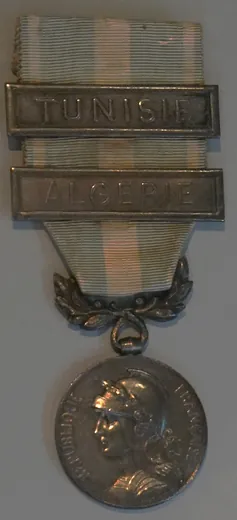
Instituted by article 75 of the finance law of 26 July 1893 for troops taking part in military operations in the colonies, the Colonial Medal took its appearance from a decree of 6 March 1894: on the obverse, the effigy of the Republic engraved by Georges Lemaire; on the reverse, a terrestrial globe surrounded by military trophies and the legend “médaille coloniale”; a ribbon striped white and sky blue. During the Indochina War the second type was in use, from 1914 to 1962, struck entirely at the Monnaie de Paris, whose mark appears on the reverse. In 1962 it became the Médaille d'Outre-mer.
The “Extrême-Orient” clasp
On the ribbon, each metal clasp names a campaign. The Indochina War clasp reads “Extrême-Orient”: the list of clasps published by the Musée de la Légion d'honneur dates it to 5 August 1946, and the 1958 instruction gives it the commemorative medal's deadline, 11 August 1954. Do not confuse it with far older clasps: “Cochinchine”, “Tonkin”, “Laos et Mékong”, “Haut Mékong” or “Asie”, created between 1894 and 1903, reward other campaigns.
Médaille militaire and Legion of Honour
For a feat of arms that deserved more, the 1921 instruction has the cross conferred and the decoration proposed to the minister; if it is granted, the citation becomes a Legion of Honour or a Médaille militaire “with Croix de guerre”. The Médaille militaire is intended for non-commissioned officers and soldiers, and the Grande Chancellerie lists among its grounds a citation in army orders and a wound received in combat. No insignia says it was won in Indochina: only the file does. See our guides to the Médaille militaire and the Legion of Honour.
Combatant's card and the titre de reconnaissance de la Nation
For Indochina, the French military pensions code treats as combatants the servicemen covered by decree no. 54-1262 of 24 December 1954 (article R311-8); according to the ministry, the general rule applies, ninety days' presence in a combat unit. The card entitles holders to the Croix du combattant, which they obtain at their own expense: see our guide to the Croix du combattant.
The titre de reconnaissance de la Nation, created by article 77 of the law of 21 December 1967, takes the form of a certificate signed by the minister; for Indochina, the 2001 finance law extended its period to 1 October 1957. According to Service-Public.fr, it requires ninety days' participation, consecutive or not, or an evacuation for wounds or illness, and holders of the combatant's card are entitled to it. It carries the right to the médaille de reconnaissance de la Nation, on a sand-coloured ribbon with indigo chevrons, whose “Indochine” clasp also covers the operations from 11 August 1954 to 1 October 1957 (article D353-7).
Reading a group at a glance
Read the last column first: without that paper, the piece stays anonymous.
| Decoration | Ribbon | What to read on the piece | The paper that ties it to a man |
|---|---|---|---|
| Croix de guerre TOE | Light blue between two red bands | “Théâtres d'opérations extérieurs” reverse; stars or palms | Certified extract of the order |
| Indochina commemorative medal | Striped yellow and green | Three-headed elephant and INDOCHINE; dragon suspension | État signalétique et des services |
| Colonial Medal | White and sky-blue stripes | “Extrême-Orient” clasp | État signalétique et des services |
| Croix du combattant | Horizon blue, seven madder-red stripes | Bronze cross about 36 mm across | Combatant's card |
| Médaille de reconnaissance de la Nation | Sand-coloured with indigo chevrons | “Indochine” clasp | Certificate of the title |
The Cross for Military Valour and the North Africa commemorative medal belong to another war: see French Algerian War medals.
Tracing service records
Start with the papers the family has kept (order extracts, cards, certificates, photographs), then request the état signalétique et des services, the statement of service. The procedure depends on the branch (army, air force, navy or Foreign Legion); for a deceased relative, enclose proof of kinship and a copy of the death certificate. For the army, the Service historique de la Défense answers online, or the Pau archives centre by form; that centre also keeps French Army citations since 1914.
Mémoire des hommes publishes the database of those who died for France in the Indochina War, servicemen and civilians, completed in 2026 by the file of missing French Air Force personnel drawn up by the Office du prisonnier of the French Red Cross. In Fréjus, the wall of remembrance of the Mémorial des guerres en Indochine carries the names of servicemen who died for France and were never found, went missing or were returned to their families.
For the Legion of Honour, the Léonore database only covers members who died before 1977; for the others, write to the Grande Chancellerie. To place a unit, sub-series 10 H, at Vincennes, holds the army's records on Indochina; for the war, its inventory counts nearly 6,000 boxes of documents produced on the spot and then brought back to France. The fifty-year limit that the Code du patrimoine sets for private life has passed for these documents, though not necessarily for a medical or later one.
Copies, made-up groups and added clasps
Metal is not enough: the Monnaie de Paris leaflet lists, among the decorations it sells, the Indochina campaign medal, the Croix de guerre TOE and the Médaille d'Outre-mer, and a recent strike tells you nothing about its wearer. The texts dictate the checks:
- The cross and its ribbon. The “Théâtres d'opérations extérieurs” reverse goes with the light blue and red ribbon, the Great War date with the green ribbon; a cross on the other one's ribbon has been remounted.
- The devices. Each star or palm answers to a citation; without an order extract, a loaded ribbon establishes nothing.
- The clasps. For this war, the Colonial Medal's clasp reads “Extrême-Orient” and that of the médaille de reconnaissance de la Nation, on the sand-coloured ribbon, “Indochine”. I found no clasp provided for the commemorative medal in the texts I read: a bar on its ribbon needs checking.
- The dates. Service begun after 11 August 1954 does not qualify for the commemorative medal, but may qualify for the titre de reconnaissance de la Nation.
- The medal bar. A group mounted in one piece may have been put together later; only papers prove that everything comes from the same man.
Wearing in public a decoration you are not entitled to is an offence under the French criminal code. The general method is in recognising fake militaria.
Judging a group without giving a price
I give no prices. Four questions are enough, in this order. Is the group attributed, by an order extract, a card, a service record or a photograph in the same name? What does each piece reward: a citation, a length of service or a title? Do clasps, devices, dates and papers agree? Finally, what is the condition of the ribbon and metal, which counts without dating anything? The full method is in valuing a military item.
What I cannot tell you here
A photograph does not tell me whether a medal was presented to your relative or acquired later, nor what he was entitled to: his units, his time in theatre, his citations and his wounds decide that, and only his service record establishes them. I could read neither the text of the 1953 decree nor the one setting the conditions for the “Extrême-Orient” clasp: the description of the commemorative medal rests on a museum record and on photographed examples. The political history of this war is not the subject of this guide.
If you have a piece in front of you, send photographs of the front, the back, the ribbon, each clasp and each paper to our free identification help. To compare, see the catalogue's Indochina War militaria.
Frequently asked questions
What are the French Indochina War medals?
The most common are the Croix de guerre for overseas theatres of operations, which goes with a citation, the Indochina campaign commemorative medal, created by decree on 1 August 1953, and the Colonial Medal with the “Extrême-Orient” clasp. To these may be added the Médaille militaire and the Legion of Honour for feats of arms, the Croix du combattant for holders of the combatant's card, and the médaille de reconnaissance de la Nation with an “Indochine” clasp. Each has its paper: citation extract, service record, card or certificate.
What is the Croix de guerre TOE?
It is the Croix de guerre for overseas theatres of operations, created by a French law of 30 April 1921 for operations outside France since 11 November 1918, the Indochina War among them. It follows the model of the 1914-1918 cross, but its reverse reads “Théâtres d'opérations extérieurs” and its ribbon is light blue between two red bands. It always marks a citation.
What does a Croix de guerre TOE with palm mean?
The bronze palm marks a citation in army orders, the highest level; a silver-gilt star stands for corps, a silver star for division and a bronze star for brigade or regiment. A silver palm can replace five bronze palms. Only the extract of the citation order proves that a man was cited, and at what level.
How was the Croix de guerre TOE awarded?
Through a citation, individual or collective, which had to state expressly that it conferred the cross. Under the 1921 implementing instruction, no certificate is issued: the extract of the order, certified as a true copy, takes its place. A decree of 14 November 1955 also opened it to French nationals and members of the French Union holding certain decorations of the Associated States, earned for their conduct in combat in the Far East.
What is the Colonial Medal with the Extrême-Orient clasp?
It is the Colonial Medal, created in 1893, with the clasp for the operations of the Indochina War, dated 5 August 1946 on the list published by the Musée de la Légion d'honneur. An instruction of 29 January 1958 set its award deadline at 11 August 1954, the date of the ceasefire. Older clasps naming Indochinese territories, such as “Tonkin” or “Cochinchine”, belong to other campaigns, and the medal was renamed the Médaille d'Outre-mer in 1962.
Who was entitled to the Indochina commemorative medal?
Servicemen who took part in operations in Indochina for at least ninety days, under decree no. 53-722 of 1 August 1953 as the French ministry applies it. The deadline is 11 August 1954, the day of the ceasefire, not 1 October 1957, the official end of hostilities. Later service may instead qualify for the titre de reconnaissance de la Nation.
How do you recognise the Indochina commemorative medal?
On the obverse, a three-headed elephant and a seven-headed naga frame the word INDOCHINE, under the legend REPUBLIQUE FRANÇAISE; the suspension is a coiled dragon. The reverse reads CORPS EXPEDITIONNAIRE FRANÇAIS D'EXTREME-ORIENT around a wreath, and the ribbon is striped yellow and green. It was issued unnamed: only papers tie it to a man.
How do you trace a French Indochina War veteran's decorations?
Start with what the family has kept, citation extracts, cards and certificates, then request his état signalétique et des services; the procedure depends on his branch, and the Pau archives centre of the Service historique de la Défense keeps French Army citations since 1914. For the Legion of Honour, the Léonore database covers members of the order who died before 1977. If he died for France, the Mémoire des hommes database for the Indochina War lists him.
Sources
This guide draws on the texts, databases and pages below, with the date each was last accessed. Most of them are in French.
- Law of 30 April 1921 creating a special Croix de guerre for overseas theatres of operations, article 2: the ribbon, on Légifrance, accessed
- French National Assembly, written question no. 751 (14th legislature) on Indochina, with its answer published on 9 October 2012: official end of hostilities, ceasefire of 11 August 1954, combatant's card, titre de reconnaissance de la Nation, commemorative medal, citations, accessed
- French Ministry of the Armed Forces, Les Chemins de la mémoire no. 286, on 1954 and the end of French Indochina (spring 2024, PDF), accessed
- Instruction no. 25161/M of 12 September 1921 applying the decree of 12 September 1921 on the Croix de guerre for overseas theatres of operations, on Légifrance, accessed
- Musée de l'Armée, “Les Invalides during the Great War, tenth episode: presentation of decoration in the main courtyard”, accessed
- Circular no. 53350/CAB/DECO/F of 27 November 1954 on the fourragères for overseas theatres of operations, on Légifrance, accessed
- Decree no. 54-212 of 24 February 1954 on wearing decorations awarded for acts of war by one of the Associated States of the French Union, on Légifrance, accessed
- Decree no. 55-1485 of 14 November 1955 allowing holders of certain decorations of the Associated States to receive the Croix de guerre for overseas theatres of operations, on Légifrance, accessed
- French National Assembly, written question no. 28254 (13th legislature) on the citations of Indochina veterans, with its answer published on 23 September 2008: decree of 14 November 1955, Vietnamese citations, time limits, accessed
- Decree no. 2012-1144 of 10 October 2012 amending decree no. 55-1485 of 14 November 1955, article 2: time limit for applications, on Légifrance, accessed
- Decree no. 53-722 of 1 August 1953 on the Indochina campaign, in the Journal officiel, on Légifrance, accessed
- Instruction no. 5600/SD/CAB/DECO/F of 29 January 1958 setting the award deadline for the Indochina campaign commemorative medal and the Colonial Medal with the “Extrême-Orient” clasp, on Légifrance, accessed
- French National Assembly, written question no. 46900 (13th legislature) on the Indochina commemorative medal, with its answer published on 21 July 2009: award deadline, “Extrême-Orient” clasp, accessed
- Code des pensions militaires d'invalidité et des victimes de guerre, articles R352-2 to D352-12: the Croix du combattant volontaire, on Légifrance, accessed
- Australian War Memorial, record REL34026, “French Commemorative Medal for Indochina”: obverse, reverse, suspender, issued unnamed, accessed
- Musée de la Légion d'honneur, Patrice Spilliaert, on the Colonial Medal that became the Médaille d'Outre-mer, with the list of clasps and their dates (PDF, Grande Chancellerie website), accessed
- Grande Chancellerie de la Légion d'honneur, on the Médaille militaire, accessed
- Code des pensions militaires d'invalidité et des victimes de guerre, articles R311-1 to R311-28: the combatant's card, on Légifrance, accessed
- Code des pensions militaires d'invalidité et des victimes de guerre, articles R353-1 to D353-5: the Croix du combattant, on Légifrance, accessed
- French National Assembly, written question no. 83325 (12th legislature) on the titre de reconnaissance de la Nation, with its answer published on 28 February 2006: creation by article 77 of the law of 21 December 1967, accessed
- Service-Public.fr, on the titre de reconnaissance de la Nation (TRN): conditions, supporting documents, procedure and certificate, accessed
- Code des pensions militaires d'invalidité et des victimes de guerre, article D353-7: the médaille de reconnaissance de la Nation, its ribbon and clasps, on Légifrance, accessed
- Decree no. 56-371 of 11 April 1956 creating the Cross for Military Valour, on Légifrance, accessed
- Service-Public.fr, on the certificate of services rendered (état signalétique et des services) and where to request it, accessed
- Service historique de la Défense, on its archives centre in Pau, accessed
- Mémoire des hommes, French Ministry of the Armed Forces, on the Indochina War: database of those who died for France and file of missing Air Force personnel, accessed
- French Ministry of the Armed Forces, Chemins de mémoire, on the Mémorial des guerres en Indochine in Fréjus: necropolis and wall of remembrance, accessed
- French National Archives, research guide to the files of members of the Legion of Honour, accessed
- French Army Historical Service, inventory of the Indochina archives, sub-series 10 H, volume I (1990, PDF), accessed
- Code du patrimoine, article L213-2: time limits before public archives may be consulted, on Légifrance, accessed
- Monnaie de Paris, leaflet on official French decorations put online by the prefecture of the Alpes-Maritimes (PDF), accessed
- Code pénal, articles 433-14 and 433-15: unlawful wearing of uniforms and decorations, on Légifrance, accessed