Indochina War militaria for sale
Listings for sale
Guides for these pieces
- French Indochina War decorations: reading a cross, a medal and a service recordFrench Indochina War medals: the Croix de guerre TOE, the commemorative medal, the Colonial Medal's Extrême-Orient clasp, and how to trace a veteran's record.
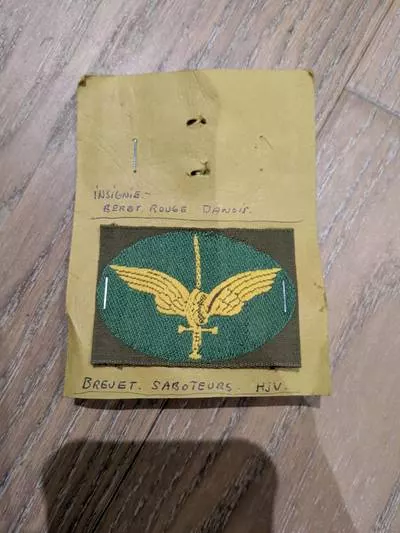
- Identifying and dating a French military insigniaThe back of an insignia says more than its face: maker, fastening, approval number. How to place a striking and spot a recent restrike.
- Reading and keeping military photographs and documentsThe back of a postcard dates the print, the service record book opens the archives. How to identify a soldier, and store papers without destroying them.
- The French fourragère: reading its colours, knowing who wears itGreen and red, yellow and green, red: what the fourragère's colours mean, the 1918 rules, individual wear, the US Marines and Army, and old pieces.
- The Croix du combattant: what it says about an ancestor, and where to find his cardThe French Combatant's Cross of 1930: who is entitled to it today, Doumenc's design and ribbon, the volunteer's cross, and how to find an ancestor's card.
- Selling militaria in France: what is allowed, what is notMost medals, helmets and uniforms can be sold freely in France. What the law regulates (weapons, ammunition, emblems) and the listing that protects you.
- French parachutist wings and the airborne beret badge: recognising them, dating them, tracing the holderFrench para wings: how to read the parachutist brevet and its engraved number, related brevets, the paratrooper beret badge, foreign wings and copies.
- The French colonial pith helmet: recognising it, dating it, telling it apartFrench colonial pith helmet in cork, from the marine infantry to Indochina: the 1886 and 1931 models, badges, lining, markings, British look-alikes.
Have pieces from this period? List them for free: they will be seen by the collectors browsing this page.
Collecting Indochina War militaria
From 1946 to the Geneva Accords, signed on 20 July 1954, the French Far East Expeditionary Corps fought a war of nearly eight years on the other side of the world. It brought together professional soldiers, legionnaires included, colonial troops, among them North African tirailleurs, and, alongside them, the national armies of the Associated States; unlike in Algeria, conscripts were not sent there. For the collector, that is the key to the period: a war fought by professionals. Every group that resurfaces deserves to be documented before it is broken up.
Where to start
Start with unit insignia, which their backs allow you to date, and with decorations; then look for photographs and papers, which attribute a piece. Clothing and equipment mix French models and American material: the aid Paris requested from the United States from 1949 first took the form of deliveries of military equipment. An insignia struck in Paris, a piece of American equipment and a photograph taken in Tonkin only form a group through their link to the same man.
Dating by the back, attributing by the papers
The back of an insignia dates the striking, not the unit. With Drago, “43 rue Olivier-Métra” corresponds to 1946 to 1951 and “3 rue de Romainville” to 1952 and 1953; an Indochina insignia marked “DRAGO Paris”, with no address, was struck in 1954 at the earliest. The Indochina campaign commemorative medal, created by decree on 1 August 1953, requires at least ninety days of operations between 16 August 1945 and 11 August 1954, the date of the ceasefire. Citations were worn on the Croix de guerre des théâtres d'opérations extérieurs, instituted in 1921, with a light blue ribbon between two red bands, and units cited two or three times in army orders in the same period of operations could receive the fourragère in its colours.
No object carries its own attribution: an insignia, a belt or an overseas theatres cross may come from other campaigns. What ties a piece to Indochina is a service book, a citation, a photograph, a name that can be followed. A piece said to be “from Dien Bien Phu”, the battle lost on 7 May 1954 after fifty-seven days of fighting, calls for proof equal to what it claims.
Tracing the man
Mémoire des hommes, the French Ministry of the Armed Forces website, publishes the database of those who died for France in the Indochina War, and the Pau archive centre of the Service historique de la Défense keeps the French Army's citations since 1914. Our guides to identifying a French military insignia and reading military photographs and papers give the method; for weapons, see what the law says.
The Athena Militaria catalogue
Athena Militaria brings together listings from collectors, flea-market hunters and heirs with a passion for history. Each piece is put online by its seller, with their own photos, description, condition and shipping location: they set their price and delivery options, you write to them directly and can offer yours. The filters at the top of the page narrow your search by price, condition, town or date of publication, and the arrangement by period and sub-category takes you straight to your collecting field.
Buying with confidence
Before committing, look at the photos in full size and read the description of the condition. Markings are often the most telling clue: maker's stamps, hallmarks, numbers or sizes inside a helmet or on a cap. If they do not show, ask the seller for them through the messaging, along with more photos or details on the provenance, then make an offer. When the listing shows “Buy”, you pay through Stripe with Buyer Protection: the seller is only paid after you confirm receipt. Our team checks listings of weapons and Second World War pieces before publication. The whole process is explained on the how it works page and in security and payments. Want to part with a piece? Publish a listing in a few minutes.