The French colonial pith helmet: recognising it, dating it, telling it apart
By Thomas, contributor to Athena Militaria Published 13 min read
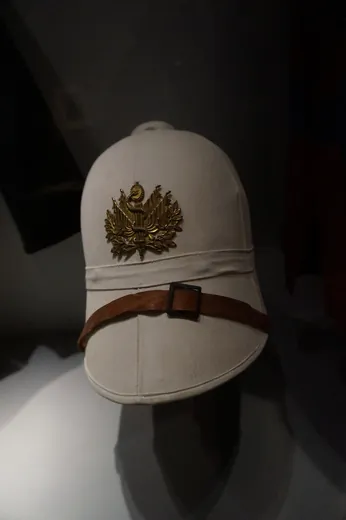
The French colonial helmet, the casque colonial, is a light cork headdress covered in white or khaki cloth that replaced the kepi in the colonies during the hot hours of the day. A dispatch of 31 March 1878 ordered its adoption for the colonies, and it went on to serve the marine troops, then the colonial troops, up to the Indochina War. Officers often bought their own, and the regulation pattern was copied for colonial administrators and expatriates: a white helmet is not necessarily military, nor even French. This guide describes the regulation helmet from period texts and museum records, then sets out a method for dating it and telling it apart from its civilian and British cousins.
Get a piece identified from photos Valuing a piece: the method
In brief
- A cork headdress. The regulation helmet described in 1910 is a cork body covered in cotton cloth, lined in green, ventilated by cork spacers and by a hole at the top under a cap.
- Three landmarks. Adoption for the colonies in 1878, then the 1886 model with its more flared shape and the 1931 model, lower and sturdier: two model names given by the Musée du Génie.
- Colour dates nothing. Whitened for garrison duty, hidden under a khaki cover or dressed in black cloth in Tonkin: the colour follows the use more than the model.
- The badge shows the arm. An anchor for the colonial infantry, the gilt badge of the kepi for officers, stars for generals.
- A British cousin. The British Wolseley-type helmet can combine cork, a zinc ventilator and spacers; on the Auckland Museum example, a folded pugri and English markings point to it.
From the salacco to the cork helmet
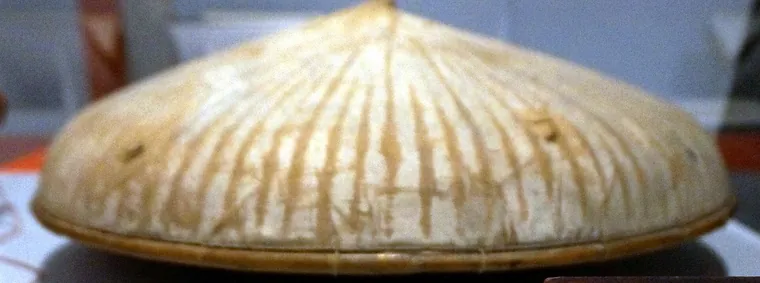
Before the helmet, some French soldiers in the Far East took up a local headdress. The salacco, the Musée de l'Armée explains, is made of varnished or woven bamboo strips and rice straw, and held on the head by a band of cloth, the chinstrap. French soldiers and officers liked it: it was lighter than the kepi or the shako and gave better protection from the sun. The Musée du Génie in Angers presents the colonial helmet as the headdress that replaced salaccos and other locally made headwear.
The turning point came in 1878. In the Vade-mecum de l'officier d'infanterie de marine, a handbook for marine infantry officers that he published in 1884, P.-L. Monteil quotes the dispatch of 31 March 1878 ordering the adoption of the helmet for the colonies, while keeping the neck cover for sea crossings. The helmet, he writes, had replaced the shako, and the kepi too, for the hot hours of the day. Monteil approved the choice, but would have preferred a felt helmet like the British pattern to the cork helmet that was chosen.
The Musée du Génie also dates to 1878 the adoption of a tropical headdress for metropolitan contingents serving in the colonies, following the British army's example. Its record calls this first helmet the “model 1873”, a year that does not match the adoption it reports: I keep to 1878, the date of the dispatch. The 1886 model followed, almost identical, but more flared in shape and so more protective. In 1896, in his Principes d'hygiène militaire, the army doctor Charles Viry describes a new model in cork covered in white cloth, with wide brims that protect the forehead, the neck and the ears.
In 1900, the Musée du Génie adds, a law moved the marine troops to the War Ministry under the name of colonial troops. The description of their uniforms drawn up in 1910 kept the helmet: in the colonies it replaced the best kepi, the képi de première tenue, in full dress.
Cork or elder pith
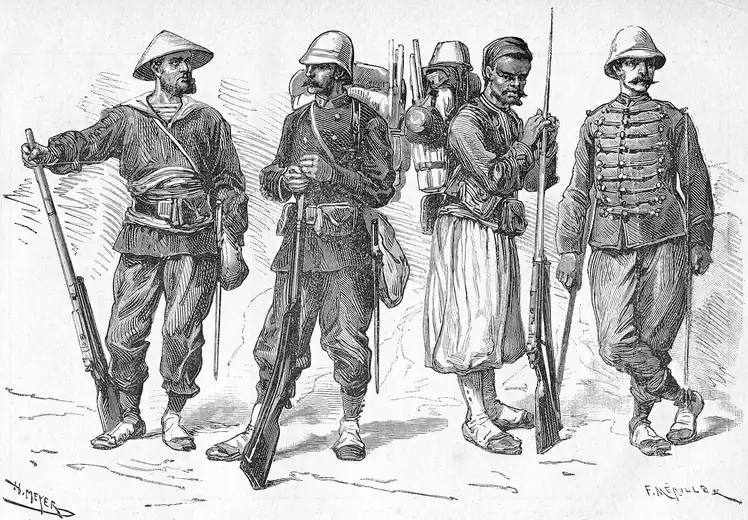
The texts speak mostly of cork, but not only. In 1886, in his Manuel d'hygiène militaire, Charles Viry notes that British colonial troops wore a cork helmet covered in white cloth, with which the French cavalry had been issued in Tunisia. In Tonkin, he adds, French soldiers used a helmet of elder pith covered in black cloth, because white showed them up to the enemy from too far away. Ten years later he records that the white flannel clothing favoured by officers in hot countries had become regulation together with the helmet in cork or in elder pith.
The regulation helmet, piece by piece
The most detailed text read for this guide is the Description des uniformes des troupes coloniales en France et aux colonies, the description of the uniforms of the colonial troops as it stood on 1 January 1910, published by the military publisher L. Fournier. It simply names the “casque colonial”, with no model year, and describes it in the colonial infantry chapter:
- The body. Twenty-six pieces of cork under a cover of coutil, a tight cotton twill, in six pieces stuck to the cork with a rubber solution.
- The lining. An inner layer of green cotton lines the helmet right to the edge of the brims.
- The headband. A cork band lined with black cotton carries a black basane, that is a sheepskin, with an adjusting string; eight cork spacers one centimetre thick hold it away from the body and let the air through.
- The top. A hole 3 centimetres across, fitted with a copper ring, takes the threaded stem of a zinc cap covered in unbleached cotton.
- The band. The bourdalou, a strip of unbleached coutil 2 centimetres high, hides the white-metal hooks; the Musée du Génie likewise describes a horizontal cloth band that hides the fixings.
- The chinstrap. Of tan calfskin, it fastens to two copper hooks.
The text also sets the weight: about 225 grams for the smallest size, 275 for the largest, without chinstrap or badge, give or take 15 grams. So weigh the helmet without its chinstrap: a clear gap is a first clue, to be read according to the model.
| Part | 1910 description | Musée du Génie record, 1886 model |
|---|---|---|
| Material | Cork body in twenty-six pieces | Compressed and glued cork, sugarloaf shape |
| Outer cloth | Unbleached cotton coutil in six pieces, stuck with rubber | Cachou cloth, a light khaki, whitened with blanco |
| Inside | Green cotton to the edge of the brims | Light green cloth, darker under the peak and the neck guard |
| Headband | Cork, black cotton and black basane, on eight cork spacers | Basane liner held by eight cork wedges |
| Ventilation | 3 cm hole at the top, zinc cap with threaded stem | Zinc cap covered in cloth |
| Chinstrap | Tan calfskin, two copper hooks | Tan leather, five metal eyelets |
| Badge | Metal badge proper to the arm | Brass engineers' badge, model 1872 |
White, khaki or black
According to the Musée du Génie, the cachou cloth was whitened by repeated applications of blanco for garrison duty and full dress. The 1910 description also provides a removable helmet cover in khaki cotton twill, over which the top cap is fixed. Viry mentions a white helmet in Tonkin in 1884, after Intendant General Baratier, and black cloth in 1886. A white helmet is therefore not necessarily old, nor a khaki one necessarily recent.
Badges and insignia
The 1910 description says the cork helmet carries a metal badge that tells the arms apart. For the colonial infantry it is an anchor of stamped and cut-out copper, 6 centimetres high and 4 wide across the flukes, entwined with a cable. The anchor is found on other items of these troops: see the guides to antique military buttons and to the French military kepi.
Officers wore the helmet “of the general model”, with the gilt copper badge of their corps' best kepi at the front. Generals' helmets carry two or three stars according to rank, and a badge of their own is provided for doctors. The Musée du Génie example carries the brass engineers' badge of the 1872 model, axe and sword crossed under a horseshoe, with a painted metal cockade that the museum considers non-regulation, perhaps a local practice.
A badge can be taken off and replaced: it is only one clue among others. To read one, see identifying a French military insignia.
Officer's helmet, soldier's helmet
Officers often equipped themselves. Henri Gallais, in his Vade-mecum de l'officier au Tonkin of 1894, puts the colonial helmet at the head of the items to buy before leaving, and advises choosing it preferably of the regulation pattern: light, sitting well down on the head, covering the ears and the neck completely. Monteil had already recommended the helmet, in felt if possible. Viry notes in 1896 that the so-called officer's helmet weighs barely 200 grams.
An officer's helmet may therefore have been bought in a shop: a shop label does not rule out military use, nor does it prove it. For the ranks, see French army ranks and braid.
From Tonkin to Indochina: where it was worn
The helmet went with the explorations and expeditions in Africa, Madagascar and Indochina, then the African and Eastern campaigns of the First World War and, after the Great War, those in Syria and the Rif, the Musée du Génie sums up. In Tonkin, according to Baratier, garrison dress included the helmet in summer and the helmet or the kepi in winter. In Benin, an order by General Dodds in August 1892 had Europeans in garrison wear the helmet from reveille to sunset; after sunset, the other ranks' dress included the kepi.
The North African troops knew it too. In August 1915, according to a thesis from the University of Kent based on the archives of the Service historique de la Défense, the staff justified the steel helmet for Zouaves and tirailleurs by recalling that these troops already wore a helmet in Morocco and on colonial expeditions, and that the tirailleurs wore cork helmets there without reluctance. For their other headdress, see the Zouave, tirailleur and Spahi uniform.
The colonial helmet then gradually disappeared in the course of the Indochina War (1946-1954), according to the Musée du Génie. For the decorations of that war, see the decorations of the Indochina War.
The 1931 model, successor to the 1886
The Musée du Génie names the successor of the 1886 model: the 1931 model, lower in shape, with the peak and the neck guard straightened, and above all sturdier. I have not read its founding text for this guide, and none of the sources read details how it was made: its lower silhouette remains the first thing to look for.
Civilian helmets and the British helmet
Civilian helmets
The colonial helmet was not reserved for soldiers. According to the Musée du Génie, the 1886 model was copied by the corps of colonial administrators and by expatriates from metropolitan France, and sold in specialist shops. Without a badge, an intendance mark or a provenance, it then becomes hard to tell an official's helmet from a soldier's.
The British helmet
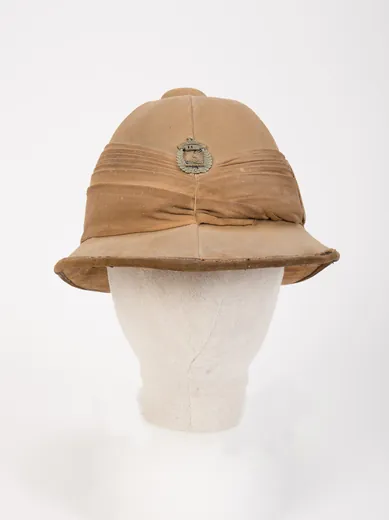
The British helmet is the closest. The National Army Museum in London describes the Wolseley, named after Sir Garnet Wolseley, as cloth over cork or pith, often from the sola plant. The Auckland Museum in New Zealand holds a helmet of this type worn at Gallipoli, which it catalogues as a British Foreign Service helmet of the 1902 pattern.
Its construction recalls the French helmet: on the Auckland example, cork covered in khaki drill, a crown with six seams, a cloth-covered zinc ventilator, cork spacers under the leather sweatband. This example stands apart by its pugri, a removable folded linen band wound round the crown, and by its English markings: a W↑D stamp with 1908, the maker Vero & Everitt followed by MADE IN ENGLAND, a size marked 22 ½. Viry also noted a British helmet in elder pith.
The National Army Museum lists Gallipoli, Salonika, Egypt and Palestine among the theatres where the Wolseley was standard issue for British units. A helmet brought back from these fronts is therefore not necessarily French.
Dating a colonial helmet
A helmet does not carry its date on the front. It is placed by cross-checking:
- The silhouette. A tall sugarloaf with flared brims suggests the 1886 model; a lower shape with straightened brims, the 1931 model.
- The construction. Cork, glued cloth, green lining, headband on spacers, screwed top cap: this matches the helmet described in 1910, but also, in the main, the British helmet and civilian ones; construction alone therefore does not date a helmet. Another material, such as the elder pith of the 1880s, is not necessarily a copy, but calls for a close look.
- The markings. Look inside for an intendance stamp, as on the Musée du Génie example, where it has become illegible. English markings point to a British helmet; a shop label, to a purchase in the trade.
- The badge. It gives the arm, not the date: check that it has always been there, from the fixing holes and the marks on the cloth.
- The colour. It tells you about use, rarely about period.
- The papers. A photograph, a service record or a family memory date it better than the object. See reading military photographs and documents and tracing a French soldier of 1914-1918.
To read a stamp or a label, see also reading the markings on a military item.
Condition, care and copies
A colonial helmet brings together different materials: cork, glued cloth, leather, zinc and copper. Do not wash it, do not whiten it again, do not grease the leather: each of these can erase a trace of use or a marking. The conservation method, with its sources, is in caring for militaria without destroying its value.
The silhouette is easy to copy, for costume or film as well as to deceive: judge the construction against the 1910 description. A crown moulded in one piece from another material, modern hooks or chinstrap, a badge too new on tired cloth all call for a second opinion before any purchase. A missing headband or chinstrap, on the other hand, proves nothing: the Musée du Génie example has lost both.
What I cannot tell you here
I cannot date a helmet to the year from a photograph, nor say who owned it without papers. I have not read the texts that created the 1886 and 1931 models: their names come here from the Musée du Génie record, and the 1910 description, the most detailed text read for this guide, gives no model year. Nor have I drawn up a list of French makers: only a legible label or stamp, compared with reliable examples, can point the way.
I give no prices: the method is in valuing a military item. For a particular helmet, photograph the front, the profile, the top with its cap, the inside with its markings and the badge front and back, then ask for free identification help. To compare, see the Indochina War uniforms and the First World War uniforms for sale on the site.
Frequently asked questions
What is a French colonial pith helmet?
It is the tropical headdress of French troops serving in the colonies: a light cork body, covered in cotton cloth and lined in green, ventilated by cork spacers and by a hole at the top under a cap. A dispatch of 31 March 1878 ordered its adoption for the colonies, where it replaced the shako and the kepi during the hot hours. It gradually disappeared in the course of the Indochina War (1946-1954).
How do you recognise a French model 1886 colonial helmet?
The Musée du Génie in Angers describes it as compressed and glued cork in a sugarloaf shape, covered in cachou cloth whitened with blanco for garrison duty, with a very large peak and neck guard. A horizontal cloth band hides the fixings, a cloth-covered zinc cap ventilates the top, and the basane headband rests on eight cork wedges. The inside is lined with green cloth.
What is the French model 1931 colonial helmet?
It is the successor of the 1886 model, according to the Musée du Génie: lower in shape, with a straightened peak and neck guard, and above all sturdier. The colonial helmet then gradually disappeared in the course of the Indochina War (1946-1954). Its founding text was not read for this guide: for a particular example, compare the silhouette and have the inside examined.
Was the colonial helmet worn in French Indochina?
Yes. In Tonkin the troops wore a white helmet in 1884 and, in 1886, the army doctor Charles Viry described elder-pith helmets covered in black cloth, because white could be seen from too far away. In 1894, Henri Gallais advised officers posted to Tonkin to buy their helmet before leaving. The colonial helmet gradually disappeared in the course of the Indochina War (1946-1954).
Why is there an anchor on a French colonial helmet?
It is the badge of the colonial infantry, which grew out of the marine troops when they became the colonial troops in 1900. The description of the colonial troops' uniforms drawn up in 1910 makes it the helmet badge of the colonial infantry: an anchor of stamped copper, 6 centimetres high and 4 wide across the flukes, entwined with a cable. Officers wore the gilt badge of their kepi on the helmet, generals two or three stars.
Why were French colonial helmets white?
For garrison duty and full dress: according to the Musée du Génie, the cachou cloth of the 1886 model was whitened by repeated applications of blanco. Yet the colour varied: the 1910 description provides a khaki cloth helmet cover, and in Tonkin, in 1886, helmets were covered in black cloth because white could be seen from too far away. Colour alone does not date a helmet.
How do you tell a French colonial helmet from a British pith helmet?
The construction is close: cork, cloth, cork spacers and a zinc ventilator are found on the British Wolseley-type helmet described by the Auckland Museum. That example stands apart from the French helmet by its pugri, a folded linen band wound round the crown, and by its English markings: a W↑D stamp, the maker's name followed by MADE IN ENGLAND, a size marked 22 ½. The French regulation helmet described in 1910 has a plain cloth band 2 centimetres high and the badge of its arm.
How much is an antique French colonial helmet worth?
This guide gives no prices. It helps you check what counts: a complete helmet, with its lining, headband, top cap and chinstrap; an original badge; legible markings; a provenance backed by photographs or papers. The full method is in the guide to valuing a military item, and the site's free identification help can look at your photographs.
Sources
This guide draws on the texts, databases and pages below, all accessed on . Most of them are in French.
- Musée de l'Armée, panel for young visitors on the troops recruited in Indochina: the salacco and Annamese headdress, PDF
- Musée du Génie (Angers), collection sheet “Le casque colonial modèle 1886” (the 1886 model colonial helmet): description and historical background, PDF
- P.-L. Monteil, Vade-mecum de l'officier d'infanterie de marine, en France et aux colonies (handbook for marine infantry officers), 1884: the dispatch of 31 March 1878 on adopting the helmet for the colonies (Gallica)
- Charles Viry, Principes d'hygiène militaire (principles of military hygiene), Paris, L. Battaille et Cie (formerly Delahaye), 1896, pp. 385 and 390-391: the colonial troops' helmet, British helmets, dress in Tonkin and Benin (Internet Archive)
- Charles Viry, Manuel d'hygiène militaire (handbook of military hygiene), Paris, A. Delahaye and É. Lecrosnier, 1886, p. 182: cork and elder-pith helmets (copy digitised by the BnF, Internet Archive)
- Description des uniformes des troupes coloniales en France et aux colonies (description of the uniforms of the colonial troops), volume as at 1 January 1910, Paris, L. Fournier, colonial infantry: colonial helmet and helmet cover, pp. 126-128 (Gallica)
- Trésor de la langue française informatisé (CNRTL), entry “coutil”
- Trésor de la langue française informatisé (CNRTL), entry “basane”
- Henri Gallais, Vade-mecum de l'officier au Tonkin (handbook for officers posted to Tonkin), Paris, A. Challamel, 1894, pp. 3 and 13: buying the colonial helmet before leaving (Internet Archive)
- Yannick Olivères, “Képi Rouge to Bleu Horizon: The Evolution of the French Military Uniform & the Development of the Headdress, 1871-1918”, MA by Research thesis, University of Kent, chapter V, “The Steel Helmet: 1915-1918”
- National Army Museum (London), white Wolseley helmet of an officer of the Army Staff in India, c. 1914, NAM. 1962-12-41-5
- Auckland War Memorial Museum, British Foreign Service pith helmet of Wolseley type worn at Gallipoli, 2015.1.1, collection database record
- National Army Museum (London), Wolseley helmet worn by a lance-corporal of the Leinster Regiment, c. 1916, NAM. 1965-07-45-4