French expedition medals, from China in 1860 to Morocco in 1909: recognising them, tracing their recipients
By François, contributor to Athena Militaria Published 13 min read
The French commemorative medals for the expeditions to China, Mexico, Tonkin, Madagascar, Dahomey and Morocco are 30 mm silver medals, created between 1861 and 1909 for the soldiers and sailors sent overseas. They share their size and often their laurel wreath, and differ in their effigy, the names on their reverse, their ribbon and their clasps. None of the texts that created them has the holder's name engraved: it is the certificate that ties a medal to a man. Here, medal by medal, is what those texts and the examples kept in museums say, then how to link a medal to a soldier and spot a copy.
Get a piece identified from photos Valuing a piece: the method
In brief
- Eight 30 mm silver medals. From China in 1860 to Morocco in 1909.
- The effigy tells you the regime. Napoleon III for China 1860 and Mexico, the helmeted Republic after that.
- The ribbon tells them apart. Yellow with the name of Peking (China, 1860), white with the eagle (Mexico), yellow striped with green (Tonkin, China 1900), green and blue (Madagascar), yellow and black (Dahomey), green striped with white (Morocco).
- Clasps come late. The texts provide none before the 1895 Madagascar medal.
- The name is on the certificate. The medal carries none as issued.
One family of medals
These medals went to everyone who had taken part in the campaign, unless found unworthy, as the Répertoire général alphabétique du droit français noted in 1898. Each was created by its own text, an imperial decree under the Second Empire, a law under the Third Republic. They were worn on the left breast, after the Legion of Honour and the Médaille militaire; from a decree of 10 March 1891, those bearing the Republic's effigy were worn with that side showing.
The two Second Empire medals follow the design of the 1859 Italy medal, which has its own guide, as do the St Helena Medal and the 1870-1871 medal.
China, 1860: Peking on the ribbon
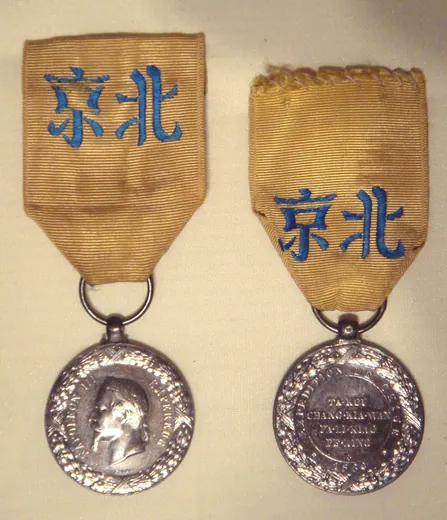
A decree signed at the Tuileries on 23 January 1861, printed by Steenackers in 1867, created the commemorative medal of the China expedition of 1860, granted “to all those who took part in the China expedition”. According to the Fondation Napoléon, it was awarded with a named certificate issued by the regiment or the maritime prefect.
The obverse carries the laureate head of Napoleon III, the legend NAPOLEON III EMPEREUR and the signature BARRE, that of Désiré-Albert Barre, chief engraver of the Paris Mint. On the reverse, EXPEDITION DE CHINE 1860 surrounds TA-KOU, CHANG-KIA-WAN, PA-LI-KIAO, PE-KING. In a 1921 book on naval medals, Milford Haven lists among the Navy's chief events the occupation of Taku, the battle of Palikao and the entry into Peking.
The yellow ribbon carries the name of Peking woven in blue in Chinese characters; the Society of Friends of the Museum of the Legion of Honour (SAMLHOC) gives its width as 36 mm and counts nearly 12,000 medals awarded with a certificate. It also exists with signatures other than BARRE.
Mexico, 1862-1863: the eagle on the ribbon
The decree of 29 August 1863, signed at Saint-Cloud, created the medal of the Mexico expedition “in 1862 and 1863” for all who took part, on the model of the China medal: silver, 30 mm, laureate head of Napoleon III. The reverse reads EXPEDITION DU MEXIQUE 1862-1863 around CUMBRES, CERRO-BORREGO, SAN-LORENZO, PUEBLA, MEXICO.
The ribbon is white, with a red and green band forming a cross and, in the middle, the Mexican eagle holding a serpent in its beak. The Fondation Napoléon adds the details: 36 mm wide, two 5 mm stripes in a St Andrew's cross, a black eagle holding a green serpent in its beak and talons.
BARRE signs the regulation pattern; other examples are signed E. Falot, E.F., S.F. or Sacristain F., others not at all; according to the Fondation, they differ in the effigy and the lettering. According to the SAMLHOC, the medal went with a certificate to the 38,000 men engaged.
Tonkin, 1883-1885: the helmeted Republic
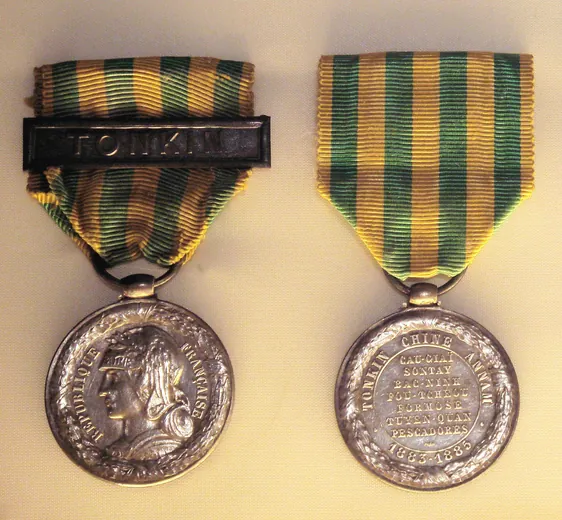
The law of 6 September 1885 created the medal “of the Tonkin expedition and of the military operations against China and Annam in 1883, 1884 and 1885”, granted to all soldiers and sailors who took part. Engraved by Daniel Dupuis, it shows the helmeted Republic, with PATRIE on the visor. On the reverse of the example in the municipal museum in Sens, TONKIN CHINE ANNAM and 1883-1885 surround seven names: CAU-GIAI, SONTAY, BAC-NINH, FOU-TCHEOU, FORMOSE, TUYEN-QUAN, PESCADORES.
Cau-Giai is where Francis Garnier and, ten years later, Henri Rivière were killed. Milford Haven counts among the actions of Admiral Courbet's squadron the fight at Foochow on 23 August 1884 and the operations in the Pescadores Islands.
With or without Cau-Giai
According to the SAMLHOC, there was a Navy pattern and an Army pattern, without CAU-GIAI; Milford Haven holds the seven-name medal to be the only one struck specially for the Navy. The Musée Bonaparte in Auxonne holds a six-name example. The Mint's first strikings had an olive-shaped loop, later ones a ball-shaped loop.
The ribbon and how long it was awarded
The law called for a ribbon “half green, half yellow”. In 1887, the one the clothing service supplied to soldiers, renewed every three months, was watered silk striped green and jonquil yellow; the examples described have it yellow with four green stripes. On 18 June 1885 the Chamber had rejected a clasp for each engagement: a TONKIN bar, like the one on the example pictured above, is provided for by none of the texts read for this guide.
The law of 26 July 1887 extended entitlement to 31 December 1886, then kept it for those who had taken part “in an effective manner” in war operations; it also opened it to Cambodia, Madagascar and Francis Garnier's companions. A circular of 13 July 1893 ended it on 1 October 1893, yet in 1894 the medal was still granted for the upper Mekong and Siam. The SAMLHOC counts 97,300 recipients.
Madagascar: the 1886 medal and the 1895 medal
The law of 31 July 1886 created a medal “conforming, in size and obverse, to the Tonkin medal”, with the word Madagascar on the reverse and a ribbon “half green, half blue, in narrow horizontal stripes”, for “all officers, sailors, soldiers and volunteers” of the expedition. Its reverse, by Daniel Dupuis, sets a radiant star between 1883 and 1886 above the word and a trophy of four flags and an anchor; according to the SAMLHOC, the first ones had an egg-shaped suspension fitting.
The law of 15 January 1896, published in the Journal officiel of 17 January, created the second for the expedition from 8 December 1894 to 31 December 1895: soldiers, sailors, “Senegalese auxiliaries” and “Kabyles”. Same metal, size and ribbon, but a new reverse and an 1895 clasp. The Sens museum's example, signed O. Roty, shows a Republic in a visored helmet, REPVBLIQVE FRANÇAISE spelt with Vs, and on the reverse MADAGASCAR over a trophy of arms; its silver clasp is made of laurel leaves. The law of 21 July 1897 extended the medal to the occupation force up to 31 October 1896.
Dahomey, 1892: the yellow and black ribbon
The law of 24 November 1892 created the medal of the Dahomey expedition, “conforming in size and obverse to the Tonkin medal”, with the word Dahomey on the reverse and a ribbon “half black, half jonquil, in narrow vertical stripes”, for “all officers, sailors and soldiers” of the expeditions. Its reverse repeats the Madagascar one, with DAHOMEY and without the dates, Milford Haven notes.
According to the SAMLHOC, the first was presented to General Dodds in Marseille on 11 May 1893; entitlement ended on 5 February 1894, and there were 12,171 recipients by 1913. Do not confuse it with King Toffa's medal, bearing his arms, which reads “Campagne du Dahomey, 1892”.
China, 1900-1901: the colonial helmet and the dragons
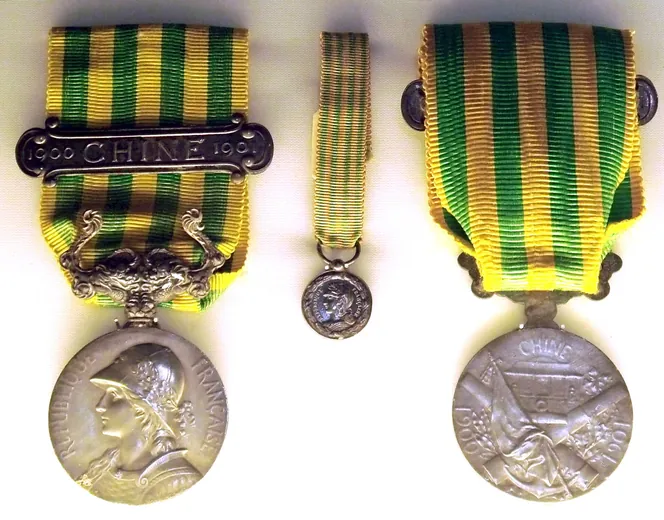
The law of 15 April 1902 created a “national commemorative medal of the China expedition 1900-1901”, the size of the Madagascar medal, on the Tonkin ribbon, with a “Chine 1900-1901” clasp. It went to the soldiers and sailors of the expedition and to French civilians who defended the legations in Peking. A decree of 1 July 1902 required Army men to have been in China between 30 June 1900 and 8 August 1901; a law of 15 April 1904 opened it to men who, bound for the expedition, landed in Tonkin.
As the newspaper Le Vétéran noted in 1902, Georges Lemaire broke with the Republic helmeted like Minerva: his wears a colonial helmet. On the reverse, a pagoda behind cannon, an anchor and a flag, with 1900 CHINE 1901. The suspension is made of two dragons, and the silver clasp is in oriental style. The example in the Australian War Memorial, unnamed as issued, has a hallmark and the word ARGENT on its rim.
Morocco, 1909: the crescent and the clasps
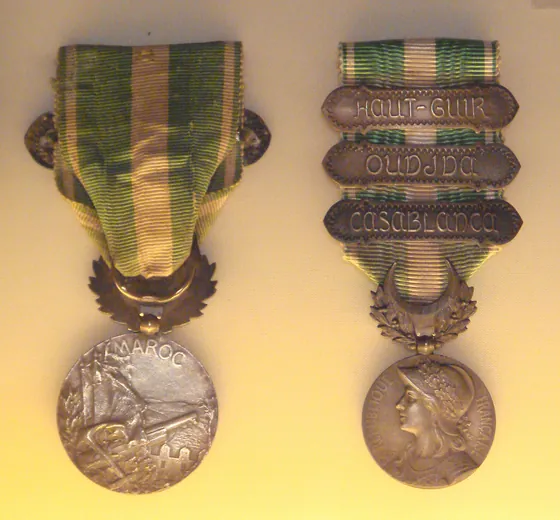
The law of 22 July 1909 created a medal for the operations carried out in Morocco: silver, 30 mm, the Republic's effigy, and on the reverse attributes “recalling the collaboration of the army and navy troops” under the word Maroc. A silver suspension “in the shape of a crescent” hangs it from a green ribbon 36 mm wide, cut by three white stripes, the middle one 7 mm, the outer ones 2 mm. Engraved by Georges Lemaire, it carries on the flags of the reverse HONNEUR ET PATRIE, CASABLANCA, HAUT-GUIR, OUDJDA.
The clasp tells you where the man served: CASABLANCA for soldiers shipped to that city between 5 August 1907 and 15 June 1909 and for the Navy, OUDJDA for the occupation of Oudjda between 29 March 1907 and 1 January 1909, HAUT-GUIR for the columns of 1908 and the garrisons of Bou-Denib and Bou-Anane. The instruction of 1 September 1909 gave one clasp per region; a fourth, MAROC, came from the finance law of 27 February 1912. The law also granted the medal to the “natives of the goums” and to some civilians.
Entitlement ended on 20 July 1912. The colonial medal, created in 1893, then took over; it is covered in the guide to the French Overseas Medal.
Telling them apart at a glance
A ribbon can be replaced; the effigy and the reverse cannot.
| Expedition | Year of the text | Ribbon | Distinguishing feature |
|---|---|---|---|
| China, 1860 | 1861 | Yellow, name of Peking woven in blue | Napoleon III; from TA-KOU to PE-KING |
| Mexico, 1862-1863 | 1863 | White, red and green cross, eagle and serpent | Napoleon III; from CUMBRES to MEXICO |
| Tonkin, 1883-1885 | 1885 | Yellow with four green stripes | Helmeted Republic, PATRIE; six or seven names |
| Madagascar, 1883-1886 | 1886 | Green and blue horizontal stripes | Star between 1883 and 1886, flags and anchor |
| Dahomey, 1892 | 1892 | Jonquil yellow with four black stripes | Madagascar reverse without dates, DAHOMEY |
| Madagascar, 1895 | 1896 | The 1886 ribbon | REPVBLIQVE, signed Roty; 1895 clasp |
| China, 1900-1901 | 1902 | The Tonkin ribbon | Colonial helmet; dragon suspension; clasp |
| Morocco, 1907-1912 | 1909 | Green with three white stripes | Crescent suspension; regional clasps |
Dating and attributing a medal
The date on the medal is that of the campaign, not of its striking: to place an example, look at the suspension and the Mint's mark; on a Tonkin medal, CAU-GIAI marks the Navy pattern.
To attribute it you need a document. The certificate was drawn up by the unit or service; for Morocco, the 1909 instruction had the name of each clasp written on it and the words “A reçu la médaille du Maroc” (received the Morocco medal) entered in the man's military papers. A family medal may also have been handed over after the soldier's death, in this order to the eldest son, the widow, the father, the mother: the Tonkin, Dahomey, Madagascar and 1900 China laws provided for this.
The research guide of the Service historique de la Défense notes that the service registers, the registres matricules, became systematic in 1867 and went to the departmental archives of the place of recruitment: see tracing a French WW1 soldier. For the earliest men, the troop registers at Vincennes, kept by unit, record decorations (colonial and marine troops in GR 43 Yc). A sailor is found in the registers of his port. To read a certificate or a photograph, see reading and keeping military photographs and documents.
Miniatures, restrikes and copies
Copies are as old as these medals: on 5 November 1885 the War Ministry warned in the Journal officiel that the medal and ribbon sold in Toulon and Marseille to soldiers returning from Tonkin were “in no way regulation”.
The Mint marked its strikings. According to an 1886 note, a horn of plenty on the reverse, below the names, guarantees the silver of the Tonkin medal at 950 thousandths; on the Dahomey medal it sits on the left, level with the top of the first flagstaff. In 1893 private makers were allowed to produce Dahomey miniatures no larger than 25 mm, without the horn of plenty or the fasces. For the 1900 China medal, by contrast, a letter of 1903 reserved all manufacture to the State, miniatures included, marked on the rim, and banned imitations in white metal.
None of the sources for this guide describes modern restrikes. Compare the size, the metal, where the mark sits, the design of museum examples and the suspension; the ribbon proves nothing. A discrepancy calls for an explanation, if need be from a militaria expert.
What I cannot tell you here
I cannot tell you, from a photograph, whether a medal was struck at the time or later, whether its ribbon is original, or who received it without a document. The numbers of recipients quoted come from the SAMLHOC; for China in 1860, the Fondation Napoléon speaks of a force of 8,000 men.
This guide gives no prices. What matters can be checked: the medal the text describes, complete, attributed by a document and kept with the man's other decorations; the method is in valuing a military item. For a particular medal, photograph the obverse, the reverse, the rim, the suspension, the ribbon, the clasp and every document, then ask for free identification help. To compare, see the Franco-Prussian War and First World War medals categories.
Frequently asked questions
What is the French China expedition medal of 1860?
A 30 mm silver medal created by a decree of Napoleon III of 23 January 1861 for everyone who had taken part in the China expedition of 1860. It shows the Emperor's laureate head and, on the reverse, “EXPEDITION DE CHINE 1860” around four names, from TA-KOU to PE-KING. Its yellow ribbon, with the name of Peking woven in blue in Chinese characters, makes it recognisable at first sight.
How do you recognise the French Mexico expedition medal?
By its white ribbon, crossed by a red and a green band, with an eagle holding a serpent in the centre. The medal, created by the decree of 29 August 1863, is silver, with the laureate head of Napoleon III; its reverse reads “EXPEDITION DU MEXIQUE 1862-1863” around five names, from CUMBRES to MEXICO. The signature BARRE is the most common, but others exist, and some examples are unsigned.
What is the Tonkin medal of 1885?
The French commemorative medal created by the law of 6 September 1885 for the Tonkin expedition and the operations against China and Annam in 1883, 1884 and 1885. Engraved by Daniel Dupuis, it shows the helmeted Republic with PATRIE on the visor and, on the reverse, TONKIN CHINE ANNAM, 1883-1885 and six or seven names of engagements: the seven-name pattern, with CAU-GIAI, is described as the Navy's. Its ribbon is yellow with four green stripes.
How do you recognise the Madagascar medal of 1895?
By its silver clasp bearing 1895, on a ribbon of green and blue horizontal stripes, the same as that of the 1886 medal. Created by the law of 15 January 1896 and engraved by Oscar Roty, it shows a Republic in a visored helmet with the legend REPVBLIQVE FRANÇAISE and, on the reverse, MADAGASCAR above a trophy of arms and 1895. The 1886 medal takes the obverse of the Tonkin medal and has a star between 1883 and 1886 on the reverse.
How do you recognise the French Dahomey medal?
By its jonquil yellow ribbon with four vertical black stripes. Created by the law of 24 November 1892, the medal takes the obverse of the Tonkin medal, and its reverse resembles that of the first Madagascar medal, with the word DAHOMEY and no dates. Entitlement to it ended on 5 February 1894.
What is the French China medal of 1900-1901?
The national commemorative medal of the China expedition 1900-1901, created by the law of 15 April 1902 for the officers, sailors and soldiers of the expedition and for French civilians who defended the legations in Peking. Engraved by Georges Lemaire, it shows the Republic in a colonial helmet. Its suspension is made of two dragons, and its ribbon, the Tonkin ribbon, carries a 1900 CHINE 1901 clasp.
What are the clasps of the French Morocco medal?
The law of 22 July 1909 created three, Casablanca, Oudjda and Haut-Guir, one for each region where the man served. A fourth, Maroc, was added in 1912 by the finance law of 27 February and the decree of 15 May. The medal can also be recognised by its crescent-shaped suspension and its green ribbon with three white stripes.
How can you find out who received a French commemorative medal?
Through a document, since the medal carries no name: a certificate in his name, a photograph, a letter. Then look for the man in his service register, held in the departmental archives of the place where he was recruited, or for the earliest ones in the troop registers of the Service historique de la Défense. For Morocco, a 1909 instruction had the medal and its clasp entered in the holder's military papers.
Sources
This guide draws on the texts, databases and pages below, accessed on unless otherwise stated. Most of them are in French.
- Répertoire général alphabétique du droit français (Fuzier-Herman, Carpentier, Frèrejouan du Saint), vol. 27, Paris, 1898, entry on commemorative medals: common rules on award, wear and discipline, then the texts for each medal (copy digitised by Internet Archive)
- François-Frédéric Steenackers, Histoire des ordres de chevalerie et des distinctions honorifiques en France, Paris, 1867, chapter on the commemorative medal of the China expedition: account of the expedition and text of the decree of 23 January 1861 (extract digitised by Düsseldorf University Library)
- Fondation Napoléon, on the commemorative medal of the China expedition: imperial decree of 23 January 1861, named certificate, ribbon and engraving by Désiré-Albert Barre
- Marquess of Milford Haven, Naval Medals: Commemorative Medals, Naval Rewards, War Medals, Naval Tokens, &c. of France, the Netherlands, Spain and Portugal, vol. 2, 1921, French section: the China (1860), Mexico, Tonkin, Madagascar, Dahomey, China (1900-1901) and Morocco medals (extract digitised by Internet Archive)
- Society of Friends of the Museum of the Legion of Honour and Orders of Chivalry, on the commemorative medal of the China expedition: history, ribbon, insignia, signature variants, text of the decree of 23 January 1861 and of the disciplinary decree of 25 March 1861
- Fondation Napoléon, on the Mexico campaign commemorative medal of the Second Empire: decree of 29 August 1863, certificate, patterns and signatures, ribbon
- Society of Friends of the Museum of the Legion of Honour and Orders of Chivalry, on the commemorative medal of the Mexico expedition: history, ribbon, insignia, signatures and text of the decree of 29 August 1863 (Bulletin des lois)
- Sens municipal museum, record of a commemorative medal of the Tonkin expedition engraved by Daniel-Dupuis, with seven names on the reverse and a yellow ribbon with four green stripes (inv. 20.1.7), Joconde database on the Plateforme ouverte du patrimoine
- Musée Bonaparte, Auxonne, record of a Tonkin and China campaign medal signed DANIEL DUPUIS, with six names on the reverse from SONTAY to PESCADORES (inv. 2010.0.518), Joconde database on the Plateforme ouverte du patrimoine
- Society of Friends of the Museum of the Legion of Honour and Orders of Chivalry, on the commemorative medal of the Tonkin expedition: history, ribbon, insignia and its two patterns, parliamentary debates of 1885 and 1887, text of the laws of 6 September 1885 and 26 July 1887, notes of 1885 and 1886, ministerial decision of 7 February 1887 on the ribbon, circulars of 1893 and 1894
- Society of Friends of the Museum of the Legion of Honour and Orders of Chivalry, on the commemorative medals of Madagascar: history, ribbon, clasp, insignia of both medals, parliamentary debates and text of the laws of 31 July 1886, 15 January 1896 and 21 July 1897
- Journal officiel de la République française, 17 January 1896, no. 16, p. 273: law of 15 January 1896 granting a commemorative medal for the Madagascar expedition of 1895 (copy digitised by Internet Archive)
- Sens municipal museum, record of a Madagascar commemorative medal signed O.ROTY, with 1895 on the reverse and a laurel-leaf clasp (inv. 20.1.27), Joconde database on the Plateforme ouverte du patrimoine
- Society of Friends of the Museum of the Legion of Honour and Orders of Chivalry, on the commemorative medal of the Dahomey expedition: history, ribbon, insignia, Mint administration notes of 1893, text of the law of 24 November 1892 and circular of 25 May 1894
- Society of Friends of the Museum of the Legion of Honour and Orders of Chivalry, on the commemorative medal of the China expedition 1900-1901: history, ribbon, clasp, insignia, extract from Le Vétéran of 1 October 1902, Mint administration letter of 25 March 1903, text of the law of 15 April 1902, the decree of 1 July 1902 and the law of 15 April 1904
- Australian War Memorial, record “French China Medal 1900-1901” (RELAWM14779): medal with its clasp, unnamed as issued, hallmark and ARGENT on the rim, two-dragon suspension
- Society of Friends of the Museum of the Legion of Honour and Orders of Chivalry, on the commemorative medal of Morocco: history, ribbon, clasps, insignia, text of the law of 22 July 1909, the instruction of 1 September 1909 and the decrees of 15 May 1912 and 4 June 1913
- Service historique de la Défense, research guide on tracing NCOs, airmen, soldiers and sailors, accessed