Collector's guide Decorations
The French 1870-1871 commemorative medal: recognising it, tracing its recipient
By François, contributor to Athena Militaria Published 13 min read
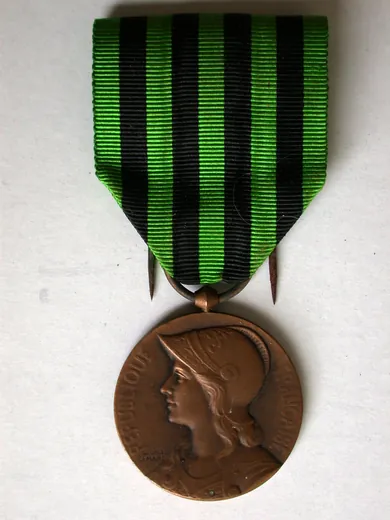
The French commemorative medal of the 1870-1871 war is a bronze disc bearing the helmeted profile of the Republic, hung from a green ribbon striped with black. It was only created in 1911, more than forty years after the war, for survivors who could prove they had served. It bears no name: its certificate is what ties it to a man. Its dedication is “Aux défenseurs de la patrie”; “Oublier... Jamais!” is the motto of a veterans' society, which issued its own badge. Here is how to recognise it, read its certificate and trace its recipient's service, from the law, the instructions of 1911 and museum records.
Get a piece identified from photos Valuing a piece: the method
In brief
- A medal of 1911. A French law of 9 November 1911 created it for combatants who could prove they had served between July 1870 and February 1871.
- A 30 mm bronze disc. The helmeted Republic on the obverse; on the reverse, a trophy of arms, the dates 1870 and 1871 and the dedication “Aux défenseurs de la patrie”, to the defenders of the homeland.
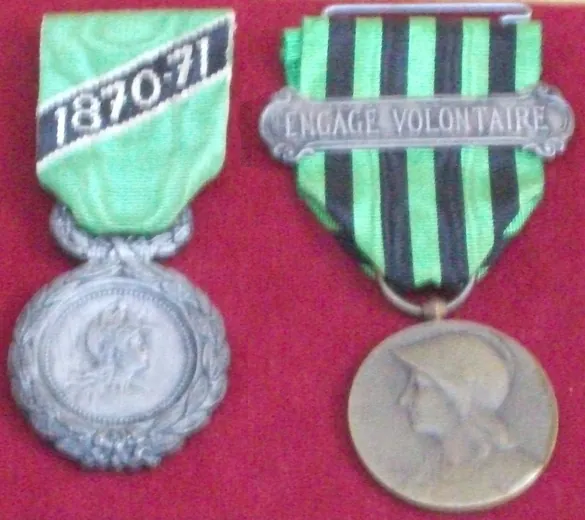
- A green ribbon striped with black. A silver clasp reading “Engagé volontaire” marks volunteers.
- The name is on the certificate. The medal bears none.
- “Oublier... Jamais!” is not the motto of the official medal. It belongs to a veterans' society, which issued its own badge.
A medal forty years in the waiting
After the war, the bravest had received the Legion of Honour or the Médaille militaire, but nothing recalled the service of everyone else. Veterans' associations gave their members private badges, with no standing as official awards, as the Nuits-Saint-Georges museum points out.
At the end of 1909, the Société des vétérans des armées de terre et de mer 1870-1871, a society of land and sea veterans, launched a petition that gathered a hundred thousand signatures. On 11 February 1910, the Chamber of Deputies adopted Georges Berry's amendment on the medal by 549 votes to 34, according to historian Bénédicte Grailles.
The law was signed on 9 November 1911 and published in the Journal officiel of 12 November 1911. It created a medal for combatants who could prove, “par pièces authentiques”, with authentic documents, that they had served under the colours “in France, in Algeria or aboard armed ships”, from July 1870 to February 1871 inclusive. The certificate was free; the insignia had to be paid for by the recipient. For the dedication, Maurice Barrès had suggested “Souviens-toi”, remember: the words chosen were “Aux défenseurs de la patrie”.
Who could receive it
The War Minister's instruction of 2 November 1911 covered serving or former soldiers “now living” who had been under the colours during that period, in one of these bodies:
- the regular army;
- the Garde nationale mobile, organised in 1868;
- recognised free corps, the corps francs;
- the Garde nationale mobilisée, raised in October and November 1870;
- the sedentary National Guard of besieged towns, such as Paris, Strasbourg or Belfort;
- the corps and services of the navy;
- customs officers, forestry officers and guards, and the Paris police constables mobilised in 1870;
- the army treasury and postal services.
An appendix of 31 March 1912 extended it to the sedentary National Guards of open towns attacked and decorated with the Legion of Honour, such as Châteaudun, Dijon or Bazeilles; the law of 27 March 1912, to doctors, male and female nurses, chaplains and the balloonists who had left Paris by balloon; the law of 13 July 1923, to children who were under fourteen when war was declared and had enrolled in the National Guard, and to minors under eighteen who had performed an act of civic courage.
The law excluded those found “unworthy through misconduct or convictions during the campaign”. The certificate of an applicant who died after the law was promulgated, and whose entitlement had been confirmed, could be handed to his closest relative as a keepsake.
The volunteers' clasp
Volunteers were entitled to a silver clasp across the ribbon, reading “Engagé volontaire”, a wording that also appears on their certificate. The application also stated, where relevant, any enlistment for the duration of the war and any wound. The child volunteers recognised in 1923 also received the medal with a clasp, and their certificate bears the title “Enfant volontaire”, child volunteer.
A clasp may have been added later: only the certificate proves the right to wear it. The Society of Friends of the Museum of the Legion of Honour also reports a rectangular black enamel clasp dated “1870-1871”, which is not regulation.
Recognising the medal
Article 2 of the law called for a 30 mm bronze medal, with the effigy of the Republic on the obverse and, on the reverse, military attributes recalling the cooperation of army and navy troops: hence the anchor at the heart of the trophy. The engraver was Georges Lemaire; according to the Nuits-Saint-Georges museum, his Republic has the features of Fernande Dubois, an actress at the Opéra-Comique.
| Feature | What the law and the museum records describe |
|---|---|
| Metal and size | Struck bronze, 30 mm in diameter; about 8 cm tall and 14.6 g with the ribbon, in Nuits-Saint-Georges |
| Obverse | Bust of the Republic, helmeted and armoured, in profile facing left; legend “REPUBLIQUE FRANCAISE”; signature “GEORGES LEMAIRE” |
| Reverse | “1870 1871” around the edge; a trophy of arms around a naval anchor, under a flag; a cartouche reading “AUX DEFENSEURS DE LA PATRIE” |
| Ribbon | 36 mm, nine stripes of 4 mm: five green, including the edges, and four black |
| Suspension | A bronze ring |
The inscriptions, word for word
The table follows the transcriptions of the Nuits-Saint-Georges and Woerth museums; in the cartouche, the dedication runs over two lines. Nuits-Saint-Georges also reads “HONNEUR ET PATRIE” on the flag and the engraver's monogram “G L”. None of these inscriptions mentions forgetting: “Oublier... Jamais!” belongs to another object, described below.
The ribbon and its colours
The ribbon, 36 millimetres wide, is divided lengthwise into nine alternating green and black stripes, each 4 millimetres wide, says the law. The Woerth museum describes a green ribbon with four black stripes: green therefore runs along both edges.
The law does not say what these colours mean. Writing about a veterans' badge, the Nuits-Saint-Georges museum sees mourning in the black and hope in the green. Bénédicte Grailles writes that they probably stand for glory and mourning, unless, she adds, they mean hope and remembrance. A new ribbon does not make the medal suspect; to keep the old one, see caring for military leather, textile and metal.
Makers: the Monnaie de Paris and the others
In December 1911, Le Vétéran, the veterans' society journal, reminded its readers that only the Monnaie de Paris, the Paris mint, had the right to strike the official 30 mm medal; the Society of Friends of the Museum of the Legion of Honour quotes the passage. The designer, however, had been allowed to have it struck in other sizes, and 36.5 mm medals circulated, in particular from the Arthus-Bertrand firm.
The Nuits-Saint-Georges museum holds an example from the mint and a 36 mm Arthus-Bertrand example whose reverse reads “LE DUC DES CARS A SES FRERES D'ARMES”, the Duc des Cars to his brothers in arms: the duke gave such medals on 16 December 1911 to eighteen or nineteen comrades of his Saint-Cyr class. A larger size may therefore be a private, non-regulation strike rather than a fake; only comparison with a documented example can tell. Whatever the size, compare the relief, the lettering and the signature, following the method for spotting fake militaria.
The certificate, the only piece that bears the name
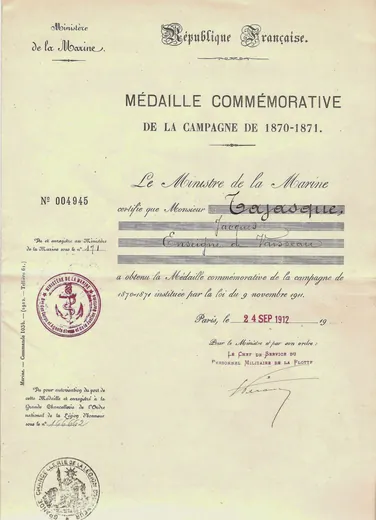
The certificate, or brevet, came from the War Ministry, or from the Navy Ministry for sailors. It went through prefects and mayors; in October 1912, the Interior Minister pointed out that veterans were waiting for the certificate “without which they cannot wear their insignia”. The same circular counted 180,000 certificates sent out for some 287,000 applications.
In Woerth, the certificate of Private Michel Burckel, of the 21st Line Infantry Regiment, is a double sheet of about 31 by 21 centimetres, signed by the War Minister Eug. Etienne and stamped by the Grand Chancellery of the Legion of Honour; that of Isidore Jean Letailleur, dated 1912, bears the name of A. Millerand. That name helps to place a War Ministry certificate: Messimy was minister at the time of the 1911 instructions, A. Millerand at the time of the law of 27 March 1912, Eug. Etienne at the time of a circular he signed on 5 May 1913. The museum also holds a large illustrated diploma, signed by Eugène Chaperon in 1912 and printed in Dijon, in the name of a Garde mobile of the Bas-Rhin. To look after these papers, see reading and keeping military photographs and documents.
Telling it apart from other medals
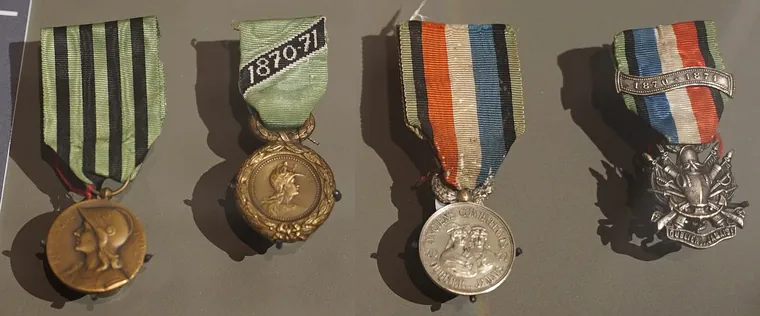
Several medals carry the dates of the war, or the figure 1870, without being the medal of 1911.
“Oublier... Jamais!”: the veterans' medal
“Oublier... Jamais!”, meaning “forget? never!”, is the motto of the Vétérans des armées de terre et de mer 1870-1871, a national retirement society founded on 1 January 1893, which gave its members its own badge. The Nuits-Saint-Georges museum describes a gilt example: an openwork trophy of arms on an anchor, above a blue-enamelled scroll reading “OUBLIER... JAMAIS !”; an oak-leaf suspension; a tricolour ribbon edged with black and green, with a bar reading “1870 - 1871”.
The spelling varies: Bénédicte Grailles writes “Oublier, jamais !”. Other associations issued medals of their own, as the Society of Friends of the Museum of the Legion of Honour points out. None of these badges is a variant of the 1911 medal: each is judged on its own terms.
The Médaille militaire and the St Helena Medal
The Médaille militaire, created on 22 January 1852, is a decoration for non-commissioned officers and soldiers; its reverse bears “Valeur et discipline”. The figure 1870 may appear in its legend: the Australian War Memorial holds an example marked “REPUBLIQUE FRANÇAISE * 1870 *”, which it catalogues under the First World War. It is not a medal of the 1870 war: see the guide to the Médaille militaire.
The St Helena Medal, created by the decree of 12 August 1857, is also bronze, but it bears the emperor's effigy, hangs from a green and red ribbon and was meant for soldiers of the campaigns of 1792 to 1815: see the guide to the St Helena Medal. Under the Second Empire, a decree of 11 August 1859 had created the Italian campaign medal, in silver, hanging from a red ribbon striped with white.
Tracing the veteran and his service
Start with the certificate: it gives the name, often the rank and corps, and the corps decided which administration handled the application, and so which archives to search.
The application file
The 1911 instruction sent applications to the War Ministry for the regular army, the Garde nationale mobile and the free corps; to the prefect of the man's wartime home for the Garde nationale mobilisée and the sedentary guard of Paris; to the town hall for that of other besieged towns; to the Navy Ministry for sailors. Prefectures and town halls checked entitlement, then sent the War Ministry lists of those entitled, with surname, first names, rank, corps and address.
The files of National Guardsmen, where they survive, are therefore in departmental and municipal archives. In February 1912, the Interior Minister noted that some prefectures and town halls still held muster lists, minutes of the election of officers and nominal rolls of the Garde nationale mobilisée. On FranceArchives, the portal of French archive inventories, search for “médaille de 1870” with the name of the department or commune.
His service during the war
For the regular army, troop rolls follow a soldier unit by unit: according to the Service historique de la Défense's research guide, infantry from 1820 to 1880 is in sub-series GR 34Yc, the provisional units and free corps of 1870-1871 in GR Lz. That guide refers National Guards and mobiles to departmental archives, where it also places recruitment records, in series R, including the registres matricules, the service registers systematised in 1867. In a photograph in uniform, the 1867 kepi can be recognised with the guide to the French military kepi.
His other decorations
For a member of the Legion of Honour, look for his file in the French National Archives' Léonore database, and date his cross with the guide to the Legion of Honour. The Grand Chancellery manages only the Legion of Honour, the Ordre national du Mérite and the Médaille militaire; for other decorations, its research sheet refers enquirers to the archives of the ministries that awarded them.
Judging a medal without talking about price
By the end of October 1912, 180,000 certificates had already been sent out. But the certificate was free and the insignia had to be bought by the recipient: that figure does not say how many medals were purchased. Four questions set a fine piece apart:
- Is it the medal of the law? Bronze, 30 millimetres, correct inscriptions; a private 36 mm strike or an association badge is judged separately.
- Is it complete? Ribbon, a clasp if the recipient was a volunteer, certificate. Each may have been brought together later.
- Is it attributed? A named certificate, confirmed by an archive file, turns an anonymous medal into that of a combatant whose story can be traced.
- What condition is it in? Relief, patina, a faded or replaced ribbon. Do not clean it to show it off.
With the same man's other decorations and papers, it is judged as a whole; to place it against comparable sales, see valuing a military item.
What I cannot tell you here
I cannot tell you, from a photograph, whether a medal was struck in 1912 or later: it bears no date of manufacture, and none of this guide's sources describes copies or miniatures. Nor can I tie a medal on its own to a man: a certificate may have joined it later. Finally, none of these sources points to a national list of recipients that can be consulted online.
This guide gives no prices. Photograph the obverse, the reverse, the ribbon, the clasp and the certificate, then ask for free identification help. To compare with other pieces from the period, see the Franco-Prussian War category. On the other side, the Prussian infantry wore the spiked helmet, which has its own guide.
Frequently asked questions
What is the French 1870 commemorative medal?
It is the medal created by the French law of 9 November 1911 for combatants of the 1870-1871 war who could prove they had served, in France, in Algeria or aboard armed ships, between July 1870 and February 1871. It is bronze, 30 millimetres across, with the helmeted Republic on the obverse and the dedication “Aux défenseurs de la patrie” on the reverse. It hangs from a ribbon of nine green and black stripes.
Who received the French Franco-Prussian War medal?
Survivors who had served between July 1870 and February 1871 in the regular army, the Garde nationale mobile, recognised free corps, the mobilised National Guard or the sedentary guard of besieged towns, the navy and a few mobilised bodies such as customs officers. Laws of 1912 and 1923 extended it to doctors, nurses, chaplains and balloonists, then to child volunteers of the National Guard. By the end of October 1912, 180,000 certificates had already been sent out.
What does “Aux défenseurs de la patrie” mean on the 1870 medal?
“To the defenders of the homeland” is the dedication in the cartouche on the reverse of the official commemorative medal, on a trophy of arms centred on a naval anchor, with the dates 1870 and 1871. Maurice Barrès had suggested “Souviens-toi”, remember; this dedication was chosen instead. The medal bears no name: to know who received it, you need its certificate.
Is the 1870 “Oublier... Jamais” medal official?
No. “Oublier... Jamais!” is the motto of the Vétérans des armées de terre et de mer 1870-1871, a national retirement society founded in 1893, which gave its members a badge with a trophy of arms that had no standing as an official award. The official medal, created by the law of 1911, bears “Aux défenseurs de la patrie” on the reverse. It is a 30 mm bronze disc on a green ribbon striped with black; the veterans' badge described by the Nuits-Saint-Georges museum is an openwork trophy on a tricolour ribbon.
What is the 1870 Médaille militaire?
The Médaille militaire was not created for the 1870 war: instituted on 22 January 1852, it is an individual decoration for non-commissioned officers and soldiers, with “Valeur et discipline” on the reverse. Some examples bear the legend “REPUBLIQUE FRANÇAISE * 1870 *” without being medals of that war. The decoration given to all veterans of 1870-1871 is the commemorative medal of 1911, in bronze, on a green ribbon striped with black.
How do you trace an ancestor who received the 1870 war medal?
Start with the certificate, which gives the name and the corps. Then look for a trace of his application. For a National Guardsman, the prefecture or town hall of his wartime home checked entitlement, so files may survive in departmental or municipal archives; for the regular army, applications went to the War Ministry. His military service can be followed in the troop rolls of the Service historique de la Défense for the regular army, and in departmental archives for National Guards and mobiles.
What does the “Engagé volontaire” clasp on the 1870 medal mean?
It marks a volunteer: the law of 9 November 1911 provides for a silver clasp across the ribbon, reading “Engagé volontaire”, a wording that also appears on the certificate. A clasp may have been added later: only the certificate proves the right to wear it. A rectangular black enamel clasp dated 1870-1871 is not regulation.
What is a French 1870 war medal worth?
This guide gives no prices. The certificate was free and the insignia had to be bought, so the 180,000 certificates sent out by the end of October 1912 do not say how many medals were purchased. What sets a piece apart is being the medal of the law, being complete, with its ribbon, its clasp where relevant and its certificate, and above all being attributed to a man whose service the archives can trace. Comparison with sales actually completed for similar pieces does the rest.
Sources
This guide draws on the texts, databases and pages below, accessed on unless otherwise stated. Most of them are in French.
- Bénédicte Grailles, “Gloria Victis: Vétérans de la guerre de 1870-1871 et reconnaissance nationale” (veterans of the 1870-1871 war and national recognition), Revue d'histoire du XIXe siècle, no. 30, 2005, on OpenEdition Journals
- Society of Friends of the Museum of the Legion of Honour and Orders of Chivalry, on the 1870-1871 commemorative medal: text of the law of 9 November 1911 (Journal officiel of 12 November 1911), of the War Minister's instructions of 21 September and 2 November 1911 and their appendix of 31 March 1912, of instructions and circulars of 1912 and 1913, and of the laws of 27 March 1912 and 13 July 1923
- Nuits-Saint-Georges municipal museum, record of an 1870-1871 commemorative medal engraved by Georges Lemaire and struck by the Monnaie de Paris (inv. 94.5.8), Joconde database on the Plateforme ouverte du patrimoine
- Museum of the battle of 6 August 1870, Woerth, record of an 1870-1871 campaign commemorative medal engraved by Georges Lemaire (inv. 2006.0.60), Joconde database on the Plateforme ouverte du patrimoine
- Nuits-Saint-Georges municipal museum, record of a private 36 mm version of the 1870-1871 medal struck by Arthus-Bertrand for the Duc des Cars (inv. 94.5.7), Joconde database on the Plateforme ouverte du patrimoine
- Museum of the battle of 6 August 1870, Woerth, record of the 1870-1871 commemorative medal certificate of Private Michel Burckel, 21st Line Infantry Regiment (inv. 2005.0.159), Joconde database on the Plateforme ouverte du patrimoine
- Museum of the battle of 6 August 1870, Woerth, record of the 1870-1871 commemorative medal certificate of Private Isidore Jean Letailleur, 94th Line Infantry Regiment (inv. 2006.0.61), Joconde database on the Plateforme ouverte du patrimoine
- Museum of the battle of 6 August 1870, Woerth, record of an illustrated diploma for the 1870-1871 commemorative medal, signed by Eugène Chaperon and printed by Gerin in Dijon (inv. 2006.4.2), Joconde database on the Plateforme ouverte du patrimoine
- Nuits-Saint-Georges municipal museum, record of the unofficial medal of the Vétérans des armées de terre et de mer society, inscribed “OUBLIER... JAMAIS !” (inv. 94.5.9), Joconde database on the Plateforme ouverte du patrimoine
- Grande Chancellerie de la Légion d'honneur, on the Médaille militaire, accessed
- Australian War Memorial, record “French Medaille Militaire” (RELAWM14767): legend “REPUBLIQUE FRANÇAISE * 1870 *” and reverse “VALEUR ET DISCIPLINE”
- François-Frédéric Steenackers, Histoire des ordres de chevalerie et des distinctions honorifiques en France, Paris, 1867, chapter on the St Helena Medal: text of the decree of 12 August 1857 and of the Moniteur notice of 28 August 1857 (extract digitised by Düsseldorf University Library), accessed
- Service historique de la Défense, research guide on tracing NCOs, airmen, soldiers and sailors, accessed
- Léonore database, French National Archives: files of members of the Legion of Honour, accessed
- Grande Chancellerie de la Légion d'honneur, archives portal, research guide on French decorations not managed by the Grand Chancellery (September 2025), accessed