Identifying and dating a German spiked helmet, from the 1842 to the 1915 model
By Augustin, founder of Athena Militaria Published
The spiked helmet is the most recognisable object in German militaria, and one of the most tampered with. Between 1842 and 1915 it changed height, visor, chinstrap and metal, and it all shows on the object. This guide gives you the method to date a helmet, spot a rebuild or a copy, and judge what makes its value. It gives no prices: it gives the criteria.
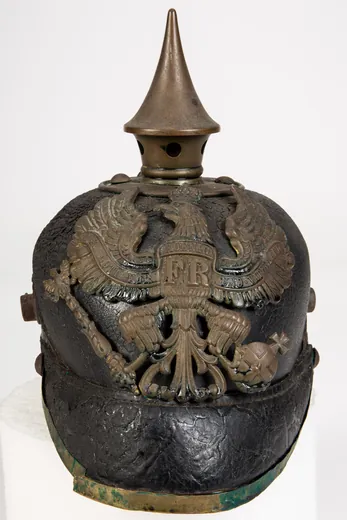
The spiked helmet in two minutes: 1842-1916
The spiked helmet entered the Prussian infantry by a cabinet order of 23 October 1842, under Frederick William IV. Russia adopted its own in 1844; who copied whom is still debated. The other German states followed, Bavaria last, around 1886.
Two misconceptions to clear up. Not every soldier of 1914 wore it: Jäger, Schützen, machine-gun detachments, telegraph, airship and supply troops wore the shako, the pioneers kept the spiked helmet, and the artillery had replaced the spike with a ball since 1844, because the spike injured horses. And it has nothing to do with 1939-1945. Withdrawn from the front in 1916 in favour of the steel helmet, after 1919 it survived only with a few police forces: the Bavarian gendarmerie and police kept their spiked helmet until 1935, while the other German police forces moved to the shako. Such a helmet belongs to the First World War or to the nineteenth century, never to the Second.
Dating a helmet: the markers that change from 1842 to 1915
An other ranks' helmet is dated by its silhouette and its fittings; many were converted from one model to the next, hence hybrids that are perfectly genuine.
- Model 1842. A very tall helmet, 34 to 38 cm including the spike, of which 14 cm is the spike on a cruciform base, a square front visor, convex scales for all ranks. Very rare.
- 1860. The scroll "MIT GOTT FÜR KOENIG UND VATERLAND" added to the eagle.
- Model 1867. Round spike base, rounded front visor, rear spine removed, plate held by slides. Dragoons kept the cruciform base and square visor.
- Model 1871. The bolt returned to hold the plate, slides having lost too many eagles, and so did the spine, the helmet being too weak without it.
- Models 1887 and 1891. For foot troops, except the Guard and grenadier regiments which kept their scales, a leather chinstrap replaced the scales, and the spike, now shorter, was pierced with five, sometimes six, vents. In 1891 came the "M91" side posts and the V-buckle chinstrap.
- Model 1895. The last height reduction, a sliding vent on the spine of infantry helmets, the plate held by loop prongs locked with leather wedges. This is the helmet of 1914, as described by the musée de l'Armée and the Meaux museum: copper-aluminium alloy lighter than brass, spike base pierced with five holes. Height: about twenty centimetres including the spike, against 34 to 38 in 1842.
Reading the plate: Prussia, the other states and the artillery ball
The plate names the state and, in Prussia, the type of troops. The line eagle carries the cipher "FR", Fridericus Rex; grenadiers "FWR"; the Guard has an eagle with spread wings and the Guard star; Landwehr and reserve replace the cipher and the scroll with the silvered Landwehr cross, shaped like an Iron Cross. On a foot troops' helmet made after 1887, the pearl ring at the collar of the spike, the Perlring, marks an officer; before that date other ranks had a plainer one too, and the cavalry kept it.
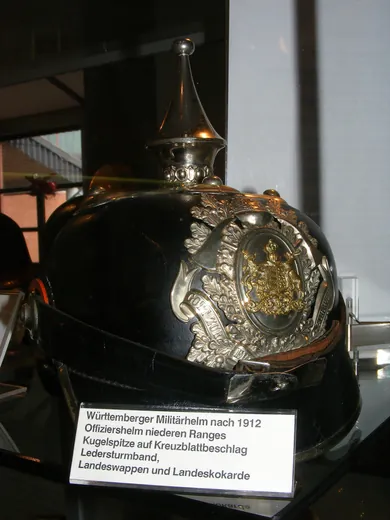
Outside Prussia, each state has its own arms and cockade: a Württemberg field artillery officer's helmet shows the kingdom's arms, a tall removable ball on a cruciform base and the state cockade. The ball is not an anomaly: artillery, police, gendarmerie and customs wore it.
Cockades, chinstraps, cover: the small parts that confirm or betray
Since 22 March 1897 a helmet carries two cockades: on the right the Reichskokarde, red at the centre, white, then black at the rim; on the left that of the state. Original other ranks' cockades are most often sheet iron, hence magnetic, but brass ones exist, Bavaria used nickel silver, some Reichskokarden are aluminium, and the first copies were tin; the lead-white paint of originals cracks, flakes and yellows.
The M91 leather chinstrap ends in a V-notched brass buckle that unhooks easily: so many helmets have lost theirs that an original chinstrap weighs heavily in the assessment.
The 1892 cloth cover carried the regiment number in red, then in green from August 1914.
Turning the helmet over: liner, stamps, and what their absence means
The other ranks' liner is leather, with rounded tongues, from the first model to the last; the fine leather sweatband and silk crown are, from about 1880, the mark of privately purchased officers' helmets. The stamps are read on the neck guard and inside the crown. "BA" followed by a Roman numeral is the Bekleidungsamt, the clothing depot of an army corps: BAG for the Guard, BA I to BA XVII, BA XIX for Leipzig. The regiment is abbreviated, IR 79, FAR 34, HR 16; an initial R means reserve; a year dates the issue or a reissue.
An example from a specialist forum: a model 1915 stamped "J.G. LIEB SÖHNE, BIBERACH", 1916, company letters, a number and "B.A. X". A reading worth redoing in good light, since a half-worn "BA X" looks very much like it.
No stamp? Only other ranks' helmets, Crown property, were stamped on issue; officers' helmets and private purchases carry no depot stamp.
1914-1916: felt, sheet metal, grey steel and the removable spike
The substitute helmets of 1914
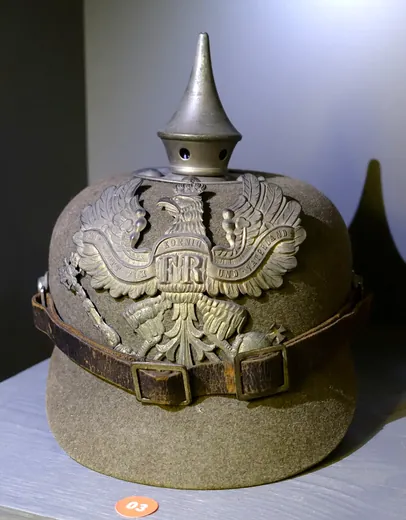
From August 1914, leather ran short. Substitute helmets, known as Ersatz, were made of felt, sheet metal, steel, fibre, even cardboard, first with brass or silvered fittings from pre-war stocks, then with the grey steel of 1915. A felt helmet with a silvered eagle and a grey spike, like the one in the Brunswick Landesmuseum, is therefore consistent.
The 1915 model and its removable spike
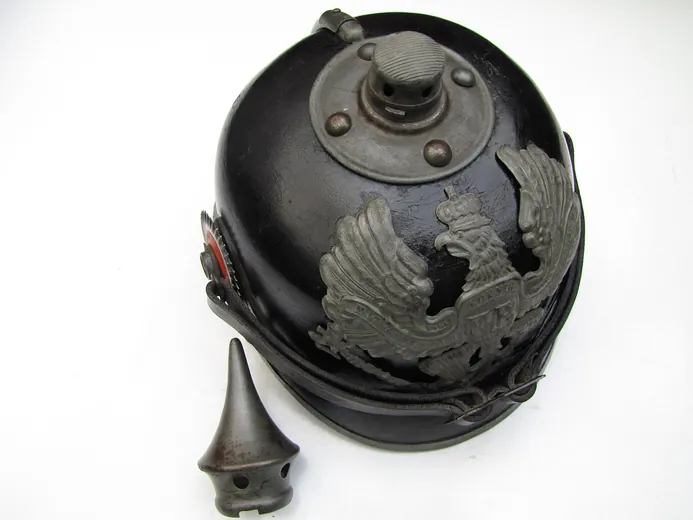
The 1915 model, introduced on 28 June 1915 (11 November in Bavaria), saved brass and silver: oxidised steel fittings, unpainted, in varying greys, and a removable spike whose slot engages a bayonet lug. A simple test: on an other ranks' 1895 model the spike is fixed and does not come off; on a 1915 it lifts off with a quarter turn. Only the 1887 spike neck rotated, to open or close its vents. From September 1915 the spike was removed in the front line; in 1916 the steel helmet took over.
Copies, rebuilds, replaced parts: the examination piece by piece
Reproductions circulate, sometimes sold honestly for re-enactment, then resold as originals.
- The body. Original leather is surface-crazed and darkened, which copies do not imitate; thin leather betrays the Indian copies; original felt is hard, never soft.
- The plate. Die-struck on an original. Cast, it has a smooth, bubbly back, a coarse grain, sometimes painted-over solder. A second set of holes in the body betrays a replacement eagle.
- The fittings. Spike-base rivets with flat heads, not domed ones; thin chinstrap buckles. Suspect: on an infantry 1895 model, a spine without a sliding vent (cavalry and artillery helmets had none) or with a bent base; a fixed spike on a supposed 1915 model.
- The liner. Original seams, hand or early machine sewn, use linen or cotton thread; new synthetic thread glows under an ultraviolet lamp.
- The stamps. A modern, too regular typeface condemns the marking.
Rebuilds are more common than copies: unplated rivets where the originals were plated, traces of another eagle on the body, a reworked rear trim, a 1915 liner under a brass spike. An 1895 model rebuilt as a 1915 is common, the reverse much less so. The general method for examining a fake and the rules for caring for leather and metal apply here: do not polish anything.
Valuing without a figure: what makes the value, and what the law says
Criteria, not prices. The model: early helmets, quickly replaced, are rare. The state: Prussia is the most common, Bavaria comes after, and the fewer regiments a state fielded, the rarer its helmets. Finally completeness: body, spike, plate, chinstrap, liner and cockades present, aged together, legible stamps. The approach is that of the guide on valuing a military item; the guide on the German steel helmet covers the following period.
As for the law, article R645-1 of the French Penal Code covers only the uniforms, insignia and emblems recalling those of organisations declared criminal at Nuremberg or of persons convicted of crimes against humanity: the imperial eagle and the cockades fall outside it. The guide on selling militaria legally recalls the general rules, and our 1914-1918 uniforms and headgear show what is on the market.
What I cannot tell you here
I cannot tell you, from photographs, whether a liner is original or whether rivets have been replated: you have to hold the helmet, turn it over, run the magnet over the cockades and the lamp over the seams. Nor can I settle the dates the sources argue over, such as the year of the Bavarian adoption. And what a helmet is worth depends on the example in your hands.
Frequently asked questions
How do I identify a German pickelhaube?
Start with the front plate, which names the state: an eagle with the FR cipher for the Prussian line, coats of arms for Bavaria, Saxony, Württemberg or Baden. Then date it by silhouette and fittings: height of the body, round or cruciform spike base, visor trim, leather or scale chinstrap. Finally turn it over to read the depot and regimental stamps.
Is my pickelhaube a model 1895 or a model 1915?
The 1895 model has brass, aluminium-bronze or silvered nickel-silver fittings depending on the unit, and its spike is fixed. The 1915 model has grey oxidised steel fittings, and its spike comes off: a slot engages a bayonet lug. An 1895 helmet rebuilt with grey parts is common; check that the rivets and the holes in the body are original.
How much is a pickelhaube worth?
There is no price for the pickelhaube, only a price per example. It depends on the model, the state (Prussia is the most common, small states are rare), the rank, and above all completeness: original liner, chinstrap and cockades, legible stamps, consistent ageing of every part. A mismatched or rebuilt helmet is judged as an assembly.
How can I tell if a pickelhaube is fake or real?
Run a magnet over the cockades: most Prussian other ranks' cockades are sheet iron and stick, but not all, Bavaria used nickel silver and some Reichskokarden are aluminium; a magnet that does not stick is a doubt, not a verdict. Look at the back of the plate, die-struck on an original, smooth and bubbly on a casting. Check that the rivets are flat, that the liner seams are in linen or cotton thread, that nothing glows under ultraviolet light and that the stamps are not in a modern typeface. Leather with no surface crazing is a strong sign of a reproduction, to be confirmed by the others.
What do the markings inside a pickelhaube mean?
"BA" followed by a Roman numeral is the Bekleidungsamt, the clothing depot of the army corps that issued the helmet; BAG is the Guard's. Letters and figures such as IR 79 or FAR 34 give the regiment, an initial R the reserve, and a year the date of issue or reissue. An officer's or privately purchased helmet carries none of these stamps.
Was the German spiked helmet worn in WW2?
No. The spiked helmet left the front line in 1916, replaced by the model 1916 steel helmet, after an order of September 1915 to wear it without its spike at the front. Only a few police forces kept it afterwards, Bavaria until 1935. A helmet described as a "WW2 pickelhaube" is misdated or misdescribed.