The French 1859 Italy campaign medal: recognising it and tracing its recipient
By François, contributor to Athena Militaria Published 13 min read
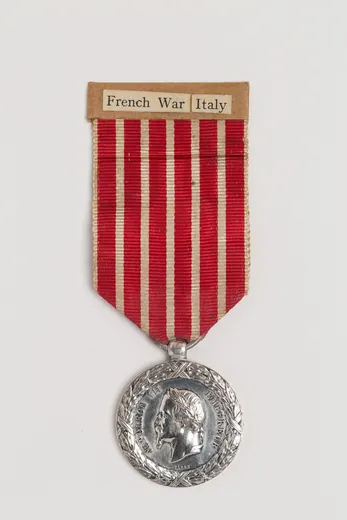
The French commemorative medal for the Italian campaign is a small silver medal bearing the head of Napoleon III, created by a decree of 11 August 1859 for the soldiers and sailors of the Army of Italy. Its reverse carries six names, from Montebello to Solferino, and its red ribbon is striped with white. It bears no recipient's name; museums hold examples in silver, white metal and tin, and miniatures, alongside souvenir medals that look much like it. Here is how to recognise it, tell it apart from the Sardinian and Italian medals of the same campaign and trace the soldier who received it, from the decree, museum records and archive guides.
Get a piece identified from photos Valuing a piece: the method
In brief
- A decree of 11 August 1859. Napoleon III created a commemorative medal for all the soldiers and sailors who had served in the Italian campaign. The first were handed out on 15 August 1859, the Emperor's feast day.
- A silver medal signed Barre. The laureate head of Napoleon III on the obverse; on the reverse, “CAMPAGNE D'ITALIE 1859” and six names, from Montebello to Solferino.
- A red ribbon striped with white. Six red stripes and five white ones, worn on the left breast.
- Several makes. Museums hold examples in silver, white metal and tin, and miniatures.
- The soldier is traced through his regiment. The medal bears no name, and the troop registers of the Service historique de la Défense, the French defence archives, are arranged by unit.
A medal created as the army came home
In May 1859, Napoleon III personally commanded the army sent to Italy alongside the Kingdom of Piedmont-Sardinia, against Austria: 170,000 soldiers, the Imperial Guard and four army corps, according to the French Ministry of the Armed Forces' magazine Soldats de France. The campaign opened at Montebello on 20 May, and its last battle was Solferino, on 24 June; on 11 July, at Villafranca, the two emperors signed an armistice, and peace was concluded at Zurich on 10 November 1859.
The decree creating the medal was signed at the palace of Saint-Cloud on 11 August 1859. In the text reproduced by Steenackers in 1867, the medal is “granted by the Emperor, on the proposal of the minister of war and of the navy, to all soldiers and sailors who have served in the Italian campaign”. According to the same magazine, the first were handed out on the Emperor's feast day, 15 August 1859.
It came two years after the St Helena Medal, created by a decree of 12 August 1857 for the soldiers of 1792 to 1815 and the work of the same engraver, according to the Vendôme museum: see recognising the St Helena Medal.
Recognising the medal
The decree sets the medal in silver, “du module de 27 millimètres”, a 27 mm medallion, and frames it with a laurel wreath standing in relief on both sides. The examples measured by museums are 30 mm across, wreath included, at the San Martino della Battaglia museum, near Solferino, as at the Risorgimento museum in Ravenna.
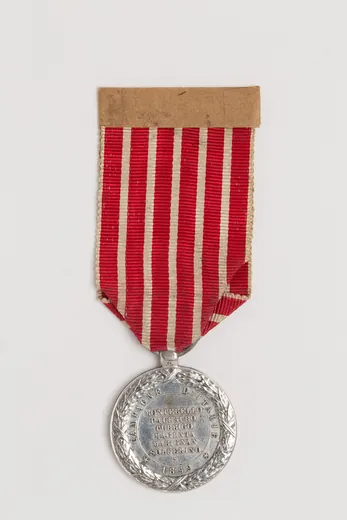
On the obverse, the laureate head of Napoleon III, facing left, is surrounded by “NAPOLEON III EMPEREUR”; the signature “BARRE”, that of the engraver Désiré-Albert Barre, is struck below the neck. On the reverse, the legend “CAMPAGNE D'ITALIE” runs along the wreath and closes on the date, “1859”, between two small stars; in the centre, the six names are set out on six lines. At the top, a small loop takes the ring for the ribbon.
| Feature | What the decree and the recorded examples show |
|---|---|
| Metal | Silver, under the decree; museums also hold examples in white metal and in tin |
| Size | A 27 mm medallion under the decree; 30 mm for the measured examples |
| Obverse | Laureate head of Napoleon III facing left, “NAPOLEON III EMPEREUR”, “BARRE” below the neck |
| Reverse | “CAMPAGNE D'ITALIE”, “1859” between two stars, six engagement names on six lines |
| Ribbon | Red striped with white: six red stripes, five white stripes |
| Recipient's name | None: the records read for this guide report no engraved name |
Six names, six engagements
The decree writes them in chronological order, and Solferino without an accent, as on the medal:
- Montebello, 20 May. The first engagement of the campaign, fought by General Forey's division.
- Palestro, 30 and 31 May. The victory of King Victor Emmanuel II, supported by the 3rd Zouave Regiment.
- Turbigo, 3 June. The Imperial Guard had thrown three bridges near Turbigo the day before; an Austrian attack was driven back there.
- Magenta, 4 June. The victory that opened the road to Milan; according to the biography published by the Élysée, Napoleon III made Mac Mahon a marshal and Duke of Magenta there.
- Marignan, 8 June. The French name for Melegnano, where Marshal Baraguey d'Hilliers' 1st Corps attacked the Austrians, not the famous victory of Francis I.
- Solferino, 24 June. The last battle: of 150,000 French and Sardinian troops and as many Austrians engaged, 30,000 men were killed or wounded.
The ribbon
The decree says only “striped red and white”. The descriptions specify: six red stripes and five white ones, according to the ministry's magazine; six broader red stripes and five narrower white ones, on the example of General Luigi Scozia di Calliano kept at San Martino. It is worn on the left breast.
In Bergamo, the historical archives of the Italian Red Cross hold an example whose ribbon, with ten white bands and nine red, is not original according to their record. A different ribbon does not condemn a medal, but it tells you nothing about its history. To keep it, follow the method in caring for leather, textile and metal.
Sizes, metals and variants
The decree knows only one medal, in silver. Public collections show more:
- Miniatures. The Solferino museum holds a 17 mm miniature in silver, with its loop, its ring and a small ribbon, bearing the same inscriptions.
- White metal. At San Martino, an example in white metal, marked “S.J” below the bust, is attributed by the museum, from examination of the material, to the Johnson firm in Milan. Because the medal was also given to Italian soldiers, the record says, some examples were struck in Italy itself.
- Tin. The Musée de la Vie romantique in Paris holds a 3.1 cm Italian campaign decoration in tin, which bears “PARIS” at the bottom of the obverse, where you would expect “BARRE”. It is said to have belonged to the engraver Luigi Calamatta.
Nothing in these records makes them fakes: they are other makes of the same decoration. But none of them is the silver medal of the decree.
Copies and restrikes: what can be checked
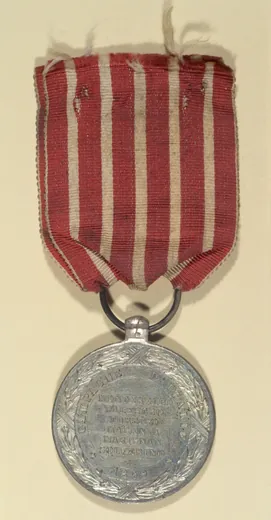
None of the sources of this guide describes modern copies or restrikes, and the date the medal bears is that of the campaign, not of its striking. What remains is comparison with documented examples:
- Metal. The silver of the decree, not white metal or tin.
- Size. About 30 mm, wreath included; 17 mm for the Solferino miniature.
- Design. The six names in order, the two stars around the date, “BARRE” below the neck or, in its place, another mark such as “S.J” or “PARIS”, the wreath in relief on both faces.
- Suspension. A loop and a ring on the recorded examples. The decree provides for no ornament set above them, a crown for instance: if there is one, it is a point to clear up.
A discrepancy proves nothing on its own: it calls for an explanation. The principles that apply to every piece are in spotting fake militaria.
Telling it apart
Three families of 1859 medals turn up alongside the French decoration.
Souvenirs of the campaign
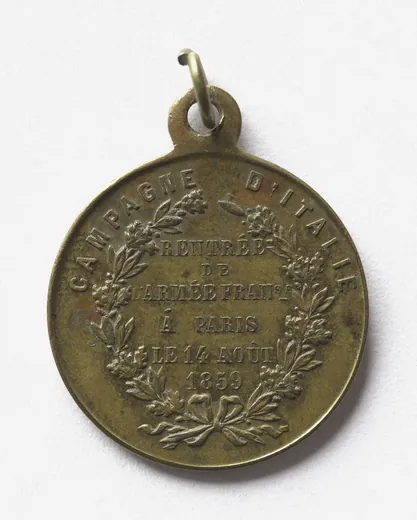
The Musée Carnavalet holds a 2.4 cm medal with the head of Napoleon III whose reverse bears “CAMPAGNE D'ITALIE” and “RENTREE DE L'ARMEE FRAN-SE A PARIS LE 14 AOUT 1859”, the return of the French army to Paris. At San Martino, a 28 mm popular medal in brass pairs Napoleon III, “LIBERATORE DEGLI ITALIANI”, with Victor Emmanuel II, “DIFENSORE DELL'INDIPENDENZA ITALIANA”. At the Solferino museum, a 23 mm brass medal with a ring shows the two sovereigns in two ovals and reads “VICTOIRE DE CAVRIANA GAGNEE LE 24 JUIN 1859”.
None of them carries the six names of the official reverse: that is the first sign to look for.
The Sardinian medal for military valour
The Kingdom of Sardinia had its own award, the medal “AL VALORE MILITARE”. According to the San Martino museum's records, it shows an oval shield with the cross of Savoy under the royal crown, between a palm and a laurel branch; its reverse reads “GUERRA CONTRO L'IMPERO D'AUSTRIA”, and its ribbon is blue. The museum holds one in gold, bearing “S.MARTINO 24 GIUGNO 1859”, and the silver one of Second Lieutenant Valdemaro Ricci d'Adorno, of the Bersaglieri, killed on 24 June 1859.
In a group of decorations, a medal on a blue ribbon with the cross of Savoy is therefore another award: only the papers will tell how it was earned.
The Italian medal for the wars of independence
Created by a royal decree of 4 March 1865, the Italian commemorative medal for the wars of independence and unification bears Victor Emmanuel II, “VITTORIO EMANUELE II RE D'ITALIA”, and on the reverse “GUERRE PER L'INDIPENDENZA E L'UNITA' D'ITALIA”. Its ribbon repeats the Italian tricolour, and each campaign is marked on it by a dated laurel clasp: that of Ferdinando Fiorio, of the Cacciatori delle Alpi, kept in Bergamo, carries two, “1859” and “1866”. A “1859” clasp on a tricolour ribbon therefore points to the Italian medal: the French decree provides for no clasp.
Who received it
The decree covers “all soldiers and sailors” of the campaign, with no condition of rank. Allies received it too: the San Martino museum holds that of General Scozia di Calliano, who commanded the Sardinian Grenadier Brigade on 24 June 1859 at Madonna della Scoperta, and the Italian Red Cross archives that of Second Lieutenant Umberto Vaccari, of the Sardinian army.
The Médaille militaire, created in 1852 for NCOs and soldiers, is by contrast an individual award, given during the campaign itself: Steenackers records, by decree of 7 June 1859, a vivandière of the Zouaves of the Guard and a canteen-keeper of the 2nd Zouaves, both distinguished at Magenta, then, on 25 June, a canteen-keeper of the Guard's chasseurs à pied, wounded at Solferino. France also gave it to Italians: at San Martino, the record of the one held by Corporal Antonio Germagnoli states that this French medal was conferred on Italian soldiers in the Crimea as in 1859.
The Médaille militaire of those years bears the effigy of Louis-Napoléon and an eagle, on a yellow ribbon edged with green: see dating a Médaille militaire, and for the cross, dating a Legion of Honour.
Tracing the soldier
The medal bears no name. The starting point is therefore a family paper that mentions it, a photograph in uniform, a grave: see reading and keeping military photographs and documents. Once the name is established, everything depends on the unit.
Soldiers and NCOs
The Service historique de la Défense's guide puts it plainly: the troop registers, the contrôles de troupe kept at Vincennes, are arranged by unit, and you must first know which unit the man served in. They follow his postings, his citations and his decorations. For this period: Imperial Guard in GR 31 Yc (1854-1870), infantry in GR 34 Yc (1820-1880), cavalry in GR 35 Yc (1816-1879), artillery in GR 36 Yc (1784-1877), engineers in GR 37 Yc (1816-1887), chasseurs à pied in GR 44 Yc (1851-1899).
If the unit is unknown, start from recruitment: series R of the departmental archives of the place of recruitment holds the lists of the drawing of lots, the medical boards and the make-up of each year's contingent. The registres matricules, the usual starting point for tracing a French soldier of 1914-1918, were only made systematic in 1867: for a soldier of 1859, rely on those lists.
Sailors
State sailors appear in the service registers of the naval ports, archived by the Service historique de la Défense at Brest, Cherbourg, Lorient, Rochefort and Toulon: you need to know the port where the man was registered. Those of the inscription maritime, the register of seafarers, are found in the registers of their district.
Officers
An officer is found in the printed army lists, among them the Annuaire militaire published from 1848 to 1870 and, for the navy, the Annuaire de la marine et des colonies. According to the same service, the officers' career files closed between 1848 and 1925 are in sub-series GR 5 Ye.
The Legion of Honour and the Médaille militaire
Look for the file of a Legion of Honour member from the campaign at the French National Archives, which keep those of members appointed since 1802 who died before 1977: the Léonore database lists them. For the Médaille militaire, the Grand Chancellery itself warns that its archives of nineteenth-century awards are not complete, most of the documents having been destroyed in the fire at the Palais de Salm in 1871. The troop registers, which record decorations, then take over.
Judging a medal without talking prices
The medal went to everyone who had served in the campaign: on its own, it is not rare. What sets a piece apart is read in four steps:
- Is it the medal of the decree? Silver, about 30 mm, “BARRE” below the neck, six names on the reverse. A miniature or another metal is judged separately.
- Is it complete? Loop, ring, a ribbon of the right pattern; a recent ribbon proves nothing.
- Is it attributed? A named paper, confirmed by the troop registers, makes it the medal of a soldier whose service is known.
- Does it come with others? A Médaille militaire, a Legion of Honour or, for a man who stayed in the army, the 1870-1871 medal tell the story of a career; separated, they lose part of it.
To place a piece against comparable sales afterwards, the method is in valuing a military item.
What I cannot tell you here
I cannot tell you, from a photograph, whether a medal was struck in 1859 or much later, nor tie it on its own to a man: none of the sources of this guide describes restrikes, and the medal bears no name. No official text or museum record consulted describes a certificate specific to this medal, or the number of medals handed out: so you will find here neither a model certificate nor a figure.
This guide gives no prices. For a particular medal, photograph the obverse, the reverse, the loop, the ribbon and every paper on both sides, then ask for free identification help. To compare with other Second Empire pieces, see the Franco-Prussian War category, or the whole catalogue.
Frequently asked questions
What is the French 1859 Italy campaign medal?
It is a silver commemorative medal created by a decree of Napoleon III of 11 August 1859 for all the soldiers and sailors who had served in the Italian campaign. It bears the laureate head of Napoleon III and “NAPOLEON III EMPEREUR” on the obverse, and “CAMPAGNE D'ITALIE 1859” with six engagement names, from Montebello to Solferino, on the reverse. The first were handed out on 15 August 1859, the Emperor's feast day.
How do you recognise a French Italy medal of 1859?
Compare it with the examples described by museums: silver, 30 mm including the wreath, laureate head of Napoleon III facing left, “BARRE” below the neck, a laurel wreath in relief on both faces, six names on six lines on the reverse and the date 1859 between two stars. The ribbon is red with five white stripes. A miniature, or an example in white metal or tin, is not necessarily fake, but it is not the silver medal of the decree.
What do Solferino and Magenta mean on the medal?
They are two of the six engagements listed on the reverse, in the order of the campaign: Montebello (20 May 1859), Palestro (30 and 31 May), Turbigo (3 June), Magenta (4 June), Marignan, that is Melegnano (8 June), and Solferino (24 June). Magenta made Mac Mahon a marshal and a duke; Solferino was the last battle of the campaign. A medal bearing only one of these names is not the French commemorative medal: it is a souvenir or another award.
What ribbon does the 1859 Italy medal have?
The decree of 11 August 1859 calls it “striped red and white” and has it worn on the left breast. Descriptions give six red stripes and five white ones, the red being broader. Ribbons are easily replaced: an example kept in Bergamo has a non-original ribbon with ten white bands and nine red.
Who received the French Italy campaign medal?
Under the decree of 11 August 1859, the Emperor granted it to all the soldiers and sailors who had served in the Italian campaign, with no condition of rank. Officers of the Sardinian army received it too: Italian museums hold those of General Luigi Scozia di Calliano and of Second Lieutenant Umberto Vaccari. The medal does not bear its recipient's name.
How can you trace a French soldier of the 1859 Italian campaign?
First establish his unit, from his papers or from the recruitment lists in series R of the French departmental archives. The troop registers of the Service historique de la Défense, at Vincennes, are arranged by unit: among others, the infantry in GR 34 Yc, the cavalry in GR 35 Yc, the Imperial Guard in GR 31 Yc and the chasseurs à pied in GR 44 Yc. If he was a member of the Legion of Honour, look for him in the Léonore database; for the Médaille militaire, the Grand Chancellery's nineteenth-century archives are incomplete.
What is the difference between the French and the Italian medals of 1859?
The French medal bears Napoleon III and six engagement names, on a red ribbon striped with white, with no clasp. The Sardinian medal for military valour bears a shield with the cross of Savoy, “AL VALORE MILITARE”, and a blue ribbon. The Italian medal for the wars of independence, created in 1865, bears Victor Emmanuel II and a tricolour ribbon, with a “1859” clasp for this campaign.
What is a French 1859 Italy campaign medal worth?
This guide gives no prices: value is read piece by piece. Given to everyone who took part, the medal on its own is not rare; what sets it apart is being the silver medal of the decree, being complete, being tied to a man by papers confirmed in the archives, and coming with the same soldier's other decorations. Comparison with sales actually concluded for similar pieces does the rest.
Sources
This guide draws on the texts, databases and pages below, accessed on unless otherwise stated. Most of them are in French.
- French Ministry of the Armed Forces, Soldats de France no. 15 (September 2019), Lieutenant-Colonel Jean Bourcart, on the battle of Solferino, 24 June 1859: the Army of Italy, the Villafranca armistice, the decree of 11 August 1859, the ribbon and the first presentation on 15 August 1859 (archived copy of the Chemins de mémoire website)
- François-Frédéric Steenackers, Histoire des ordres de chevalerie et des distinctions honorifiques en France, Paris, 1867, chapter on the commemorative medal of the Italian campaign: account of the campaign and text of the decree of 11 August 1859 (extract digitised by Düsseldorf University Library)
- François-Frédéric Steenackers, Histoire des ordres de chevalerie et des distinctions honorifiques en France, Paris, 1867, chapter on the St Helena Medal: text of the decree of 12 August 1857 and of the Moniteur notice of 28 August 1857 (extract digitised by Düsseldorf University Library), accessed
- Musée municipal de Vendôme, record of a St Helena Medal with its box (inv. 2211), Joconde database on POP, accessed
- Emilia-Romagna heritage catalogue, Museo del Risorgimento, Ravenna: silver Italian campaign medal, 30 mm, attributed to Désiré-Albert Barre, reverse with six lines and the date 1859 between two five-pointed stars (record in Italian)
- French Presidency (Élysée), biography of Patrice de Mac Mahon: the victory of Magenta on 4 June 1859 and the title of Duke of Magenta
- Lombardia Beni Culturali, San Martino della Battaglia museum, MN020-00244: the French 1859 campaign medal of General Luigi Scozia di Calliano, silver, 30 mm, signed BARRE, ribbon with six red and five white stripes (record in Italian)
- Lombardia Beni Culturali, historical archives of the Italian Red Cross, Bergamo, 1s010-00075: two silver Italian campaign medals, 30 mm, signed BARRE, non-original ribbon, awarded to Second Lieutenant Umberto Vaccari (record in Italian)
- Lombardia Beni Culturali, Solferino museum, s2020-00100: miniature of the Italian campaign medal, silver, 17 mm, with loop, ring and small ribbon (record in Italian)
- Lombardia Beni Culturali, San Martino della Battaglia museum, MN020-00024: French 1859 campaign medal in white metal, marked “S.J” below the bust, attributed to the S. Johnson firm of Milan, some examples having been struck in Italy (record in Italian)
- Paris Musées, Musée de la Vie romantique, Italian campaign decoration with the effigy of Napoleon III, D 89.185: tin, 3.1 cm, “PARIS” at the bottom of the obverse, said to have belonged to the engraver Luigi Calamatta
- Paris Musées, Musée Carnavalet, medal for the return of the French army from the Italian campaign, 14 August 1859, ND10194: 2.4 cm, with the head of Napoleon III
- Lombardia Beni Culturali, San Martino della Battaglia museum, MN020-00028: Italian and French popular medal of the 1859 war, brass, 28 mm, with Napoleon III and Victor Emmanuel II (record in Italian)
- Lombardia Beni Culturali, Solferino museum, s2020-00103: French medal of the Franco-Sardinian alliance, brass, 23 mm, with a ring, “VICTOIRE DE CAVRIANA GAGNEE LE 24 JUIN 1859” (record in Italian)
- Lombardia Beni Culturali, San Martino della Battaglia museum, MN020-00276: Sardinian gold medal for military valour for 24 June 1859, shield with the cross of Savoy, reverse “GUERRA CONTRO L'IMPERO D'AUSTRIA”, blue ribbon (record in Italian)
- Lombardia Beni Culturali, San Martino della Battaglia museum, MN020-00048: Sardinian silver medal for military valour of Second Lieutenant Valdemaro Ricci d'Adorno, 9th Bersaglieri Battalion, killed on 24 June 1859, with its diploma (record in Italian)
- Lombardia Beni Culturali, historical archives of the Italian Red Cross, Bergamo, 1s010-00101: Italian commemorative medal for the wars of independence and unification, royal decree of 4 March 1865, 1859 and 1866 clasps of Ferdinando Fiorio, Cacciatori delle Alpi (record in Italian)
- François-Frédéric Steenackers, Histoire des ordres de chevalerie et des distinctions honorifiques en France, Paris, 1867, chapter on the Médaille militaire: the decrees of 1852 and the canteen-keepers decorated during the Italian campaign (extract digitised by Düsseldorf University Library)
- Lombardia Beni Culturali, San Martino della Battaglia museum, MN020-00435: French Médaille militaire of Corporal Antonio Germagnoli, also conferred on Italian soldiers in the Crimea and in 1859 according to the record (record in Italian)
- Service historique de la Défense, research guide on tracing NCOs, airmen, soldiers and sailors, accessed
- Service historique de la Défense, research guide on tracing an officer, accessed
- French National Archives, research guide to the files of members of the Legion of Honour, accessed
- Léonore database, French National Archives: files of members of the Legion of Honour, accessed
- Grande Chancellerie de la Légion d'honneur, archives portal, research guide on tracing a French holder of the Médaille militaire (September 2025): nineteenth-century award records largely destroyed in the fire at the Palais de Salm in 1871