Collector's guide Decorations
The St Helena Medal: recognising it and tracing its recipient
By François, contributor to Athena Militaria Published 14 min read
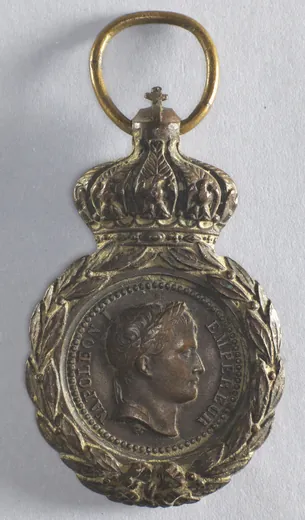
The St Helena Medal is a small bronze award shaped like a laurel wreath, bearing the head of Napoleon I, given from 1857 to the surviving veterans of the armies of 1792 to 1815. It may turn up on its own, or with its white box and its certificate, which change everything. More than 350,000 were handed out: what is rare is not the medal itself, but what can be learnt about the man who received it. Here is how to recognise it, tell apart what comes with it and trace its recipient, from the decree, museum records and archive inventories.
Get a piece identified from photos Valuing a piece: the method
In brief
- An award of 1857. Created by a decree of Napoleon III of 12 August 1857, it went to French and foreign soldiers who had served under the French flag between 1792 and 1815 and were still alive.
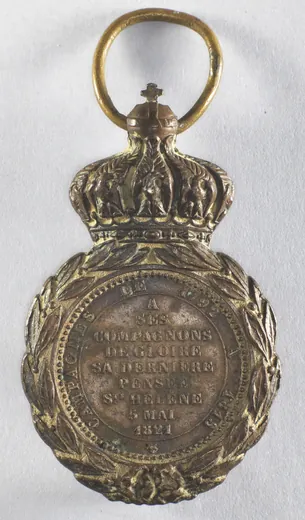
- One regulation pattern, in bronze. A laurel wreath topped by the imperial crown, Napoleon I on the obverse, a dedication dated 5 May 1821 on the reverse.
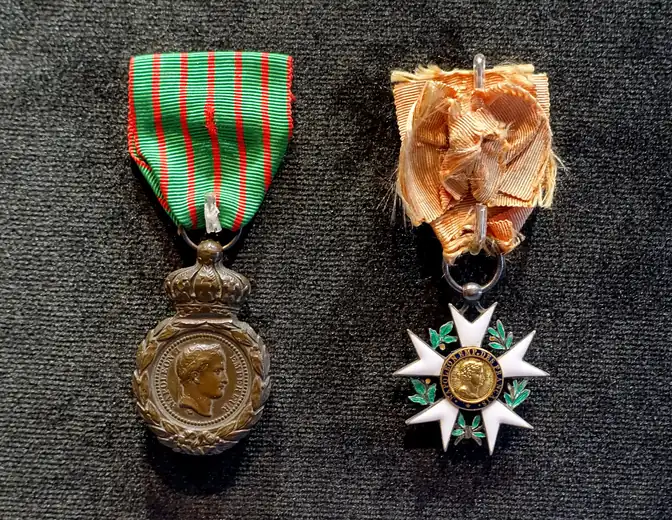
- A green ribbon with red stripes. It could not be worn without the medal.
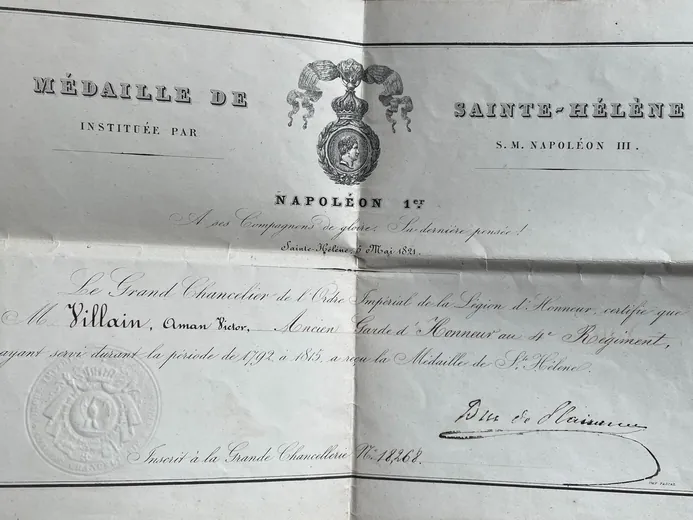
- A box and a certificate. Handed over in a white card box, the medal carries no name; the certificate from the Grand Chancellery of the Legion of Honour does.
- The files are kept locally. The Grand Chancellery refers enquirers to the departmental archives of the place where the recipient lived when he received it.
A medal born of a will
In his will, Napoleon had left half of his private estate to the officers and soldiers who had fought for him. Once emperor, his nephew Napoleon III acted on it: he set aside 8 million francs to be shared among the survivors, then created a medal. According to an article in the Carnets de la Sabretache reproduced by the Fondation Napoléon, it was the first time a medal made to be worn was called “commemorative”. Two years later, a decree of 11 August 1859 created the commemorative medal of the Italian campaign, in silver, with the laureate head of Napoleon III.
The decree of 12 August 1857, signed at Saint-Cloud, gives a commemorative medal “to all French and foreign soldiers of the land and sea forces who fought under our colours from 1792 to 1815”. It was to be bronze, with the emperor's effigy and the legend “Campagnes de 1792 à 1815” and “À ses compagnons de gloire, sa dernière pensée, 5 mai 1821” (to his companions in glory, his last thought), 5 May 1821 being the day Napoleon died; it was to be worn in the buttonhole, on a green and red ribbon.
The text, as reproduced by Steenackers in 1867 in his history of orders of chivalry, does not name the island. It was a decision of the emperor, announced in the Moniteur of 28 August 1857, that named the award the “médaille de Sainte-Hélène” and opened the distribution on 1 September: former soldiers living in the Seine department were to collect it at the Grand Chancellery of the Legion of Honour, on presenting their papers. The same notice stated that wearing the ribbon without the medal was “expressly forbidden”.
Elsewhere in France, mayors drew up lists of the old soldiers and gathered the applications; medal and certificate were handed over once the man's service had been checked, often at a ceremony: at Le Tréport, sixty-one veterans received the medal on 28 February 1858.
Recognising the medal
The medal is shaped like a laurel wreath tied at the base, around a medallion with a beaded border, topped by a solid imperial crown and a suspension ring. An article in the journal of the Orders and Medals Society of America (OMSA), published in 1996, describes the crown: eight palm leaves, an imperial eagle at the foot of each, and an orb with a cross, through which the ring passes.
On the obverse, the laureate head of Napoleon I faces right, within the legend “NAPOLEON I EMPEREUR”. Below the bust, the same journal notes a small anchor, the mark of Barre. According to the Vendôme museum's record, Désiré-Albert Barre (1818-1878) designed the medal and was chief engraver of the French mint from 1855. On the reverse, the legend “CAMPAGNES DE 1792 A 1815”, closed by a small star, surrounds a nine-line dedication: “A SES COMPAGNONS DE GLOIRE SA DERNIÈRE PENSÉE Ste HÉLÈNE 5 MAI 1821”. The OMSA journal names the Administration des Monnaies et Médailles in Paris as the official maker.
| Feature | Examples described |
|---|---|
| Metal | Struck bronze |
| Size | 5 to 6 cm high by 3 wide depending on the description; 52 mm by 30 and just over 29 g for the Teylers Museum example in Haarlem |
| Obverse | Laureate head of Napoleon I facing right, “NAPOLEON I EMPEREUR”, beaded circle, small anchor below the bust |
| Reverse | “CAMPAGNES DE 1792 A 1815” and a small star around the edge; nine-line dedication, from “A” to “1821” |
| Crown and ring | Solid imperial crown with eight leaves and eagles, orb with a cross, ring passing through the orb |
| Ribbon | Green, with five narrow red stripes and red edges |
| Recipient's name | None on the medal; it appears on the certificate |
The ribbon
The decree says only “green and red”. The OMSA journal describes a green ribbon 38 mm wide with five narrow rose stripes and edges of the same colour; the book by Yves Moerman and Yann Deniau, presented by the Fondation Napoléon, speaks of green and raspberry red; the Australian War Memorial counts seven thin red stripes on the green ribbon of its example, probably counting the edges. The ribbon was never worn on its own.
A ribbon is easier to replace than a medal: a new ribbon is not a deception, but it says nothing about the piece's history. To keep it in good condition, follow the method for caring for leather, textile and metal.
The box and the certificate
The box is rectangular, in white card; its lid bears an embossed imperial eagle and the inscription “Aux compagnons de gloire de Napoléon I”, followed by “Décret impérial du 12 août 1857”, according to the Vendôme museum's record. The OMSA journal gives its size as 63 mm by 42; according to Moerman and Deniau's book, it also held a small green leaflet. A box is easily separated from its medal: the Musée des Avelines, in Saint-Cloud, keeps one without its medal.
The certificate, or brevet, is the part of the set that names the recipient. It is printed, headed “Médaille de Sainte-Hélène instituée par S. M. Napoléon III”, with an engraving of the medal and the dedication, then the formula: the Grand Chancellor of the Imperial Order of the Legion of Honour certifies that the holder, having served during the period from 1792 to 1815, has received the St Helena Medal, followed by a registration number at the Grand Chancellery. The Sens museum keeps one in the name of Louis Victor André Lefeuvre, displayed with his decorations. The OMSA journal says the certificates were printed by the Pascal firm in Paris and bore the stamped signature of the Duc de Plaisance, the Grand Chancellor; the Risorgimento museum in Faenza records the Grand Chancellery's blind stamp on the certificate of a veteran from Rome.
Makers, miniatures and copies
The decree knows only one medal, in bronze. According to the OMSA journal, the gilt or silvered examples that turn up are not regulation issue. Richer examples exist too: the Roguet foundation in Clichy keeps a gold example attributed to General Count Christophe-Michel Roguet. Moerman and Deniau's book also catalogues variants of a pattern it calls “initially unique”.
The same journal states that Barre produced non-regulation miniatures 16, 20 and 33 mm high, the smallest bearing only a shortened legend on the reverse, “SAINTE HÉLÈNE, 5 MAI 1821”. A small medal of this kind is therefore not necessarily a copy.
None of this guide's sources describes copies or restrikes. That leaves comparison with documented examples: size and weight, crispness of the portrait and lettering, crown, anchor, star, “Ste HÉLÈNE” above the date. A difference proves nothing on its own, but it calls for an explanation; the principles that apply to every piece are in spotting fake militaria.
Do not confuse the award with souvenir medals, such as Antoine Bovy's “Mémorial de Sainte-Hélène” held by the Musée Carnavalet: a round copper medal 4.1 cm across, dated to around 1840.
Who could receive it
The decree covers soldiers “who fought under our colours from 1792 to 1815”; the August 1857 notice and the certificate speak more broadly of men who “served” during that period. It had to be proved: in the Vosges archives, applications come with discharge papers, certificates and records of service. The medal went to the living.
The figure most often given is 405,000 recipients, used by the Australian War Memorial and the Fondation Napoléon; the Carnets de la Sabretache article speaks of more than 350,000 medals handed out, perhaps 400,000. The sources do not settle the question.
Museums abroad hold some: the Teylers Museum in Haarlem, in the Netherlands, that of Lieutenant Steven Gertshagen; in Faenza, Italy, that of Nicolas Pozzi, of Rome, pinned to his certificate. Steenackers even tells, in 1867, of a woman who received it for services in 1815 at the siege of Huningue, where she had followed her husband, a mobilised National Guardsman.
Tracing a recipient and his service
The medal was issued without an engraved name, the Australian War Memorial's record points out. The starting point is therefore the certificate, a mention in family papers or a gravestone; how to read such papers is explained in reading and keeping military photographs and documents. Do not look for a central register: the Grand Chancellery, which issued the certificates, itself refers enquirers to the departmental archives, and the fire at its palace on 23 May 1871 destroyed a great many of its records.
In the departmental archives
The Grand Chancellery's research guide puts it in one sentence: information on the medal is held by the departmental archives of the place where the recipient lived when it was awarded. That is not necessarily where he was born. Depending on the department, it is found in the prefecture's records, in series M (honours) or R (military affairs), and in deposited municipal archives. Three inventories available on FranceArchives show what you can hope to find:
- Vosges, 2 R 201 to 205 (1857-1867): census of former soldiers, applications with discharge papers, certificates and records of service, receipts for medals handed over, reports on ceremonies, tables of recipients.
- Cher, 24 M 9 (1857-1862): applications for and presentations of medals, list of recipients.
- Meuse, archives of the commune of Guerpont: the list of recipients drawn up in 1857.
On FranceArchives, search for “médaille de Sainte-Hélène” with the name of the department or commune.
The recipients' database and the Legion of Honour
An online database brings together volunteers' transcriptions: “Les médaillés de Sainte-Hélène”, created by Norma Alosi from the lists and files of the departmental archives and now hosted by Geneanet. Its indexing is not finished: a missing name proves nothing. When a name does appear, go back to the original document and check the date and place of birth to rule out namesakes.
If the recipient also held the Legion of Honour, like Auguste Mamelin (1793-1870), buried in Boulogne-sur-Mer, a soldier of Napoleon I, knight of the order and St Helena medallist according to the French heritage inventory, look for his file in the Léonore database of the French National Archives, and for his cross in dating a Legion of Honour cross. Be careful, though: according to the Grand Chancellery, First Empire files were almost entirely destroyed under the Restoration, except those of members who had sworn allegiance to Louis XVIII.
His military career
The discharge paper or record of service attached to the application may give the unit. That is the key: the troop registers of the Service historique de la Défense, the French defence archives, are kept by unit. For the Revolution and the Empire, these are sub-series GR 16 Yc to GR 29 Yc, including the Imperial Guard (GR 20 Yc) and the line infantry (GR 21 Yc).
Some are online: Mémoire des hommes publishes the registers of the Imperial Guard and the line infantry from 1802 to 1815, with those of the Revolution and the Consulate; the others are consulted at Vincennes. If the unit is still unknown, start from recruitment: the Service historique de la Défense's guide points to series R of the departmental archives of the place of recruitment, which holds a general register of conscripts, kept every year from 1798 to 1814.
Judging a medal without talking prices
With several hundred thousand recipients, a St Helena Medal on its own is nothing exceptional. What sets one piece apart can be read in four steps:
- Is it the regulation medal? Compare it with the description in this guide; a miniature, or a gilt or silvered example, is judged separately.
- Is it complete? Period ribbon, box, leaflet, certificate. Each element may have been added later; a box and a certificate that arrived together, from the same family, carry more weight.
- Is it attributed? A named certificate, confirmed by an archive file giving the man's unit and service, changes everything: the anonymous medal becomes that of a soldier whose story is known.
- What condition is it in? Wear to the relief, a faded or replaced ribbon. Do not clean it to make it look better.
When it comes with other decorations of the same man, like Lefeuvre's group in Sens, it is judged as a whole: separated, each piece loses part of its story. To place it against comparable sales afterwards, the method is in valuing a military item.
What I cannot tell you here
I cannot tell you, from a photograph, whether a medal was struck in 1857 or much later: none of this guide's sources describes the copies, and the medal bears no year of manufacture. Nor can I link a medal on its own to a man: it is not named, and a certificate may have joined it later. Finally, none of these sources gives a complete national list of recipients, and their exact number is still debated.
This guide gives no prices. For a particular medal, photograph the obverse, the reverse, the area below the bust, the crown, the ribbon, the box and both sides of the certificate, then ask for free identification help. Decorations of the period for sale on the site are listed under Revolution and First Empire.
Frequently asked questions
What is the St Helena Medal?
A bronze medal created by Napoleon III, by a decree of 12 August 1857, for French and foreign soldiers who had served under the French flag between 1792 and 1815 and were still alive. It is shaped like a laurel wreath topped by the imperial crown, with Napoleon I on the obverse and, on the reverse, “CAMPAGNES DE 1792 A 1815” around a dedication dated 5 May 1821, the day he died. It was worn in the buttonhole, on a green ribbon with red stripes.
Who were the recipients of the St Helena Medal?
The surviving veterans of the armies of the Revolution and the Empire, French or foreign, who could prove their service between 1792 and 1815 with a discharge paper, a certificate or a record of service. The figure most often given is 405,000 recipients; another estimate speaks of more than 350,000. The distribution to veterans opened in Paris on 1 September 1857; in the provinces it was often marked by a ceremony in the communes, as at Le Tréport on 28 February 1858.
Where can I find the list of St Helena Medal recipients?
The Grand Chancellery of the Legion of Honour does not provide one: it refers enquirers to the departmental archives of the place where the recipient lived when he received the medal. Lists, applications and records of service are filed there in series M or R, sometimes in deposited municipal archives. The online database “Les médaillés de Sainte-Hélène”, run by volunteers, brings part of them together, but its indexing is not finished.
How do I trace an ancestor who received the St Helena Medal?
Start with the certificate, which gives the name and sometimes the unit, then look for the file in the departmental archives of the place where he lived when the medal was awarded, and for the name in the “Les médaillés de Sainte-Hélène” database. The discharge paper or record of service attached to the application may give the unit: the troop registers of the Service historique de la Défense, including those of the Imperial Guard and the line infantry, online on Mémoire des hommes, then trace his career. If he was also a member of the Legion of Honour, search the Léonore database.
How much is a St Helena Medal worth?
Its value is read piece by piece, and this guide gives no prices. With several hundred thousand recipients, the medal on its own is common; what sets one apart is being the genuine regulation medal, being complete with its ribbon, box and certificate, and above all being attributed to a man whose career the archives can trace. Comparison with sales actually concluded for similar pieces does the rest.
Why is the St Helena Medal associated with 1857?
Because it was created by the decree of 12 August 1857, and the distribution to veterans opened in Paris on 1 September of the same year. The date on its reverse, 5 May 1821, is the day Napoleon died on Saint Helena, and the years 1792 and 1815 frame the campaigns it commemorates. An award described as being “from 1821” was therefore struck in 1857 or later.
How can I tell a genuine St Helena Medal?
Compare it with the examples described by museums and by the OMSA journal: struck bronze, 5 to 6 cm high by 3 wide depending on the description, an imperial crown with eight leaves and eagles, an orb with a cross through which the ring passes, a small anchor below the bust, “NAPOLEON I EMPEREUR” on the obverse, “CAMPAGNES DE 1792 A 1815” and a small star on the reverse. Gilt or silvered examples and miniatures of 16 to 33 mm are not regulation issue. A difference is not proof of a fake, but it calls for an explanation.
Could foreigners receive the St Helena Medal?
Yes. The decree of 12 August 1857 gives it to “all French and foreign soldiers” who fought under the French flag between 1792 and 1815. Museums in other countries hold some, such as the Teylers Museum in Haarlem, in the Netherlands, and the Risorgimento museum in Faenza, in Italy; their records do not give the holders' nationality.
Sources
This guide draws on the texts, databases and pages below, accessed on unless otherwise stated. Most of them are in French.
- Fondation Napoléon, press review: Joël Beauvais, “La médaille de Sainte-Hélène dans le Calvados 1857-1870”, Carnets de la Sabretache, no. 203, June 2015
- François-Frédéric Steenackers, Histoire des ordres de chevalerie et des distinctions honorifiques en France, Paris, 1867, chapter on the St Helena Medal: text of the decree of 12 August 1857 and of the Moniteur notice of 28 August 1857 (extract digitised by Düsseldorf University Library)
- Fondation Napoléon, on Jérôme Maes's book Les Médaillés de Sainte-Hélène au Tréport (Édilivre, 2014)
- Kendall L. Witt, “To His Companions of Glory: The French Saint Helena Medal”, The Medal Collector, journal of the Orders and Medals Society of America, vol. 47, no. 8, 1996, pp. 10-12
- Musée municipal de Vendôme, record of a St Helena Medal with its box (inv. 2211), Joconde database on POP
- Australian War Memorial, “French Saint Helena Medal”, unnamed as issued, with its ribbon, object RELAWM14769
- Fondation Napoléon, on Yves Moerman and Yann Deniau's book Les Grognards centenaires de Napoléon. Les derniers soldats médaillés de Sainte-Hélène (Mémogrames, 2010)
- Musée des Avelines, Saint-Cloud, St Helena Medal box without its medal (inv. 616), Joconde database on POP
- Musée municipal de Sens, St Helena Medal certificate of Louis Victor André Lefeuvre, with his decorations (inv. 91.16.1), Joconde database on POP
- Emilia-Romagna heritage catalogue, Museo del Risorgimento e dell'Età Contemporanea, Faenza, St Helena Medal pinned to the certificate of Nicolas Pozzi, of Rome, inv. N.6 (record in Italian)
- Fondation Roguet, Clichy, gold St Helena Medal attributed to General Count Christophe-Michel Roguet, Palissy database on POP
- Musée Carnavalet, “Mémorial de Sainte-Hélène, vers 1840”, medal by Antoine Bovy (inv. ND12225), Joconde database on POP
- Teylers Museum, Haarlem, St Helena Medal awarded to Lieutenant Steven Gertshagen, TMNK 12511 (record in Dutch)
- Grande Chancellerie de la Légion d'honneur, archives portal, history of its archives: the fire at the Palais de Salm on 23 May 1871 and the First Empire files
- Grande Chancellerie de la Légion d'honneur, archives portal, research guide on French decorations not managed by the Grand Chancellery (September 2025)
- Vosges departmental archives, 2 R 201 to 205, St Helena Medal files (1857-1867), record on FranceArchives
- Cher departmental archives, 24 M 9, St Helena Medal applications, presentations and list of recipients (1857-1862), record on FranceArchives
- Meuse departmental archives, municipal archives of Guerpont, E dépôt 162/93, list of St Helena Medal recipients (1857), record on FranceArchives
- Les médaillés de Sainte-Hélène, database created by Norma Alosi and indexed by volunteers, hosted by Geneanet
- French heritage inventory, Hauts-de-France region, tomb of Auguste Mamelin, Boulogne-sur-Mer, Mérimée database on POP
- Léonore database, French National Archives: files of members of the Legion of Honour, accessed
- Mémoire des hommes, French Ministry of the Armed Forces, enlistment and service registers: troop registers of the Ancien Régime, the Revolution, the Consulate, the Imperial Guard and the line infantry (1802-1815)
- Service historique de la Défense, research guide on tracing NCOs, airmen, soldiers and sailors, accessed