Collector's guide Uniforms and insignia
The French army kepi: reading the arm, the rank and the period
By François, contributor to Athena Militaria Published , updated 14 min read
The French army kepi can be recognised from afar and read up close. Its colours tell the arm or corps, its braid the rank, its interior, at times, the man who wore it and the workshop that made it. This guide follows it from its origins to 1918, using a regulation of 1867, the records of museums that hold these kepis and a recent university thesis. It also says where the sources diverge, and what they cannot settle.
Get a piece identified from photos Valuing a piece: the method
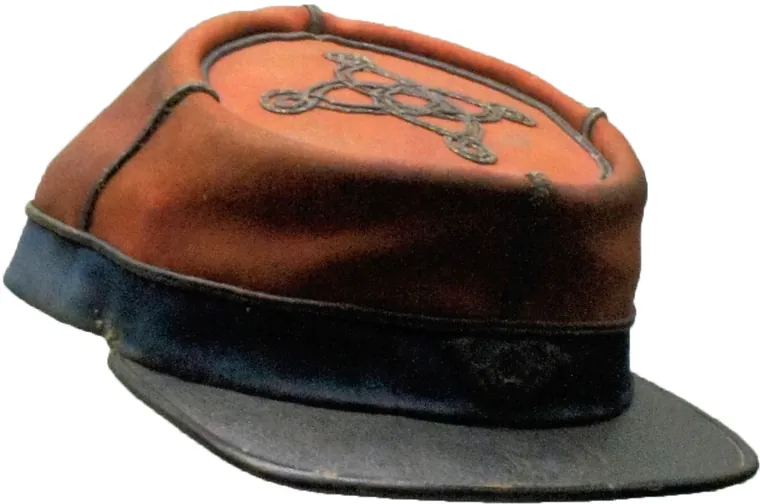
In brief
- A cap to read. The Musée de l'Armée calls the kepi the typical headdress of the French soldier since 1852. Its colours tell the arm of service, an officer's braid the rank, and the inside sometimes the man and the workshop.
- A late name. The word is attested as early as 1809, but the 1867 infantry regulation still calls the cap a bonnet de police, a forage cap.
- Infantry: madder red and blue. For the infantryman, from 1867 to August 1914: madder-red turban and top, dark blue band, regimental number on the front.
- Rank can be counted. On an officer's kepi, the 1867 description places one braid above the band for a second lieutenant, and five for a colonel.
- The helmet relegates it. The infantryman goes off in August 1914 under a kepi cover; a simplified kepi is adopted on 19 September 1914, according to the Musée de l'Armée. The Adrian helmet equips units from September 1915.
- Reworkings and fancy pieces. Museums themselves point out altered kepis. Fancy does not mean fake.
Where the kepi comes from
The Trésor de la langue française records the word as early as 1809, in an inventory of General Lasalle, and derives it from the Alemannic Käppi, a diminutive of Kappe, “cap”. In its sheet on the kepi of a fédéré of the Paris Commune, the Musée de l'Armée notes that its stiff structure recalls the chasseurs d'Afrique cap known as the “Taconnet”, named after the master tailor in Algeria who designed it around 1830.
The description of the line infantry uniform, decision of 2 December 1867, still speaks of a bonnet de police. The Musée de l'Armée dates the official appearance of the word “képi” to 1875; a master's thesis from the University of Kent, drawing on a book by Frédéric Coune, gives 20 April 1874 instead.
The 1867 kepi, the kepi of the war of 1870
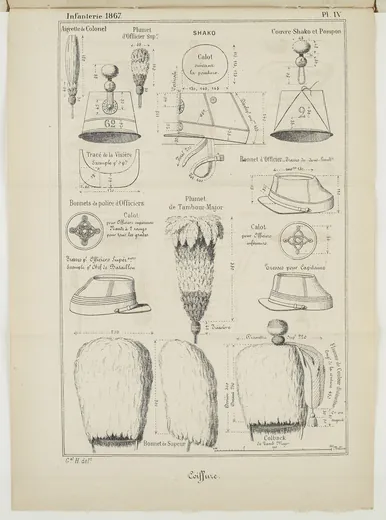
In the 1867 description, article 84 makes the other ranks' kepi from a band of dark blue cloth, a turban in four pieces and a top (calot), these last two in madder-red cloth, with dark blue piping on the seams. The regimental number, 28 mm high, is cut out of madder-red cloth and sewn onto a piece of blue cloth on the front of the band. The black patent leather peak, with rounded corners, has no welt or binding; it must stay horizontal, and the kepi is worn straight, like the shako. The same description no longer provides a shako plate for the line infantry.
The Musée de la bataille du 6 août 1870, in Woerth, holds an infantry kepi it classes as the 1867 model: dark blue band, madder-red turban and top, a rectangular peak with no welt or binding, the number 99 on the band. Its record speaks of a cut that is bahutée at the front. For the Trésor de la langue française, to bahuter one's kepi means to soften it and give it an old look. The regulation wanted the kepi straight; several kepis kept in Woerth are bahutés.
The peak helps with dating. The Musée de l'Armée regards the square peak as a mark of Second Empire forage caps, one that gradually disappeared under the Third Republic. According to the Kent thesis, the peak became rounded with the 1873 model; the municipal museum of Nuits-Saint-Georges holds a chasseur à pied's kepi dated 1882 whose peak is round.
Recognising the arm or corps by its colours
The cloth is the first clue, the sign on the band the second. The summary table of 1867 gives the same madder-red kepi with a blue band to the line infantry and to the corps attached to it; only the sign changes. The other rows come from museum pieces or from the Kent thesis.
| Arm or corps | Colours and signs | Source |
|---|---|---|
| Line infantry, 1867 | Dark blue band, madder-red turban and top; number in madder-red cloth | 1867 description |
| Light infantry of Africa, 1867 | Same kepi; number in daffodil yellow | 1867 description |
| Foreign regiment, 1867 | Same kepi; madder-red star instead of the number | 1867 description |
| Infantry, August 1914 | Madder-red turban and top, dark blue band; number on dark blue cloth | Musée de l'Armée; Musée de la Vie bourguignonne |
| Chasseurs à pied, 1882 | All dark blue, yellow piping and number; buttons with a hunting horn | Nuits-Saint-Georges museum |
| Artillery, 1867 model | Black cloth, red cord; buttons with cannons and a grenade | Nuits-Saint-Georges museum |
| Light cavalry, 1884 model | Madder red and sky blue | Kent thesis |
| Algerian tirailleurs, officer, 1870 | Sky blue band, madder-red turban and top | Woerth museum |
| Colonial infantry, before 1914 | Dark blue, red number and piping; underside of the peak green | Kent thesis |
| Pharmacists, officers, about 1886 | Green velvet band, madder-red turban | Nuits-Saint-Georges museum |
| Interpreters, officers, early twentieth century | Blue velvet band, sphinx head | Historial, Péronne |
Buttons and band confirm what the cloth suggests. On the artilleryman's kepi at Nuits-Saint-Georges, it is the buttons, with two crossed cannons and a grenade, that give the arm away. The pharmacist captain's kepi in the same museum has a green velvet band, and the Historial de la Grande Guerre in Péronne holds an interpreter lieutenant's kepi with a blue velvet band and a sphinx head. The Kent thesis mentions only, on officers' and NCOs' kepis worn behind the lines in 1914-1918, a cloth band of distinction for certain specialities of the Health Service, without giving its colour. According to the 1885 description it quotes, the Foreign Legion wore a grenade instead of a number; a scarlet anchor was authorised on the colonial infantry kepi on 28 January 1915.
Colour alone is not always enough. In Woerth, a kepi of the 1867 model with a sky blue band and a madder-red turban, the combination the Kent thesis calls typical of the light cavalry, is, according to its record, a second lieutenant's kepi of the Algerian tirailleurs.
Reading the rank: braids, uprights and Hungarian knot
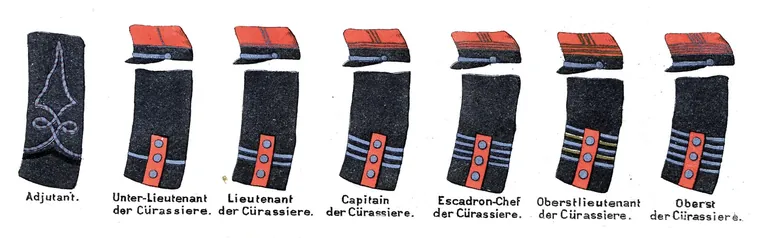
On an officer's kepi, rank can be counted. The 1867 description places one braid above the band, gold in the line infantry, for a second lieutenant, then one more for each rank, up to five; its article 384 applies to the kepi the rule that article 372 gives for the shako. The uprights, or soutaches, on the upright seams and the Hungarian knot on the top follow the same progression. The officer's sword has its own signs too: on the shell guard, the plate called the clavier bears the emblem of the regime, as set out in our guide to the French officer's épée.
| Rank | Braids above the band | Braid on the upright seams | Hungarian knot on the top |
|---|---|---|---|
| Second lieutenant | 1 | Single | One strand |
| Lieutenant | 2 | Single | One strand |
| Captain | 3 | Double | One strand |
| Battalion commander, major | 4, the 1st in the metal opposite to the buttons for a major | Three rows | Two strands |
| Lieutenant-colonel | 5, the 2nd and 4th in the metal opposite to the buttons | Three rows | Two strands |
| Colonel | 5 | Three rows | Two strands |
An officer can also be recognised by his false chinstrap of gold or silver lace and by his peak edged with a small welt of patent leather. In 1867, his band carries “no number or ornament of any kind”. Surviving pieces sometimes depart from this: an infantry lieutenant-colonel's kepi at Nuits-Saint-Georges, dated 1867-1872, does have three gold braids and two silver ones, but also a regimental number in gilt metal, 32, and the label of a maker, B. Peisson, in Philippeville. Generals wear embroidered oak leaves on the band; in Woerth, the record of a general's kepi states that a divisional general's kepi has two rows of embroidery.
NCOs and private soldiers
The rank-and-file kepi says almost nothing about rank. In 1867, the NCO's kepi is “in every respect like that of the soldiers”, in medium-fine cloth (drap mi-fin). The adjutant wears above his band a flat braid in the metal opposite to the buttons, a Hungarian knot mixing wool and metal, and a simple cord instead of the false chinstrap, which is reserved for officers. The Kent thesis, however, notes a gilt false chinstrap on NCOs' kepis with the 1873 model, and the 1885 description it quotes gives them a chinstrap and buttons that are usually gilt.
From the 1884 model to the outbreak of war
The kepi of August 1914 is the kepi of 1884. The Musée de l'Armée, which calls it the typical headdress of the French soldier since 1852, says it was adopted and described on 30 October 1884, in its record of a kepi of the 319th Infantry Regiment; in August 1914 it equipped the metropolitan infantry, except the chasseurs alpins. The infantryman went on campaign in a kepi with a madder-red turban and a blue band, under a blue kepi cover.
The Musée de la Vie bourguignonne, in Dijon, holds a kepi from the 1914 field dress of the 27th Infantry Regiment: madder-red cloth, dark blue band, the number 27 on two pieces of dark blue cloth, blue cords, two ventilation eyelets and two gilt buttons with the infantry grenade for the chinstrap. The Nuits-Saint-Georges museum takes these vents, or “strainers”, as a sign of an 1884 model; the Kent thesis, however, has them appear with the 1873 model.
Officers, for their part, went to a tailor, for cuts known as “polo” or “foulard” according to the Kent thesis, and the label stayed in the lining, like that of the Dijon tailor Negre in the pharmacist's kepi at Nuits-Saint-Georges. An officer's kepi that departs from the regulation is not a fake for that reason alone.
The Great War: kepi cover, simplified kepi, horizon blue
According to the Kent thesis, most men wore a bluish iron-grey kepi cover in 1914; officers could cut a window in it showing the number and the braid, until this was banned on 14 October 1914. On 19 September 1914, according to the Musée de l'Armée, a simplified kepi was adopted, with band and turban in one piece, in the new bluish-grey shade; some makers nevertheless kept the old cut, using offcuts of bluish iron-grey cloth, as with the 319th's kepi. There were also grey-blue or light blue kepis, then the horizon-blue uniform described in the notice of 9 December 1914.
That notice, according to the Kent thesis, called for a light blue kepi with no piping, no badge and no number, except for the chasseurs. The rule was not always followed: in Dijon, a horizon-blue kepi of the 27th, used from 1915 according to its record, still carries its number. At Nuits-Saint-Georges, the kepi of Pierre Seurot, a lieutenant of chasseurs, dated 1915-1918, has only two braids, on the front, and its silver false chinstrap is hidden under a second one in cloth.
The helmet pushed the kepi aside. In December 1914, Joffre was shown a steel skullcap to slip under the kepi, the cervelière; 700,000 were ordered in February 1915, and the one in the 319th's kepi saved the life of Corporal Marcel Delesques on 31 May 1915, in the attack on the Labyrinth. The Adrian helmet equipped units from September 1915, and all the poilus in 1916. Finally, in 1918, according to the Kent thesis, a decision by Clemenceau of 22 February gave officers back, from 1 June, the kepi in its pre-war colours.
Reading the inside: maker, size, name or service number
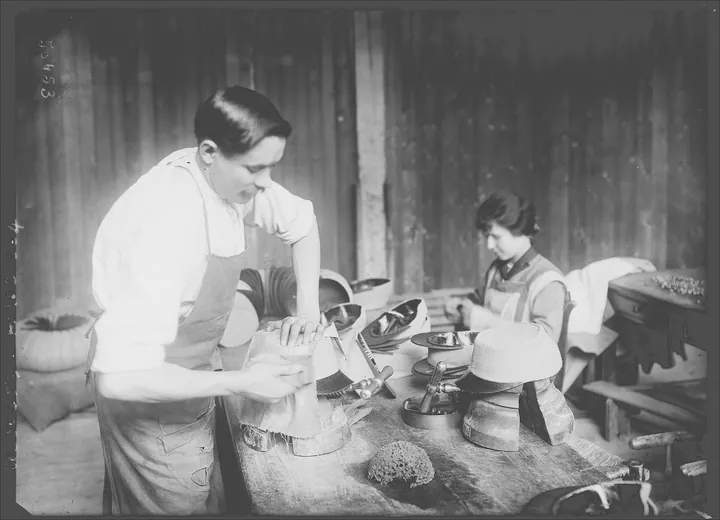
Turn the kepi over before reaching a conclusion. In 1867, article 87 provides a lining of black sheepskin and, under the top, a piece of sheepskin pierced with a round hole 45 mm across, behind which a piece of white cloth is “intended to receive the man's service number and the year the cap was put into service”. According to the Kent thesis, the 1885 description kept this round of cloth and provided three sizes of peak, numbered 1, 2 and 3.
Museum records show what you actually find. In the centre of the top of the 1882 chasseur's kepi at Nuits-Saint-Georges: “3e 82 / 1015”. On the 1867 kepi in Woerth: “2e 74 9915” in the top, “2” on the peak. In the 1914 kepi in Dijon, the round cut-out in the leather at the top gives access to a stamp reading “57”, an incomplete name and “13”, and to a pencilled number; the peak is engraved “[SII 2]”. No record interprets these figures, and I will not do it for them: they recall the service number, year and sizes of the regulations, without archival proof.
Officers' kepis tend to carry a label or a name instead: in Woerth, the tirailleurs second lieutenant's kepi keeps that of Seur and Peyrot, in Lyon; at Nuits-Saint-Georges, the lieutenant-colonel's kepi already mentioned bears the name “Tisserau” in ink. A name opens a line of research, explained in reading and keeping military photographs and documents; for a soldier who died for France, start with Mémoire des hommes. Clean nothing and peel off no labels: the right care is in caring for military leather, textile and metal.
Copies, fancy pieces, stage kepis and reworkings
Museums themselves point out altered kepis. At Nuits-Saint-Georges, an infantryman's kepi appears to be an 1884 model, judging by its ventilation strainers, onto which a rectangular peak seems to have been sewn to make it an 1867; chinstrap and buttons have been converted, the number 32 is a later disguise, and the record rules out its coming from the battle of Nuits. On an NCO's kepi of chasseurs in the same museum, a brass horn seems to have replaced a number whose outline can still be seen: the record speaks of a doubtful restoration.
Hence the method. Check consistency: peak and cut, vents and model, number and band. A badge sewn on again often leaves old needle holes or less faded cloth, like the collar patches described in dating a French military uniform. Compare the inside with the regulation of the period: a kepi that claims to be regulation issue but has no sheepskin lining, no round under the top, no stamp or label, may be a fancy, stage or re-enactment piece, or may have been redone.
Fancy does not mean fake: the Musée de l'Armée's fédéré kepi matches no regulation, and the museum sees in it the fancy of that turbulent period. What separates a period piece from a copy is its materials, its wear and its consistency, more than its conformity to the drawing; the general method is in recognising fake militaria.
Judging value without giving a price
I give no prices. The method comes down to five questions, in order:
- Identification. Are the arm, rank, model and period established by the piece itself?
- Original condition. Are the peak, chinstrap, buttons, number and lining original?
- Consistency. Do all the parts belong together?
- The inside. Can the service number, stamp or label be read?
- Attribution. Does a name, a photograph or a set of papers link the kepi to a man?
A declared restoration is better than a hidden one. To place a kepi against sales actually concluded, the method is in valuing a military item.
What I cannot tell you here
I cannot date a kepi to the year from a photograph of the outside, nor attribute it to a regiment if its number is not original. Nor can I read the figures inside a lining with certainty: only comparison with the regulation of the period and with documented pieces can settle it. An arm missing from my tables does not have an unknown colour: I lack a source that gives it.
The kepi is still worn today; in the Foreign Legion, the white kepi has even become a byword for legionnaire, according to the French Army. These recent models fall outside this guide. For a particular piece, photograph the kepi from the front, the side, above and inside, then have it identified free of charge from photos. To compare, see in the catalogue the First World War uniforms and the pieces from the war of 1870.
Frequently asked questions
What is a French army kepi?
A peaked cap made of a band, a turban and a top, worn by the French army since the nineteenth century. The word, borrowed from the Alemannic Käppi, is attested as early as 1809, and the Musée de l'Armée calls the kepi the typical headdress of the French soldier since 1852. Its colours tell the arm, its braid the rank, and its inside often the man and the maker.
How do you read rank on a French kepi?
Count the braids above the band. According to the 1867 description of the infantry uniform, there is one for a second lieutenant, two for a lieutenant, three for a captain, four for a battalion commander and five for a lieutenant-colonel and a colonel. The Hungarian knot on the top has one strand for junior officers and two for senior officers. Generals wear oak leaves on the band.
What do the gold braids on a kepi mean?
On an officer's kepi, the horizontal braids above the band give the rank, and their metal follows that of the uniform buttons, gold or silver. A lieutenant-colonel's second and fourth braids are in the opposite metal, which sets him apart from a colonel. The upright braids on the turban and the Hungarian knot on the top complete the reading, under the 1867 regulation.
What kepi did French soldiers wear in WW1?
In August 1914 the infantryman wore the 1884-model kepi, with a madder-red turban and a blue band, covered in the field by a blue kepi cover. On 19 September 1914 a simplified bluish-grey kepi was adopted, then a light blue cloth kepi went with the horizon-blue uniform described on 9 December 1914. The Adrian helmet replaced it in combat from September 1915.
What did the French kepi of 1870 look like?
For the line infantry, the description of 2 December 1867 provides a band of dark blue cloth, a madder-red turban and top, dark blue piping and the regimental number cut out of madder-red cloth. Its black patent leather peak is rectangular with rounded corners, with no welt or binding. The museum in Woerth holds a kepi of this model numbered 99.
How do you recognise a French officer's kepi?
By its gold or silver braid above the band and on the seams of the turban, its Hungarian knot on the top and its false chinstrap of lace laid on the peak, an ornament the 1867 regulation reserves for officers but that NCOs also wear later. Its peak is edged with a small welt of patent leather. Many officers' kepis came from a tailor, whose label is often found inside.
What does the number on the front of a kepi mean?
It is the number of the regiment or battalion. In 1867 it was cut out of madder-red cloth and sewn onto a piece of blue cloth on the front of the band; other corps had another sign, such as the star of the foreign regiment. Check that it is original before drawing an attribution from it: a Burgundy museum describes a number added long afterwards.
How can you tell if an antique kepi is genuine?
Check its consistency: peak, vents, number and buttons must match the model claimed, with no traces of newer stitching. Look at the inside, the sheepskin lining, the round cut-out under the top, the service number, stamp or label, and compare it with the regulation of the period. If in doubt, have the piece examined from photos, inside included.
Sources
This guide draws on the texts, databases and pages below, accessed on unless otherwise stated. Most of them are in French.
- Trésor de la langue française informatisé (CNRTL), entry “képi”
- Musée de l'Armée, object sheet on a Paris Commune greatcoat and kepi (1871): a fédéré's kepi (inv. Gb 21888), the square peak of Second Empire forage caps and the chasseurs d'Afrique cap known as the “Taconnet”
- Description of the uniform of the line infantry, the light infantry battalions of Africa, the cadres of the disciplinary companies and the foreign regiment, decision of 2 December 1867 (Paris, J. Dumaine, 1868): summary table p. 391 (view 11), forage cap of other ranks, NCOs and adjutants pp. 407-409 (views 27-29), officers' braid and forage cap pp. 457-459 (views 77-79), plate IV “Coiffure” (view 121); copy of the Bibliothèque nationale de France (Prints, 4-OA-329) reproduced on Wikimedia Commons
- Yannick Olivères, “Képi Rouge to Bleu Horizon: The Evolution of the French Military Uniform & the Development of the Headdress, 1871-1918”, MA by Research thesis, University of Kent, chapter IV, “The Képi”
- Musée de la bataille du 6 août 1870, Woerth, record of a model 1867 kepi numbered 99 (inv. 1970.1.60), Joconde database on POP
- Trésor de la langue française informatisé (CNRTL), entry “bahuter”: “bahuter son képi”
- Municipal museum of Nuits-Saint-Georges, record of a chasseur à pied's kepi dated 1882, inner inscription “3e 82 / 1015” (inv. 95.14.64), Joconde database on POP
- Municipal museum of Nuits-Saint-Georges, record of an artilleryman's kepi, 1867 model (inv. 96.2.195), Joconde database on POP
- Municipal museum of Nuits-Saint-Georges, record of a pharmacist captain's kepi with a green velvet band and the label of the tailor Negre, Dijon (inv. 96.18.1), Joconde database on POP
- Historial de la Grande Guerre, Péronne, record of an interpreter lieutenant's kepi made by Delion, Paris (inv. 009083), Joconde database on POP
- Musée de la bataille du 6 août 1870, Woerth, record of a second lieutenant's kepi of the Turcos (Algerian tirailleurs), 1867 model, with a sky blue band and the label of Seur and Peyrot, Lyon (inv. 2007.0.5), Joconde database on POP
- Municipal museum of Nuits-Saint-Georges, record of an infantry lieutenant-colonel's kepi made by B. Peisson, Philippeville (inv. 96.2.167), Joconde database on POP
- Musée de la bataille du 6 août 1870, Woerth, record of a Second Empire divisional general's kepi with oak leaves (inv. 2005.0.87), Joconde database on POP
- Musée de l'Armée, record of a model 1884/1914 kepi of the 319th Infantry Regiment (inv. 21210), on Google Arts & Culture
- Musée de l'Armée, teaching sheet on the French infantryman's uniform in 1914 and 1916, accessed
- Musée de la Vie bourguignonne, Dijon, on deposit from the Musée de l'Infanterie, record of a kepi from the 1914 field dress of the 27th Infantry Regiment (inv. D99.1.398), Joconde database on POP
- Musée de la Vie bourguignonne, Dijon, record of a horizon-blue soldier's kepi of the 27th Infantry Regiment (inv. D99.1.190), Joconde database on POP
- Municipal museum of Nuits-Saint-Georges, record of the kepi of Pierre Seurot, lieutenant of chasseurs à pied, dated 1915-1918 (inv. 95.14.71), Joconde database on POP
- Mémoire des hommes, French Ministry of the Armed Forces: First World War databases (soldiers who died for France, unit war diaries), accessed
- Municipal museum of Nuits-Saint-Georges, record of an altered infantryman's kepi, an 1884 model disguised as an 1867 model (inv. 96.2.14), Joconde database on POP
- Municipal museum of Nuits-Saint-Georges, record of a chasseurs à pied NCO's kepi with a doubtful restoration (inv. 95.14.54), Joconde database on POP
- French Army, Ministry of the Armed Forces, “Le képi blanc de la Légion étrangère” (the Foreign Legion's white kepi)