The French shako plate: dating the eagle, the fleur-de-lis and the cockerel
By François, contributor to Athena Militaria Published 13 min read
The shako plate is the metal piece that adorned the front of the shako: an eagle, fleurs-de-lis or a cockerel, a number, sometimes a grenade or a hunting horn. It can be dated fairly well, because official texts described it at almost every change of regime, from the circular of 1810 to the army yearbook of 1861, before the description of 1867 removed it from the line infantry shako. Looked at on its own, it is easily misread: a plate lived on a headdress, and its back keeps the trace. This guide brings together the reference points given by period texts and museum records. It also shows what should raise suspicion about a remounted piece, and what French law says about a plate dug from the ground.
Get a piece identified from photos Valuing a piece: the method
In brief
- The emblem gives the regime. A lozenge, then an eagle under the First Empire, fleurs-de-lis under the Restoration, a cockerel from 1830, a crowned eagle again under the Second Empire.
- The number and the device give the unit. A hunting horn for the light infantry, a grenade for the artillery, the engineers and the grenadiers.
- The metal has its rule. In 1810, white for units with white buttons, yellow for the rest; silvering appears on some officers' and National Guard plates.
- The back counts as much as the front. A worn plate took the curve of the shako, and its fittings deserve a close look.
- What comes out of the ground falls under the law. Searching with a metal detector needs a permit, and a chance find must be reported to the mayor.
Part of the shako, described by official texts
According to General Bardin's Dictionnaire de l'armée de terre, a decision of 4 Brumaire Year X (26 October 1801) recognised the shako for the light cavalry and light infantry; the leather fitted to its front was “hidden by the plate”. A decree of 25 February 1806 made it the headdress of the line infantry from the 1807 renewal of issue. The plate was therefore a component of the headdress: the circular of 9 November 1810, reprinted in 1812 in Berriat's Législation militaire, describes it with the rest of the shako, arm by arm.
Dating by the emblem: from eagle to cockerel and back
Each reference point gives a date from which a pattern existed; the old pattern could stay in use after the new one arrived.
| Period | Emblem | Number |
|---|---|---|
| First Empire, 1810 | Lozenge (line infantry: no ornament other than two fillets) | In the centre, or inside a hunting horn |
| First Empire, 1812 | Crowned eagle on a half-moon base | Cut out of the base |
| Restoration | Arms of France: fleurs-de-lis under a crown | Unit number |
| July Monarchy | Gallic cockerel, sometimes on a globe | Depends on the unit |
| Second Republic | Cockerel; republican motto on National Guard plates | Depends on the unit |
| Second Empire | Crowned eagle on a globe and thunderbolts | Cut out of the globe |
| Line infantry, from 1867 | No plate | On the band of the shako |
First Empire: the lozenge, then the eagle
In 1810, “the plate of all the infantry shall be lozenge-shaped”. For the line, it was of yellow copper, eleven centimetres high and wide, “with no ornament other than two fillets around it”, with the number in the centre. The crowned eagle on a base was then reserved for mounted troops.
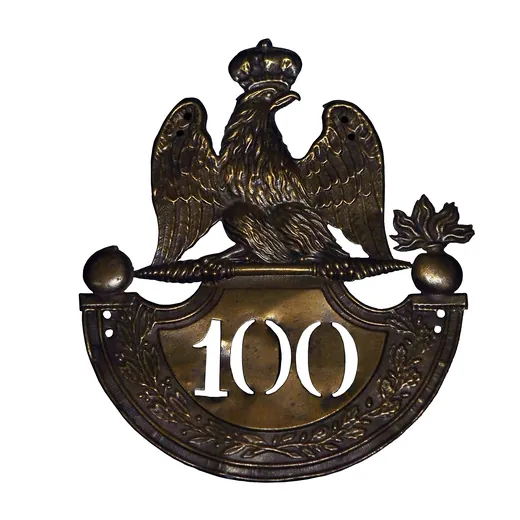
Before 1810, units did not look alike: according to Bardin, the circular deplored the “disparities” of the shako “in the various units”. English Heritage holds at Portchester Castle a pressed plate of the 26th Line; the photograph in its record shows a lozenge in which a crowned eagle stands above the number. The record dates this type from 1806 to 1812, the year when, it says, plates changed to a half-moon shape, the one in this guide's illustration.
The old pattern did not vanish overnight: in a grave from the retreat from Russia excavated in Vilnius in 2002, a “regulation 1810 plate” of the 2nd Line was found with the remains of an “1812 pattern” plate of the 21st.
Restoration: the arms of France
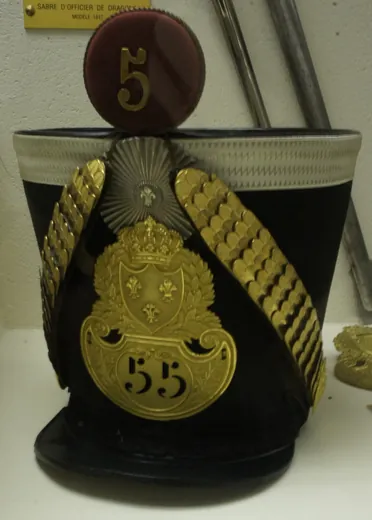
A decision of 25 September 1815, summarised by Bardin, called for one shako for all arms, with a plate showing the unit's number. In 1819 the Annuaire de l'état militaire de France described for the infantry, then organised in departmental legions, “black felt shakos with a plate bearing the arms of France and the number, in yellow for all the Legions”. The 55th Regiment's shako pictured below shows one example.
July Monarchy: the cockerel
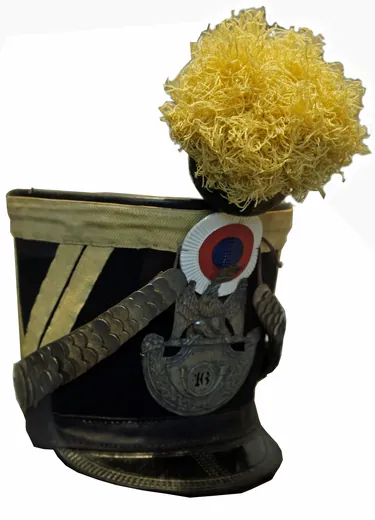
“The revolution of 1830 changed its cockade and its plate,” Bardin writes, and a decision of 11 September put the Gallic cockerel on the plate. The cockerel then replaced the fleur-de-lis on flags, gorgets and shako plates. At the Musée Condé in Chantilly, a shako of the 17th Light Infantry dated 1841 bears a cockerel and the number 17 in a medallion. In Nuits-Saint-Georges, the silvered copper plate of a chasseurs officer's shako shows a cockerel holding a globe marked “liberté”. The same change of regime can be read on the clavier of officers' swords, fleurs de lys under the Restoration, a cockerel under the July Monarchy: see our guide to the French officer's épée.
Second Republic and National Guard
In 1848 the cockerel stayed, now with the motto of the Republic. The plates of the National Guard shakos at Auxonne and Senlis read “Liberté, Égalité, Fraternité” and “République française”, and their records date them to 1848 (Senlis) or 1848 to 1851 (Auxonne). The one at Mehun-sur-Yèvre, with the cockerel and a motto for the Republic, is nonetheless classed as Louis-Philippe period: the motto, more than the cockerel, points to 1848.
The National Guard also had local patterns: in 1831 the Bibliographie de la France announced a “model of the shako plate for the National Guard of Lyon”.
Second Empire: the eagle returns, then the plate disappears
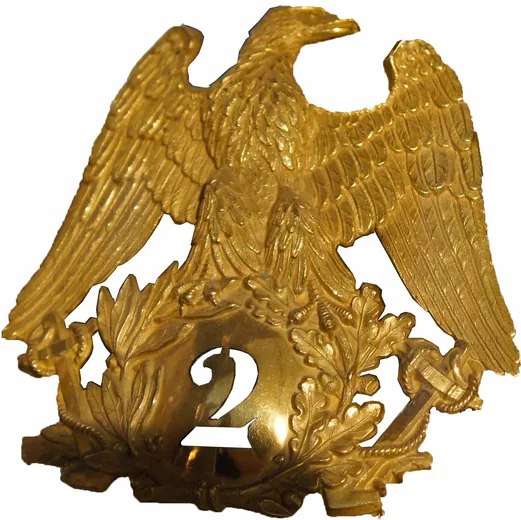
The eagle came back with the Empire: the 1852 pattern infantry shako kept in Senlis already has one on its plate. The Annuaire militaire de l'Empire français for 1861 describes for the line a “copper plate with a crowned eagle, in the centre of which is placed the regiment's number”. At the Musée de la bataille du 6 août 1870 in Woerth, this number is cut out of the globe, as on the shako of the 36th Regiment. The same yearbook describes two crossed cannon surmounted by a grenade for the artillery, the legend “Régiment Étranger” around the number for the foreign regiments, and a “shako plate without a number” for the cadres of the disciplinary companies.
Then the plate left the line infantry shako: the description of the uniform, decision of 2 December 1867, no longer provides for one. On the other ranks' shako, the regiment's number, cut out of jonquil-yellow cloth, is sewn on the front of the band; on an 1867 pattern officer's shako in Woerth, it is a 71 in gilt copper.
The number and the branch devices
In 1810, “all plates shall bear the regiment's number”: in the middle for the line, inside a hunting horn for the light infantry, under the grenade for the artillery and engineers. Units “outside the line” had a plate without a number. The circular of 21 February 1811 gave the grenade to grenadiers and carabiniers and the horn to line voltigeurs, without changing the shape of the plate.
Not every plate has a number: on an 1862 pattern engineers' shako in Woerth, “the globe of the plate is not cut out”. And soldiers were not the only ones to wear the shako: an eagle marked “Forêts” adorns that of a brigadier of the Eaux et Forêts, the forestry service, in Nuits-Saint-Georges, and two crossed axes that of a fireman at the Musée du Temps in Besançon.
Material and manufacture
In 1810 the line infantry plate was of “yellow copper”, a synonym of brass according to the Trésor de la langue française; those of the light infantry, veterans and train were of tinplate, an iron sheet coated with tin. The circular set the rule: white metal for units with white buttons, “yellow metal for the others”. In 1861 the artillery train's shako ornament was “in white metal known as maillechort”, an alloy of copper, zinc and nickel that imitates silver.
The other ranks' plates described in Woerth are of stamped or pressed brass or copper; silvering appears on officers' and National Guard shakos, in Nuits-Saint-Georges as in Auxonne. A few recorded measurements: eleven centimetres high and wide for the 1810 lozenge, 12.4 by 10 centimetres for the plate of the 36th in Woerth.
Reading the back: curve, fittings, traces
A worn plate follows the curve of the shako. In Argenteuil, a National Guard plate “was curved to the rounded shape of the shako”, its record notes, before being flattened: a perfectly flat plate may have been straightened.
Next, look at what held it. The contract of 31 December 1830, summarised by Bardin, lists the plate and a “plate holder” among the parts of the shako. The fastening can even date a piece: in Thonon-les-Bains, the record of a Prussian plate distinguishes the 1895 pattern, with fixing loops, from the 1871 pattern, with screws.
There remain rules of thumb, which none of the sources cited here describes but which should raise suspicion: a fitting resoldered or foreign to the period of the design, traces of brazing around the lugs, wear that does not follow the curve. None of the records cited here notes a maker's mark on a plate: do not expect a mark to settle the question.
Remounted plates, restrikes, copies, ground finds: warning signs
A complete shako is not necessarily all of a piece. In Nuits-Saint-Georges, a chasseur à pied's shako is described as doubtfully restored, made of “elements from different periods”; the front fittings of another are probably not a valid reconstruction. In Woerth, a shako whose globe is cut out with the figure 3 has the number 96 written in its lining, and the record does not explain the discrepancy.
None of this guide's sources describes a restrike or a copy of a shako plate. The records do show pieces with mismatched parts, and that mismatch is what to look for: a design, device and number that do not belong to the same regime or unit, or a metal that contradicts the rule of the period (in 1810, the buttons' colour).
A plate offered as a dug find is judged first by its surface. The Thonon-les-Bains museum reasons this way: the absence of corrosion on its plate shows that it does not come from an excavation. Such finds have changed hands for a long time: in memoirs published in 1894, Marcel de Baillehache tells how he bought from a child, at Magenta station, an Austrian shako plate “from the battlefield”.
A plate from the ground: what the law says
This guide does not encourage searching; it summarises the French heritage code. Digging for objects of historical interest requires a permit, even on your own land (article L531-1). Using a metal detector for such searches requires prior authorisation (article L542-1), granted by the regional prefect with the landowner's written consent (article R542-1), on pain of a fine (article R544-3). For the regional cultural affairs directorate for the Grand Est, detecting is not a hobby.
A chance find must be reported immediately to the mayor (article L531-14), on pain of a fine (article L544-3). On land acquired after the law of 7 July 2016, archaeological objects are presumed to belong to the State, from the recognition of their scientific interest in the case of a chance find (article L541-4). Buying or selling an object from an illegal excavation or an unreported find is punishable by two years' imprisonment and a fine (article L544-4).
At the slightest doubt about an explosive device, do not touch it and read what to do with a shell or ammunition.
What the plate tells you about the shako and the man
A plate gives a regime, an arm, a number, sometimes the company (grenade or horn in 1811); it gives neither the rank nor the man. In 1867 the pompom gave the battalion by the colour of its ball and, for the centre companies, the company number, cut out in copper. In 1810 an officer's rank could be read from the width of the gold or silver lace band on his shako, from 14 millimetres for a second lieutenant to 34 for a colonel, who wore a second one.
The inside of the shako can say more: inside the crown of the Eaux et Forêts shako, the name and address of a maker in Rouen; in the lining of an artillery shako in Woerth whose globe bears a 9, “ALEXIS - GODILLO PARIS”; inside the peak of the 36th's shako, “C 2”, which the record reads as the 2nd company. As for the man, only an archive names him. In Argenteuil, a National Guard officer's shako is kept with a cardboard box bearing the name of a local lawyer, which the record says was probably not meant for a shako. To go from the regiment to the soldier, see reading and keeping military photographs and documents and dating a French military uniform.
Judging a plate without talking about prices
- Is it consistent? Emblem, device, number and metal belong to the same regime and the same unit.
- Is it complete? Original fittings, untouched number, gilding or silvering kept, curve intact.
- Where does it come from? Still on its shako, it says more than a loose plate; a ground find raises a legal question first.
- Is it common? Comparison with public collections and reference works, such as Christian Blondieau's book on plates from 1814 to 1870, published in 1994, will help you judge.
The method for placing a piece is in valuing a military item, and the signs of copies in spotting fake militaria.
What I cannot tell you here
I cannot tell you, from a photograph of the front, whether a plate is old: the back, the fittings, the curve and the surface count as much as the design. I cannot list the variants of every regiment and National Guard, or say where a dug plate offered to you comes from. I have read no regulation on the 1812 plate: its date comes from the English Heritage record, its description from the pieces photographed. And I give no prices.
For a particular plate, photograph the front, the back and the fittings, measure it, then send everything for free identification help. See also identifying and dating French military buttons, the French military kepi and caring for your militaria.
Frequently asked questions
What is a shako plate?
It is the metal plate fixed to the front of the shako, the peaked military headdress. Depending on the period and the unit, it carries the emblem of the regime, the regiment's number and a branch device: a grenade, a hunting horn, crossed cannon. It was not a separate badge: official texts describe it with the shako, as the French circular of 9 November 1810 does.
How do you date a French shako plate?
By the emblem first: a lozenge, then an eagle under the First Empire, the arms of France with fleurs-de-lis under the Restoration, a cockerel from 1830, a crowned eagle under the Second Empire. Then come the number and device, the metal, which the 1810 circular ties to the colour of the unit's buttons, and the back, which keeps the curve of the shako and its fittings. A pattern date is not a date of wear: in Vilnius, plates of 1810 and 1812 were found in the same grave.
What does a Napoleonic shako plate look like?
In 1810 the infantry plate was a lozenge: yellow copper for the line, with the regiment's number in the centre, tinplate for the light infantry, with the number inside a hunting horn. From 1812 it took a half-moon shape, with a crowned eagle above a base in which the number is cut out. Plates with a crowned eagle also existed for the line infantry, like that of the 26th Line held by English Heritage, whose record dates this type from 1806 to 1812.
What is the 1812 pattern French shako plate?
It is the infantry plate that succeeded the lozenge: a crowned eagle above a half-moon base with the regiment's number cut out. English Heritage dates the change to a half-moon shape to 1812; the eagle on thunderbolts already appears on its 1806 to 1812 plate. The old pattern did not vanish at once: the grave from the retreat from Russia excavated in Vilnius held both an 1810 and an 1812 plate.
How can you recognise a Restoration shako plate?
By the arms of France, fleurs-de-lis under a crown. In 1819 the French army yearbook described black felt infantry shakos with a plate bearing the arms of France and the number, in yellow for all the legions. A decision of 25 September 1815 had already called for a plate showing the unit's number.
How can you recognise a Second Empire shako plate?
It shows the crowned imperial eagle on a globe and thunderbolts, with the regiment's number cut out of the globe. The French army yearbook for 1861 describes a plate “with a crowned eagle” for the line infantry, with the number in its centre, and gives variants for the artillery, engineers, foreign regiments and disciplinary companies. From the description of 2 December 1867, the line infantry shako has no plate: the number, in cloth, is sewn on the band.
What is on a French National Guard shako plate?
In 1848 the plates of National Guard shakos at Auxonne and Senlis combine the cockerel with “Liberté, Égalité, Fraternité” and “République française”. Several National Guard plates are in silvered copper, as at Auxonne and Mehun-sur-Yèvre. Patterns could also be local, like the model of shako plate for the Lyon National Guard announced in 1831.
What should you do with a shako plate found in the ground?
If the find is accidental, report it immediately to the mayor of the commune: the French heritage code requires this of the finder and of the landowner. Searching for such objects with a metal detector requires prior authorisation, and buying or selling an object from an illegal excavation or an unreported find is punishable by two years' imprisonment. On land acquired after the law of 7 July 2016, the object may also be presumed to belong to the State.
Sources
This guide draws on the texts, databases and pages below, accessed on unless otherwise stated. Most of them are in French.
- General Bardin, Dictionnaire de l'armée de terre (dictionary of the army), vol. 15 (Paris, J. Corréard, 1850), entries “Schako”, “Schako d'homme de troupe” and “Schako d'infanterie”: decision of 4 Brumaire Year X, decree of 25 February 1806, circular of 9 November 1810, decision of 25 September 1815, contract of 31 December 1830, decisions of 11 September 1830 and 31 July 1837, on Internet Archive, in French
- H. Berriat, Législation militaire (French military legislation), vol. 3 (1812): decree of 25 February 1806 (no. 467), circular of 9 November 1810 with its specification of the shako (no. 475), circular of 21 February 1811 on plumes, pompoms and shako plates (no. 476), on Internet Archive, in French
- English Heritage, pressed shako plate of the French 26th Line Infantry Regiment, Portchester Castle, record on Google Arts & Culture
- Yann Ardagna, Catherine Rigeade, Michel Signoli and Thierry Vette, “Les ombres de la retraite de Russie: Vilna 1812, Vilnius 2002” (shadows of the retreat from Russia), Cahiers lituaniens no. 7, 2006, in French, accessed
- Annuaire de l'état militaire de France pour l'année 1819 (French army yearbook for 1819), chapter X, Infantry: uniform of the legions, on Internet Archive, in French
- General Bardin, Dictionnaire de l'armée de terre (dictionary of the army), vol. 6 (Paris, J. Corréard, 1849), entry “Coq gaulois” (Gallic cockerel), on Internet Archive, in French
- Musée Condé, Chantilly, record of a shako of the 17th Light Infantry Regiment with a cockerel, 1841, number 17 in the medallion (inv. OA 205), Joconde database on POP
- Municipal museum of Nuits-Saint-Georges, record of a Louis-Philippe period chasseurs officer's shako, silvered copper plate with a cockerel holding a globe marked “liberté” (inv. 95.14.43), Joconde database on POP
- Musée Bonaparte, Auxonne, record of a National Guard junior officer's shako, 1848-1851, silvered copper, plate reading “Liberté Égalité Fraternité / République française” (inv. 2010.0.733), Joconde database on POP
- Musée d'art et d'archéologie, Senlis, record of an 1848 National Guard shako, cockerel plate reading “Liberté / Égalité / Fraternité / République française” (inv. A.2008.0.43), Joconde database on POP
- Musée Charles VII, Mehun-sur-Yèvre, record of a silvered copper National Guard shako plate, cockerel on a globe and clasped hands with a republican motto, classed as Louis-Philippe period (inv. 909.3.2 (4)), Joconde database on POP
- Bibliographie de la France, 11 June 1831, no. 514: “Modèle de la plaque de schako pour la garde nationale de Lyon” (model of the shako plate for the Lyon National Guard), lithograph, on Internet Archive, in French
- Musée d'art et d'archéologie, Senlis, record of an 1852 pattern infantry shako with an eagle plate, received with National Guard headdresses (inv. A.2008.0.44), Joconde database on POP
- Annuaire militaire de l'Empire français pour l'année 1861 (French army yearbook for 1861): uniforms of the line infantry, foreign regiments, disciplinary companies, artillery, artillery train and engineers, on Internet Archive, in French
- Musée de la bataille du 6 août 1870, Woerth, record of an 1860 pattern infantry shako of the 36th Regiment, stamped brass plate with the globe cut out with 36, mark “C 2” inside the peak (inv. 2005.0.88), Joconde database on POP
- Description of the uniform of the line infantry, the light infantry battalions of Africa, the cadres of the disciplinary companies and the foreign regiment, decision of 2 December 1867 (Paris, J. Dumaine, 1868): shako and its ornaments pp. 403-406 (views 23-26), plate IV “Coiffure” (view 121); copy of the Bibliothèque nationale de France (Prints, 4-OA-329) reproduced on Wikimedia Commons, in French
- Musée de la bataille du 6 août 1870, Woerth, record of an 1867 pattern infantry officer's shako of a captain of the 71st Line, gilt copper number on the band (inv. 1970.1.184), Joconde database on POP
- Musée de la bataille du 6 août 1870, Woerth, record of an 1862 pattern engineers' shako, stamped brass plate with an uncut globe (inv. 2006.0.115), Joconde database on POP
- Municipal museum of Nuits-Saint-Georges, record of an 1852 pattern shako of a brigadier of the Eaux et Forêts, copper eagle marked “Forêts”, name and address of the maker Hamel, of Rouen, inside the crown (inv. 96.2.192), Joconde database on POP
- Musée du Temps, Besançon, record of a fireman's shako with two crossed axes and a flaming grenade (inv. 1949.6.5811), Joconde database on POP
- Trésor de la langue française informatisé (CNRTL), entry “laiton” (brass), synonym “cuivre jaune”
- Trésor de la langue française informatisé (CNRTL), entry “fer-blanc” (tinplate)
- Trésor de la langue française informatisé (CNRTL), entry “maillechort” (nickel silver)
- Musée du Vieil Argenteuil, record of a stamped gilt-metal National Guard shako plate with a cockerel, once curved to the shako and later flattened, Joconde database on POP
- Musée de Thonon-les-Bains, record of a Prussian shako or spiked helmet plate, 1895 pattern with fixing loops, whose lack of corrosion rules out a dug find (inv. 2005.0.33), Joconde database on POP
- Municipal museum of Nuits-Saint-Georges, record of a chasseur à pied's shako, 1860 trial pattern, doubtfully restored with elements from different periods (inv. 95.14.47), Joconde database on POP
- Municipal museum of Nuits-Saint-Georges, record of an 1872 chasseur à pied's shako whose front fittings are probably not a valid reconstruction (inv. 95.14.66), Joconde database on POP
- Musée de la bataille du 6 août 1870, Woerth, record of an 1860 pattern infantry shako, stamped copper plate with the globe cut out with 3, number 96 written in the lining (inv. 1970.1.178), Joconde database on POP
- Marcel de Baillehache, Souvenirs intimes d'un lancier de la Garde impériale (memoirs of a lancer of the Imperial Guard), Paris, Paul Ollendorff, 1894: an Austrian shako plate bought at Magenta station, on Internet Archive, in French
- Code du patrimoine, article L531-1: excavations and test digs subject to authorisation, on Légifrance, accessed
- Code du patrimoine, article L542-1: searching with metal detectors, on Légifrance, accessed
- Code du patrimoine, article R542-1: authorisation to use a metal detector, issued by the regional prefect, on Légifrance, accessed
- Code du patrimoine, article R544-3: penalty for using a metal detector without authorisation, on Légifrance, accessed
- Regional cultural affairs directorate for the Grand Est, “L'utilisation des détecteurs de métaux soumise à autorisation préfectorale” (metal detector use subject to prefectoral authorisation), Ministry of Culture website, in French, accessed
- Code du patrimoine, article L531-14: reporting chance finds to the mayor, on Légifrance, accessed
- Code du patrimoine, article L544-3: penalty for failing to report a find, on Légifrance, accessed
- Code du patrimoine, article L541-4: presumption of State ownership of archaeological movable objects, on Légifrance, accessed
- Code du patrimoine, article L544-4: penalty for buying or selling objects from illegal excavations or concealed finds, on Légifrance, accessed
- Musée de la bataille du 6 août 1870, Woerth, record of an 1860 pattern artillery shako of the 9th Regiment, pressed brass plate with crossed cannon under a grenade, globe marked 9, inscription “ALEXIS - GODILLO PARIS” in the lining (inv. 1987.1.8), Joconde database on POP
- Musée du Vieil Argenteuil, record of a National Guard officer's shako with a silvered cockerel plate, kept with a box bearing the name of an Argenteuil lawyer (inv. 2006.00.77), Joconde database on POP
- Christian Blondieau, Plaques de shakos, de shapskas, de bonnets à poils, part 2: Les lys, le coq, l'aigle, 1814-1870 (Paris, Le Képi rouge, 1994): record in the French Armed Forces Ministry's digital libraries, in French