The French officer's épée, from the Ancien Régime to the Great War
By Augustin, founder of Athena Militaria Published 13 min read
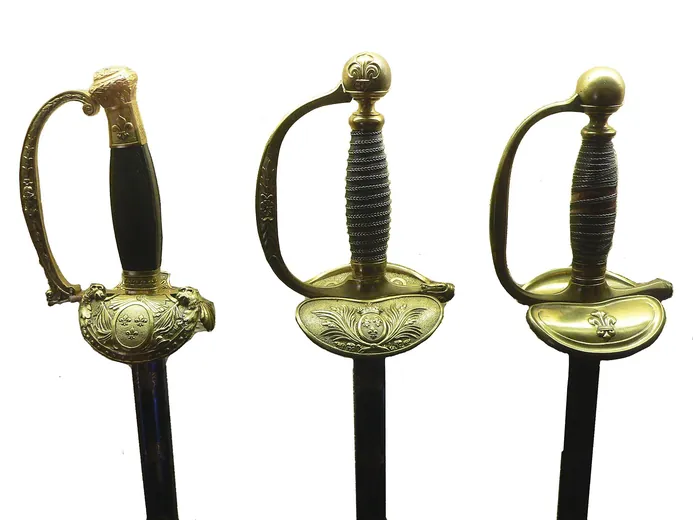
A French officer's sword, the épée, is recognised first by its blade, straight and made for the point, then by its hilt: a single knuckle bow, a shell guard and, on the shell, an emblem. That emblem often gives the regime, fleur-de-lis, cockerel or eagle, and sometimes the branch of service, such as the Navy's anchor or the army doctors' caduceus. The blade, when it is engraved, tells you where and when it was made. It must not be confused with a straight-bladed sabre, with an academician's or a prefect's sword, or with a made-up assembly. Here is how to read it, from the records of the museums that hold these swords.
Get a piece identified from photos Valuing a piece: the method
In brief
- A blade made for the point. An épée has a long, sharp, straight blade, triangular or double-edged; a sabre has a blade that curves out on the cutting side. A straight blade is not enough: the 1882 pattern for infantry officers is a sabre.
- The clavier first. On the shell guard, the plate that French museums call the clavier carries an emblem: fleurs-de-lis under the Restoration, a cockerel under the July Monarchy, an eagle under the Second Empire, an anchor for the Navy, a caduceus for army doctors.
- Dates that waver. From one museum to another, general officers' swords with the same six-flag design are said to be of 1816 or of 1817: read the piece itself, clavier, grip and blade inscription, rather than the pattern name.
- Not every épée is military. Academicians and prefects have worn one too, and sword cutlers sold court swords: with no military device on the hilt, be careful.
- An edged weapon, freely sold to adults in France. You may keep one at home without formalities; outside the home, carrying or transporting it requires a legitimate reason.
Épée or sabre: what the blade and hilt tell you
The Trésor de la langue française defines the épée as a weapon with a long, sharp steel blade, sometimes triangular but most often double-edged; and the sabre as an edged weapon with a long pointed blade, slightly convex on the cutting side. The estoc, the same dictionary says, is the point: frapper d'estoc et de taille means to strike with the point and with the edge.
The fusée is the grip, the part of the sword between the guard and the pommel. The knuckle bow runs from the pommel to the shell, the coquille, which the dictionary defines as the part that protects the hand. On nineteenth-century officers' swords, the shell often carries a decorated plate, the clavier: the Musée de la Loire in Cosne-Cours-sur-Loire describes an officer's sword of 1822 in just those terms, with a hilt "à clavier".
Shape is not always enough. The 1882 pattern infantry officer's weapon has a straight, double-edged blade and a three-bar guard, according to the Australian War Memorial; it is often called an épée, but the Musée Bonaparte in Auxonne files it among sabres. Read it with identifying and dating a French military sword. Conversely, a record of the Thonon-les-Bains museum makes the point: the presence of the shell marks an épée hilt.
The main patterns, from 1767 to the Great War
From the old monarchy to the Empire
Even before the Revolution, the épée had its regulation pattern: the Musée de l'Armée holds a foot troops' officer's sword of the 1767 pattern, made in 1780 according to its record. It also keeps a nineteenth-century drawing that gives one pattern of command sword to generals, staff officers, aides-de-camp, engineers, war commissaries and medical officers.
Under the First Empire, senior officers also bought their dress weapons from sword cutlers, the fourbisseurs, craftsmen who fitted and repaired edged weapons. A record of the Thonon-les-Bains museum mentions the pattern catalogues that Fournera, Dupont or Martin published in Paris, and Solingen blades with gilt decoration; another notes that the Empire preferred scenes inspired by Antiquity.
The Restoration: the 1816 and 1817 patterns
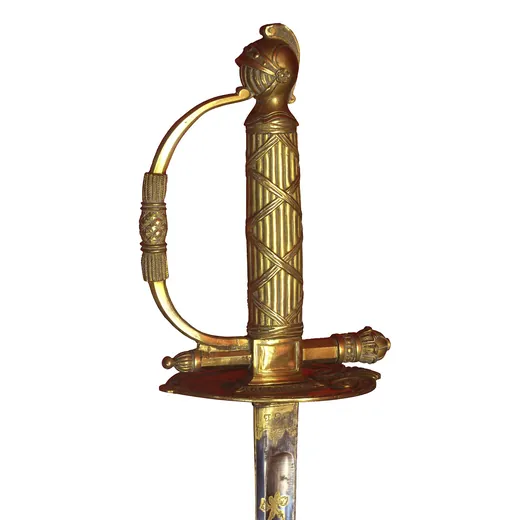
The Thonon-les-Bains museum holds a general officer's sword, 1816 pattern, dated 1817: a grip of horn bound with wire, a clavier bearing the royal arms over six flags. According to its record, horn was reserved for general officers, field and staff officers receiving a shagreen grip, and this fixed-shell pattern was replaced in 1818 by a folding-shell pattern, devised by the cutler Manceau so that the sword could be worn flat against the body.
The sword of Marshal Count Harispe, of the 1816 pattern, in the Musée de l'Armée, carries on its clavier two crossed marshal's batons and seven stars. The Musée de la Princerie in Verdun files under "1817 pattern" an infantry brigadier general's sword decorated with six flags. The Musée Blanche Hoschedé-Monet in Vernon sees in a doctor's sword made at Châtellerault in July 1916, engraved "Epée à ciselures", a "1816-1817 pattern modified in 1884". The Musée Bertrand in Châteauroux describes a naval officer's sword of the "1816 or 1819 pattern", with an anchor on the clavier. The date thus wavers from one record to the next: what is called the "1817 épée" has to be checked on the piece.
Doctors, NCOs and infantry officers
The Thonon-les-Bains museum holds an 1872 pattern sword for a médecin principal, with a caduceus in a wreath of oak and laurel, worn in full dress according to its record. NCOs had theirs: in the Musée de la Princerie, an infantry NCO's sword carries on its blade "MANUFACTURE D'ARMES DE CHATELLERAULT AVRIL 1878" and "Epée de S.O. Mle 1857", the NCO's sword of the 1857 pattern, with a flaming bomb as decoration. The same museum holds an engineers' adjudant's sword of 1910.
For infantry officers, on the other hand, museums hold sabres: a Restoration sabre with a curved Klingenthal blade at the Musée de l'hôtel Sandelin in Saint-Omer, another of May 1846 in Cosne-Cours-sur-Loire, then the straight-bladed 1882 pattern. An "1882 infantry officer's épée" is that sabre.
Reading the hilt: the clavier and its emblems
The clavier often tells you the regime, sometimes the branch of service or the rank. This table, drawn from museum records, gives leads, not rules.
| On the clavier or hilt | What it suggests | Example described by a museum |
|---|---|---|
| Classical scene or warrior, lion's head | Empire taste, still found under the Restoration | Empire child's sword (Thonon-les-Bains); Count Harispe's lieutenant general's sword (Musée de l'Armée) |
| Arms of France, fleurs-de-lis | Restoration | General officer's sword, 1816 pattern (Thonon-les-Bains); sword of about 1815 (Châteauroux) |
| Gallic cockerel holding the thunderbolt and the globe | July Monarchy | Sword of about 1830; Paris municipal guard sword engraved "29 juillet 1830" (Châteauroux) |
| Imperial eagle | Second Empire | Two officers' swords (Châteauroux); gendarmerie sword (Arbois) |
| Anchor | Navy | Naval officer's sword (Châteauroux) |
| Caduceus | Medical service | Doctors' swords of 1872 (Thonon-les-Bains) and 1916 (Vernon) |
| Flaming grenade | Grenadiers, according to the Musée Bertrand | Grenadier officer's sword (Châteauroux) |
| Helmet and two axes | Fire brigade (sapeurs-pompiers) | Fire officer's sword (Châteauroux) |
| Scrolls, foliage, no military device | Possibly a civil sword | Academician's sword (Saint-Lô) |
An emblem may have gone. On a Restoration sword in the Musée Bertrand, the fleurs-de-lis on the clavier are effaced; on a Second Empire gendarmerie sword in the Arbois museum, the eagle seems to have been hammered. A plain clavier therefore dates nothing on its own. Look at the back of the hilt too: the Musée Bonaparte in Auxonne describes, on a sword with an all-arms decoration, a sliding inner shell, a contre-clavier à pompe, and the Musée Bertrand, on a Second Empire sword, a back shell that pivots on a push-button mechanism.
Reading the blade and scabbard: factories and cutlers
On the 1822 sword in the Cosne-Cours-sur-Loire museum, the inscription is engraved on the flats of the blade: "Manufre/Royale du/Klingenthal" on one side, "Mars/1822" on the other. Its scabbard bears a half-worn name, "MANCEAUX", followed by "A [P]ARI[S]". Another blade in the same museum was deliberately blued for a third of its length: that is decoration, not damage.
Klingenthal, an edged-weapons factory founded in Alsace in 1730, passed on 1 February 1801 into the hands of Julien Couleaux; in 1830 the factory was moved to Châtellerault and Couleaux bought the site, according to the French national heritage inventory. The name can be read on the weapons, spelt Coulaux: "COULAUX Frères" on a sword with the arms of France on its clavier in the Musée Bonaparte in Auxonne. A Second Empire sword in the Musée Bertrand bears "Manuf de Klingenthal" and a name the record transcribes as "Cerveaux et Cie".
The Châtellerault factory, founded in 1819, made the NCO's sword of 1878 and the doctor's sword of 1916. On the Verdun engineers' adjudant's sword, the record reads "MANUFACTURE ROYALE DE CHATELLERAULT FEVRIER 1910": in 1910, under the Republic, a royal title does not fit the year, and the inscription, or its reading, deserves a closer look. Private cutlers signed too: Dippe, "a Andlau", in Alsace, on a fire officer's sword in the Musée Bertrand.
The scabbard also dates a sword: for the 1872 pattern doctor's sword, steel replaced leather in 1884, according to the Thonon-les-Bains museum. A scabbard from another period than the blade is not necessarily a fake, but it needs explaining.
Polytechnique and Saint-Cyr: the schools' swords
The École polytechnique, founded in 1794, was made a military school by Napoleon I in 1804; today still, according to the school, its students' full-dress uniform includes a bicorne and a sword called the "tangente".
The École spéciale militaire of Saint-Cyr was founded by the First Consul on 1 May 1802 at Fontainebleau and moved to Saint-Cyr in 1808, the French Ministry of the Armed Forces recalls. None of the sources for this guide describes a regulation épée specific to Saint-Cyr cadets. At Coëtquidan, the officer cadets of the École militaire interarmes receive a sabre: the order of the day of 15 November 2025 speaks of the oath taken on receiving the sabre from their sponsor. A "Saint-Cyr épée" should therefore first be checked by its blade.
Civil swords and court swords: what gets taken for an officer's épée
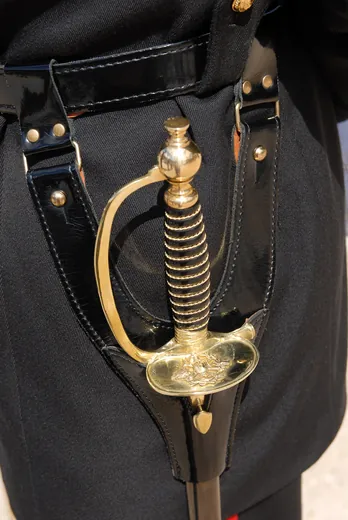
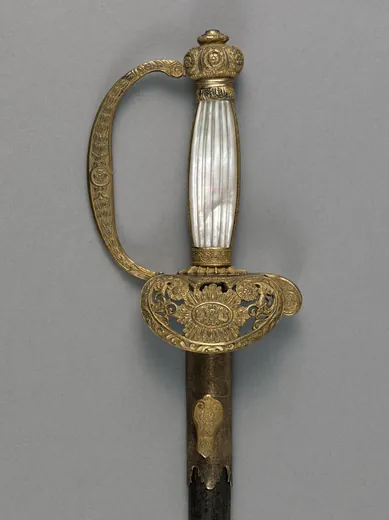
The Académie française points out that the coat and the sword are shared by the members of all five academies of the Institut de France. The sword, first a sign that academicians belonged to the King's Household, came into general use from the Restoration; its grip traditionally bears symbols of the holder's life and work. The sword of Victor Hugo, elected in June 1841, belongs to the Maisons de Victor Hugo: mother-of-pearl grip, brass guard, pommel and locket, black leather scabbard. That of Octave Feuillet, in Saint-Lô, is decorated with scrolls, oak leaves and vine leaves.
Prefects wore the sword too. According to the prefecture of the Alpes-Maritimes, three orders of Year VIII set their uniform, adjusted afterwards with each change of regime; the circular of 10 April 1873 gives them a sword with a mother-of-pearl grip in full dress as in undress.
Then there are court and dress swords, which were not reserved for soldiers: the Thonon-les-Bains museum mentions pommels made in Turin for the civil officials of the ministries. To decide, look for the military device: on the 1872 doctor's sword, the thunderbolt on the knuckle bow and the laurels on the cross-guard show that the owner was a soldier, its record says.
Copies, made-up pieces and replicas
The Thonon-les-Bains museum describes a textbook case: a Restoration épée hilt, decorated with a scene of knights, fitted to a Solingen sabre blade. According to its record, many Solingen blades with damascened decoration had never been mounted, and at the end of the nineteenth century and the beginning of the twentieth it was easy to put such pieces together. The same museum holds a child's sword, a very careful replica of senior officers' dress swords, with an unsharpened blade and a rounded point, 64.5 cm long.
Departing from the pattern is not necessarily a flaw: the Musée Bonaparte in Auxonne calls an 1882 pattern infantry officer's sabre a "fancy model". What should raise doubts is what does not match: one regime's emblem on a blade dated under another, a factory title that does not fit the year, a sabre blade under a shell, a scabbard from another period. The general method is in recognising fake militaria.
Caring for and owning an antique sword
Store the blade beside its scabbard, not in it: the Canadian Conservation Institute advises against keeping an iron object in its protective covering, and recommends handling it with gloves, avoiding commercial liquid rust-strippers and, when cleaning it, not taking the iron down to bare metal unless appropriate. So do not polish the blade to read its inscription. Leather and brass are covered in caring for military leather, textiles and metal.
An épée is an edged weapon within the meaning of article R311-1 of the French internal security code, and a ministerial answer published on 24 June 2025 places edged weapons in category D. According to Service-Public.fr, a weapon in that category may be bought freely by any adult and kept freely; outside the home, carrying or transporting it requires a legitimate reason. The rules on selling are in selling militaria legally in France.
What I cannot tell you here
I cannot tell you, from a photograph, whether a clavier is original, whether an emblem was worn away or removed on purpose, or which exact pattern an uninscribed sword belongs to. This guide relies on museum records, not on the regulations, which I have not read: its dates are those of the records. The reference work cited by the Thonon-les-Bains museum, Armes blanches militaires françaises by Christian Ariès, runs to thirty parts; it can be consulted in libraries.
I give no prices: the method for placing a piece is in valuing a military item. For a particular sword, photograph the clavier and its reverse, both flats of the blade near the guard, the grip and the scabbard, then have it identified free of charge. Pieces for sale are in Revolution and Empire arms, the Franco-Prussian War of 1870 and First World War arms.
Frequently asked questions
What is a French officer's épée?
The dress and command weapon some French officers wore with their uniform: a long straight blade, triangular or double-edged, made for the point, under a hilt with a single knuckle bow and a shell guard. On the shell, the clavier often carries an emblem of the regime or the branch of service. Museums hold many patterns, from the foot officer's sword of the 1767 pattern to the doctor's sword still made at Châtellerault in 1916.
How do you identify a French military sword?
Look first at the clavier, the decorated plate on the shell guard: fleurs-de-lis, a cockerel or an eagle give the regime; an anchor, a caduceus or marshal's batons give the branch or rank. Then read the flats of the blade near the guard, where a factory such as Klingenthal or Châtellerault may have engraved its name, the month, the year and sometimes the pattern. A hilt with no military device at all may belong to a civil sword, an academician's or a prefect's.
How can you date an antique French officer's sword?
By cross-checking. The emblem on the clavier gives a regime; the blade inscription gives a factory and a date, and its title, royal, imperial or national, must fit that date; the scabbard gives a period, since for the 1872 pattern doctor's sword steel replaced leather in 1884. When these clues do not match, the piece may have been reassembled, or its inscription misread.
What is the French 1817 pattern épée?
A common name that museums do not all use in the same way. The Musée de la Princerie in Verdun files under "1817 pattern" an infantry brigadier general's sword decorated with six flags; the Thonon-les-Bains museum calls a general officer's sword dated 1817 the "1816 pattern"; the Vernon museum sees in a doctor's sword of 1916 a "1816-1817 pattern modified in 1884". Trust the piece: clavier, grip and blade inscription.
What sword did French infantry officers carry?
Before the Revolution, a regulation épée: the Musée de l'Armée holds a foot troops' officer's sword of the 1767 pattern, made in 1780. For the nineteenth century, museums hold infantry officers' sabres: a Restoration one in Saint-Omer, one of 1846 in Cosne-Cours-sur-Loire, then the straight-bladed 1882 pattern, often called an épée but still a sabre. The so-called 1817 pattern épée in Verdun, for its part, belonged to an infantry brigadier general.
Do Saint-Cyr cadets carry an épée?
None of the sources for this guide describes a regulation épée specific to Saint-Cyr cadets. At Coëtquidan, the officer cadets of the École militaire interarmes receive a sabre from their sponsor, according to the order of the day of 15 November 2025. The épée does belong, on the other hand, to the full-dress uniform of the École polytechnique, which includes a bicorne and a sword called the tangente.
How do you tell an épée from a sabre?
By the blade: an épée's is straight and sharp-pointed, often triangular or double-edged, made for the thrust; a sabre's is slightly convex on the cutting side. Then by the hilt: a shell guard marks an épée hilt, as the Thonon-les-Bains museum points out. Beware of the exception: the 1882 pattern infantry officer's weapon has a straight double-edged blade and a three-bar guard, and it is a sabre.
How do you recognise a French academician's sword?
By its grip, which traditionally bears symbols of the holder's life and work, according to the Académie française. The sword is shared by the members of the five academies of the Institut de France, and it is generally given to the newly elected member by subscription. Victor Hugo's, kept by the Maisons de Victor Hugo, has a mother-of-pearl grip and a brass guard; Octave Feuillet's, in Saint-Lô, is decorated with scrolls, oak leaves and vine leaves.
Sources
This guide draws on the texts, databases and pages below, accessed on unless otherwise stated. Most of them are in French.
- Trésor de la langue française informatisé (CNRTL), entry “épée”, accessed
- Trésor de la langue française informatisé (CNRTL), entries “sabre” and “sabre-briquet”, accessed
- Trésor de la langue française informatisé (CNRTL), entry “estoc”
- Trésor de la langue française informatisé (CNRTL), entry “fusée”, sense used in arms making
- Trésor de la langue française informatisé (CNRTL), entry “coquille”, part of an edged weapon
- Musée de la Loire, Cosne-Cours-sur-Loire, record of an officer's sword with a Klingenthal blade of March 1822 and a Manceaux scabbard (inv. COOA 940.5.21), Joconde database on POP
- Australian War Memorial, French pattern 1882 infantry officer's sword and scabbard, object RELAWM13728, accessed
- Musée Bonaparte, Auxonne, record of a model 1882 infantry officer's sabre, a “fancy model” (inv. 2010.0.707), Joconde database on POP, accessed
- Musée de Thonon-les-Bains, record of an épée hilt reassembled on an officer's sabre blade (inv. 1993.1.11), Joconde database on POP
- Musée de l'Armée, collections database, foot troops' officer's sword, 1767 pattern (inv. 6805)
- Musée de l'Armée, collections database, nineteenth-century drawing of the pattern of the command sword and plates for generals, staff officers and other corps, including medical officers (inv. 2010.0.2580-40)
- Trésor de la langue française informatisé (CNRTL), entry “fourbisseur” (sword cutler)
- Musée de Thonon-les-Bains, record of a child's dress sword copying senior officers' swords (First Empire, inv. 1953.47.1.5), Joconde database on POP
- Musée de Thonon-les-Bains, record of a general officer's sword, 1816 pattern (1817, inv. 1996.118.3), Joconde database on POP
- Musée de l'Armée, record of Marshal Count Harispe's sword, 1816 pattern (inv. 2003.10.6), Joconde database on POP
- Musée de la Princerie, Verdun, record of an infantry brigadier general's sword, “1817 pattern” (inv. 2008.0.18), Joconde database on POP
- Musée Blanche Hoschedé-Monet, Vernon, record of a doctor's sword made at the Châtellerault national arms factory in July 1916, engraved “Epée à ciselures” (inv. 79.211), Joconde database on POP
- Musée Bertrand, Châteauroux, record of a naval officer's sword, “1816 or 1819 pattern” (inv. 2000.0.13), Joconde database on POP
- Musée de Thonon-les-Bains, record of a médecin principal's sword, 1872 pattern (inv. 1996.108.12), Joconde database on POP
- Musée de la Princerie, Verdun, record of an infantry NCO's sword, 1857 pattern, with a Châtellerault blade of April 1878 (inv. 2006.0.30), Joconde database on POP
- Musée de la Princerie, Verdun, record of an engineers' adjudant's sword with a Châtellerault blade of February 1910 (inv. 54.17.131), Joconde database on POP
- Musée de l'hôtel Sandelin, Saint-Omer, record of a Restoration infantry officer's sabre with a Klingenthal blade signed Coulaux frères (inv. 4009.2), Joconde database on POP
- Musée de la Loire, Cosne-Cours-sur-Loire, record of an infantry officer's sabre of 1846 (inv. COOA 940.5.20), Joconde database on POP, accessed
- Musée de l'Armée, record of Count Harispe's lieutenant general's sword, Restoration period (inv. 2003.10.7), Joconde database on POP
- Musée Bertrand, Châteauroux, record of a July Monarchy officer's sword with a Gallic cockerel on the clavier (inv. 970), Joconde database on POP
- Musée Bertrand, Châteauroux, record of a Paris municipal guard sword engraved “garde municipale de Paris 29 juillet 1830” (inv. 5006), Joconde database on POP
- Musée Bertrand, Châteauroux, record of a Second Empire officer's sword with an imperial eagle and a mother-of-pearl grip (inv. 2000.0.15), Joconde database on POP
- Musée Bertrand, Châteauroux, record of a grenadier officer's sword (inv. 2000.0.10.1), Joconde database on POP
- Musée Bertrand, Châteauroux, record of a Restoration officer's sword of about 1815, with effaced arms of France on the clavier (inv. 972), Joconde database on POP
- Musée Sarret de Grozon, Arbois, record of four swords, including a Second Empire gendarmerie sword with a hammered eagle (inv. 319), Joconde database on POP
- Musée Bonaparte, Auxonne, record of an officer's sword with an all-arms clavier and a sliding inner shell (inv. 2010.0.373), Joconde database on POP
- Musée de la Loire, Cosne-Cours-sur-Loire, record of an officer's sword with a triangular blade blued for a third of its length (inv. COOA 940.5.22), Joconde database on POP
- French national heritage inventory, the edged-weapons factory at Klingenthal (Boersch), Mérimée record IA00075488 on POP, accessed
- Musée Bonaparte, Auxonne, record of a sword signed “COULAUX Frères” with the arms of France on the clavier (inv. 2010.0.374), Joconde database on POP
- Musée Bertrand, Châteauroux, record of a Second Empire officer's sword with a Klingenthal blade and a pivoting back shell (inv. 3147.1), Joconde database on POP
- French national heritage inventory, the Châtellerault arms factory, Mérimée record IA86000053 on POP, accessed
- Musée Bertrand, Châteauroux, record of a Restoration fire brigade officer's sword with a blade signed “Dippe” “a Andlau” (inv. 732.1), Joconde database on POP
- École polytechnique, “A military School”: founded in 1794, made military in 1804, full-dress uniform with a bicorne and a sword called the “tangent”
- French Ministry of the Armed Forces, Saint-Cyr Coëtquidan military academy (AMSCC): history of the École spéciale militaire and its schools
- French Ministry of the Armed Forces, order of the day no. 82 to the officer cadets of the École militaire interarmes, Coëtquidan, 15 November 2025 (sabre ceremony)
- Académie française, “L'habit et l'épée”, presentation of the academician's green coat and sword
- Paris Musées, Maisons de Victor Hugo, Victor Hugo's academician's sword (before 1841, inv. 1291.2)
- Saint-Lô museum of art and history, record of Octave Feuillet's academician's sword (inv. 1957.01.003), Joconde database on POP
- Prefecture of the Alpes-Maritimes, on the prefect's uniform: orders of Year VIII and circular of 10 April 1873
- Canadian Conservation Institute, Note 9/6, “Care and Cleaning of Iron”, accessed
- Code de la sécurité intérieure, article R311-1: definitions, including components of ammunition, on Légifrance, accessed
- French National Assembly, written question no. 5868 (17th legislature) on carrying category D weapons, with its answer of 24 June 2025, accessed
- Service-Public.fr, on category D weapons (free acquisition and possession), accessed
- French defence ministry digital libraries, catalogue record of Christian Ariès, Armes blanches militaires françaises, 30 parts