Collector's guide Edged weapons
Identifying and dating a French military sword
By Augustin, founder of Athena Militaria Published , updated 20 min read
On a French regulation sword, the date is often engraved in full: you just need to know where to look, and how to read it. The back of the blade gives the factory, the month and the year, and often the model; the inspection stamps tell you who accepted the weapon; the numbers, whether hilt and scabbard have always travelled together. Here is how to read them, from the records of the museums that hold these swords, and what French law lets you do with one.
Get a piece identified from photos Valuing a piece: the method
In brief
- The back of the blade first. Near the hilt, French factories engraved their name and the month and year of manufacture; from October 1855, the model was added. Copy the inscription before you interpret it.
- Two factories dominate. Klingenthal, in Alsace, for blades of the First Empire, those of the swords known as Napoleonic, and of the Restoration; Châtellerault, founded in 1819, after that.
- The shape gives the family. A curved blade and a three-bar brass hilt for the light cavalry, a straight blade for the heavy cavalry's 1854 model, a short blade for the infantry briquet.
- Stamps and numbers cross-check the date. The letters struck at the ricasso belong to inspectors, controllers and directors whose years of service are known; the same number on hilt and scabbard means the set has not been split up.
- A category D edged weapon. You must be an adult to buy one, keeping it at home is free, carrying or transporting it without a legitimate reason is prohibited.
Reading the back of the blade: factory, month and year
The back of a sabre is the edge opposite the cutting edge. That is where, near the hilt, the factories engraved their inscription. The Musée de l'Armée, the French army museum in Paris, describes it on a light cavalry sabre of the First Empire: the square back bears the factory's name and the date of manufacture, “Mre Imple du Klingenthal septembre 1813”, that is, Imperial factory of Klingenthal, September 1813.
Until 1855 the inscription stops there. The Musée de la bataille du 6 août 1870, in Woerth, reports that on 6 October 1855, at the minister's request, the model was added to it. Its sabre of 1858 thus reads “Mre Impale de Châlt Mars 1858 Cavrie lre Mle 1822”, which the record expands as Imperial factory of Châtellerault, March 1858, light cavalry, model 1822. A light cavalry sabre of 1853 held by the Australian War Memorial, by contrast, reads only “Manufre Imperiale de Chatellerault Fevrier 1853”.
The inscription also says whom the blade was made for: “Carabinier Modèle 1854” on a sabre of October 1856 in the Bavarian Army Museum, “Adjt d'Infrie Mle 1845” on an infantry warrant officer's sabre of 1916, “Offer de Cavrie lre Mle 1822” on a light cavalry officer's sabre of 1890. The back dates the blade and names its model; it dates neither the hilt nor the scabbard, which may have been changed.
Two names keep coming back. Klingenthal, near Boersch in the Bas-Rhin, is an edged-weapons factory founded in 1730; according to the French national heritage inventory, it became a national factory in 1792, passed into the hands of Julien Couleaux in 1801, and in 1830 manufacture was transferred to Châtellerault while Couleaux acquired the site. The Musée de la Loire, in Cosne-Cours-sur-Loire, says it belonged to the state until 1836 and passed to the Coulaux family in 1838: the dates differ, the fact does not. Its blades then read “Coulaux & Cie”, like that of a cavalry officer's sabre of the 1850s held in Cosne. Châtellerault, in the Vienne, was founded by a royal ordinance of 14 July 1819 to make edged weapons; it later made firearms and closed on 1 November 1968.
The word describing the factory generally follows the regime. Klingenthal is “impériale” on blades of 1812 and 1813 and “royale” on blades of 1814 to 1823; Châtellerault is “royale” in 1831, 1832 and 1846, “nationale” in 1849, “impériale” from 1853 to 1863, “nationale” again in 1871, plain “manufacture d'armes” from 1878 to 1890, and “manufacture nationale d'armes” in 1916. When the qualifier does not fit the year, the inscription, or its reading, deserves a closer look: one record in Saint-Omer transcribes “Manuf Nationale Châtellerault février 1831” on a trooper's sabre, while another, in the same museum, reads “Manufre Rale de Châtellerault mars 1831”.
The abbreviations become easy with practice: “Mre” or “Manufre” for manufacture, “Rle” or “Rale” for royale, “Impale” for impériale, “Nle” for nationale, “Châtt” or “Châlt” for Châtellerault, “Mle” for modèle. The month is sometimes written with a figure, as in “7br 1849” or “7bre 1871”: the figure follows the month's place in the Roman year, which began in March, so 7bre reads September and 9bre November. The Trésor de la langue française, the reference dictionary of French, notes that septembre and novembre come from the Latin septem, seven, and novem, nine.
Copy the inscription character by character, abbreviations and full stops included, before expanding it: misread one figure of the month and the date slips by several months. On officers' swords it may also be on the flat of the blade: the Musée de la Loire holds an infantry officer's sabre with “Manufre Rle de Châtellerault” on one flat and “Mai 1846” on the other. The same habit applies to every kind of object: our guide to reading the markings on a military item sorts stamps, punches and numbers by family of objects.
The main models from 1800 to 1918 in one table
The shape of the blade and of the hilt gives the family; the inscription on the back, when it names the model, settles it. This table only includes models described in the records of public museums; where none of them describes a point, the cell says so rather than guess. Lengths are those of the blades described, to within a few millimetres. Sword bayonets are covered in identifying a French bayonet.
| Model | Issued to | Blade | Hilt and scabbard | Source |
|---|---|---|---|---|
| Infantry briquet, An IX and An XI | Infantry; under the Empire, the elite companies: grenadiers, carabiniers, voltigeurs | Short, about 60 cm, slightly curved | Brass hilt cast in one piece; as a rule 36 grooves on the grip for the An IX, 28 for the An XI | Woerth and Thonon-les-Bains museums |
| Light cavalry sabre, An IX and An XI, known as An XI-An XIII | Mounted chasseurs, light horse lancers, horse artillery, then hussars | Slightly curved, hollow-ground, about 88 cm | Three-bar brass hilt; sheet-iron scabbard with two bands and two rings | Musée de l'Armée |
| Heavy cavalry sword, An XIII (An IX modified in An XI) | Cuirassiers, with an iron scabbard; dragoons, with a leather scabbard | Flat back, two fullers on each face, point in line with the back, about 97 cm; point moved to the middle of the blade in 1816 on swords still in service | Brass hilt with a broad guard plate and S-shaped bars; scabbard with two rings | Musée de l'Armée |
| Light cavalry sabre, model 1822 | Light cavalry; there is also a heavy cavalry model 1822 | Slightly curved, “Montmorency” type, hollow-ground with fullers, about 92 cm | Brass hilt with a main bar and two side bars; iron scabbard, with two rings on the 1832 and 1871 examples in the Gronau museum | Musée de l'Armée, Woerth and Gronau museums |
| Horse artillery sabre, model 1829 | Mounted gunners, replacing the 1822; withdrawn on 19 March 1888 | Curved, hollow-ground with a flat back, about 81 cm | A single guard bar, with a hooked quillon | Woerth museum |
| Infantry warrant officer's sabre, model 1845 | Infantry adjudants; still made in 1916 | Half straight, half curved, fullered and hollow-ground | Brass hilt decorated with foliage; second scabbard ring removed in 1883 and grip of blackened service-tree wood in 1915, according to the Thonon-les-Bains museum; the Dijon museum's example of May 1916 still has a horn grip | Thonon-les-Bains and Dijon museums |
| Cavalry sword, model 1854 | Heavy cavalry: carabiniers, including those of the Imperial Guard, and dragoons; the Gronau museum lists it as a cuirassier's sword | Straight, with a double fuller | Three-bar brass hilt; steel scabbard with two rings on a sword of 1863, with one on a dragoon's sword of 1882 | Bavarian Army Museum, Gronau museum, Australian War Memorial |
| Infantry officer's sword, model 1882 | Infantry officers | Straight, double-edged, one fuller on each side | Three-bar hilt; nickel-plated steel scabbard with a single ring; the example described bears the name of a Paris firm | Australian War Memorial, Musée Bonaparte in Auxonne |
| Cavalry officer's sabre, model 1896 | Cavalry officers | Not described here: none of this guide's sources describes it | Not described here, for the same reason; the Musée de l'Armée has lent one to the museum of Fort de la Pompelle | Musée de l'Armée |
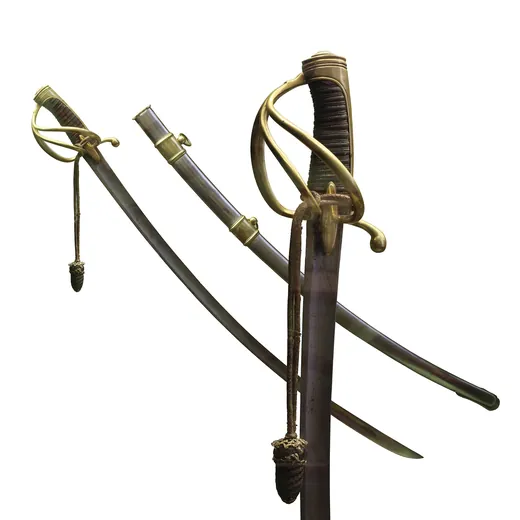
According to the Musée de l'Armée, the An XI light cavalry sabre differs from the An IX mainly in its reinforced scabbard, thicker and heavier; it is sometimes called An XI-An XIII because the regulation describing it only appeared in Year XIII. The two are so alike that the photograph at the top of this guide is captioned An XI in French and An IX in English. The same museum reports that the 1822 model, adopted to rationalise the supply of cavalry weapons, satisfied neither the heavy nor the light cavalry and earned the nickname “bancal”, because of its slightly curved blade.
A record of the Musée de l'hôtel Sandelin, in Saint-Omer, files under the label “model 1822-1882” a sabre of 1831 which it calls a light cavalry sabre, although its 97 cm blade has the length of the heavy cavalry 1822, without saying what changed. The French national heritage inventory, for its part, describes a light cavalry sabre, “model 1822 transformed”, kept at the town hall of Herm, in the Landes: a trooper's hilt of the 1822 model on a straight, double hollow-ground blade, of the type of the reserve cavalry swords of the 1854 model, shortened by a few centimetres. Its record considers the weapon probably reassembled around 1880, before the decision to bring into service a new straight-bladed model of 1882, which the cavalry had been asking for. It is one example, not a rule: none of this guide's sources describes in detail an official modification of the 1822 in those years, or the cavalry sword of 1882, so this guide does not go into them. For 1914, the Australian War Memorial presents a model 1822 sabre and a model 1854 dragoon sword in its collection as types still issued to the French cavalry during the First World War.
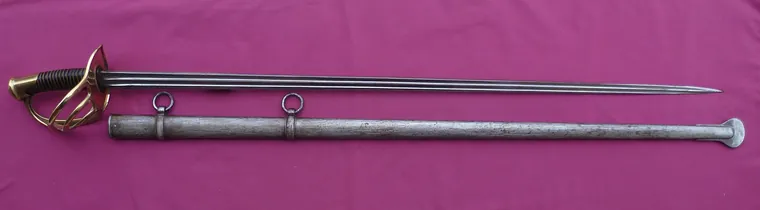
A cavalry officer's sword of 1884: straight blade and steel hilt
In the table, the model 1822 light cavalry sabre and the model 1854 cavalry sword have brass hilts. The Australian War Memorial holds a cavalry officer's sword of 1884 whose hilt is steel and whose blade is straight. The back of its blade reads “Mre d'Armes de Chatl Fevrier 1884 = Offer = de Cavrie Mle 1883 Entse Henry”. The record copies the inscription without expanding it; its title, which gives the 1883 model and a cavalry officer, fits “Offer = de Cavrie Mle 1883”.
The blade has a wide fuller on each side, stopping 15 cm from the point. The guard has three bars; the fishskin grip is bound with silver wire; the plain steel scabbard has a single loose ring. The museum links the sword to the First World War. The sword belonged to a general of a cavalry brigade, who served in France and Macedonia.
This sword is an example, not a rule. For the cavalry sword of 1882 mentioned above, as for the other swords of those years, record the model on the back of the blade rather than judging by the hilt alone. To go beyond this example, the Châtellerault factory records at the Service historique de la Défense, the French defence archives, include decisions on the swords of the 1854 to 1896 models and on the study of a new cavalry sword. They also contain plans of a cavalry officer's sword dated 1895, and blade engravings for model 1896 officers' swords, one of them marked “promotion 1899-1900”.
Trooper's or officer's
The same model often came in a trooper's and an officer's version. The trooper's weapon described in the records comes from a state factory and bears numbers on the hilt and scabbard; from 1855, its back often also names the arm of service it was made for: “Cavrie lre”, “Carabinier”, “Dragon”. The officer's is finer, and the inscription sometimes says so: the Musée de la Loire holds a sabre engraved “Mre d'Armes de Châtt Août 1890 Offer de Cavrie lre Mle 1822”, a light cavalry officer's sabre of the 1822 model made at Châtellerault in August 1890, with a gilt brass hilt decorated with sheaves of wheat.
Officers' weapons did not all come from state factories, or not entirely. On another light cavalry officer's sabre in the same museum, the Klingenthal blade, dated April 1823, is mounted on a hilt marked “MANCEAUX A PARIS”. The model 1882 infantry officer's sword in the Australian War Memorial, often called an épée in French, bears, etched near the hilt, the name and Paris address of a private firm, H. Faure Le Page. And the Musée Bonaparte in Auxonne describes an infantry officer's sabre of the 1882 model as a “fancy model”: for an officer, departing from the regulation pattern is not a fault in itself.
In between, the model 1845 infantry warrant officer's sabre is a regulation weapon for a senior NCO, with a decorated hilt, which the back of its blade announces: “Adjt d'Infrie Mle 1845”. The Musée de la vie bourguignonne, in Dijon, holds one made at Châtellerault in May 1916 and used, according to its record, in the 27th Infantry Regiment. Its grip is still of buffalo horn, whereas the Thonon-les-Bains record, which refers to volume III of Pétard's work, dates the replacement of horn by blackened service-tree wood to 1915: the material of the grip is therefore not enough to date a sabre of those years.
A name or monogram engraved on a sword does not, on its own, tell you who carried it: you need papers. How to read them is explained in reading and keeping military photographs and documents.
Scabbards, rings and numbers
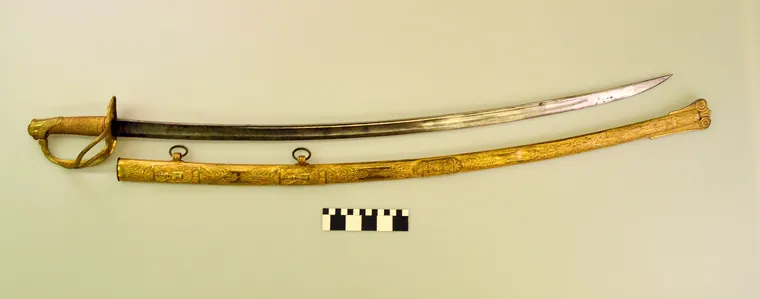
The scabbard is read together with the blade. Under the Empire, the light cavalry sabre's scabbard is of sheet iron over a wooden core, with two bands each carrying a ring; that of the An XIII heavy cavalry sword is of iron for cuirassiers and of leather for dragoons, according to the Musée de l'Armée. For the helmets of these two branches: identifying a French cuirassier or dragoon helmet.
The number of rings varied. In the Gronau museum, in Germany, two model 1822 sabres dated 1832 and 1871 and a model 1854 sword dated 1863 have scabbards with two rings; in the Australian War Memorial, two 1822s dated 1853 and 1880 and a model 1854 dragoon sword dated 1882 have only one. For the infantry warrant officer's sabre, the Thonon-les-Bains museum dates the removal of the second ring to a ministerial note of 22 December 1883. None of this guide's sources gives a date for cavalry swords: a single ring dates nothing on its own; it is a reason to compare with a known piece.
The numbers tell you something else: whether hilt and scabbard have travelled together. The 1878 warrant officer's sabre in the Thonon-les-Bains museum bears 12 566 on the hilt and on the scabbard band, the Australian War Memorial's dragoon sword 1456 on both. A number struck through and restamped means the parts were re-matched: on the same museum's 1822 of 1853, the hilt bears 720 struck through and 722, the number of its scabbard. That sabre was, incidentally, recaptured from the Germans by an Australian battalion at Lihons, on the Somme, during the First World War. In the Musée de l'hôtel Sandelin, two sabres of 1831 have their numbers crossed: 427 on the hilt of one and the scabbard of the other, 586 the other way round.
Store the blade out of its scabbard. The Canadian Conservation Institute advises against keeping an iron object in its sheath, where it can rust unseen, stain the sheath or become stuck in it, and recommends storing it alongside; it also advises handling it with gloves, since salts from the skin encourage corrosion. The steps that apply to all metal and to leather are gathered in caring for military leather, textile and metal.
Inspectors' stamps
At the ricasso, near the hilt, and often on the hilt itself, small letters struck in a circle, an oval or a lozenge, sometimes topped by a crown or a star: these are the stamps of the men who accepted the weapon. On the Musée de l'Armée's sabre of 1813, K stands for the inspector Krantz, B and L for the controllers Bick and Lobstein. The Musée de la Loire reads three stamps on a sabre of November 1814: the inspector's, the controller's and the reviser's.
Each letter stands for a person, and each person had years of service. The record of the Woerth sabre of 1858 thus reads a crowned M, that of J.B.M.L.A. de Mecquenem, director of the Châtellerault factory from 28 July 1855 to 6 August 1859; a starred B, that of the first-class controller J.A. Bisch, in post from 16 February 1844 to 31 January 1861; a starred S, that of the second-class controller F.A. Schütz, in post from 14 February 1854. That of a warrant officer's sabre of 1878, in Thonon-les-Bains, finds at the ricasso the stamp of the controller François-Louis Sprenger, used from 1864 to 1885, and on the hilt the R of Major Jean-Paul Réallon, director from 1876 to 1883.
That is what makes the stamps valuable: they cross-check the date on the back. The Thonon-les-Bains record even uses them to attribute a worn stamp at the ricasso to Réallon, from the clear one on the hilt. A stamp whose holder was not in post at the engraved date is an inconsistency to be explained; it is not, on its own, proof of a fake.
Record each stamp exactly as it is, letter, crown or star, circle, oval or lozenge, before looking for whose it is.
Shortened blades, reassembled pieces and replicas
Measure the blade, from the ricasso to the point, and compare. The records give benchmarks: about 60 cm for the An XI briquet, 88 cm for the An XI light cavalry sabre, 92 cm for the model 1822, 97 cm for the heavy cavalry 1822 and for the An XIII cuirassier's sword. A few millimetres' difference from one example to another means nothing; several centimetres need explaining.
The explanation may be official. According to the Musée de l'Armée, An XIII cuirassier's swords still in service in 1816 had their point moved to the middle of the blade and their scabbard changed, which makes those that kept their original state rare. It may also come from use: the blade of the Australian War Memorial's 1822 of 1880 has been sharpened, and bent near the hilt. Or it may come from reassembly: the “model 1822 transformed” sabre at the town hall of Herm, described above, combines a hilt and a blade from two different models, and its shortened blade now measures only 88 cm.
A reassembled piece is not necessarily a deception. The Musée de l'Armée's An XIII cuirassier's sword combines a Klingenthal blade with a hilt marked VERSAILLES, where it was assembled: that is its original state. What should alert you is what does not match: a hilt whose number is not the scabbard's, a blade back whose model does not fit the hilt, stamps whose holders do not fit the date, a factory qualifier that does not fit the year. The checks that apply to every piece are in spotting fake militaria.
Against a replica, the back of the blade remains the best witness, provided you read it to the end. A blade dated before October 1855 that already bears its model contradicts the rule reported by the Woerth museum; a perfectly crisp inscription on a worn blade calls for the same caution. Do not polish to read better: the Canadian Conservation Institute advises against stripping iron to bare metal unless necessary and against commercial liquid rust removers, which can strip the metal in places. Raking light does more to bring out a worn inscription.
What French law says
Under the French code de la sécurité intérieure, a sabre is an edged weapon, defined in article R311-1 as any weapon whose piercing, cutting or blunt action is due only to human force or to a mechanism to which that force has been transmitted, excluding an explosion. Edged weapons fall into category D, the weapons that may be acquired and possessed freely: article R311-2 places in it, under a, all objects likely to constitute a weapon dangerous to public safety, and the Ministry of the Interior, in its answer published on 24 June 2025 to a member of parliament's written question, names daggers and, more broadly, edged weapons among them.
In practice, according to Service-Public.fr, the French government's information site, you must be an adult to buy a category D weapon, keeping it at home is free, and carrying or transporting it outside your home without a legitimate reason is prohibited, as article R315-1 provides. Carrying means having it on you, ready for immediate use; transporting means moving it with you when it is not ready for immediate use: both require a legitimate reason, which the police, then the courts, assess case by case, according to the place, the time, the weapon and the person. Article L317-8 punishes carrying or transporting a category D weapon without a legitimate reason with one year's imprisonment and a fine of 15,000 euros; except for firearms, proceedings can be ended by voluntarily surrendering the weapon and paying a fixed fine of 500 euros.
For a collector, that means a sabre wrapped and out of reach when you take it to an arms fair, to an expert or to its buyer, and a way of explaining why you are moving it: if you are checked, Service-Public.fr points out, you must be able to give a legitimate reason.
Two texts of 2025 changed this classification without naming sabres. The order of 4 July 2025 lists the other weapons in category D under a: butterfly knives, automatic knives, throwing stars, mixed weapons of a model earlier than 1 January 1946 combining knuckle-dusters and a blade; its explanatory note recalls that those who trade in them must obtain an authorisation to open a business, compulsory for selling weapons in category D under a. Decree no. 2025-894 of 5 September 2025, which amended article R311-2, now places in category A1, prohibited for acquisition and possession, certain knives, cutlasses and machetes with a fixed, sharp, pointed and serrated blade that is also pierced with several holes or set with several sharp spikes, and knuckle-dusters of a model later than 1 January 1900.
The rules for selling, between private individuals and on this site, are in selling militaria legally in France. This guide describes French law in force on 10 October 2026; other countries have their own rules.
What I cannot tell you here
I cannot tell you, from a photograph, whether a blade has lost two centimetres, whether a stamp is original, or exactly which model a sabre without an inscription belongs to: you need the piece, a ruler and a known example to compare. Nor do I go into what none of this guide's sources describes: an official modification of the 1822 in the 1880s, the cavalry sword of 1882, the cavalry officer's sabre of 1896. For anyone who wants to go further, the plans of the Châtellerault factory, including those of the model 1822 light cavalry sabre, are kept by the Service historique de la Défense, the French defence archives.
I give no prices: the method for placing a piece is in valuing a military item. For a particular sword, photograph the back of the blade along its whole length, the ricasso on both sides, the hilt, the scabbard and every number, then ask the community. Pieces for sale are in Revolutionary and Napoleonic weapons and First World War weapons.
Frequently asked questions
How to identify an antique sword?
For a French regulation sword, start with the back of the blade, near the hilt: the factories engraved their name and the month and year of manufacture there, and, from October 1855, the model. Then look at the shape: a curved blade and three-bar brass hilt for light cavalry, a straight blade for the heavy cavalry's 1854 model, a short blade for the infantry briquet. The stamps at the ricasso and the numbers on hilt and scabbard cross-check the whole.
How to clean an antique sword?
As little as possible. The Canadian Conservation Institute advises dusting iron dry with a soft brush, not stripping it to bare metal unless necessary and avoiding commercial liquid rust removers; for a thin, even layer of rust, it describes gentle rubbing with light oil and very fine steel wool. It recommends asking a conservator before cleaning a sword, and storing it out of its scabbard. Never polish the back of the blade: that is where its date is engraved.
What is a briquet sword?
A short French infantry sabre. The Trésor de la langue française defines the sabre-briquet as an infantry and foot artillery sabre used until the nineteenth century, slightly curved, with a false edge towards the point. Under the First Empire it marked out the elite companies, grenadiers, carabiniers and voltigeurs, according to the Thonon-les-Bains museum, which explains that briquet meant a small knife, because of its short blade.
How much is an antique French sword worth?
Its value is read on the sword itself, point by point. First the inscription on the back of the blade, which gives the factory, the month and the year, and from October 1855 the model. Then whether the set has stayed together: the same number on the hilt and on the scabbard means it has not been split up. Next a blade at its full length, neither shortened nor recombined, and never repolished. Finally the rank, an officer's weapon being finer than a trooper's. The range itself is built from sales actually concluded for comparable swords.
Is it legal to own a sword in France?
Yes. Under French law a sword is an edged weapon in category D, which an adult may acquire and possess freely: nothing needs to be declared to keep one at home. What is prohibited is carrying or transporting it outside your home without a legitimate reason, punishable by one year's imprisonment and a fine of 15,000 euros (article L317-8 of the code de la sécurité intérieure).
Can you carry a sword in France?
Not without a legitimate reason. Carrying a category D weapon, having it on you ready for use, and transporting it, moving it with you when it is not ready for use, are both prohibited outside your home without a legitimate reason, which the police and the courts assess case by case. If you are checked, you must be able to give that reason. Take a sword to a fair or a buyer wrapped and out of reach.
What sword did French cuirassiers use?
Under the First Empire, the An XIII heavy cavalry sword, which the Musée de l'Armée describes with a flat-backed blade about 97 cm long, two fullers on each face, a brass hilt with a broad guard plate and, for cuirassiers, an iron scabbard. In between came the 1822 model, adopted to rationalise the supply of swords to the cavalry and also made in a heavy cavalry version; the Musée de l'Armée reports that it satisfied neither the heavy nor the light cavalry. From 1854 came a straight-bladed sword, which the Bavarian Army Museum calls the main weapon of the heavy cavalry: museum examples are engraved “Carabinier Modèle 1854”, and the Gronau museum in Germany catalogues its example as a cuirassier's sword.
How to recognise a cavalry sword?
Start with the back of the blade, near the hilt: from 1855 it often names the arm of service a trooper's sword was made for, “Cavrie lre”, “Carabinier” or “Dragon”. Then look at the shape: light cavalry sabres have a curved blade and a three-bar brass hilt, the heavy cavalry's 1854 model a straight blade. A cavalry officer's sword of 1884, held by the Australian War Memorial, has a straight blade and a steel hilt.
Sources
This guide draws on the texts, databases and pages below, accessed on unless otherwise stated. Most of them are in French.
- Service historique de la Défense, Châtellerault arms factory records, plans of a model 1822 light cavalry sabre (ref. AA/232/2/H/2/2586/5), accessed
- Musée de l'Armée, collections database, light cavalry sabre, An XI / An XIII model (inv. 03775)
- Musée de l'Armée, collections database, cuirassier's sword and scabbard, An XIII model (inv. 12786 I)
- Musée de l'Armée, collections database, light cavalry sabre, model 1822 (inv. 4384)
- Musée de l'Armée, collections database, heavy cavalry sabre, model 1822 (inv. 21507)
- Musée de l'Armée, collections database, record of the loan to the Fort de la Pompelle museum (cavalry officer's sabre, model 1896)
- Musée de la bataille du 6 août 1870, Woerth, record of a model 1822 sabre (inv. 1987.1.23.1), Joconde database on POP, accessed
- Musée de la bataille du 6 août 1870, Woerth, record of a model 1829 sabre (inv. 2006.0.101), Joconde database on POP
- Musée de la bataille du 6 août 1870, Woerth, record of an An XI infantry briquet (inv. 2005.0.42), Joconde database on POP
- Thonon-les-Bains museum, record of an An IX infantry briquet (inv. 1993.1.12), Joconde database on POP
- Thonon-les-Bains museum, record of an infantry warrant officer's sabre of 1878 (inv. 1993.1.10), Joconde database on POP, accessed
- Musée de la vie bourguignonne, Dijon, record of a model 1845 infantry warrant officer's sabre dated May 1916 (inv. D99.1.386), Joconde database on POP
- Musée de la Loire, Cosne-Cours-sur-Loire, record of an infantry officer's sabre of 1846 (inv. COOA 940.5.20), Joconde database on POP
- Musée de la Loire, Cosne-Cours-sur-Loire, record of a French light cavalry officer's sabre of 1890 (inv. COOA 940.5.18), Joconde database on POP
- Musée de la Loire, Cosne-Cours-sur-Loire, record of a French light cavalry officer's sabre with a blade of 1823 (inv. COOA 940.5.16), Joconde database on POP
- Musée de la Loire, Cosne-Cours-sur-Loire, record of an officer's sabre of 1814 (inv. COOA 940.5.11), Joconde database on POP
- Musée de la Loire, Cosne-Cours-sur-Loire, record of a French cavalry officer's sabre with a Coulaux & Cie blade (inv. COOA 940.5.15), Joconde database on POP
- Musée de la Loire, Cosne-Cours-sur-Loire, record of a cavalry sabre of the King's Bodyguard, 1814 (inv. COOA 940.5.13), Joconde database on POP
- Musée Blanche Hoschedé-Monet, Vernon, record of an An XI light cavalry sabre dated September 1812 (inv. 79.213), Joconde database on POP
- Musée de l'hôtel Sandelin, Saint-Omer, record of a model 1816 light cavalry sabre with a Klingenthal blade of April 1821 (inv. 4011), Joconde database on POP
- Musée de l'hôtel Sandelin, Saint-Omer, record of a light cavalry sabre, “model 1822-1882”, with a blade of March 1831 (inv. 4015.1), Joconde database on POP
- Musée de l'hôtel Sandelin, Saint-Omer, record of a line trooper's sabre with a blade of February 1831 (inv. 4015.2), Joconde database on POP
- French national heritage inventory, Nouvelle-Aquitaine region, French light cavalry sabre, model 1822 transformed, and its scabbard (Herm town hall, Landes), Palissy record IM40004088 on POP
- Musée Bonaparte, Auxonne, record of a model 1882 infantry officer's sabre, a “fancy model” (inv. 2010.0.707), Joconde database on POP
- Drilandmuseum, Gronau, model 1822 French sabre with a blade of August 1832 (inv. 1981-560), on museum-digital (record in German)
- Drilandmuseum, Gronau, model 1822 French sabre with a blade of 1871 (inv. 1981-545), on museum-digital (record in German)
- Drilandmuseum, Gronau, French model 1854 cuirassier's sword with a blade of July 1863 (inv. 1981-561), on museum-digital (record in German)
- Bavarian Army Museum, Ingolstadt, French model 1854 heavy cavalry sword (inv. B 2488), on museum-digital (record in German)
- Australian War Memorial, model 1822 light cavalry sabre and scabbard dated 1853, object RELAWM12337
- Australian War Memorial, French model 1822 light cavalry sabre and scabbard dated 1880, object RELAWM13729
- Australian War Memorial, French heavy cavalry dragoon sword and scabbard, model 1854, dated 1882, object RELAWM12932
- Australian War Memorial, French pattern 1882 infantry officer's sword and scabbard, object RELAWM13728
- French national heritage inventory, the edged-weapons factory at Klingenthal (Boersch), Mérimée record IA00075488 on POP
- French national heritage inventory, the Châtellerault arms factory, Mérimée record IA86000053 on POP
- Trésor de la langue française informatisé (CNRTL), entry “septembre”, etymology
- Trésor de la langue française informatisé (CNRTL), entry “novembre”, etymology
- Trésor de la langue française informatisé (CNRTL), entries “sabre” and “sabre-briquet”
- Trésor de la langue française informatisé (CNRTL), entry “épée”
- Canadian Conservation Institute, Note 9/6, “Care and Cleaning of Iron”
- Code de la sécurité intérieure, article R311-1: definitions, including components of ammunition, on Légifrance
- Code de la sécurité intérieure, article R311-2: classification of weapons into categories, on Légifrance
- French National Assembly, written question no. 5868 (17th legislature) on carrying category D weapons, with its answer of 24 June 2025
- Service-Public.fr, on category D weapons (free acquisition and possession)
- Code de la sécurité intérieure, article R315-1: carrying and transporting weapons, on Légifrance
- Code de la sécurité intérieure, article L317-8: carrying and transport without a legitimate reason, penalties, on Légifrance
- Order of 4 July 2025 listing the other weapons classified in category D under a, on Légifrance
- Service historique de la Défense, Châtellerault arms factory records, plans of a cavalry officer's sword, 1895 (ref. AA/232/2/H/2/2586/4), accessed
- Australian War Memorial, French model 1883 cavalry officer's sword and scabbard dated 1884, object RELAWM12931, accessed
- Service historique de la Défense, Châtellerault arms factory records, decisions on edged weapons, including swords of the 1854 to 1896 models and the study of a new cavalry sword (refs. AA/232/2/H/2/2219 to AA/232/2/H/2/2220), accessed
- Service historique de la Défense, Châtellerault arms factory records, blade engravings for a model 1896 officer's sword, “promotion 1899-1900” (ref. AA/232/2/H/2/2586/1), accessed