Collector's guide Helmets
Identifying a French cuirassier or dragoon helmet, 1845 to 1874 models
By Thomas, contributor to Athena Militaria Published , updated 17 min read
A steel or brass skull, a crest with a Medusa's head, a long black horsehair mane: this is the helmet of the French cuirassiers and dragoons. This guide covers the 1845, 1858, 1872 and 1874 models, and how they were worn until 1914-1915, under a canvas cover, until the change to horizon blue; the First Empire is not covered here. It draws on the records of the museums that hold these helmets and on an official description of 1856, and it leaves a cell empty rather than guess.
Get a piece identified from photos Valuing a piece: the method
In brief
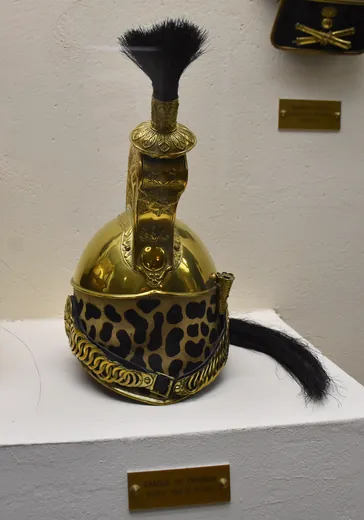
- Cuirassier or dragoon: look first at the skull and the band. On the helmets held in Woerth, the 1845 cuirassiers' have a sheet-steel skull and a band of sealskin dyed black; the dragoons' have a brass skull and a spotted band, imitating panther skin in 1845 and tiger skin in 1858.
- The crest tuft has its colour. Scarlet on the cuirassier helmets described here, black on the dragoons'.
- In 1874, one shape. The M1872/74 cuirassier trooper's helmet is of polished steel with a brass crest; this shape, shared by cuirassiers and dragoons until 1915, has no plume holder above the Medusa's head on the dragoons' helmets.
- The officer's has the same shape, in richer materials. A silver-plated copper skull and gilt fittings for the 1874 cuirassier officer; a vulture-feather plume instead of the troopers' cock-feather plume on a cuirassier officer's helmet of 1845-1858 held in Woerth, as for the dragoon officers of the Guard in 1856.
- Horsehair, feathers and leather get replaced. A complete helmet is not necessarily original: check that every part matches the others, and copy the markings before you interpret them.
The models from 1845 to 1874 in one table
This table only includes what is described in the records of public museums and in an official description; where none of my sources describes a point, the cell says so. The year of a model is not the year your helmet was made: the Musée de la bataille du 6 août 1870, the museum of the battle of 6 August 1870 in Woerth, dates to 1830-1848 the making of cuirassier helmets that it classes as the 1845 model, and states that they were used in the war of 1870.
| Model | Skull and band | Crest, mane, tuft | Chinstraps | Source |
|---|---|---|---|---|
| Cuirassiers, 1845 model | Sheet-steel skull; leather turban covered with a band of sealskin dyed black; two beadings at the join | Brass crest stamped with a braid; black horsehair tail; scarlet horsehair tuft | Twisted brass wire on black patent leather, or patent leather with eleven rows of three small rings; rosettes decorated with a sun | Woerth museum, three records |
| Cuirassiers, 1858 model | Band of sealskin dyed black, a single beading; skull described as brass by the record (see below the table) | Stylised braid stamped at the top of the crest; black horsehair tail; scarlet horsehair tuft | Curb-chain straps of flat rings on black patent leather; rosettes with laurel leaves | Woerth museum |
| Cuirassiers, 1872 model | Not specified here: the only source in this guide that names it groups it with the 1874 model, as the M1872/74, without saying what tells them apart | Not specified here | Not specified here | Imperial War Museum |
| Cuirassiers, 1874 model | Trooper: polished steel skull, peak and neck guard edged with brass, brass plate with a flaming grenade between two laurel branches. Officer: silver-plated copper skull | High brass crest with a Medusa's head, black horsehair mane; plume holder with a red brush above the Medusa | Trooper: brass scales on leather. Officer: ten ornamental leaves, the first forming one piece with the rosette | Imperial War Museum, Musée de l'Armée |
| Dragoons, 1845 model | Brass skull; band of yellowish sealskin spotted to imitate panther skin; a single beading | Braid stamped at the top of the crest; black horsehair tail; black horsehair tuft | Black patent leather with eleven rows of three small rings; rosettes decorated with a sun | Woerth museum |
| Dragoons, 1858 model | Brass skull; band of beige cloth spotted to simulate tiger skin; a single beading | Braid stamped at the top of the crest; black horsehair tail; black horsehair tuft | Curb-chain straps of fourteen flat rings on black patent leather; rosettes with laurel leaves | Woerth museum |
| Dragoons, 1872 model | Not specified here, for the same reason as the cuirassiers' 1872 model | Not specified here | Not specified here | Imperial War Museum |
| Dragoons, 1874 model | The shape of the 1874 cuirassier helmet | Mane; no plume holder above the Medusa's head | Not specified here | Imperial War Museum, Musée de l'Armée |
| Dragoons of the Imperial Guard, 1856 | “Entirely of brass”, “special model” | Flowing mane, black horsehair crest tuft; scarlet cock-feather plume, 200 mm | Not specified here | Description of the Guard's uniform, 1856 |
| Cuirassiers of the Imperial Guard | Not specified here: the 1856 description refers to that of 19 June 1854, which this guide could not consult | Not specified here | Not specified here | Description of the Guard's uniform, 1856 |
Two records from the same museum show that a model is not a mould. Two cuirassier helmets of the 1845 model in Woerth do not have the same chinstraps: twisted brass wire on one, patent leather with eleven rows of three small rings on the other, the very fitting of the museum's dragoon helmet of the 1845 model. And the record of the cuirassier helmet of the 1858 model describes a brass skull, like the dragoons', whereas the 1845 cuirassiers have a sheet-steel skull; it does not say why. I report it as it stands: one example does not make a rule.
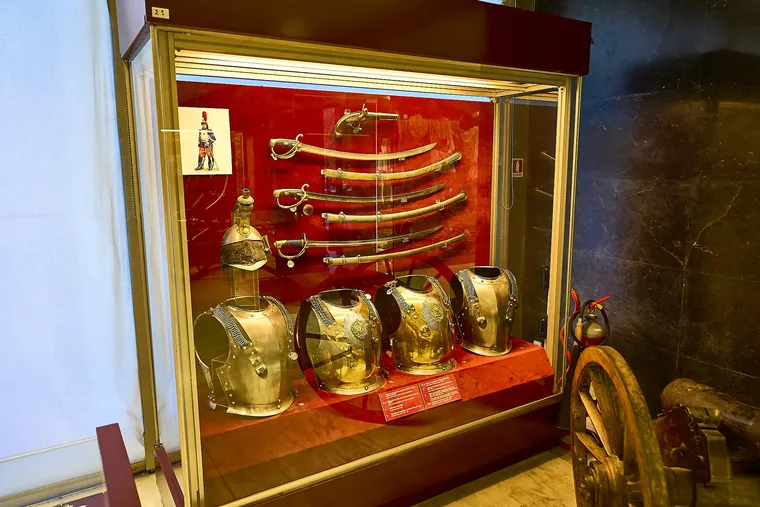
For the Third Republic, the Imperial War Museum describes a cuirassier trooper's helmet that it calls the M1872/74: polished steel skull, peak and neck guard edged with brass, a high brass crest with a Medusa's head carrying the mane, and a brass plate at the front, struck with a flaming grenade between two laurel branches. It thus groups 1872 and 1874 together. None of my sources says what separates the two models, and I will not say it for them.
The Imperial Guard of the Second Empire had its own helmets. The description of the uniform of the 2nd cuirassier regiment, the dragoons, the lancers and the mounted chasseurs of the Guard, approved on 21 June 1856 by Marshal Vaillant, Minister of War, gives in its article 48 the dragoons' helmet: “entirely of brass with a flowing mane, crest tuft of black horsehair. Special model.” For the headdress of its 2nd cuirassier regiment, it refers, in its article 17, to the description of the uniform of the 1st cuirassier regiment of the Guard, decision of 19 June 1854, which I have not been able to read: the row of the Guard cuirassiers stays empty.


Cuirassier or dragoon: what tells them apart
The Trésor de la langue française, the reference dictionary of French, defines the cuirassier as a soldier wearing a cuirass and, by extension, as a soldier serving in a heavy cavalry unit; the dragoon as a line cavalry soldier, serving on foot or on horseback. Their helmets, for their part, are alike to the point of sharing the same shape by the end of the century.
First the vocabulary, that of the museum records. The skull, bombe in French, is the metal bowl. At its base, a leather turban carries the band, of skin or cloth. The crest, cimier, is the high ridge set on the skull; its front face, the mask, bears a Medusa's head under a laurel wreath and, below it, a flaming grenade. At the top of the crest, a socket holds the horsehair tuft, the houppette; the mane, or flowing tail, starts at the back. Peak and neck guard edge the skull, and the chinstraps, held by rosettes, pass under the chin. Do not confuse this bombe with the riders' bombe of today, which the Trésor de la langue française defines as a cap with a hemispherical crown, usually of velvet.
If you are looking for the marmouset of your helmet: the word appears in none of the museum records this guide cites, which speak of the mask of the crest or of the Medusa's head. The Trésor de la langue française defines a marmouset as a grotesque figure, for instance the one decorating a corbel or a bracket in architecture.
On the 1845 and 1858 models, the skull and the band usually settle it. The cuirassier helmets of the 1845 model in Woerth have a sheet-steel skull and a band of sealskin dyed black, with two beadings where the turban meets the skull. The dragoon helmets of the same museum have a brass skull, a single beading and a spotted band: yellowish sealskin imitating panther skin on the 1845 model, beige cloth simulating tiger skin on the 1858 model, adopted by ministerial decision of 20 March 1858. The tuft says the same thing: scarlet for the cuirassiers, black for the dragoons. The only exception in my sources is the brass skull of the 1858 cuirassier helmet in Woerth, noted above.
By 1874, the question changes. The Imperial War Museum presents the M1872/74 shape as common to cuirassiers and dragoons until 1915, with one difference: the dragoons had no plume holder mounted above the Medusa's head. On a helmet of this period, look at the top of the crest before anything else.
Trooper, NCO, officer
The Musée de l'Armée, the French army museum in Paris, says it plainly for the 1874 model: the cuirassier officer's helmet is “identical in shape to the troopers'”, but its skull is of copper plated with silver at one tenth, its copper fittings are mercury-gilt, matt and burnished, and its chinstraps are made of ten ornamental leaves, the first forming one piece with the rosette. The example it holds belonged to Henri Gaillard de Saint-Germain, a lieutenant in the 12th Cuirassiers, who left for the front on 1 August 1914 and was wounded and taken prisoner on 22 September that year.
The plume also tells ranks apart. On a cuirassier officer's helmet that Woerth classes as the 1845-1858 model, it is of vulture feathers, on a pompom covered with silver wool cord; on the troopers' helmets of the same museum, of cock feathers. The 1856 description follows the same rule for the dragoons of the Guard. Its article 76 gives the officers a helmet “like the troopers' and gilt”, a scarlet vulture-feather plume and an olive of matt gold twists, small or large according to rank; the plume is white, with a third of scarlet at the base, for field officers, and the colonel alone wears a white heron aigrette.

For the line dragoons, my sources stop sooner. The Musée de l'Armée holds a dragoon officer's helmet of the 1858 model, on loan to the Musée vivant du Cheval at the Château de Chantilly, and a dragoon officer's helmet of the 1874 model, without describing what separates them from a trooper's helmet. So I will not tell you on their basis.
For NCOs, none of my sources describes a specific helmet. The 1856 description sets out their distinctions, rank stripes, long-service chevrons and epaulettes, in articles 56 to 60, without saying anything about the helmet. I will not give you a sign that would identify an NCO's helmet: it would take a source I do not have.

An engraved name or an old label is not enough to attribute a helmet to a man: you need papers, and how to read them is explained in reading and keeping military photographs and documents.
Markings: numbers, stamps, maker
The records note markings in three places: the back of the skull, the inner reinforcement of the neck guard and the inside of the skull. Here is what they read there, as given:
- cuirassier helmet of the 1845 model, Woerth: “72”, a framed L and “1848”, at the back of the skull;
- another cuirassier helmet of the 1845 model, Woerth: an L in a circle, at the back of the skull;
- dragoon helmet of the 1845 model, Woerth: “740 9 D 18 11” at the back of the skull, an L in a circle on the neck-guard reinforcement;
- dragoon helmet of the 1858 model, Woerth: “B 400 4 D 78” at the back of the skull, a B on the inner reinforcement of the neck guard, “4 1/2” inside the skull;
- cuirassier helmet of the 1858 model, Woerth: an L in a circle on the skull and on the neck guard;
- M1872/74 cuirassier trooper's helmet, Imperial War Museum: “58 3.C 109” and “GODILLOT”.
The records do not expand these groups. A D appears on both dragoon helmets and a C on the IWM cuirassier helmet, and an L stamp, in a frame or in a circle, recurs on four helmets in Woerth; but neither the museum nor the Imperial War Museum says what these figures and letters mean. A number alone gives neither the regiment nor the man. Copy everything, character by character, and draw no conclusion beyond your documents.
None of my sources describes the sizes of these helmets: the “4 1/2” read inside the 1858 dragoon helmet is not explained by its record, and I will not make it say more. The only name they record is GODILLOT, inscribed on the IWM helmet, which the museum gives without comment; none of them lists the makers or workshops that produced these helmets.
The inside of the peak and neck guard can help. The Imperial War Museum dates its helmet to before 1912 because those two parts are lined with leather, whereas they were later painted green. Green does not always mean paint, though: the peak of the 1858 dragoon helmet in Woerth is lined with green sheepskin. Check whether it is paint or leather before drawing a date from it.
Mane, plume and the 1914 cover
The Trésor de la langue française defines the mane as a tuft of horsehair decorating the crest of cuirassier and dragoon helmets, which hung over the rider's neck to protect him from sabre cuts, and notes that it can still be seen on the helmet of the Garde républicaine. On the 1845 and 1858 helmets in Woerth it is double: a stylised braid, stamped in the metal of the crest, and a flowing tail of black horsehair starting from its rear base.
Its colour can be read. According to the Imperial War Museum, the black mane was common to all twelve cuirassier regiments, and trumpeters wore it red. The Musées de la Cour d'or in Metz thus describe a cuirassier trumpeter's helmet with mane, braid and tuft of red horsehair. Their record dates it to between 1872 and 1874, but the inventory card it transcribes reads “IIe Empire”, the Second Empire: the two do not agree, and I do not settle the question. The record also states that it was stolen in 1994, in Gravelotte.
The plume is a parade piece. According to the Woerth records, it is scarlet, of cock feathers for the troopers, worn only in full dress, and set on a wooden pompom covered with wool cord “in the colour of the squadron”: blue, jonquil yellow or scarlet depending on the helmet. For its dragoons, the 1856 description gives the rule: dark blue for the 1st squadron, crimson for the 2nd, green for the 3rd, sky blue for the 4th, jonquil yellow for the 5th, orange for the 6th. Nothing says that the line cavalry followed the same one; do not count squadrons from that table. On the M1872/74, the Imperial War Museum describes a detachable red plume, worn on the left by all ranks, in full dress only.
In August 1914, these helmets went to war. According to the Musée de l'Armée, the French army then had 32 dragoon regiments, which, like the cuirassiers, went into battle with the 1874 model helmet with its mane, covered with a pale khaki canvas cover. The one it holds belonged to Captain Guy Conte Roy de Puyfontaine, of the 5th Dragoons, killed on 2 October 1914 east of Arras, his squadron fighting on foot, by a shell fragment that went through his helmet. The Imperial War Museum adds that the cuirassiers left with helmet and cuirass, under these canvas covers, and presents them as the last army to have done so in action. The German spiked helmet on the other side has its own guide: identifying and dating a Pickelhaube.
The Imperial War Museum tells what followed in a few lines. By the spring of 1915, some cuirassier regiments were serving as infantry or machine-gunners: the tall brass crest was removed and the helmet covered with a close-fitting cover; uniforms changed to horizon blue. Once the Adrian helmet was adopted across the board, the cavalry helmet was put aside until the Armistice, then kept for ceremonial dress. The helmet that replaced it at the front has its own guide: identifying a 1915 Adrian helmet.
The cuirassiers themselves did not vanish with their helmet: the French Army today presents its 12th Cuirassier Regiment, at Olivet, as an armoured regiment equipped with the Leclerc tank.
Replaced parts and composite helmets
A crested helmet is an assembly: skull, turban and band, crest, mane, tuft, plume, chinstraps and rosettes, lining. Everything made of horsehair, feathers or leather wears and gets replaced. That is where to look first, then check that every part matches the others.
- The skull and the arm of service. On a trooper's helmet, a brass skull under a crest presented as a cuirassier's, or a steel skull under a spotted dragoon band of the 1845 or 1858 model, calls for an explanation, even if the 1858 record in Woerth is a reminder that not everything fits a rule. On an 1874 cuirassier officer's helmet, by contrast, the skull is of silver-plated copper, according to the Musée de l'Armée: worn plating can therefore show the copper underneath.
- The tuft and the plume holder. A black tuft on a cuirassier helmet, a scarlet one on a dragoon helmet, or, on an 1874 helmet, a plume holder above the Medusa of a supposed dragoon helmet, does not match what my sources describe.
- The chinstraps. Two 1845 cuirassier helmets in the same museum have different ones: they date nothing on their own, but a type of chinstrap that no source places on that helmet deserves a closer look.
- The missing crest. A skull without its crest may come from a 1915 conversion, like the one the Imperial War Museum reports, or from a lost part: a photograph cannot settle it.
Not all reproductions are recent. The Musée des Arts décoratifs in Bourges holds a cuirassier captain's outfit, a child's dressing-up costume from around 1910, with a cuirass and a metal helmet with a mane, padded with fabric inside; the Samaritaine department store's catalogue of New Year gifts for 1910 offered a similar one.
A reassembled piece is not a fault if it is declared. What deceives is a part presented as original when it is not. The checks that apply to every piece are in spotting fake militaria, and careful steps for leather and metal in caring for military leather, textile and metal.
What I cannot tell you here
I cannot tell you, from a photograph, whether a mane, a tuft or a chinstrap is original, or whether a crest has been refitted: you need to hold the helmet and compare it with a known example. Nor do I go into what my sources do not describe: what distinguishes the 1872 model from the 1874 model, the helmet of the cuirassiers of the Imperial Guard, that of NCOs, sizes, the meaning of the groups of figures and letters stamped on the skull, the list of makers.
I give no prices: the method for placing a piece is in valuing a military item. For a particular helmet, photograph the skull from the front, the side and the back, the crest, the inside, the chinstraps and every marking, then ask the community. Pieces from 1914-1918 for sale are in First World War uniforms and headgear. If the helmet comes with a sabre, the sabre falls under another regime, that of edged weapons: see what can be sold freely, and what cannot.
Frequently asked questions
What is the difference between a cuirassier and a dragoon?
In the French army, the cuirassier is a heavy cavalryman who wears a cuirass, and the dragoon, according to the Trésor de la langue française, a line cavalry soldier serving on foot or on horseback. Their helmets differ by model: on the 1845 model helmets held in Woerth, the museum records describe a steel skull with a black sealskin band and a scarlet tuft for cuirassiers, a brass skull with a spotted band and a black tuft for dragoons (the Woerth record of an 1858 cuirassier helmet, however, describes a brass skull). On the 1874 model, the shape is shared, and the dragoons' helmet has no plume holder above the Medusa's head, according to the Imperial War Museum.
What did French cuirassiers wear?
In 1914, according to the Imperial War Museum, French cuirassiers rode to war in red trousers and short dark blue tunics, with their crested helmet and their cuirass, the bright metal hidden under covers of pale khaki fabric. Their helmet was the M1872/74: polished steel skull, high brass crest with a Medusa's head, black horsehair mane, and a red plume on the left for full dress only.
Were there cuirassiers in WW1?
Yes. The twelve French cuirassier regiments went to war in 1914 with helmet and cuirass, according to the Imperial War Museum. By the spring of 1915, some were serving as infantry or machine-gunners, with the brass crest removed from the helmet, and the cavalry helmet was set aside once the Adrian helmet was adopted across the board.
When did France stop using cuirassiers?
Not all at once, and not entirely. According to the Imperial War Museum, the cuirassiers rode to war in 1914 in helmets and breastplates; by the spring of 1915, some regiments were reassigned as infantry or machine-gun troops, the crest of their helmet removed; once the Adrian steel helmet was adopted across the board, the cavalry helmet was put aside until the Armistice, then kept for ceremonial dress. The name has remained: the French Army still has a 12th Cuirassier Regiment, based at Olivet, which it describes as an armoured regiment equipped with the Leclerc tank.
What is a cuirassier helmet called?
In French museum records it is a casque à cimier, a crested helmet, or a helmet with a mane: the Woerth museum catalogues “casque à cimier de cuirassiers, modèle 1845”. Collectors then name it by its model year, 1845, 1858, 1872 or 1874; the Imperial War Museum calls its example the M1872/74. Its parts are the skull (bombe), the crest (cimier), the horsehair mane and tuft, the plume and the chinstraps.
What is a French cuirassier helmet worth?
Its value is read on the helmet itself. First its exact identification: cuirassier or dragoon, and the model, from 1845 to 1874. Then the rank: according to the Musée de l'Armée, the 1874 cuirassier officer's helmet has the same shape as the troop helmet, with a skull of silver-plated copper and gilt fittings. Next the consistency of the whole: horsehair, plume and leather wear out and get replaced, and a complete helmet is not necessarily original. Finally the papers that tie it to a man, which an engraved name does not replace. The range is built from sales actually concluded for comparable helmets.
Sources
This guide draws on the texts, databases and pages below, accessed on unless otherwise stated. Most of them are in French.
- Musée de la bataille du 6 août 1870, Woerth, record of a cuirassier crested helmet, 1845 model (inv. 2005.0.85), Joconde database on POP
- Musée de la bataille du 6 août 1870, Woerth, record of a cuirassier crested helmet of the 1845 model (inv. 2005.0.91), Joconde database on POP
- Musée de la bataille du 6 août 1870, Woerth, record of a cuirassier officer's crested helmet, 1845-1858 model (inv. 1992.3.1), Joconde database on POP
- Musée de la bataille du 6 août 1870, Woerth, record of a cuirassier crested helmet, 1858 model (inv. 1970.1.221), Joconde database on POP
- Musée de la bataille du 6 août 1870, Woerth, record of a dragoon crested helmet of the 1845 model (inv. 2005.0.84), Joconde database on POP
- Musée de la bataille du 6 août 1870, Woerth, record of a dragoon crested helmet, 1858 model (inv. 2005.0.86.1), Joconde database on POP
- Imperial War Museums, “Helmet, M1872/74 Cuirassier: O/Rs, French Army”, UNI 14089
- Musée de l'Armée, collections database, cuirassier officer's helmet, 1874 model (inv. 2019.15.1), accessed
- Musée de l'Armée, collections database, dragoon officer's helmet, 1874 model (inv. 05373-1 C1)
- Musée de l'Armée, collections database, dragoon officer's helmet, 1858 model (inv. 2971)
- Description of the uniform of the 2nd cuirassier regiment, the dragoons, the lancers and the mounted chasseurs of the Imperial Guard, p. 1026: approval of 21 June 1856, signed Vaillant; copy of the Bibliothèque nationale de France (Prints, 4-OA-376) reproduced on Wikimedia Commons
- Description of the uniform of the 2nd cuirassier regiment, the dragoons, the lancers and the mounted chasseurs of the Imperial Guard, p. 1007, art. 17, headdress and equipment of the 2nd cuirassier regiment, referring to the decision of 19 June 1854; copy of the Bibliothèque nationale de France (Prints, 4-OA-376) reproduced on Wikimedia Commons
- Description of the uniform of the 2nd cuirassier regiment, the dragoons, the lancers and the mounted chasseurs of the Imperial Guard, p. 1011, art. 48, the dragoons' helmet; copy of the Bibliothèque nationale de France (Prints, 4-OA-376) reproduced on Wikimedia Commons
- Description of the uniform of the 2nd cuirassier regiment, the dragoons, the lancers and the mounted chasseurs of the Imperial Guard, p. 1013, art. 56 to 60, distinctions of dragoon NCOs and troopers; copy of the Bibliothèque nationale de France (Prints, 4-OA-376) reproduced on Wikimedia Commons
- Description of the uniform of the 2nd cuirassier regiment, the dragoons, the lancers and the mounted chasseurs of the Imperial Guard, p. 1015, art. 76, the dragoon officers' headdress; copy of the Bibliothèque nationale de France (Prints, 4-OA-376) reproduced on Wikimedia Commons
- Musées de la Cour d'or, Metz, record of a cuirassier trumpeter's helmet, dated 1872-1874 by the record (inv. CB583), Joconde database on POP
- Musée des Arts décoratifs, Bourges, record of a child's cuirassier captain outfit, around 1910 (inv. 1968.9.2), Joconde database on POP
- French Army, French Ministry of the Armed Forces, page of the 12th Cuirassier Regiment (12e régiment de cuirassiers)
- Trésor de la langue française informatisé (CNRTL), entry “cuirassier”
- Trésor de la langue française informatisé (CNRTL), entry “dragon”, second definition
- Trésor de la langue française informatisé (CNRTL), entry “crinière”
- Trésor de la langue française informatisé (CNRTL), entry “marmouset”
- Trésor de la langue française informatisé (CNRTL), entry “bombe”, riding sense