Reading the markings on a French military item: stamps, punches and numbers
By Thomas, contributor to Athena Militaria Published 12 min read
French military markings are what an object says about itself: the name of an arms factory, a month and year, an inspector's letters, a serial number, a unit stamp, the Paris Mint's mark. Read well, they tell you who made the piece, when, who accepted it for the State, and sometimes which unit it belonged to. Read badly, they date a restrike to the event it commemorates, or give a helmet to a man who never wore it. This guide shows where to look on an edged weapon, a helmet, a uniform, leather equipment, a medal, a button or an identity disc, and how to read what you find, from museum records and official texts.
Get a piece identified from photos Valuing a piece: the method
In brief
- Copy before you interpret. Photograph the marking under raking light and note every sign exactly, without cleaning the piece.
- Edged weapons say the most. The back of the blade gives the factory, month and year; the letters at the base belong to the men who accepted the weapon; the numbers tell you whether hilt and scabbard stayed together.
- Textiles, leather and helmets keep stamps. A unit, a maker, a dated acceptance, and figures that museums themselves cannot always read.
- A medal is read on its edge. The Paris Mint's mark changed several times: it dates the striking, not the event.
- No marking proves anything on its own. A restrike carries a genuine mark, a named helmet may have come out of a store: what convinces is the agreement between marks.
Recording a marking before interpreting it
Struck, engraved, inked or sewn, a marking is often small, worn and partly erased. Do nothing to it: the Canadian Conservation Institute advises against taking iron back to bare metal unless necessary and against commercial liquid rust removers, and recommends handling iron with gloves, because salts from the skin encourage corrosion.
Photograph it close up with a ruler in the frame, then under raking light. Copy every sign exactly: a letter in a circle is not a letter in a lozenge.
| Object | Where to look | What you may read |
|---|---|---|
| Sword, bayonet | Back and base of the blade, hilt or crossguard, scabbard | Factory, month and year, model; acceptance stamps; serial number |
| Helmet | Shell, inside and out; plate fixed to the front | A stamped word; on the commemorative plate, a name and a rank |
| Uniform, headdress | Lining, fly, crown and peak | Unit, maker, acceptance, numbers |
| Leather equipment | Under the flap | Stamped numbers |
| Medal, decoration | Edge, reverse, ring, suspension | Striking mint and metal; hallmarks |
| Button | Back | Maker and town |
| Identity disc | Both faces | Name, year, town, number |
Edged weapons: blade, base, hilt and scabbard
The models are covered in the guides to the French military sword and the French bayonet; the marks follow a common logic.
The back of the blade: factory, month, year
According to the Klingenthal museum in Alsace, blades generally bear the usual name of the factory at the time they were made. It cites article 11 of the lease granted to the contractor Coulaux on 29 April 1810: the contractor's name on the back of blades was replaced by the month and year. A blade bearing only the contractor's name is therefore, for the museum, a commercial blade with civilian stamps.
So you will read “Manufre Royale du Klingenthal 8bre 1828” on a cuirass, “Mre Impale de Châlt Mars 1858 Cavrie lre Mle 1822” on a sword in the Musée de la bataille du 6 août 1870 at Woerth, “Mre d'Armes de St. Étienne Mars 1874” on a bayonet in the McCord Museum in Montreal. “8bre” reads October: the Trésor de la langue française notes that it was the eighth month of the Roman year, from octo, eight.
The Woerth museum adds that from 6 October 1855, at the minister's request, the inscription also named the model. A blade dated earlier that already names its model deserves a second look.
Acceptance stamps
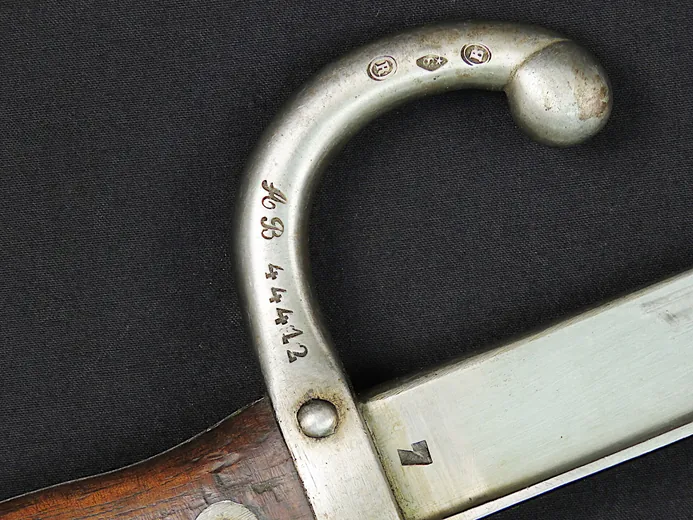
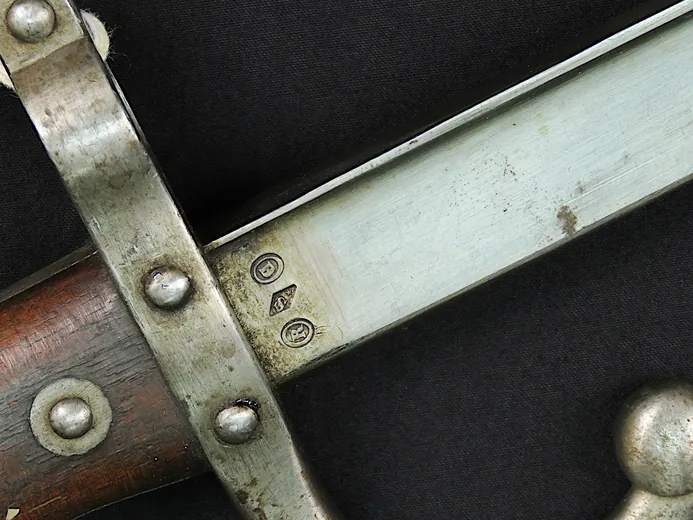
At the base of the blade, small letters in a circle, an oval or a lozenge, sometimes under a crown or a star: these are the marks of the men who accepted the weapon. At Klingenthal, according to its museum, blades bore a fleur-de-lis or crown stamp until about 1790, then the initials of the inspector and of the chief controller; hilts and scabbards bore the stamp of the controller in charge of that part.
Each letter stands for a person whose years in office are known. On the Woerth sword, the crowned M is that of Mecquenem, director at Châtellerault from 28 July 1855 to 6 August 1859, and the starred B and S those of the controllers Bisch and Schütz. On an adjutant's sword of July 1878, the Thonon-les-Bains museum reads at the base of the blade the starred S, in a lozenge, of the controller Sprenger, used from 1864 to 1885, and on the hilt the R of the director Réallon, in post from 1876 to 1883. The dates agree.
The number: the weapon's, not the soldier's
The number struck on the hilt or crossguard is a serial number: the Australian War Memorial records 71159 on the quillon of a model 1886 Lebel bayonet. It is not a man's service number: in 1914 the information page of Félix Chapuis's manual had blanks side by side for the soldier's service number and his rifle number. Only a document that names a man links a weapon to him: the number alone is not enough.
The same number on hilt and scabbard, such as 12 566 at Thonon-les-Bains, says the set stayed together. Conversely, the hilt of a light cavalry sabre of 1853 at the Australian War Memorial is stamped 720, crossed out, and 722, its scabbard's number; a Chassepot bayonet of August 1868 in the McCord Museum bears “74151” followed by a question mark on the hilt, and on the scabbard “H 14128” and “H 50777”, with the note “apparently struck through”.
Helmets: a stamped word, a remembrance plate
The 1915 Adrian helmet came in three sizes, the Musée de l'Armée notes, dating to 13 April 1915 the presentation to Joffre of the Japy firm's prototype. According to the Musée du Génie in Angers, other companies then made it, including the Compagnie des compteurs, the Jouet de Paris and the Reflex company, as did the arsenals of Brest and Cherbourg: compare any name found on the shell with that list. The Australian War Memorial records the word “CABARAT” stamped into the right rear quarter of one helmet, without explaining it.
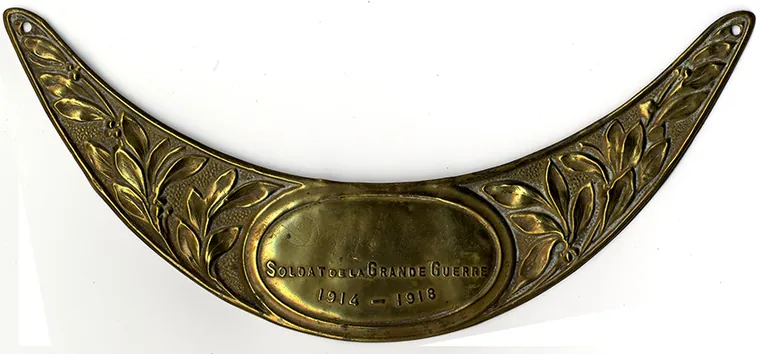
The most telling mark is a brass plate fixed to the front: “Soldat de la Grande Guerre 1914-1918”, with a name and a rank. According to the Musée du Génie, a decree of 18 December 1918 gave every combatant a helmet so marked; soldiers still mobilised kept their own, the others received one taken at random from stock. The plate names a veteran, not necessarily the man who wore that helmet at the front. See identifying an Adrian helmet.
Uniforms, headdress and leather: stamps, labels, numbers
In 1914, according to Chapuis's manual, all items of kit bore the soldier's service number, even the personal items he used during his service. Museums record three kinds of marks. The unit: “2e Zs”, for the 2nd Zouave Regiment, in a black box on the lining of a Zouave waistcoat at the Imperial War Museum; “C 2”, read as the 2nd company, under the peak of a 36th Line Infantry shako at Woerth. The maker: “ALEXIS - GODILLO PARIS” inside a model 1860 shako in the same museum, “G.GARFET PARIS” on the lining of madder-red trousers at the Imperial War Museum. Acceptance: those trousers bear inside the fly “COMMISSION DE RECEPTION” and the year 1913.
Not every figure can be read. The Garfet stamp carries 3, 13, 50 and 1 in its centre; the waistcoat, “4 1 68 5024” on the back. In a 1914 kepi of the 27th Infantry, the Musée de la Vie bourguignonne in Dijon records an ink stamp “57” followed by an incomplete name, a pencilled number, a round handwritten label “4” and an inscription cut into the peak. None of these records explains the figures: do not read a size or a service number into them without a source. See dating a French military uniform and the French military kepi.
Leather follows the same logic. On a blackened leather cartridge pouch of 1888 to 1914, the Nuits-Saint-Georges museum records numbers stamped under the flap: “8405 / N03 / 4 64”.
Medals and decorations: the edge and the hallmarks
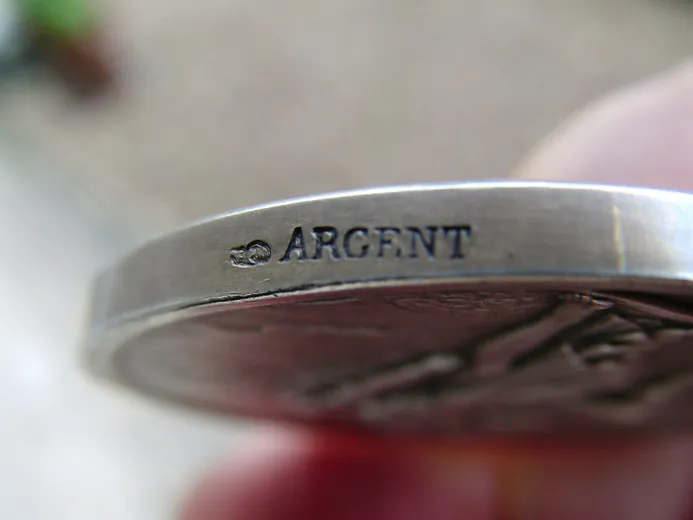
Medals struck by the Paris Mint carry on the edge a small mark followed by the name of the metal, such as “CUIVRE”, copper, on the two Louvre medals cited here. The mark has changed: the Louvre dates two of its forms precisely; an article in The E-Sylum, the journal of the Numismatic Bibliomania Society, gives the whole list, to within a few weeks.
| Edge mark | Period of use | Source |
|---|---|---|
| Antique lamp | March 1832 to October 1841 | The E-Sylum |
| Anchor and interlaced C | October 1841 to September 1842 | The E-Sylum |
| Ship's prow | 1842 to 1845 | The E-Sylum |
| Pointing hand | 12 June 1845 to 30 September 1860 | Louvre |
| Bee | 1 October 1860 to 5 December 1879 | Louvre |
| Cornucopia | Since 1 January 1880 | The E-Sylum |
The mark dates the striking, not the event. The Louvre holds a medal of Queen Victoria's visit to Napoleon III on 18 August 1855 whose edge bears the bee: struck between 1860 and 1879, it is catalogued as a restrike. A restrike is not a fake, but it says nothing about the date of an award. See the guides to the Médaille militaire and the Legion of Honour.
Hallmarks, for their part, concern the metal. Since 1838, Catherine Arminjon explains in the Encyclopædia Universalis, the standard and the guarantee have been one mark, and silver bears the head of Minerva. Another guarantee mark, the crab, created in 1835, was replaced on 1 July 1984 by a cut-out Minerva head (decree no. 84-624). The maker adds his own: today, according to French customs, a lozenge for gold and silver at the legal standards and a square for plated work, with his initial and symbol. Their absence proves nothing: a silver item weighing under 30 grams may be exempt from the guarantee mark, though not from the maker's.
Buttons and identity discs
The back of a button
The back often carries a name and a town: “TW & W PARIS” on a button numbered 12 at the Musée Carnavalet, “PETIT & DUPERIER”, incuse, on an Imperial Guard gendarmerie button. The Missouri History Museum attributes to the Paris firm Anglade Masse et Cie an aluminium infantry button of about 1914, marked “A.M. & CIE. / PARIS”. The maker places the button in time, without saying who wore it: see identifying an old military button.

The identity disc
In 1914 every man wore an identity disc on a cord round the neck, Chapuis's manual notes. That of Jean Peyramaure, deposited by the Haute-Vienne departmental archives, reads “Peyramaure Jean 1902” on the front and “Limoges 1792” on the back: a name, a year, a town, a number. The service registers are searched by recruitment office and by class, the year the conscript turned twenty, and their indexes give each man's service number, the Ille-et-Vilaine archives explain. See reading a military identity disc and tracing a French soldier of 1914-1918.
On more recent items: approval numbers and NATO stock numbers
An insignia's approval number begins, under the instruction of 10 April 2024 on military symbols, with G for the army, directorates and services, M for the navy, A for the air and space force and GN for the gendarmerie; it is struck or engraved on the back of metal insignia. An insignia of the engineer command in French West Africa, made by Drago between 1956 and 1958 and held by Paris Musées, reads “H 712 DRAGO PARIS” on the back.
The NATO stock number has thirteen digits. According to the booklet of the French Defence materiel identification centre (CIMD), the first four give the group and class, 84 for clothing and individual equipment, the next two the country that created the number, 14 for France, and the last seven are allocated by the system. See identifying a French military insignia and Cold War militaria.
The traps: added markings, restrikes, numbers that do not match
- The date that clashes. A model engraved on a blade dated before October 1855, a stamp whose holder was not in office at the engraved date: each calls for an explanation, without proving a fake on its own.
- Numbers that do not match. Blade, hilt and scabbard may have been re-paired, and a crossed-out number sometimes says so. Record every number and where it is.
- The restrike. It bears a genuine mark, that of its own striking, like the 1855 medal with the bee.
- The plate that names. A name identifies a man, not the use of the object: the remembrance helmets may have come out of stores.
- The commercial blade. Its stamps are civilian, not those of the State's controllers.
- The fancy stamp and the marking that is too crisp. An official mark has a regulated shape: a design that follows none guarantees nothing, and a perfect inscription on a worn piece calls for caution. See spotting fake militaria.
What I cannot tell you here
I cannot give you the complete list of inspectors' and controllers' letters: it changes from one factory and one decade to the next, and museum records rebuild it piece by piece. Nor can I translate every figure in a lining when the Imperial War Museum or the Dijon museum does not explain it. And I give no prices: the method is in valuing a military item.
For a particular piece, send your photographs and your transcription for free identification help. Great War pieces are in the First World War catalogue, everything else in the militaria catalogue.
Frequently asked questions
What are French military markings?
They are the inscriptions a French military item carries on itself: the factory name, a date, a controller's stamp, a serial number, a unit or maker's stamp, a mint mark or a hallmark. They are struck into the metal, engraved, inked or sewn. Read well, they tell you who made the piece, when, and sometimes who accepted it for the State or which unit it belonged to.
Where are the markings on a French bayonet?
At the base of the blade near the hilt, and on the hilt or crossguard: small letters in a circle, an oval or a lozenge, sometimes under a star or a crown. These are the marks of the inspectors, controllers and directors who accepted the weapon. The back of the blade often gives the factory, month and year, and the serial number is read on the crossguard or quillon, often on the scabbard too.
What does the number on a French bayonet or sword mean?
It is the weapon's serial number, not the soldier's service number. The same number on hilt and scabbard means the set stayed together; a crossed-out number followed by another means it was re-paired. The information page of a soldier's manual of 1914 had a blank for his rifle number beside his service number: only a document that names a man links a weapon to him.
How do you read the stamps inside a French uniform?
Copy them exactly before interpreting them. Museums read in them a unit, such as “2e Zs” for the 2nd Zouave Regiment, a maker, such as “G.GARFET PARIS”, or an acceptance commission dated 1913. They also leave figures unexplained: do not read a size or a service number into them without a source that says so.
How do you recognise the Paris Mint mark on a medal?
Look at the edge: a small mark followed by the name of the metal, such as “CUIVRE”, copper. Since 1 January 1880 it has been a cornucopia; before that a bee (1860 to 1879), a pointing hand (1845 to 1860), a ship's prow, an anchor or an antique lamp. The mark dates the striking, not the event commemorated: a restrike bears the mark of its own year.
What does the Minerva head mean on a French medal?
It is a silver hallmark: since 1838 it has combined the standard and the State's guarantee. Another guarantee mark, the crab, created in 1835, was replaced on 1 July 1984 by a cut-out Minerva head, similar to the standard marks used for silver. The Minerva head tells you about the metal, not about the date of the award or whether it is genuine.
Is an unmarked military item a fake?
No. A marking wears away, disappears under polishing or hides under a flap, and even today a silver item weighing under 30 grams may be exempt from the guarantee mark. What should raise doubts is a marking that contradicts the rest of the piece: a date foreign to the model, a number that does not match, an inscription too crisp on a worn object.
What does an inspection stamp on a French blade mean?
It is the mark of a man who examined and accepted the weapon: an inspector, a controller or the factory's director. At Klingenthal the inspector's initial stood beside the chief controller's, at the base of the blade. Because each man's years in office are known, these letters cross-check the date engraved on the back.
Sources
This guide draws on the texts, databases and pages below, with the date each was last accessed. Most of them are in French.
- Canadian Conservation Institute, Note 9/6, “Care and Cleaning of Iron”, accessed
- Klingenthal museum, house of the former edged weapons factory, “Markings and stamps”, accessed
- Klingenthal museum, markings and stamps of the Coulaux factory, with article 11 of the contract lease of 29 April 1810, accessed
- Musée de la bataille du 6 août 1870, Woerth, record of a model 1822 sabre (inv. 1987.1.23.1), Joconde database on POP, accessed
- McCord Stewart Museum, Montreal, bayonet marked “Mre d'Armes de St. Étienne Mars 1874” on the back of the blade (1995.24.36), accessed
- CNRTL, Trésor de la langue française informatisé, etymology of “octobre” (October), accessed
- Thonon-les-Bains museum, record of an infantry warrant officer's sabre of 1878 (inv. 1993.1.10), Joconde database on POP, accessed
- Australian War Memorial, Lebel model 1886 bayonet and scabbard: cruciform blade, white alloy grip, hooked quillon, object REL34473, accessed
- Félix Chapuis, L'Instruction théorique du soldat par lui-même (a soldier's self-study manual), 22nd edition, Berger-Levrault, 1913-1914, on Project Gutenberg, accessed
- Australian War Memorial, model 1822 light cavalry sabre and scabbard dated 1853, object RELAWM12337, accessed
- McCord Stewart Museum, Montreal, Chassepot bayonet of August 1868 and its scabbard, with their stamps and numbers (1973.3.3 ab), accessed
- Musée de l'Armée, teaching sheet on the French infantryman's uniform in 1914 and 1916, accessed
- Musée du Génie, Angers, sheet no. 82 on the Adrian helmet, model 1915, accessed
- Australian War Memorial, Adrian pattern helmet stamped “CABARAT” on the right rear quarter (REL24351), accessed
- Imperial War Museums, other ranks' waistcoat, pattern 1879, 2nd Zouave Regiment, stamped “2e Zs” on the lining (UNI 3256), accessed
- Musée de la bataille du 6 août 1870, Woerth, record of an 1860 pattern infantry shako of the 36th Regiment, stamped brass plate with the globe cut out with 36, mark “C 2” inside the peak (inv. 2005.0.88), Joconde database on POP, accessed
- Musée de la bataille du 6 août 1870, Woerth, record of an 1860 pattern artillery shako of the 9th Regiment, pressed brass plate with crossed cannon under a grenade, globe marked 9, inscription “ALEXIS - GODILLO PARIS” in the lining (inv. 1987.1.8), Joconde database on POP, accessed
- Imperial War Museums, madder-red field service trousers, model 1897, with the maker's stamp and the 1913 acceptance commission stamp (UNI 3259), accessed
- Musée de la Vie bourguignonne, Dijon, on deposit from the Musée de l'Infanterie, record of a kepi from the 1914 field dress of the 27th Infantry Regiment (inv. D99.1.398), Joconde database on POP, accessed
- Nuits-Saint-Georges municipal museum, blackened leather cartridge pouch, 1888-1914 (95.14.32), Joconde database on the Plateforme ouverte du patrimoine, accessed
- Louvre Museum, “Musée national du Louvre” medal by Maurice Valentin Borrel, edge with the pointing-hand mark (OAP 3099), accessed
- David T. Alexander, “Paris Mint Privy Marks Appearing on Medals”, The E-Sylum, Numismatic Bibliomania Society, vol. 17, no. 38, 14 September 2014, accessed
- Louvre Museum, medal of Queen Victoria's visit to France, 18 August 1855, by Louis Merley, restrike with the bee mark (OAP 3112), accessed
- Catherine Arminjon, “Titres et garanties, métaux précieux” (standards and hallmarks of precious metals), Encyclopædia Universalis, accessed
- Decree no. 84-624 of 16 July 1984, article 1: hallmarks, on Légifrance, accessed
- French customs (DGDDI), on marking articles of precious metal with a maker's or responsibility mark, accessed
- French customs (DGDDI), on hallmarking articles of precious metal, accessed
- Musée Carnavalet, button numbered 12 marked “TW & W PARIS” on the back (inv. B3143), Paris Musées record, accessed
- Musée Carnavalet, “Garde impériale gendarmerie” button in white metal repoussé on a brass support, marked “PETIT & DUPERIER” on the back (inv. B3487), Paris Musées record, accessed
- Missouri History Museum, French First World War infantry button in aluminium marked “A.M. & CIE. / PARIS” on the back, about 1914, record reproduced on Wikimedia Commons, accessed
- Europeana 1914-1918, “Plaque d'identification de Jean Peyramaure”, contributed by the Haute-Vienne departmental archives: “Peyramaure Jean 1902” on the front, “Limoges 1792” on the back, accessed
- Ille-et-Vilaine departmental archives, “Registres matricules militaires” (military service registers): content of the records, alphabetical indexes, recruitment subdivisions, Grand Mémorial, the order of 20 December 2012 and online publication up to the class of 1921, accessed
- Instruction no. 849/ARM/SGA/DMCA/SHD/DHS/DSD of 10 April 2024 on military symbolism in the armed forces and the gendarmerie, Bulletin officiel des armées, accessed
- Paris Musées, Musée de la Libération de Paris, record of the insignia of the Engineer Command in French West Africa (1956-1958), accessed
- Centre d'identification des matériels de la défense, booklet on NATO codification, accessed