Collector's guide Collecting
Cold War militaria, French, NATO and Warsaw Pact: what to collect and how to date it
By Augustin, founder of Athena Militaria Published , updated 15 min read
An olive helmet at the back of a cupboard, a rain-pattern combat suit brought back from East Germany, an enamel badge of the French forces in Germany. These objects are often our parents' age, and that is what makes them misleading: people assume they have no history because they are recent, or that they are old because they are worn. Between 1947 and 1991 the two blocs never fought each other directly in Europe, and most of the equipment they maintained never saw combat. Here is what collectors look for, how to read a label or a number, and what French law asks of you.
Get a piece identified from photos Valuing a piece: the method
Looking for pieces? Browse Cold War militaria for sale, listed by collectors: uniforms, equipment, documents.
In brief
- Date in order. Never date by eye. Check the inside marking first, which takes precedence when legible, then the number, then the model, which gives only an earliest date.
- A period without battle. From 1947 to 1991, the two blocs never fought each other directly in Europe. The condition of a piece therefore says almost nothing about its age.
- The NATO number. It has thirteen digits, two of them for the country that codified the item. A label with code 14, France's, dates from 1960 at the earliest.
- Particular care. According to Andra, a dial that still glows after two days in complete darkness indicates a radioactive object: do not open it. Ammunition, grenades and explosive devices, even inert ones if they are not certified, may not be sold on the site.
- Museums and fairs. In Berlin, the Allied Museum holds more than two hundred uniform jackets. Fair dates are listed in the militaria fairs calendar.
A period without a battle between the two blocs
The Cold War is usually dated from 1947 to 1991. Between those dates, the Atlantic Alliance, born in April 1949, and the Warsaw Pact, signed on 14 May 1955 and dissolved on 1 July 1991, faced each other in Europe. The Berlin Wall went up on 13 August 1961 and opened on 9 November 1989. France left NATO's integrated command in 1966 without leaving the Alliance.
For the collector, one fact outweighs all the others: the two blocs never fought each other directly in Europe. Most of this equipment was made, issued, stored and then struck off without ever coming under fire. So you find many pieces in good condition, and condition, here, says almost nothing about age. It is the first thing to understand, and the one that misleads most.
The wars in Indochina and Algeria belong to the same era, with their own objects, their own decorations and their own traps. They call for guides of their own, such as those on French Indochina War decorations and French Algerian War medals: this one does not go into them.
What collectors look for on the French side
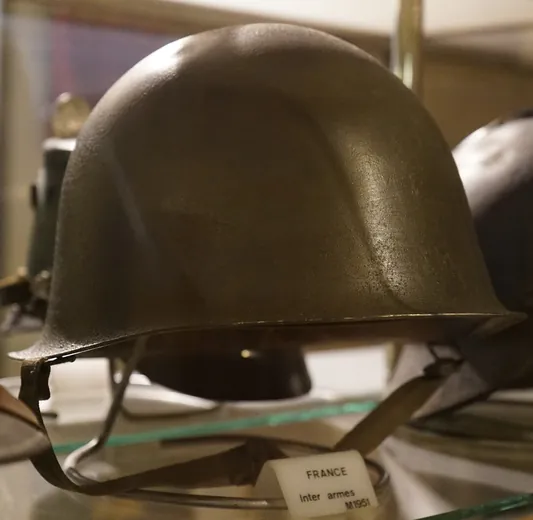
The model 1951 helmet
Made from 1951 to 1976 and still on issue in the 1980s, it covered the heads of generations of French conscripts; collectors also call it the "TTA 51". It has two parts: a shell of non-magnetic manganese steel about 1.2 mm thick, and a removable liner. Its shape recalls the American M1 helmet, with a shorter visor and a more flared rim.
Several makers produced it, among them Franck in Aubervilliers, AG in Paris and Dunois. Look first, torch in hand, for a marking inside the shell and the liner: a maker's name or a year, where they exist and are still legible, date the example better than the model does. Remember too that the liner can be swapped in a moment. A shell and a liner that share neither shade nor wear do not make a fake, but they no longer make an original set.
Combat dress
The model 1947 fatigues were followed in 1964 by the uniform known as the "satin 300"; the F1 and F2 uniforms then took over. To date a French uniform, the inside label remains the best guide when it has survived: it generally gives the size, the maker and the year of manufacture. The guide to dating a French military uniform sets out the method, and the catalogue page on Cold War uniforms gives the reference points of cut.
Insignia, and those of the French forces in Germany
Unit insignia of the period are read like any others, from the back: maker's mark, fastening, approval number, which dates the design and not the example. It is all explained in the guide to identifying and dating French military insignia.
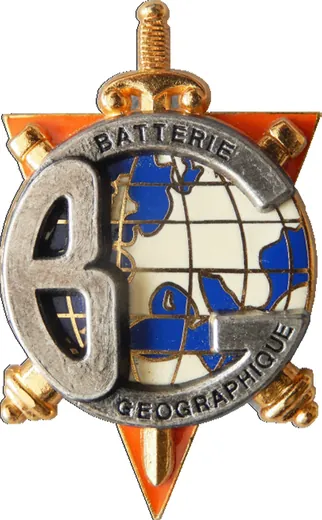
One family deserves a closer look: that of the French Forces in Germany, created in 1949 and dissolved in 1993, and of the French forces in Berlin, which left in September 1994. Regiments, companies, hospitals and services stationed across the Rhine had their own insignia, like the geographic battery at Offenburg shown below. To start a collection, it is a ready-made thread: one unit, one garrison town, one period. Their garrison souvenirs, pennants, tankards and engraved plaques have their own catalogue page: Cold War instruments and souvenirs.
Decorations and papers
Among the French decorations of the period, the Médaille de la Défense nationale, the national defence medal, was created by decree on 21 April 1982, in three grades: bronze, silver and gold. Older, the Colonial Medal was renamed the French Overseas Medal (médaille d'outre-mer) in 1962. Both are still awarded, which has a consequence for selling, explained below.
Papers, finally, service books, movement orders, manuals, maps, form the most documentary part of the period. A service book in a man's name, with his photographs and his kit, tells the story of his service; the catalogue page on Cold War documents explains how to authenticate them.
NATO equipment and its numbers
For Western equipment, the collector's best ally is a number. The NATO stock number has thirteen digits: four for the group and class of the item, two for the country that codified it, seven for the item itself. The French centre that manages these numbers gives the example of class 8430, men's footwear. Code 14 stands for France, 12 for Germany; the United States has codes 00 and 01. A pair of boots marked 8430-14 followed by seven digits was therefore codified by France.
This code tells you which country codified the item first, not necessarily where it was made. On American equipment, an eleven-digit number with no country code is the old federal format, replaced in 1974 by the thirteen-digit number: a label that still carries it is a good sign of age.
Two more reference points help place an American item: the ALICE load-carrying system, adopted in January 1973, and the BDU in woodland camouflage, issued from 1981. A piece of this kind cannot be older than its model; it can, on the other hand, be much more recent, since these models stayed in production for a long time. The catalogue page on Cold War field equipment adds to these reference points.
The Warsaw Pact: what came from the East
Whole armies disappeared within a few years, and their depots with them. The National People's Army of East Germany, the NVA, was dissolved on 2 October 1990, on the eve of German reunification; its facilities and equipment passed to the Bundeswehr, which sold or gave away a large part of them. The Warsaw Pact was dissolved in July 1991, the Soviet Union in December of the same year.
The NVA Strichtarn uniform
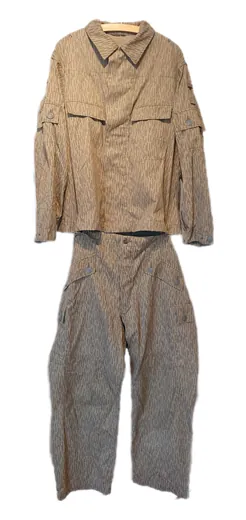
You can spot it from a distance: fine vertical brown lines, close-set like a downpour, on a light ground, grey-green or sandy depending on the production. This camouflage, known as Strichtarn, appeared in the NVA in 1965 under the name Kampfanzug 64 and stayed until 1990; it replaced a blotch pattern adopted in 1958. An NVA uniform in this pattern therefore dates, at the earliest, from the mid-1960s.
The Soviet SSh-68 helmet
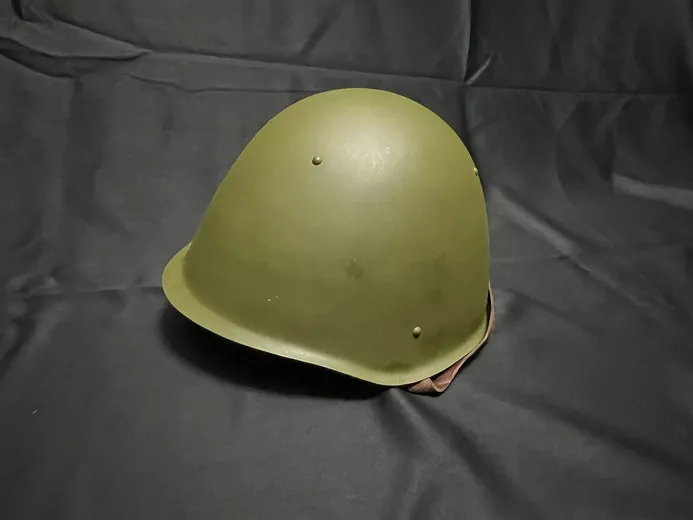
On the Soviet side, the SSh-68 helmet was designed and produced from 1968. It derives from the SSh-60, from which it differs by a dome sloping further forward and a shorter rim, and it equipped the Soviet army as well as several allied armies. Here again, the model gives only an earliest date: to go further, you need a legible marking or papers.
The Strichtarn summer jacket: 1965 or 1986?
The Imperial War Museums hold two NVA summer jackets in the Strichtarn pattern: one of the 1965 model, made in 1970, the other of the 1986 model. The first has two slash breast pockets with flaps. According to the museum, the 1986 model keeps the same pattern, but introduces bellows breast pockets, two pockets of the same type at the bottom of the jacket and a new system for attaching rank insignia to the left arm.
The museum adds that this style of uniform was also used by other Warsaw Pact forces, those of Poland and Czechoslovakia. In its records, each of the two jackets carries an inscription that includes the letters NVA.
Dating a piece: the order of checks
- The inside marking. Label, stamp, painted inscription: when it is legible, it outweighs everything else. Photograph it before handling the piece any further.
- The number. A NATO stock number tells you which country codified the item; an old eleven-digit US federal number points to a label from before 1974.
- The model. It gives an earliest date, never the age of the example: model 1951 helmet, satin 300 of 1964, Strichtarn of 1965, SSh-68, ALICE of 1973, BDU of 1981. A model 1951 helmet may have left the factory in 1975.
- The consistency of the whole. Same shade, same wear, same thread across the whole piece. A badge sewn onto a uniform, a liner fitted into a shell, a label of another size: each element is dated on its own.
Authentic Cold War militaria: what the NATO stock number says
Three things to remember about the NATO stock number.
- It has a date of birth. According to the Centre d'identification des matériels de la défense, France set up a codification bureau in 1958. The first NATO stock number was created in 1960, for the Alouette II programme. A number with code 14 was created by France: the label that carries it therefore dates from 1960 at the earliest.
- It identifies an item. An item of supply corresponds to a single logistical need, that is, a single number. The centre compares the number to a barcode, which identifies a product in a shop.
- Its start can change. According to the centre, the class of an item can change over time. The number can then change group and class, but its last seven digits stay the same.
For a specific piece, have it identified from photos.
The traps of the period
- New is not recent, worn is not old. A piece from stock that was never issued can be fifty years old and look new; a uniform worn for three years by a conscript can be worn down to the weave. Never date by eye.
- The made-up uniform. Ranks, badges and tabs can be sewn onto a plain uniform in a few minutes. Look at the reverse: the colour of the thread, old needle holes, the fading around the spot.
- The military-style piece. A regulation cut does not make an issued item: the label, the number and the maker make the difference, and so does their absence.
- The document filled in afterwards. A blank service book can be filled in in ten minutes. Several hands, several inks, stamps worn unevenly are reassuring; a single hand and a stamp that is too crisp should make you hesitate. The guide to spotting a fake gives the general method.
- The piece of wall. A painted chip of concrete is tied to the Berlin Wall only by its provenance. Without a document tracing where it has been, the stone itself proves nothing.
What calls for particular care
Luminous dials: watches, compasses, instruments
Old watches, alarm clocks, compasses, aircraft dials and night sights were given luminous paint containing radium, and later tritium. Andra, the French national agency for radioactive waste, notes that these objects are often held by collectors of military items. According to Andra, hands and a dial that still glow after two days in complete darkness indicate a radioactive object; the Canadian Nuclear Safety Commission, for its part, points out that radium paint that no longer glows is still radioactive, and places these objects up to the 1960s.
The quantities involved are small, and the case acts as a screen as long as it is intact. The rules are simple: do not open the object, do not keep it against you for long, wash your hands after handling it, do not send it by post and do not throw it away. In France, Andra collects such objects from private individuals, most of the time free of charge.
Ammunition, grenades and weapons
A grenade, even a training one, a cartridge or a flare is not to be handled: what to do is set out in the guide on old ammunition. Weapons of the period, even deactivated, fall under a precise regime, presented in the guide on selling militaria in France. Finally, the rubber of gas masks and protective equipment hardens and cracks with age: these objects are kept, not worn.
What French law says
As the guide on selling points out, most of these objects can be sold freely. Four points nonetheless call for attention.
- Wearing is not owning. Article 433-14 of the French code pénal punishes publicly wearing, without the right to do so, a uniform or decoration regulated by the public authorities, and article 433-15 punishes publicly wearing a uniform or badge so similar to those of the armed forces as to cause confusion. A recent uniform, close to today's, can be collected; wearing it in public is another matter.
- Decorations still awarded. A national defence medal, or any other decoration still conferred, may belong to a living person. The Athena Militaria terms exclude official decorations still awarded, granted to a living and identifiable person, offered without that person's consent; an old decoration or an ancestor's is not concerned.
- Classified documents. Article 413-11 of the code pénal punishes anyone who is not its authorised holder for taking possession of a document that is a national defence secret. A "Confidentiel Défense" or "Secret Défense" stamp does not by itself tell you whether the document still is one: if in doubt, do not buy it and do not offer it for sale.
- Weapons and ammunition. See the two guides mentioned above. On the site, ammunition, grenades and explosive devices, even inert ones if they are not certified, may not be sold.
This guide is not legal advice: for a specific piece, ask a legal professional or the competent authorities.
What makes a piece valuable, without figures
You will find no price here. Many models of the period were mass-produced, and a common piece left in stock does not compare with a rare or attributed one. What makes the difference: the model and the variant, condition and completeness, a legible marking, and above all attribution. A helmet, a uniform and a service book in the name of the same conscript form a group that tells the story of a service; separated, they are three objects among many. The method is set out in the guide on valuing a military item, and the catalogue gathers the Cold War militaria for sale on the site.
For collectors: museums and fairs
In Berlin, the Allied Museum (AlliiertenMuseum) holds more than two hundred uniform jackets. According to the museum, they give a good idea of the differences in dress and equipment between American, British and French soldiers. Part of its holdings is online, on the museum-digital platform.
In Dresden, today's Military History Museum of the Bundeswehr was, from 1972 to 1990, the Army Museum of the GDR.
Fair dates are listed in the militaria fairs calendar.
What I cannot tell you here
I cannot tell you where your helmet served, in Germany, overseas or in a barracks in provincial France: a shell keeps no trace of its postings, its wearer's papers do. Nor do I know of a complete and reliable list of Eastern makers' markings, and I would rather say so than invent one. Finally, I cannot judge whether a document marked secret still is: that is not for a collector to decide. For a specific piece, photograph every marking and ask the community.
Frequently asked questions
What is Cold War militaria?
Military objects from the 1947-1991 period: uniforms, helmets, insignia, field equipment, decorations and documents of the NATO armies, the French army among them, and of the Warsaw Pact armies. Because the two blocs never fought each other directly in Europe, much of this equipment never saw combat. The wars in Indochina and Algeria, from the same era, form a separate field.
What French Cold War militaria do collectors look for?
The model 1951 helmet, made from 1951 to 1976 and still issued in the 1980s; combat dress, from the model 1947 fatigues to the satin 300 of 1964 and then the F1 and F2; unit insignia, notably those of the French Forces in Germany (1949-1993) and of the French forces in Berlin, which left in 1994; the national defence medal created in 1982; and papers such as service books, which tie the objects to a man.
How do I date a French model 1951 helmet?
First look for a marking inside the shell and the liner: a maker's name or a year, where they exist and are still legible, date the example. The model was made from 1951 to 1976 by several makers, among them Franck, AG and Dunois. Then check that the liner, which is easily replaced, has the same shade and wear as the shell: otherwise the set is no longer original, even if each part is genuine.
What does the thirteen-digit NATO number on equipment mean?
It is the NATO stock number. The first four digits give the group and class of the item, the next two the country that first codified it (14 for France, 12 for Germany, 00 or 01 for the United States), the last seven the item itself. It tells you who codified the item, not necessarily where it was made. On American equipment, an old eleven-digit number with no country code points to a label from before 1974.
How do I recognise an East German Strichtarn uniform?
By its camouflage: fine vertical brown lines on a light ground, grey-green or sandy depending on the production. East Germany's National People's Army adopted it in 1965 under the name Kampfanzug 64 and kept it until 1990. An NVA uniform in this pattern therefore dates at the earliest from the mid-1960s; inside markings, when legible, let you go further.
Can a Cold War medal or uniform be sold?
As a general rule, yes: these objects are sold between collectors. Two limits are worth knowing. Publicly wearing a regulated uniform or decoration without the right to do so is punished by article 433-14 of the French code pénal. And a decoration still awarded, such as the national defence medal, may belong to a living person: the Athena Militaria terms exclude such decorations when they are offered without the consent of their identifiable holder.
Where can I buy authentic Cold War militaria?
At militaria fairs and shows, in auctions of military memorabilia, from specialist dealers and on collector-to-collector sites, including Athena Militaria, which has a section devoted to the Cold War. Whatever the channel, ask for photographs of the inside markings and the label before buying: they are what dates the piece, NATO stock number included (see what the NATO stock number says).
Is Cold War militaria valuable?
Yes, and the gap between two pieces comes down to details. Many models of the period were mass-produced: a common piece left in stock does not compare with a rare or attributed one. What makes the difference: the model and the variant, condition and completeness, a legible marking, and above all attribution. A helmet, a uniform and a service book in the name of the same conscript are worth more together than apart. The range is then built from sales actually concluded for comparable pieces.
Can an old military watch or compass be radioactive?
Yes, if its hands or dial were given luminous radium paint, which was done up to around the 1960s on watches, compasses and military instruments. According to Andra, the French radioactive waste agency, a dial that still glows after two days in complete darkness is radioactive, and the Canadian Nuclear Safety Commission points out that radium paint that has stopped glowing still is. Do not open the object, do not keep it against you, do not post it: in France, Andra collects it, most of the time free of charge.
How can I tell if Cold War militaria is authentic?
Cross-check the clues in order: the inside marking first, when it is legible, then the number, the model and the consistency of the whole. A NATO stock number with code 14 dates the label to 1960 at the earliest. For a specific piece, have it identified from photos.
Sources
This guide draws on the texts, databases and pages below, accessed on unless otherwise stated. Most of them are in French.
- NATO, “France and NATO”
- ECPAD, the French defence image archive, on the fall of the Berlin Wall
- Decree no. 82-358 of 21 April 1982 creating the Médaille de la Défense nationale, on Légifrance
- Decree no. 2014-389 of 29 March 2014 on the Médaille de la Défense nationale, on Légifrance
- Centre d'identification des matériels de la défense, booklet on NATO codification
- Andra, the French radioactive waste agency, leaflet on recognising radioactive objects (2021)
- Canadian Nuclear Safety Commission, “Could your collectible item contain radium?”
- Code pénal, articles 433-14 and 433-15: unlawful wearing of uniforms and decorations, on Légifrance
- Code pénal, article 413-11: breaches of national defence secrecy, on Légifrance
- Imperial War Museums, “Jacket, Field, Summer, M1965 'Strichtarn' Feldjacke: Feldwebel, DDR NVA”: NVA summer jacket made in 1970, with slash breast pockets, a style of uniform also used by Poland and Czechoslovakia (UNI 13500), accessed
- Imperial War Museums, “Jacket, Field, Summer, M1986 'Strichtarn' Feldjacke: O/Rs, DDR NVA”: what the 1986 model changed on the NVA summer jacket (UNI 13576), accessed
- Allied Museum (AlliiertenMuseum), Berlin, on its collections: uniform jackets of American, British and French soldiers, holdings online, accessed
- Military History Museum of the Bundeswehr, Dresden, “History of the museum”: the Army Museum of the GDR from 1972 to 1990, accessed