The French Overseas Medal: reading its clasps, tracing an award
By Thomas, contributor to Athena Militaria Published 13 min read
The French Overseas Medal, the médaille d'outre-mer, is recognised by its ribbon striped in white and light blue, often crossed by a silver-gilt coloured clasp: “Tchad”, “Liban”, “Moyen-Orient”, “Sahel”. It was not born in 1962: that year, the Colonial Medal created in 1893 changed its name and kept its design, apart from the legend on the reverse. Its clasp names a territory, never a date or a man. Here is how to read it, tell it apart from its predecessor and find the papers that prove an award, from the texts that governed it.
Get a piece identified from photos Valuing a piece: the method
In brief
- A name from 1962, a medal from 1893. The Overseas Medal is the Colonial Medal, renamed by decree no. 62-660 of 6 June 1962, with the same design apart from the legend on the reverse.
- Two forms. With a clasp, it rewards an operation abroad; without one, long years of service outside metropolitan, European France.
- One clasp, one territory. “Tchad”, “Liban”, “Moyen-Orient”, “Sahel”: the clasp names a territory or an area, never a date.
- No grades. The medal is silver-coloured; “vermeil”, silver-gilt, refers to the clasp.
- Paper proves it, metal does not. Recipients buy their own insignia; only the certificate and the service record link a medal to a man.
From the Colonial Medal to the Overseas Medal
The Colonial Medal was created by article 75 of the finance law of 26 July 1893. The decree of 6 March 1894 set its appearance and listed the operations that qualified for it, each with its own clasp; the law of 27 March 1914 opened it, without a clasp, to soldiers who had served more than six years in the colonies. These steps are summarised in a note by Patrice Spilliaert published by the Grande Chancellerie of the Legion of Honour.
The 1962 decree, signed by General de Gaulle, gave it its present name; the decree of 10 October 2024 rewrote it and repealed the Colonial Medal texts. Two orders of 27 November 2024 deal with the medal with a clasp and the medal without one respectively, and both leave holders the right to wear what they received.
Who receives it, and what for
The decree intends it for military or civilian services rendered to the armed forces outside metropolitan, European France or abroad. Awarded by the Minister of Defence, it comes in two forms: one follows an operation, the other a career.
The medal with a clasp
It may be awarded to military personnel or civilians, French or foreign, who took part in operations abroad as part of a war, an armed conflict or an overseas operation. The minister, on the proposal of the Chief of the Defence Staff, sets by order the territories, operations, periods and lengths of stay that qualify, with no minimum stay for those killed, wounded, cited or medically repatriated. Since 1 December 2024, that list has been kept in an unpublished ministerial order.
The medal without a clasp
According to a ministerial answer of 5 July 1999, it went to regular army soldiers with fifteen years of effective service for officers, ten for the others, and at least six years in African countries or Madagascar listed by an order of 30 November 1988.
Since the order of 27 November 2024, it requires ten years of effective service and a period of at least six years, continuous or not, of service outside metropolitan, European France or abroad, in territories set by an unpublished order. The explanatory note of the 2024 decree extends it to military service performed on French national territory outside Europe. A medal without a clasp is therefore not incomplete: it rewards length of service.
Obverse, reverse, ribbon: the medal's design
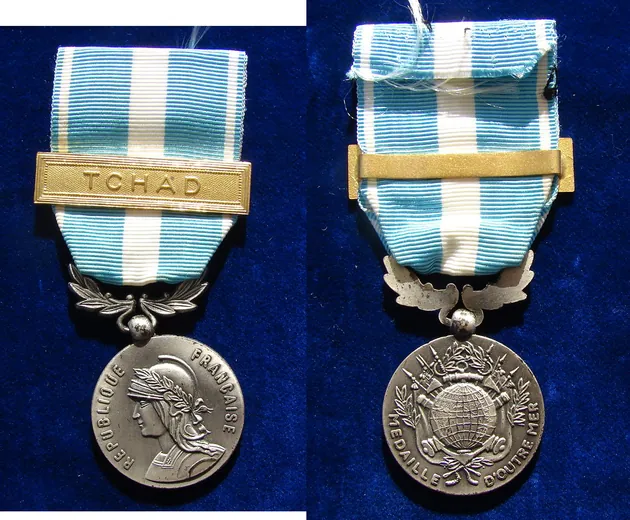
The decree describes it as follows: a 30 mm medal in silver-coloured metal, bearing on the obverse the helmeted effigy of the Republic and the words “République française”, and on the reverse a terrestrial globe surrounded by military emblems with the inscription “Médaille d'outre-mer”. It hangs from a ribbon striped in white and light blue, which carries the clasps.
According to the note, the effigy is by Georges Lemaire; the Overseas Medal continues, with a new legend on the reverse, the model redrawn by Lindauer and struck by the Paris Mint from 1914 to 1962. On the piece photographed at the top of this guide, the suspension is shaped as two sprays of leaves.
“Vermeil”: the clasp, not the medal
Official texts speak of the “médaille d'outre-mer avec agrafe en vermeil”, the Overseas Medal with a silver-gilt clasp, and the phrase misleads: the decree describes a single medal, silver-coloured, with no grades, and only the clasps are in silver-gilt coloured metal. This was not new in 1962: an instruction of 15 January 1926 already deals with the Colonial Medal with the silver-gilt “Maroc 1925” clasp.
Recipients, the decree adds, buy the insignia at their own expense: how a medal was made therefore does not tell you when it was awarded.
The clasps, territory by territory
The clasp is a metal bar fixed to the ribbon. The note counts thirteen official clasps for the Overseas Medal, created from 1979 to 2003; the “Sahel” clasp followed, by an order of 5 June 2013. The table follows those dates and the decisions repealed on 27 November 2024.
| Clasp | Date created | What the public texts specify |
|---|---|---|
| Tchad (Chad) | 14 December 1979 | Actions from 15 March 1969; closed for actions from 30 September 2014 |
| Liban (Lebanon) | 14 December 1979 | Actions from 22 March 1978 |
| Zaïre | 14 December 1979 | Closed by a decision of 29 June 1990 |
| Mauritanie (Mauritania) | 14 December 1979 | Closed by a decision of 29 June 1990 |
| Ormuz (Hormuz) | 21 December 1987 | Closed by a decision of 29 June 1990 |
| Moyen-Orient (Middle East) | 20 December 1990 | Gulf War, then Operation Chammal |
| Cambodge (Cambodia) | 18 January 1993 | Closed by a decision of 3 May 1994 |
| Somalie (Somalia) | 10 June 1993 | Closed by a decision of 3 May 1994 |
| Rwanda | 24 August 1995 | Rwanda and the Goma area of Zaïre, before 1 October 1994 |
| République centrafricaine (Central African Republic) | 24 March 1997 | Extended to Operations Boali and Barracuda |
| République du Congo (Republic of the Congo) | 19 November 1999 | Closed for Operation Okoumé in 2001 |
| République de Côte d'Ivoire | 3 April 2003 | Operations Licorne and Calao |
| République démocratique du Congo (Democratic Republic of the Congo) | 28 August 2003 | Closed in 2004, reopened in 2007 for Operation Benga |
| Sahel | 5 June 2013, by order | Operations Sabre, Serval and Barkhane, then the “opérations au Sahel” |
Two clasps people often look for exist in no official text consulted. There is no “Djibouti” clasp: in 2016, for soldiers who had served there, the ministry pointed to the medal without a clasp, after six years in Djibouti or in the territories of the 1988 order. Nor is there a “Golfe” clasp: in 2012 the ministry ruled out creating one, since the “Moyen-Orient” clasp already rewarded those who fought in the Gulf War.
Tchad: from Operation Manta to Barkhane
According to a ministerial answer of 19 December 2023, the “Tchad” clasp was awarded to military and assimilated personnel who took part in actions in Chad from 15 March 1969, excluding earlier cooperation missions. An order of 23 September 2014 ended it for actions from 30 September 2014.
Operation Manta is one example: in 2005 the ministry stated that its combatants, from 9 August 1983 to 11 November 1984, could receive the “Tchad” clasp, which had already been awarded to several hundred veterans of the operation.
As worded in 2014, the “Sahel” clasp order placed Chad, from 1 October 2014, among the territories of Operations Sabre and Barkhane: for a stay in Chad after that date, look for a “Sahel” clasp.
Liban, Moyen-Orient, Sahel: the written conditions
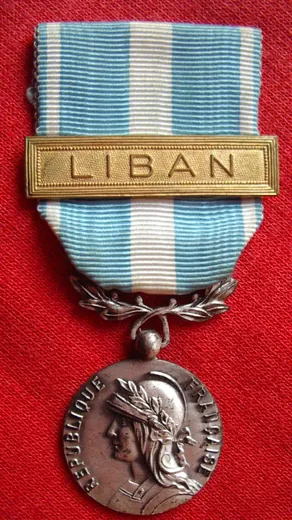
For the “Liban” clasp, the order of 2 July 2015 covers actions in Lebanon from 22 March 1978, with at least fifteen days' presence, continuous or not.
For the “Moyen-Orient” clasp, the order of 31 December 2014 covers Operation Chammal from 8 August 2014, in Iraq, Jordan, five countries of the Arabian Peninsula and three air and sea areas, with the same length of stay; an order of 12 November 2015 adds Syria from 8 September 2015.
For the “Sahel” clasp, the 2014 wording also requires fifteen days, for Sabre since 1 December 2009, Serval from 11 January 2013 to 30 September 2014 and Barkhane from 1 October 2014; an order of 26 May 2023 replaces the 2013 one: it adds the “opérations au Sahel” to the three operations and leaves territories and periods to an unpublished order.
Reading the ribbon, the clasps and ribbon bars
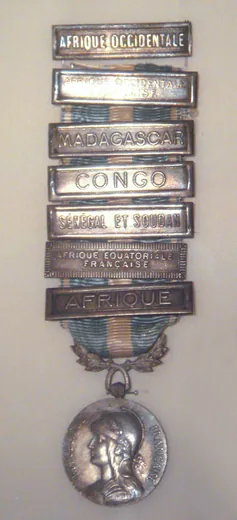
One ribbon can carry several clasps, one per theatre of operations. A Navy instruction of 17 January 2017 is explicit: a sailor receives as many certificates as theatres, but the holder of a clasp cannot be put forward again for the same one.
The ribbon bar, worn without the medal, repeats the ribbon's colours. Yet the decree describes the Overseas Medal ribbon as striped in white and light blue, and the note describes the Colonial Medal ribbon as striped in white and sky blue: a ribbon bar alone does not tell the two medals apart.
Telling it apart from the Colonial Medal
The two medals share the same design and the same ribbon: the legend on the reverse decides, “Médaille coloniale” or “Médaille d'outre-mer”. The note describes two types of Colonial Medal: from 1895 to 1914, G. Lemaire's signature in relief on the obverse, a two-sided suspension and rectangular clasps from private makers; from 1914 to 1962, striking by the Paris Mint, a mark on the reverse, an incuse signature and a one-sided suspension. This second type is the one in use during the Indochina War, with the “Extrême-Orient” clasp: see French Indochina War decorations.
The clasps help, with one caveat: some names exist for both medals, such as “Tchad”, from 1903 and 1979, or “Mauritanie”, from 1909 and 1979. A clasp that belongs only to the Overseas Medal, such as “Liban” or “Zaïre”, on a “Médaille coloniale” reverse points to an assembly made after 1979: let the papers speak.
Finally, an “Algérie” clasp on a Colonial Medal refers to campaigns that the note places before the Third Republic. The North African operations of the 1950s have a decoration of their own, created by the decree of 12 October 1956: see French Algerian War medals.
Tracing a veteran's award
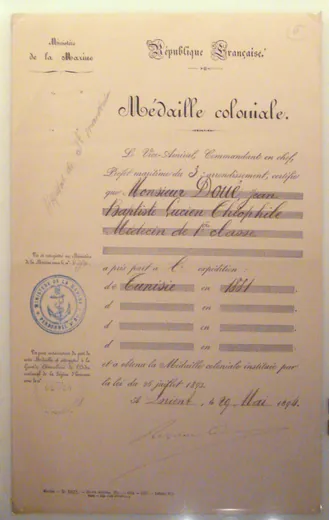
Start with the family papers. The certificate is the key document: the model attached to the 2017 Navy instruction certifies, in the name of the Minister of Defence, that the holder has obtained the Overseas Medal, with its geographical clasp. It is not numbered, each theatre has its own, and it states the lineage: the medal is described there as instituted by the law of 26 July 1893 and decree 62-660 of 6 June 1962.
The same instruction had the service record state “A reçu la médaille d'outre-mer avec agrafe en vermeil” (received the Overseas Medal with silver-gilt clasp), followed by the territory and the date. The statement of service, the état signalétique et des services, is requested from the Service historique de la Défense or from the office that Service-Public.fr indicates for the service and rank; for a deceased relative, enclose proof of kinship and a copy of the death certificate. The Pau archives centre also handles requests that establish former soldiers' rights, decorations included.
The brevet shown below, signed at Lorient on 29 May 1894, names a first-class doctor, the Tunisia expedition of 1881 and the law of 26 July 1893; in the margin, it is “Vu pour autorisation du port de cette Médaille”, approved for wearing the medal, and registered at the Grande Chancellerie. For the Colonial Medal, a brevet like this one stood in for the certificate. To read such papers: reading and keeping military photographs and documents.
Copies, new medals and made-up groups
A new Overseas Medal is not a fake: the decoration is still awarded, and the Monnaie de Paris leaflet shows the “Médaille d'Outre-Mer (ex-Médaille Coloniale)” among the insignia the Paris Mint makes. What should raise doubts is a mismatch with the texts:
- Reverse and clasp. A clasp that does not fit the legend on the reverse points to an assembly to be checked.
- The clasp's name. “Golfe” or “Djibouti” match no clasp in the texts consulted.
- Duplicates. Two identical clasps on one ribbon match no award provided for by the 2017 instruction.
- Clasp and dates. For a stay in Chad after 30 September 2014, the 2014 orders provide for the “Sahel” clasp, not “Tchad”: the service record settles it.
The general method is in recognising fake militaria. The French criminal code punishes anyone who wears a decoration in public without being entitled to it.
Judging value without a price
This guide gives no prices, but a method in five questions:
- Which medal? Colonial or Overseas, from the reverse; 1895-1914 or 1914-1962 type for the Colonial Medal.
- Which clasp? Its name, its date of creation, whether it fits the reverse.
- An original whole? Ribbon, clasps and suspension of the same period, with no sign of reassembly.
- A man behind the piece? A certificate, a brevet or a statement of service in the same name changes everything.
- What condition? It matters, but dates nothing.
To place a piece against sales actually concluded, see valuing a military item. A decoration still awarded today, attributed to a living, identifiable person, also falls under the rules on selling decorations.
What I cannot tell you here
I cannot tell you, from a photograph, whether a medal was presented to your relative or bought later, nor who fitted its clasp, nor how many men received each clasp: no source consulted says. Nor is the current list of territories and lengths of stay that qualify for each clasp public: since December 2024, an unpublished order has set it.
For a particular piece, photograph the obverse, the reverse, both sides of the clasp, the ribbon and every paper, then have it identified free of charge from photos.
Frequently asked questions
What is the French Overseas Medal (médaille d'outre-mer)?
A French decoration rewarding services rendered to the armed forces outside metropolitan, European France or abroad. Since decree no. 62-660 of 6 June 1962 it has been the new name of the Colonial Medal created in 1893, whose design it keeps apart from the legend on the reverse: the helmeted Republic on the obverse, a globe surrounded by military emblems on the reverse, a ribbon striped in white and light blue. It is awarded with or without a clasp.
What is the French Overseas Medal awarded for?
With a clasp, for taking part in operations abroad as part of a war, an armed conflict or an overseas operation, under the decree of 10 October 2024. Without a clasp, for long years of service outside metropolitan, European France or abroad. Military personnel and civilians killed, wounded, cited or medically repatriated may receive the medal with a clasp with no minimum stay.
Médaille d'outre-mer with or without clasps: what is the difference?
The medal with a clasp follows an operation: the silver-gilt coloured clasp names the territory or area, such as “Tchad”, “Liban” or “Sahel”. The medal without a clasp follows a career: since the order of 27 November 2024, it requires ten years of effective service and a period of at least six years of service outside metropolitan, European France or abroad. A medal without a clasp is therefore not necessarily incomplete.
Who is entitled to the Overseas Medal with the Moyen-Orient clasp?
In 2012 the French ministry cited it as the award for those who fought in the Gulf War, and for that reason ruled out any “Golfe” clasp. An order of 31 December 2014 opened it to Operation Chammal from 8 August 2014, for at least fifteen days' presence, then an order of 12 November 2015 extended it to Syria from 8 September 2015. Since December 2024, the list of operations has been set by an unpublished order.
What are the conditions for the Liban clasp of the Overseas Medal?
Under the order of 2 July 2015, it covers actions in Lebanon from 22 March 1978, for at least fifteen days' presence, continuous or not. No minimum applies to personnel wounded, cited, killed or medically repatriated. That order was repealed at the end of 2024, but holders of the clasp keep the right to wear it.
Who received the Overseas Medal with the Tchad clasp?
Military and assimilated personnel who took part in actions in Chad from 15 March 1969, under a decision of 14 December 1979. The combatants of Operation Manta, from 9 August 1983 to 11 November 1984, are among them. An order of 23 September 2014 closed the clasp for actions from 30 September 2014; from 1 October 2014, Chad came under the “Sahel” clasp.
Is there a médaille d'outre-mer for Djibouti?
None of the official texts consulted for this guide creates a “Djibouti” clasp. In 2016 the French ministry stated that the Overseas Medal without a clasp rewarded military personnel who had served at least six years in Djibouti or in the territories of an order of 30 November 1988, with ten years of effective service for NCOs and fifteen for officers. The order of 27 November 2024 now requires ten years of effective service, without singling out officers.
How can you trace a veteran's médaille d'outre-mer?
Look first for the certificate, which names the clasp, then request the statement of service, the état signalétique et des services, from the Service historique de la Défense or from the office Service-Public.fr indicates for the veteran's service and rank. A French Navy instruction of 2017 also provided for the award to be entered in the service record. For a deceased relative, enclose proof of kinship and a copy of the death certificate.
Sources
This guide draws on the texts, databases and pages below, accessed on unless otherwise stated. All of them are in French.
- Decree no. 62-660 of 6 June 1962 on the Médaille d'outre-mer, current version and signatories, on Légifrance
- Patrice Spilliaert, on the Colonial Medal that became the Médaille d'outre-mer, note published by the Grande Chancellerie of the Legion of Honour (PDF)
- Decree no. 2024-927 of 10 October 2024 on the Médaille d'outre-mer, on Légifrance
- Order of 27 November 2024 on the award of the Médaille d'outre-mer with a clasp, on Légifrance
- French National Assembly, written question no. 31116 (11th legislature) on the Médaille d'outre-mer, with its answer of 5 July 1999, accessed
- Order of 27 November 2024 on the award of the Médaille d'outre-mer without a clasp, on Légifrance
- Instruction no. 772/M of 15 January 1926 on issuing the Colonial Medal with the silver-gilt “Maroc 1925” clasp, on Légifrance
- Order of 5 June 2013 opening the “Sahel” clasp on the Médaille d'outre-mer, as amended by the order of 23 September 2014, on Légifrance
- Decision of 27 November 2024 repealing various decisions on the award of the Médaille d'outre-mer with a clasp, Bulletin officiel des armées of 6 December 2024 (PDF)
- Order of 26 July 2016 ending the award of the Médaille d'outre-mer with the silver-gilt “Rwanda” clasp, on Légifrance
- Order of 24 April 2015 on the Médaille d'outre-mer with the silver-gilt “République de Côte d'Ivoire” clasp, on Légifrance
- French National Assembly, written question no. 93989 (14th legislature) on service in Djibouti, with its answer of 17 May 2016
- French National Assembly, written question no. 128606 (13th legislature) on Gulf War servicemen, with its answer of 3 April 2012
- French National Assembly, written question no. 11310 (16th legislature) on the Médaille d'outre-mer and Chad, with its answer of 19 December 2023
- Order of 23 September 2014 ending the award of the Médaille d'outre-mer with the silver-gilt “Tchad” clasp, on Légifrance
- French National Assembly, written question no. 40521 (12th legislature) on Operations Barracuda and Manta, with its answer of 26 April 2005
- Order of 2 July 2015 on the Médaille d'outre-mer with the silver-gilt “Liban” clasp, on Légifrance
- Order of 31 December 2014 on the Médaille d'outre-mer with the silver-gilt “Moyen-Orient” clasp, as amended by the order of 12 November 2015, on Légifrance
- Order of 26 May 2023 on the award of the Médaille d'outre-mer with the “Sahel” clasp, on Légifrance
- Instruction no. 974/DEF/CEMM/CAB/CHAN of 17 January 2017 on awarding the Médaille d'outre-mer with a clasp to French Navy personnel, with its model certificate, on Légifrance
- Decree no. 56-1032 of 12 October 1956 on the commemorative medal for security and law-and-order operations in North Africa, on Légifrance (digitised Journal officiel), accessed
- Service-Public.fr, on the certificate of services rendered (état signalétique et des services) and where to request it, accessed
- Service historique de la Défense, on its archives centre in Pau, accessed
- Monnaie de Paris, leaflet on official French decorations put online by the prefecture of the Alpes-Maritimes (PDF), accessed
- Code pénal, articles 433-14 and 433-15: unlawful wearing of uniforms and decorations, on Légifrance, accessed