Collector's guide Decorations
French Algerian War medals: recognising them and tracing a veteran's entitlements
By Thomas, contributor to Athena Militaria Published 14 min read
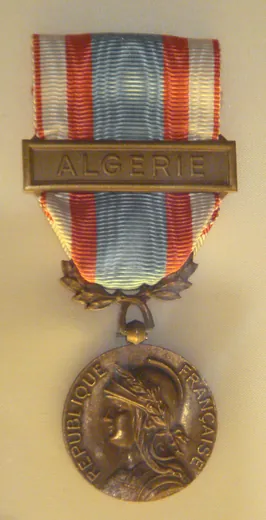
In a box of family keepsakes, a medal on a red and light blue ribbon crossed by an “Algérie” clasp, a bronze cross on a scarlet ribbon striped with white, a certificate signed in a minister's name: these are the decorations of the Algerian War and of the fighting in Morocco and Tunisia. They speak the administrative language of their time, that of “security and law-and-order operations”, and each follows a rule: a length of presence, a citation or a title. Their metal says little; their papers say almost everything. Here is how to recognise them, work out what a veteran was entitled to and find the papers that prove it, from the texts that created them.
Get a piece identified from photos Valuing a piece: the method
In brief
- The AFN medal. The commemorative medal for security and law-and-order operations, with an “Algérie”, “Tunisie” or “Maroc” clasp, rewards at least ninety days of operations.
- The Cross for Military Valour. Created in 1956, it always comes with a citation, and the star or palm on its ribbon shows the level at which the man was cited.
- The titre de reconnaissance de la Nation. This certificate, granted after ninety days in North Africa, entitles its holder to a medal on a sand-coloured ribbon with indigo chevrons.
- The combatant's card and cross. Opened to North Africa veterans from 1974, they have a guide of their own.
- A rule of method. Every decoration has its paper: certificate, citation, card, statement of service. The medal alone proves nothing, because these decorations are still sold new.
A vocabulary of its time: “maintien de l'ordre”, then “war”
During the conflict, the decrees that created its decorations did not speak of war: they referred to “security and law-and-order operations” in North Africa, which the administration shortened to AFN, for Afrique du Nord. It took the law of 18 October 1999 for the phrase “the Algerian War or the fighting in Tunisia and Morocco” to replace, in French law, “operations carried out in North Africa”.
This vocabulary shows on the objects themselves: a citation earns a new cross, the Cross for Military Valour, rather than the Croix de guerre, and the commemorative medal bears the name of the operations. Between 1956 and 1962, according to the French Ministry of the Armed Forces, some 400,000 to 470,000 men were stationed in Algeria at any one time.
The AFN commemorative medal
Two texts underpin it: the decree of 12 October 1956, which created it for North Africa, and decree no. 58-24 of 11 January 1958, which the ministry gives as its founding text. According to a ministerial answer published on 15 December 2003, it is awarded by the Minister of Defence to members of the army, navy and air force who took part in operations for at least ninety days, in a regular or auxiliary unit. That period is not required of the wounded or of holders of the Cross for Military Valour, and some civil authority and police staff may also qualify.
Ribbon, obverse, reverse
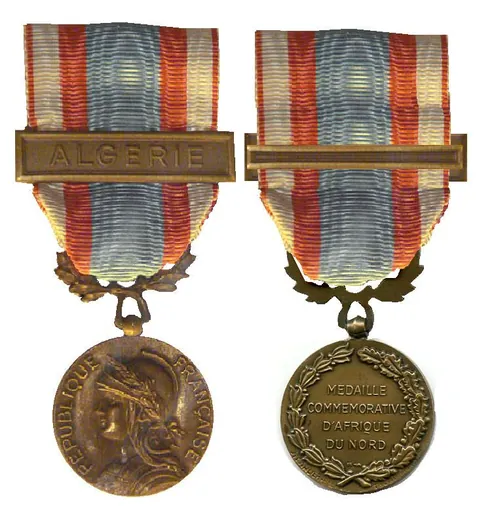
On the example photographed at the top of this guide, the ribbon is red, with a broad light blue central band and a white stripe near each edge. The ribbon of the Croix de guerre for overseas theatres of operations is, under the law of 30 April 1921, a light blue central band between two red bands: the white stripes make the difference. The obverse shows the helmeted Republic and the legend RÉPUBLIQUE FRANÇAISE.
The reverse carries an inscription within a wreath of foliage; on the example shown below, it reads MEDAILLE COMMEMORATIVE D'AFRIQUE DU NORD. Do not date a medal, or its holder's service, from its reverse alone.
The clasps and their dates
The clasp, a metal bar fixed to the ribbon, names the territory, notably “Algérie”, “Tunisie” or “Maroc”. According to the same answer, the “Algérie” clasp may be awarded for service up to 2 July 1964, more than two years after the ceasefire of 19 March 1962. For Tunisia and Morocco, the deadline was first 5 May 1958; the order of 26 July 2004 moved it to 2 July 1962, for service from 1 January 1952 in Tunisia and from 1 June 1953 in Morocco.
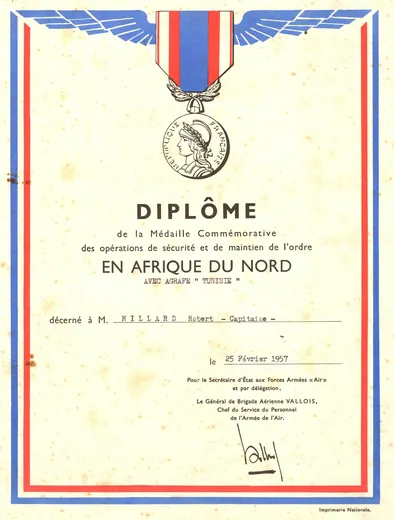
The certificate shown below, dated 25 February 1957, names the medal “en Afrique du Nord”, in North Africa, and mentions a “Tunisie” clasp. Keep it with the medal: it is what ties the medal to a man.
The Cross for Military Valour and its stars
The Croix de la Valeur militaire was created by decree no. 56-371 of 11 April 1956, amended as early as the following 12 October, to reward feats of arms performed during or in connection with security or law-and-order operations. According to a ministerial answer of 26 December 2006, crosses with a citation were awarded to conscripts until 1 January 1963.
The decree in force describes it as a bronze cross about 36 mm across, matching the model deposited with the Monnaie de Paris, the French mint, with the effigy of the Republic and the legend RÉPUBLIQUE FRANÇAISE on the obverse and the inscription CROIX DE LA VALEUR MILITAIRE on the reverse. The ribbon, scarlet and 36 mm wide, is crossed by three white stripes: one of 7 mm in the centre and one of 2 mm near each edge.
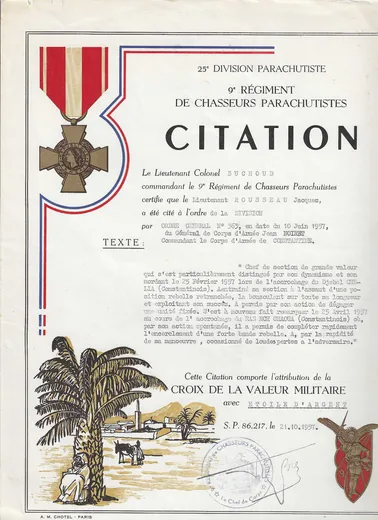
As on the Croix de guerre, the device pinned to the ribbon gives the level of the citation: a bronze star for regiment or brigade, a silver star for division, a silver-gilt star for army corps, a bronze palm for army. The decree requires every award to come with a text that recalls the facts precisely: the citation, the document that counts. On the one shown below, signed in Algiers on 18 April 1959, the citation in army corps orders comes with the silver-gilt star.
For the ministry, this cross is awarded on the same principles as the Croix de guerre, and its citation, regarded as a war title, counts like that of a Croix de guerre for the Legion of Honour and the Médaille militaire. It is still awarded for feats of arms outside French territory, on overseas operations: only the citation shows that a cross comes from North Africa.
The titre de reconnaissance de la Nation and its medal
The titre de reconnaissance de la Nation, the Nation's recognition title, is first of all a certificate. Created by article 77 of the law of 21 December 1967, it was meant for servicemen who had taken part in the North African operations, at a time when these did not qualify for the combatant's card. Today, according to Service-Public.fr, the French government's information site, it requires ninety days of presence, consecutive or not, in Algeria, Morocco or Tunisia, within periods that run to 2 July 1962, and to 1 July 1964 for Algeria. It is granted as of right to holders of the combatant's card and to people evacuated for a wound or illness. The certificate, signed by the minister responsible for veterans, is sent by the ONACVG, the French veterans' office.
The title entitles its holder to a medal, and the medal has changed. From 1997 to 2002 it was the Médaille d'Afrique du Nord: the Southern Cross on the obverse, the inscription “Médaille d'Afrique du Nord” on the reverse, a sand-coloured ribbon with indigo chevrons, and no clasp provided for in its decree. The decree of 12 April 2002 replaced it with the médaille de reconnaissance de la Nation, in bronze, with the effigy of the Republic, on the same ribbon; holders of the 1997 medal keep it.
The newer medal can be recognised by its clasp: under article D353-7 of the code of military disability pensions, the clasp is made of white metal and reads, for North Africa, “Afrique du Nord”. The title can still be applied for from the ONACVG, online or on form Cerfa 15409; for service in Algeria between 3 July 1962 and 1 July 1964, another form must be used.
The combatant's card and the volunteer combatant's cross
North Africa veterans were recognised as combatants only in 1974, the Ministry of the Armed Forces notes. Since the finance law for 2004, a period of presence has been enough to obtain the card, without a combat unit: four months at first, 112 days today according to Service-Public.fr. The card entitles its holder to the Croix du combattant, the same for every war, which he buys at his own expense. Criteria, procedure and archives are in our guide to the Croix du combattant.
The Croix du combattant volontaire with the “Afrique du Nord” bar is more demanding. According to the ministry, the decree of 20 April 1988 reserves it for men who enlisted without being obliged to, were posted to a combat unit, and held both the combatant's card for North Africa and the commemorative medal. An instruction of 1995 also opened it to conscripts who had asked for and obtained a posting to North Africa, for instance after giving up their deferment.
Médaille militaire and Legion of Honour
The 2006 ministerial answer spells it out: an individual citation or a combat wound could earn a conscript the Médaille militaire, the first distinction for private soldiers and non-commissioned officers, or, if he was an officer, a direct appointment as a knight of the Legion of Honour. It is the file, not the insignia, that ties these decorations to North Africa. To recognise them, see our guides to the Médaille militaire and the Legion of Honour.
Recognising a ribbon at a glance
The last column matters most: it is the paper that proves the award.
| Decoration | Ribbon | What to read on the piece | The paper that proves it |
|---|---|---|---|
| AFN commemorative medal | Red, broad light blue central band, white stripe near the edges | Helmeted Republic; “Algérie”, “Tunisie” or “Maroc” clasp | Certificate, statement of service |
| Cross for Military Valour | Scarlet, three white stripes | Bronze cross; star or palm on the ribbon | Citation |
| Médaille d'Afrique du Nord (1997 to 2002) | Sand with indigo chevrons | Southern Cross on the obverse; no clasp provided for | Certificate of the titre de reconnaissance de la Nation |
| Médaille de reconnaissance de la Nation (since 2002) | Sand with indigo chevrons | Effigy of the Republic; “Afrique du Nord” clasp in white metal | Certificate of the title |
| Croix du combattant | Horizon blue, seven red stripes | Cross of the 1930 pattern, the same for every war | Combatant's card |
Tracing service records and decorations
Start with the papers at home: service book, certificates, citations, card, photographs. Then request the état signalétique et des services, the statement of service, which sets out periods and units: for the army, Service-Public.fr points to the Service historique de la Défense, online, or to its Pau archives centre, by form. For a deceased parent, have ready proof of your relationship and a copy of the death certificate.
The centre holds the records used to manage military personnel and the French Army's citations since 1914, and helps examine applications for decorations. For a particular decoration, the ONACVG points to the honours department of the Ministry of the Armed Forces.
Card and title files are kept by the local ONACVG offices and are subject to legal time limits; an exemption from these limits can be requested. For public archives, the French heritage code, the Code du patrimoine, sets in particular fifty years for anything touching on private life and twenty-five years after death for medical confidentiality.
For the Legion of Honour, the Léonore database of the French National Archives opens the files of members of the order who died before 1977. Beyond that, the Liste unique des décorés of the Grand Chancellery covers Legion of Honour holders since the late nineteenth century, but its database for twentieth-century conflicts is still being indexed. It covers Médaille militaire holders of the last thirty years only. Finally, Mémoire des hommes publishes the database of those who died for France in the Algerian War and the fighting in Morocco and Tunisia: nearly 26,000 names, civilian and military.
Copies and made-up groups: what should alert you
The metal on its own proves little: a Monnaie de Paris leaflet, put online by the prefecture of the Alpes-Maritimes, lists among the insignia it sells the AFN medal with its Algérie, Maroc and Tunisie bars, the Cross for Military Valour and the médaille de reconnaissance de la Nation. A recent medal is not a fake: it simply says nothing about the man who wore it.
What should alert you is anything that contradicts the texts:
- Clasp and ribbon. “Algérie”, “Tunisie” and “Maroc” go on the red, light blue and white ribbon of the commemorative medal; “Afrique du Nord”, in white metal, on the sand ribbon. A clasp moved from one ribbon to the other points to a made-up piece.
- Clasp and service. A “Maroc” clasp for a man who served only in Algeria matches nothing: the statement of service settles it.
- The devices on the cross. Every star or palm refers to a citation; without the texts, a ribbon loaded with devices proves nothing.
- The mounted group. Decorations sewn onto one bar may have been brought together afterwards; only the papers tie them to one man.
Ribbon bars, short strips of ribbon worn on a jacket, show what a man wore, not what he had been awarded. The general method is in spotting fake militaria.
Judging a group without talking about prices
The method comes down to three questions. Is the piece tied to a man? A certificate, a citation, a card or a statement of service in the same name changes everything. What does it reward? A length of presence for the commemorative medal and the médaille de reconnaissance de la Nation, a cited action for the Cross for Military Valour, a deed of war established by the file for a Médaille militaire or a Legion of Honour earned under fire. Is the group consistent, with clasps and devices in line with the papers? The condition of ribbon and metal comes next; it matters, but dates nothing. The detail is in valuing a military item.
Two more precautions. The French criminal code punishes the public wearing of a decoration by someone not entitled to it. And these decorations are recent: one awarded to a living, identifiable person falls under the rules for selling decorations.
What I cannot tell you here
I cannot tell you, from a photograph, whether a medal was presented to your relative or bought later. Nor can I tell you what he was entitled to without his record of service: length of service, units, citations and wounds decide everything, and only the papers establish them. This guide deals with objects and archives; it does not comment on the political history of this war. And I give no prices.
For a particular piece, photograph the obverse, the reverse, the clasp, the ribbon and every paper, then ask for free identification help. Decorations from this period for sale on the site are gathered in Algerian War medals.
Frequently asked questions
What is the French AFN medal?
It is the common name of the commemorative medal for security and law-and-order operations, founded by a decree of 12 October 1956 and then by decree no. 58-24 of 11 January 1958. It went to servicemen who took part in the North African operations for at least ninety days, with no minimum period for the wounded or for holders of the Cross for Military Valour. Its ribbon is red with a broad light blue central band and white stripes near the edges, and its clasp names the territory, notably Algérie, Tunisie or Maroc.
Who was entitled to the AFN medal with the Algérie clasp?
Members of the army, navy and air force who took part in operations for at least ninety days, in a regular or auxiliary unit, as well as some civil authority and police staff. The period was not required of the wounded or of holders of the Cross for Military Valour. According to the French ministry, the “Algérie” clasp may be awarded for service up to 2 July 1964.
What is the difference between the AFN medal and the médaille de reconnaissance de la Nation?
The AFN medal is a commemorative medal, on a red, light blue and white ribbon, with an “Algérie”, “Tunisie” or “Maroc” clasp. The médaille de reconnaissance de la Nation, created in 2002, is worn by right of the titre de reconnaissance de la Nation; its ribbon is sand-coloured with indigo chevrons and its white-metal clasp reads “Afrique du Nord”. From 1997 to 2002 the title carried the right to the Médaille d'Afrique du Nord, with the Southern Cross, which its holders have kept.
How was the Cross for Military Valour awarded in Algeria?
With a citation, as a reward for a feat of arms during or in connection with the security and law-and-order operations, under the decree of 11 April 1956. According to the French ministry, crosses with a citation were awarded to conscripts until 1 January 1963. The citation that comes with it counts as a war title, weighed like a Croix de guerre for the Legion of Honour and the Médaille militaire.
What do the stars on the Cross for Military Valour mean?
They give the level of the citation: a bronze star for regiment or brigade, a silver star for division, a silver-gilt star for army corps; the bronze palm stands for a citation in army orders. Each device refers to a written citation, which alone proves the award.
How do you get the medal of the titre de reconnaissance de la Nation?
By obtaining the title, which carries the right to wear the médaille de reconnaissance de la Nation. For North Africa you need ninety days of presence, consecutive or not, within the periods set by law, or an evacuation for a wound or illness; holders of the combatant's card receive it as of right. Applications go to the ONACVG, online or on form Cerfa 15409, and the title takes the form of a certificate signed by the minister.
How do you get the French combatant's card for service in Algeria?
By applying to the ONACVG, online or on form Cerfa 15409. For North Africa, 112 days of service are enough today, without having belonged to a combat unit, according to Service-Public.fr; other criteria exist, such as a war wound or an individual citation with a cross. The details are in our guide to the Croix du combattant, which the card entitles you to wear.
How can I trace a French Algerian War veteran's medals?
Start with the family papers: certificates, citations, card, service book. Then request his statement of service from the Service historique de la Défense, online, or from its Pau archives centre, which also holds the French Army's citations since 1914. For the Legion of Honour, search the Léonore database or the Grand Chancellery's Liste unique des décorés; card and title files stay with the ONACVG, subject to time limits.
Sources
This guide draws on the texts, databases and pages below, accessed on unless otherwise stated. All of them are in French.
- Law no. 99-882 of 18 October 1999 replacing the phrase “operations carried out in North Africa” with “the Algerian War or the fighting in Tunisia and Morocco”, on Légifrance
- French Ministry of the Armed Forces, Chemins de mémoire, on the conscripts of the Algerian War: numbers stationed in Algeria, veteran status recognised in 1974, ceasefire of 19 March 1962
- Decree no. 56-1032 of 12 October 1956 on the commemorative medal for security and law-and-order operations in North Africa, on Légifrance (digitised Journal officiel)
- Decree no. 58-24 of 11 January 1958 on the commemorative medal for security and law-and-order operations in North Africa, on Légifrance (digitised Journal officiel)
- French National Assembly, written question no. 26266 (12th legislature) on the commemorative medal for security and law-and-order operations, with its answer published on 15 December 2003: award conditions, “Algérie” clasp until 2 July 1964, deadline of 5 May 1958 for Morocco and Tunisia
- Law of 30 April 1921 creating a special Croix de guerre for overseas theatres of operations, article 2: the ribbon, on Légifrance
- French National Assembly, written question no. 2506 (13th legislature) on the volunteer combatant's cross with the “Afrique du Nord” bar, with its answer published on 22 January 2008: order of 26 July 2004 and the qualifying periods in Tunisia and Morocco, decree of 20 April 1988, finance law for 2004
- Decree no. 56-371 of 11 April 1956 creating the Cross for Military Valour, on Légifrance, accessed
- French National Assembly, written question no. 106146 (12th legislature) on the decorations of North Africa conscripts, with its answer published on 26 December 2006: Cross for Military Valour, Médaille militaire, Legion of Honour, 1995 instruction on the volunteer combatant's cross
- French National Assembly, written question no. 118432 (12th legislature) on the name of the Cross for Military Valour, with its answer published on 13 March 2007
- French National Assembly, written question no. 83325 (12th legislature) on the titre de reconnaissance de la Nation, with its answer published on 28 February 2006: creation by article 77 of the law of 21 December 1967
- Service-Public.fr, on the titre de reconnaissance de la Nation (TRN): conditions, supporting documents, procedure and certificate
- ONACVG, on the titre de reconnaissance de la Nation: conditions and the rights it opens
- Decree no. 97-424 of 29 April 1997 creating the Médaille d'Afrique du Nord, on Légifrance
- Decree no. 2002-511 of 12 April 2002 creating the médaille de reconnaissance de la Nation, repealed in 2017, on Légifrance
- Code des pensions militaires d'invalidité et des victimes de guerre, article D353-7: the médaille de reconnaissance de la Nation, its ribbon and clasps, on Légifrance
- Service-Public.fr, on the application form for the combatant's card and the titre de reconnaissance de la Nation: form Cerfa 15409*02, accessed
- Service-Public.fr, on the combatant's card: the rights it opens, the award criteria and how to apply, accessed
- Code des pensions militaires d'invalidité et des victimes de guerre, articles R353-1 to D353-5: the Croix du combattant, on Légifrance, accessed
- Decree of 24 August 1930 on the Croix du combattant, and instruction of 26 August 1930 setting the rules of the design competition, Journal officiel of 28 August 1930, on Gallica, accessed
- Service-Public.fr, on the certificate of services rendered (état signalétique et des services) and where to request it, accessed
- Service historique de la Défense, on its archives centre in Pau, accessed
- ONACVG, consulting the files of applications for cards and titles, accessed
- Code du patrimoine, article L213-2: time limits before public archives may be consulted, on Légifrance
- Léonore database, French National Archives: files of members of the Legion of Honour, accessed
- Archives of the Grande Chancellerie de la Légion d'honneur, “Liste unique des décorés”: Legion of Honour holders since the late nineteenth century, completed by a database still being indexed for twentieth-century conflicts, Médaille militaire holders for the last thirty years, accessed
- Mémoire des hommes, French Ministry of the Armed Forces, on the Algerian War and the fighting in Morocco and Tunisia: database of those who died for France and databases of the missing
- Monnaie de Paris, leaflet on official French decorations put online by the prefecture of the Alpes-Maritimes (PDF)
- Code pénal, articles 433-14 and 433-15: unlawful wearing of uniforms and decorations, on Légifrance, accessed