The French Colonial Medal: reading its clasps, dating it, tracing its holder
By Augustin, founder of Athena Militaria Published 13 min read
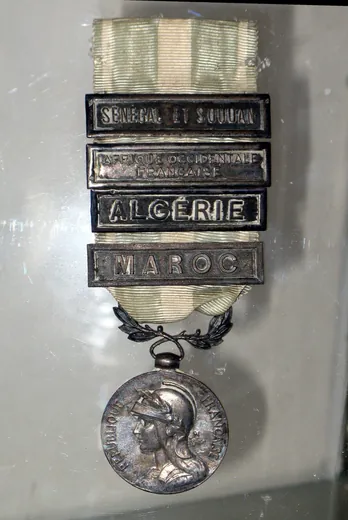
The French Colonial Medal is a round, silver-coloured medal bearing the helmeted Republic, hanging from a sky blue ribbon striped with white that often carries one or more clasps: “Tonkin”, “Sahara”, “Maroc”. Created by the finance law of 26 July 1893, it rewarded campaigns in the colonies and protectorates before becoming the Overseas Medal in 1962. Each clasp names a territory and refers to decrees that state which operations it covers. This guide follows the clasps created up to 1932 and explains how to read a medal, place it in time and find the man who received it, from the official texts and museum records.
Get a piece identified from photos Valuing a piece: the method
In brief
- One medal, dozens of clasps. The medal is the same for every campaign; the clasp, a bar fixed on the ribbon, names the territory.
- A territory, rarely a date. Up to 1932, only the silver-gilt “Maroc 1925” and “Maroc 1925-1926” clasps bear a year.
- Two types of medal. Before 1914, a raised engraver's signature and a double-sided suspension; afterwards, striking at the Monnaie de Paris, an incuse signature and a single-sided suspension.
- A clasp dates an entitlement, not an object. It cannot have been granted before the text that created it, but it does not say when the medal was made.
- The name is on the paper. The medal is not named: the certificate and the service record link it to a man.
One medal for every colonial campaign
The Colonial Medal was born of article 75 of the finance law of 26 July 1893, which created a single colonial medal to reward taking part in operations of war in a colony or a protectorate. A decree was to set the qualifying campaigns, past and future alike: the medal was retroactive.
That was the decree of 6 March 1894. Its report excluded expeditions that already had a commemorative medal, such as those of Dahomey, Madagascar and Tonkin; its list of operations created the first clasps. According to a note by Patrice Spilliaert published by the Grande Chancellerie of the Legion of Honour, the medal itself was only issued from a decision of the Navy Minister of 4 June 1895.
The finance law of 13 April 1898 opened it to civil servants who took part in operations of war, and to soldiers and civilians who showed courage on perilous colonial missions. The law of 30 June 1903 extended it to study and exploration missions in Africa and Asia since 1875; the decree of 11 June 1913 listed them and created the “Afrique” and “Asie” clasps. The decree of 6 June 1962 turned it into the Overseas Medal, and the decree of 10 October 2024 repealed its main texts.

With or without a clasp
With a clasp, the medal rewards a campaign, whatever its length. The law of 27 March 1914 created a medal without a clasp for soldiers, indigenous troops excepted, with ten years of service, fifteen for officers. At least six of those years had to be spent in the south of Algeria and Tunisia or in the colonies and protectorates other than Réunion, French India, Saint-Pierre and Miquelon and the French possessions in the Pacific and the West Indies. The decree of 5 October 1920 finally applied it: because of mobilisation, its report says, the work had been set aside. It also had any clasp earned later worn on the ribbon of the medal without a clasp: a medal with no clasp is therefore not necessarily incomplete.
Recognising the medal: obverse, reverse, ribbon
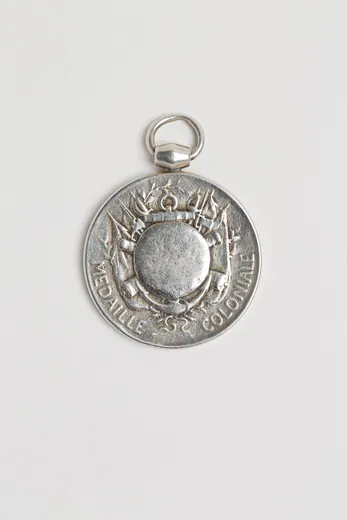
The 1894 decree describes a silver medal 30 millimetres across: on one side, the effigy of the Republic and the words “République française”; on the other, the legend “Médaille coloniale” and a terrestrial globe surrounded by military emblems. The Republic, helmeted and crowned with laurel, is signed by the engraver Georges Lemaire. The suspension is made of two laurel branches, and the 36-millimetre sky blue ribbon has three white stripes, according to the Society of Friends of the Musée de la Légion d'honneur.
The metal varies: the Sens museum describes one of the two Colonial Medals from General Duchesne's collection as silvered bronze, the other as silver. Metal alone neither dates a medal nor condemns it.
Two types, before and after 1914
The Grande Chancellerie note describes two types of Colonial Medal:
- From 1895 to 1914. Raised “G. Lemaire” signature, double-sided suspension, worked on both faces; rectangular clasps with a notched folding clip, made by the private firms Mercier, Roux and Salat.
- From 1914 to 1962. Medal struck entirely at the Monnaie de Paris, marked on the reverse; design redrawn by Lindauer, Lemaire's signature incuse, single-sided suspension; clasps by the Monnaie or private medallists, recognisable by their hallmarks.
The same note counts nearly fifty variants by private makers, including trial pieces sold before 1895. To read a maker's mark, see reading the markings on a military item.
Reading the clasps
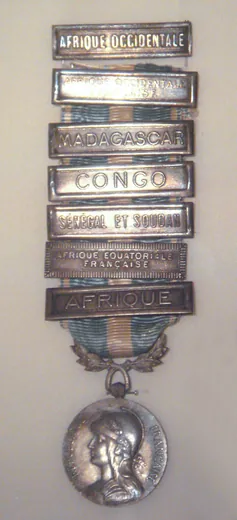
The 1893 law wanted a clasp bearing the name of the colony and the date of the campaign; those created up to 1932 bear only a name, except the two silver-gilt Morocco clasps. According to the same society, the standard pattern is a silver rectangle 40 by 10 millimetres, edged with a raised line.
The 1894 decree grants as many clasps as campaigns completed in different possessions. The instruction of 28 May 1923 forbids proposing the same clasp twice, and an unbroken stay in one colony earns only one, unless the operations were of different kinds.
According to the official list of qualifying operations and perilous missions, updated in 1951, “Sénégal et Soudan” and “Dahomey” gave way, for acts of war, to “Afrique occidentale française” on 1 January 1900. The instruction of 15 January 1926 allows the silver-gilt “Maroc 1925” clasp to be added to the silver “Maroc” one.
The gold clasps of the great missions
Four clasps of a special pattern, according to the same society, reward great African missions. “De l'Atlantique à la mer Rouge” is gold for the French members of the Liotard and Marchand mission, silver for its indigenous soldiers; “Centre africain”, gold for officers and the European cadre, silver for indigenous soldiers; “Mission saharienne” and “Gabon-Congo” are gold. These names also exist on standard-pattern clasps, in silver or silver gilt.
The clasps created from 1894 to 1932
List from the Grande Chancellerie note, stopped at 1932; examples taken from the 1951 list and the published decrees, with no claim to be complete.
| Clasp | Decree or law | Campaigns (examples) |
|---|---|---|
| Algérie | 6 March 1894 | From the conquest to operations in 1906 |
| Sénégal et Soudan | 6 March 1894 | Campaigns since 1833; replaced in 1900 |
| Îles Marquises | 6 March 1894 | Before the Third Republic |
| Îles de la Société | 6 March 1894 | 1844-1847; Raiatea-Tahaa (1897) |
| Nossi-Bé | 6 March 1894 | Service in 1849 |
| Côte d'Or | 6 March 1894 | Grand-Bassam (1849, 1852-1853) |
| Nouvelle-Calédonie | 6 March 1894 | Periods from 1853 to 1869, 1878-1879, 1916-1918 |
| Cochinchine | 6 March 1894 | Conquest and operations, 1857-1868; 1872 |
| Tunisie | 6 March 1894 | 1881-1883 expedition; southern Tunisia, 1915-1918 |
| Madagascar | 7 June 1895 | 1829-1831; then from November 1896 |
| Tonkin | 7 June 1895 | Tonkin and Annam, from 1 October 1893 to 1928 |
| Comores | 7 June 1895 | Anjouan and Grande Comore (1891); Mohéli (1902) |
| Côte d'Ivoire | 24 September 1895 | Kong column (1894-1895); issued again for 1909-1910 |
| Guyane | 24 September 1895 | Mapa, a disputed territory (May 1895) |
| Congo | 1895 or 1896, depending on the source | Upper Ubangi (1894-1895); Gabon and Middle Congo up to 1908 |
| Laos et Mékong | 29 November 1899 | Pavie missions (1880-1895); Franco-Siamese boundary commission (1904-1907) |
| Dahomey | 11 February 1899 | Upper Dahomey (1896-1899); replaced in 1900 |
| Haut-Mékong | 9 May 1899 | Crew of the La Grandière (1897); Luce mission (1893) |
| De l'Atlantique à la mer Rouge | Law of 4 July 1899 | Liotard and Marchand mission (1896-1899) |
| Sahara | 26 September 1900 | Far south of Algeria (1899-1900), then up to the raids of the 1920s |
| Mission saharienne | Law of 22 February 1901 | Foureau-Lamy mission (1898-1900) |
| Afrique occidentale française | 4 August 1901 | From 1900 to 1932 |
| Centre africain | Law of 28 May 1902 | Central Africa before 5 September 1900 |
| Tchad | 10 April 1903 | Service from 1901, except 1909 |
| Gabon-Congo | Law of 30 June 1903 | Brazza's missions (1875-1885) |
| Afrique | Law of 30 June 1903; decree of 11 June 1913 | Exploration missions since 1875 |
| Asie | Law of 30 June 1903; decree of 11 June 1913 | Twenty-six missions since 1875 |
| Guinée française | 25 November 1904 | Coniagui (1904); 1906-1907 |
| Mauritanie | 3 August 1909 | Service in 1908 |
| Adrar | 3 August 1909 | Operations in 1908; Mauritania in 1909 |
| Afrique équatoriale française | 31 August 1910 | From 1909 to 1931, Cameroon included from 1914 |
| Maroc | 28 April 1914 | Occupation from July 1912; yearly decrees |
| Maroc 1925 | 6 January 1926 | Northern Moroccan front, 1925; silver gilt |
| Maroc 1925-1926 | 30 December 1926 | Replaces “Maroc 1925”; 1926; silver gilt |
Clasps created after 1932 fall outside this guide: see the decorations of the Indochina War and, for the clasps created since 1962, the Overseas Medal.
Dating a Colonial Medal
The medal bears no date; it is placed by cross-checking:
- The clasp. It cannot have been granted before the text that created it: a “Maroc” clasp is later than the decree of 28 April 1914, even for service in 1912.
- The medal. Raised signature and double-sided suspension: first type, 1895 to 1914. Incuse signature, single-sided suspension and Monnaie mark: after 1914.
- The back of the clasps. A notched folding clip points to the first type; later, the Monnaie used a rounded clip or a clamping clip, private makers a clamping clip and their hallmark.
- Silver gilt. The decree of 30 December 1926 replaced “Maroc 1925” with “Maroc 1925-1926”; the instruction of 13 January 1927 let holders change clasps at their own expense without altering certificates. A “Maroc 1925” certificate can therefore go with a “Maroc 1925-1926” clasp.
- No clasp. It may come under the 1914 law: only the papers can tell.
A second-type medal may carry an old clasp, such as “Cochinchine”: the medal may have been bought or replaced later, all the more since the 1923 instruction no longer gave it free, with some exceptions, to those whose entitlement came after 2 August 1914. Its manufacture does not date the award.
Tracing the campaign and the holder
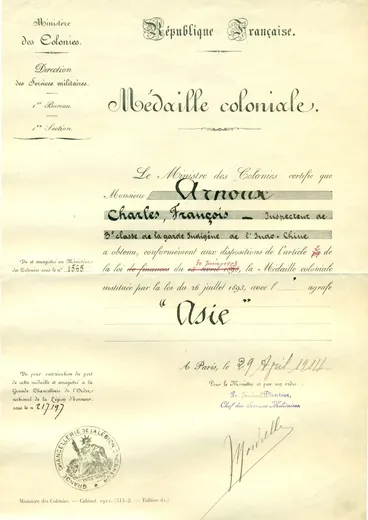
The named document is the certificate, the brevet, issued by a ministry. Cyrille Cardona, who has studied dozens of them, describes a plain document 21.2 by 32 centimetres, headed “Médaille coloniale”, signed by the authority and stamped by the Grande Chancellerie of the Legion of Honour. Its two registration numbers are the ministry's and the Grande Chancellerie's.
The instruction of 28 May 1923 had the award entered on the service record: “A reçu la médaille coloniale avec agrafe”, followed by the name of the clasp. Former soldiers applied through the gendarmerie, with an état signalétique et des services, the statement of service; after a death, certificate and medal could be given to the family as a keepsake.
Start from the service register, with the method in tracing a French soldier of 1914-1918. The Service historique de la Défense also points to files of personnel decorated before 1900, the Colonial Medal included, in sub-series GR Xq, and to the rolls of the marine troops, which became the colonial troops in 1900, in sub-series GR 43Yc. Anyone who served in the colonies may have a file at the Archives nationales d'outre-mer, where Cyrille Cardona consulted the requests for the “Afrique” and “Asie” clasps.
It remains to link the clasp to a campaign. Each decree sets places, dates and a condition: presence in the colony or actual participation. For “Tonkin”, the 1951 list requires effective participation in operations from 1 October 1893. Compare with the service record, and read the papers with reading and keeping military photographs and documents.
Added clasps, restrikes and copies
A ribbon completed over the years is nothing unusual: the 1920 decree provides for an added clasp, the 1927 instruction for an exchange. Only the papers confirm each clasp; two identical clasps on one ribbon, however, match no award the texts provide for.
Not all clasps are official. The Society of Friends of the Musée de la Légion d'honneur lists some that no text created: “Sud-Oranais”, “Taza”, “Rif”, “Tafilalet”, “Siam”, “Colonies”, “Maroc” clasps dated from 1926 to 1929, and even the spelling “Maroc 1925-26”. No certificate can mention them.
A variant is not a fake. The Navy Minister's decision of 4 June 1895, quoted by the same society, reserved to the State the making of medals in the official design and size, which the Monnaie could sell to the trade, forbade imitations in base metal and left to private industry reductions of 25 millimetres at most, suspensions and clasps.
The reverse settles it: since 1962 it has read “Médaille d'outre-mer”, and the Monnaie de Paris leaflet on official decorations names the award “Médaille d'Outre-Mer (ex-Médaille Coloniale)”. A clasp belonging only to the Overseas Medal on a “Médaille coloniale” reverse points to a later assembly.
What I cannot tell you here
I cannot tell you, from a photograph, whether a clasp was earned by the man who wore the medal: only the certificate and the service record establish that. Nor does this guide give every decree; the 1951 list and the Journal officiel set them out. Certificates and variants have their own books, not read for this guide, such as La Médaille coloniale par ses brevets, by Cyrille Cardona, or the catalogue La Médaille coloniale, 1893-1993, from an exhibition shown at Vincennes and Épinal.
I give no prices: the method is in valuing a military item. For a particular medal, photograph the obverse, the reverse, the suspension, each clasp front and back and the certificate, then ask for free identification help. To compare, see the First World War medals and decorations for sale on the site.
Frequently asked questions
What is the French Colonial Medal?
A French decoration created by article 75 of the finance law of 26 July 1893 to reward taking part in operations of war in a colony or a protectorate. Round, silver and 30 millimetres across, it shows the helmeted Republic and the legend “République française” on the obverse, and a globe surrounded by military emblems with the legend “Médaille coloniale” on the reverse. A clasp on the sky blue and white ribbon names the territory; in 1962 the medal became the Overseas Medal, the médaille d'outre-mer.
How do you recognise a French Colonial Medal marked “République française”?
On the obverse, the legend “République française” surrounds the effigy of the Republic, helmeted and crowned with laurel, signed by the engraver Georges Lemaire. The reverse identifies the award: a terrestrial globe surrounded by military emblems and the legend “Médaille coloniale”, replaced by “Médaille d'outre-mer” since 1962. The suspension of two laurel branches and the sky blue ribbon with three white stripes complete the description; a raised signature and a double-sided suspension point to the type made before 1914.
What are the clasps of the French Colonial Medal?
Between 1894 and 1932, thirty-four official clasps were created, from “Algérie” and “Tunisie” in 1894 to “Maroc 1925-1926” in 1926. Most name a territory, such as “Tonkin”, “Sahara”, “Madagascar” or “Afrique occidentale française”; four reward great African missions, and “Afrique” and “Asie” exploration missions. The table in this guide gives the text that created each one.
What does the Maroc clasp on a French Colonial Medal mean?
It rewards service in Morocco. Created by the decree of 28 April 1914 for men of the occupation troops who served at least two months between 20 July 1912 and 31 December 1913, it was then granted by yearly decrees. The silver-gilt “Maroc 1925” clasp, then “Maroc 1925-1926”, which replaced it, cover the operations of 1925 and 1926 on the northern Moroccan front and, in 1926, in the Taza pocket; other dated “Maroc” clasps, such as “Maroc 1926-1927”, match no official text.
What does the Tunisie clasp on the Colonial Medal stand for?
First, the 1881 Tunisia expedition: the decree of 6 March 1894 grants it to sailors present from April to December 1881 and to army troops up to December 1881, or February 1883 for the southern division. Decrees of 1917 and 1919 also granted it for southern Tunisia between 1915 and 1918, in the districts of Médenine, Tataouine, Dehibat, Ben Gardane and Zarzis. The service record shows which campaign applies to a given man.
What did the Sahara clasp of the Colonial Medal reward?
Created by the decree of 26 September 1900, it first covers operations in the far south of Algeria from December 1899 to September 1900: the Flamand mission and the Tidikelt, Igli and Gourara columns. Later decrees extended it to Touat and Gourara in 1901, to the fights at Taghit and El-Moungar in 1903, then to reconnaissance missions and raids, up to the crossings of the Sahara in the 1920s. The Foureau-Lamy mission has its own gold clasp, “Mission saharienne”.
What does the Tonkin clasp on a French Colonial Medal mean?
It rewards actual participation in operations of war in Tonkin or Annam from 1 October 1893, under the decree of 7 June 1895 as summarised in the 1951 list. Earlier campaigns, which had their own commemorative medal, were kept apart by the 1894 decree; holders of that medal could receive the Colonial Medal for later operations. The clasp was then extended to Kouang-Tchéou-Wan, from 1898, and to operations in Tonkin up to 1928.
How much is a French Colonial Medal worth?
This guide gives no prices. It helps you check what makes a piece interesting: the type of medal, before or after 1914; official clasps that are consistent with each other; the condition of the ribbon and metal; above all, a certificate or service record that links the medal to a man. The full method is in the guide to valuing a military item.
Sources
This guide draws on the texts, databases and pages below, accessed on unless otherwise stated. All of them are in French.
- Finance law of 26 July 1893 for the 1894 budget, article 75: creation of the Colonial Medal, in the French Armed Forces official bulletin, consolidated edition (archived copy)
- Decree of 6 March 1894 setting the actions and campaigns of war that qualify for the Colonial Medal, with the report of the Navy and War ministers, in the French Armed Forces official bulletin (archived copy)
- Finance law of 13 April 1898, article 77: Colonial Medal for civil servants and for members of perilous colonial missions, in the French Armed Forces official bulletin (archived copy)
- Law of 30 June 1903 granting the Colonial Medal to members of African and Asian missions since 1875, article 2, with the list of missions for the “Afrique” and “Asie” clasps, in the French Armed Forces official bulletin (archived copy)
- Journal officiel of 26 June 1913, p. 5477: report of the Minister of the Colonies and decree of 11 June 1913 creating the “Afrique” and “Asie” clasps of the Colonial Medal; copy of the Société de géographie (Bibliothèque nationale de France) reproduced on Wikimedia Commons
- Law of 27 March 1914 on the Colonial Medal without a clasp, in the French Armed Forces official bulletin (archived copy)
- Decree of 5 October 1920 applying the law of 27 March 1914 on the Colonial Medal without a clasp, with its report, in the French Armed Forces official bulletin (archived copy)
- Instruction of 28 May 1923 on issuing the Colonial Medal, in the French Armed Forces official bulletin, consolidated edition (archived copy)
- Instruction no. 772/M of 15 January 1926 on issuing the Colonial Medal with the silver-gilt “Maroc 1925” clasp, on Légifrance, accessed
- Instruction of 13 January 1927 on issuing the Colonial Medal with the silver-gilt “Maroc 1925-1926” clasp, in the French Armed Forces official bulletin (archived copy)
- List of the operations of war and perilous missions qualifying for the Colonial Medal, updated to 1 October 1951, annex to article 75 in the French Armed Forces official bulletin (archived PDF)
- Decree no. 62-660 of 6 June 1962 on the Médaille d'outre-mer, current version and signatories, on Légifrance, accessed
- Decree no. 2024-927 of 10 October 2024 on the Médaille d'outre-mer, on Légifrance, accessed
- Patrice Spilliaert, on the Colonial Medal that became the Médaille d'outre-mer, note published by the Grande Chancellerie of the Legion of Honour (PDF), accessed
- Society of Friends of the Museum of the Legion of Honour and Orders of Chivalry, on the Colonial Medal: history, ribbon and medal, the decision of 4 June 1895 on manufacture, official and unofficial clasps, decrees published in the Journal officiel
- Cyrille Cardona, on the certificate of the Colonial Medal with the “Asie” clasp, Articles de phaléristique, 2022-S-3, Society of Friends of the Museum of the Legion of Honour and Orders of Chivalry (PDF)
- Sens museum, “Médaille coloniale d'Algérie”, silvered bronze, engraved by Georges Lemaire, from General Duchesne's collection (inv. 20.1.6): Joconde record on the Plateforme ouverte du patrimoine
- Sens museum, Colonial Medal in engraved silver, from General Duchesne's collection (inv. 20.1.12): Joconde record on the Plateforme ouverte du patrimoine
- Service historique de la Défense, research guide on ancestors who received a military pension or award: decoration files in sub-series GR Xq
- Service historique de la Défense, research guide on ancestors who served overseas: marine and colonial troops, sub-series GR 43Yc, Archives nationales d'outre-mer
- Service-Public.fr, on the certificate of services rendered (état signalétique et des services) and where to request it, accessed
- Monnaie de Paris, leaflet on official French decorations put online by the prefecture of the Alpes-Maritimes (PDF), accessed
- Cyrille Cardona, La Médaille coloniale par ses brevets, 1893-1962, PBCO, 2013, Guide du collectionneur series: record in the digital libraries of the French Ministry of the Armed Forces
- Francis-Henri Courroy, La Médaille coloniale, 1893-1993, exhibition catalogue, Vincennes and Épinal, 1993: record in the digital libraries of the French Ministry of the Armed Forces