Zouaves, tirailleurs and Spahis: recognising the uniforms of the Armée d'Afrique, 1830 to 1918
By François, contributor to Athena Militaria Published 13 min read
The French Zouave uniform can be recognised from afar: a red chéchia, a short jacket with neither collar nor buttons, baggy trousers and a long wool sash. The tirailleur wore the same cut in other colours, and the Spahi, a cavalryman, wrapped himself in a red burnous. From the conquest of Algeria to the khaki of 1915, these uniforms “in the oriental style” made the Armée d'Afrique recognisable; today they turn up as separate pieces, in family photographs or as children's costumes. Here is how to recognise and date them, piece by piece, from the museums that hold them and the dictionaries that fixed their words.
Get a piece identified from photos Valuing a piece: the method
In brief
- Three corps of the Armée d'Afrique. The Zouave was an infantryman recruited among the French, then among Europeans; the tirailleur, an infantryman recruited in Algeria or Tunisia; the Spahi, a cavalryman.
- A cut “in the oriental style”. Chéchia, short jacket with neither collar nor buttons, waistcoat, baggy trousers, long wool sash: Zouave and tirailleur share the cut, and the colours tell them apart.
- Colours to read. Dark blue and madder red for the Zouave, sky blue for the tirailleur, a red burnous for the Spahi; the colour of the tombo, the false pocket drawn by the braid, told the Zouave regiments apart.
- 1915, khaki. When the infantry of mainland France went into horizon blue, the Armée d'Afrique was given a khaki uniform verging on mustard yellow; its headdress still set it apart.
- A uniform alone does not date a photograph. In April 1916, in Tarascon, Spahis still posed in red burnous for an autochrome now held by the Musée Albert-Kahn.
Three corps of the Armée d'Afrique
On the eve of 1914, the French Ministry of the Armed Forces describes the 19th Army Corps, also called the Armée d'Afrique, with its headquarters in Algiers: Zouaves, tirailleurs and Spahis served there alongside Chasseurs d'Afrique, legionnaires and African light infantry battalions.
The Zouaves take their name from the Zouaoua, tribes of Kabylie; an order by General Clauzel created their corps on 1 October 1830. From 1835, in the infantry, recruitment was split: the Zouaves took Frenchmen, then Europeans, and local recruits served in separate units described as indigenous. A royal ordinance of 8 September 1841 provided for a Zouave regiment, formed in 1842 according to the Musée de l'Armée; there were three by 1852, and their uniform was fixed the following year.
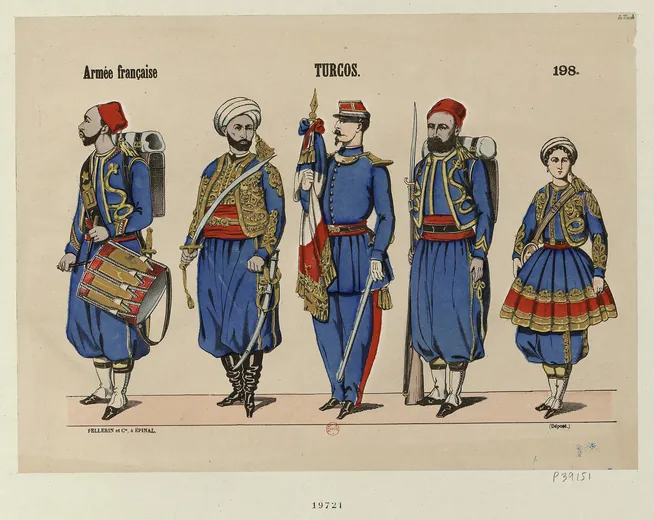
The tirailleurs were born of an ordinance of 7 December 1841, which formed in Algeria “bataillons de tirailleurs indigènes”, battalions of native riflemen. Their nickname, Turcos, recorded from 1856, most probably comes, according to the Trésor de la langue française, from the Algerian sabir, the local lingua franca, or from the Italian turco, “Turk”. In 1914 the Ministry of the Armed Forces counts seven regiments of Algerian tirailleurs and two Tunisian ones, the 4th and 8th.
The Spahis were cavalrymen: a royal ordinance of 10 September 1834 formed in Algiers a corps of native horsemen under the name of spahis réguliers. The word comes from the Turkish sipahi, “cavalry soldier”. Tirailleurs and Spahis had French or indigenous officers and NCOs, the latter among the junior ranks. The Papal Zouaves, formed to defend the Papal States, and the Senegalese tirailleurs, soldiers of the colonial infantry, are other subjects.
The words of the period
- Chéchia. A tall cylindrical cap of coarse red cloth, trimmed with a tassel, says the Trésor de la langue française; the Académie française spelt it chechia in 1932.
- Séroual. The dictionary accepts saroual, sarouel, seroual and séroual, and quotes as early as 1891 “le séroual des zouaves français”, the séroual of the French Zouaves; the Musée de l'Armée speaks of trousers “de forme arabe”, of Arab cut.
- Burnous. A hooded wool cloak without sleeves, worn by Arabs or by the old Spahi regiments, according to the same dictionary.
- Tombo. The false pocket drawn by the braid of the jacket; the Woerth museum writes tombô, and calls the tirailleur's waistcoat a sédria.
The Zouave uniform, piece by piece
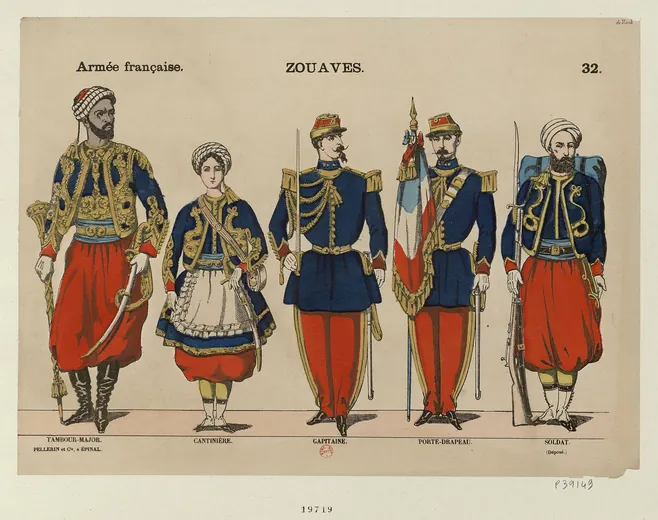
According to the Musée de l'Armée, the uniform “in the oriental style”, which set the Zouaves and the Algerian tirailleurs apart from the rest of the infantry, was designed by Captain de Lamoricière after local traditions. The museum details its pieces on a Zouave of the Imperial Guard of 1856 to 1860:
- The headdress. A grey wool felt skullcap, a madder-red chéchia with a long tassel, then a white cotton turban 4.80 m long.
- The jacket and waistcoat. A cloth jacket with neither collar nor buttons, open over a sleeveless waistcoat; the braid on the fronts draws the tombo, which ends in a trefoil.
- The trousers. Madder-red cloth, with 36 pleats and an 8 cm slit in the seat, the “trou Lamoricière”, to let water drain out after a river crossing.
- The sash. Blue wool, also 4.80 m long.
- The legs. Leather leggings gathered the trousers at the knee, and gaiters partly covered the boots.
Chevrons on the upper left sleeve marked seniority: one chevron for five years of service, for seven years from 1866.
The tombo, the regiment's mark
According to the Musée de l'Armée, it was the colour of the tombo, red, white or yellow, that told the Zouave regiments apart; other units wore their number on the collar. In the Guard, the dark blue jacket and waistcoat were edged with jonquil-yellow braid, the tombo took the colour of the cloth and the chéchia's tassel was jonquil. Among the tirailleurs, the Woerth museum reads the red tombô of a paper soldier printed in 1873 as the mark of the 1st Regiment. None of the sources read for this guide gives the full table of colours: do not infer a number from a colour without a document.
The Zouave officer
On the Épinal print at the top of this guide, the Zouave captain does not wear the men's Arab jacket: he wears a kepi and a tunic with epaulettes. At Woerth, the kepi of a second lieutenant of Algerian tirailleurs in the war of 1870, of the 1867 model, has a sky blue band and a madder-red body and top; kepis are read with the French military kepi.
The tirailleur: the same cut, in sky blue
On the Woerth museum's 1873 paper soldier, the jacket and waistcoat are of sky blue cloth with jonquil braid, the séroual is sky blue, the crimson chéchia is wrapped in a white turban, the sash is crimson and the gaiters are white canvas.
The same pieces return, in a fanciful version, on a child's costume in the Musée de la Grande Guerre in Meaux: a short jacket with yellow piping and a red tombô, a blue and white waistcoat, a red sash, blue sarouel, white gaiters and a red chéchia with a yellow tassel. For the Tunisian tirailleurs, none of the sources read here details what set their uniform apart.
The Spahi: the cavalry of the burnous
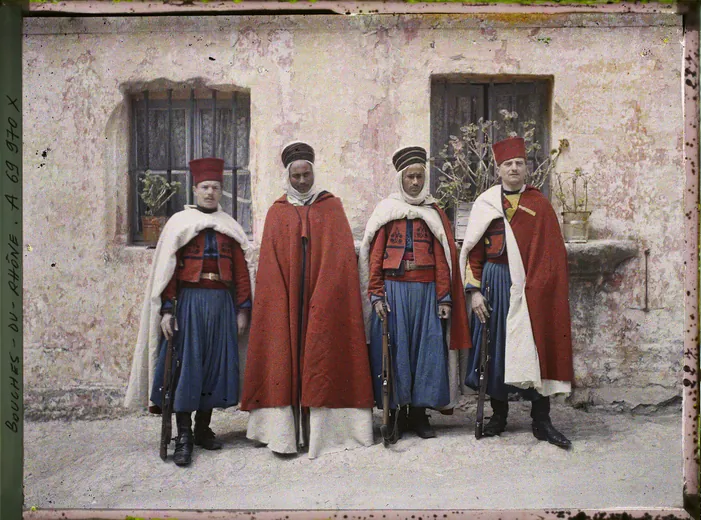
The Trésor de la langue française cites “le manteau rouge des spahis”, the Spahis' red cloak, and the Musée de l'Armée mentions their dazzling uniforms, their red burnous and their soft boots. Their headdress, the guenhour, was a thick protective skullcap covered with the haïck, a veil about three metres long crossed round the chest and held by a camel-hair cord; a panel in the same museum describes it as a rigid headdress, meant to soften the blow of a fall.
An autochrome taken in Tarascon on 19 April 1916 by Georges Chevalier, now in the Musée départemental Albert-Kahn, gives their colours: red and white burnous, decorated red jackets, blue trousers, a tall red cap or a white veil. For 1914, the Ministry of the Armed Forces counts five Spahi regiments, four Algerian and one Tunisian; the Musée de l'Armée speaks of three regiments of Algerian Spahis, in action in Morocco when war broke out.
The three uniforms side by side
This table sums up the sources cited; colours vary with the period.
| Uniform | Headdress | Jacket and trousers | Sash, cloak, legs |
|---|---|---|---|
| Zouave of the Guard, 1856-1860 | Grey skullcap, madder-red chéchia, white turban | Dark blue jacket and waistcoat, jonquil braid; madder-red trousers | Blue wool sash; leather leggings, gaiters |
| Algerian tirailleur, 1873 | Crimson chéchia, white turban | Sky blue jacket and sédria, red tombô of the 1st Regiment; sky blue séroual | Crimson sash; white canvas gaiters |
| Spahi, before the trenches | Guenhour: haïck over a protective skullcap | Dazzling uniform; wide trousers | Red burnous; soft boots |
| Armée d'Afrique, from 1915 | Distinctive headdress, khaki chèche; crescent helmet of the indigenous troops | Khaki verging on mustard yellow | Puttees, ankle boots |
From the Second Empire to 1870
The uniform of the Second Empire fixed the image of the Zouave. In the Crimea, the Zouaves made their mark at the Alma and at Inkerman, and a decree of 13 December 1854 brought a Zouave regiment into the Imperial Guard. Their fame crossed borders: the Musée de l'Armée mentions Zouave units in the United States, in Poland and in the service of the Pope.
In 1870 the 1st and 2nd Algerian Tirailleur Regiments distinguished themselves at the battle of Woerth, on 6 August, recalls the record of an 1889 painting by Eugène Bellangé. The Zouave regiment of the Guard, shut up in Metz, surrendered on 28 October 1870 and shared its colour out among the men present rather than hand it over. The medals of that war have their own guide: the French 1870-1871 commemorative medal.
1914: the traditional dress goes to war
In August 1914 the Armée d'Afrique left for France: two divisions, some 35,000 men, according to the Musée de l'Armée; three infantry divisions, the 37th, 38th and 45th, according to the Ministry of the Armed Forces. Its soldiers remained recognisable by their headdress, or by a uniform that married French colours and cloth to oriental shapes, the Musée de l'Armée notes.
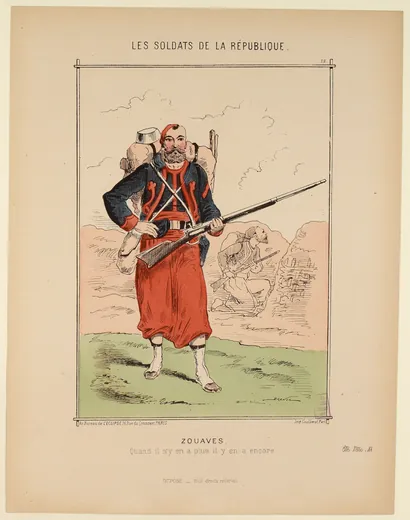
The National WWI Museum in Kansas City holds a Zouave uniform dated 1914: a blue wool jacket with red wool designs, a waistcoat, very baggy sarouel trousers and a wool chéchia. Puttees, which replaced the infantry's leather gaiters from August 1915, were already in service with the chasseurs alpins, the Zouaves and the tirailleurs, according to the Musée de l'Armée.
The war multiplied units, among them mixed regiments in which one battalion of tirailleurs served beside two battalions of Zouaves; the Ministry mentions the 8th Zouaves in the Moroccan Division, and the Legion of Honour fourragère of the 4th Mixed Regiment of Zouaves and Tirailleurs. The war diaries of most regiments, the journaux des marches et opérations, are online at Mémoire des hommes.
1915-1918: the khaki of the Armée d'Afrique
In 1915, when the infantry of mainland France went into horizon blue, the Armée d'Afrique was given khaki uniforms verging on mustard yellow, according to the Musée de l'Armée. The Meaux museum speaks of a khaki with a mustard shade, a panel in the Musée de l'Armée of green khaki wool cloth: the descriptions vary, and the shade alone does not date a piece.
In the trenches, the Spahis left behind horses, dazzling uniforms and red burnous for a khaki tunic, wide breeches gathered by the puttee and ankle boots; they preferred the khaki chèche, smaller and more practical, to the haïck, the chèche being the scarf that soldiers of the African troops tied as a turban. They kept a distinctive headdress: the Musée de l'Armée holds the photograph of a Spahi wearing the guenhour in a trench at Bailly, in the Oise, on 27 September 1915.
The embroidered crescent of the pennants and uniforms of the indigenous troops was repeated on their 1915 model helmet, the Ministry of the Armed Forces recalls. To judge a helmet, see valuing an Adrian helmet; for the infantryman's leather and canvas, the poilu's equipment.
Dating a photograph or a postcard
On a portrait, the uniform gives a period, rarely a date:
- Colours and cut. Contrasting jacket and waistcoat, baggy trousers, chéchia: the traditional dress, fixed in 1853. Plain tunic, puttees and helmet: the war, from 1915.
- The headdress. Chéchia, chèche or guenhour mark the Armée d'Afrique even in the trenches, and a crescent on the helmet marks the indigenous troops.
- The exceptions. A traditional uniform does not prove a pre-war date: in Tarascon, far from the front, the Spahis pose in their burnous in April 1916.
- The support. Format, the back of the card, the photographer's name: the method is in reading and keeping military photographs and documents.
- Popular prints. A popular print is not enough to settle a colour: on a Silbermann paper soldier kept at Woerth, the line Zouave wears a green turban, whereas the Guard Zouave in the Musée de l'Armée has a white one.
To trace the soldier and his regiment's movements, follow tracing a French soldier of 1914-1918.
Reproductions, costumes and confusions
- Fashion. The London Museum dates the vogue for the women's Zouave jacket, short, collarless and open-fronted, to 1859-1865, inspired by the Zouaves of the Crimea and of Italy; the one it holds, of black wool embroidered with pink silk, came from a large London department store.
- The American Zouaves. During the Civil War, volunteers on both sides adopted a uniform modelled on the French Zouaves: a jacket, vest, sash, baggy trousers and fez in the 5th New York Volunteer Infantry in 1861, according to the Smithsonian Institution.
- Children's costumes. In the early twentieth century, the “Zouave, Spahi or Turco” uniform appeared in almost every catalogue of children's military costumes, in France as in Germany, the Meaux museum notes.
Compare the materials with those the Musée de l'Armée describes: cloth for the jacket and trousers, wool felt for the skullcap, cotton for the turban, wool for the sash. Read the stamps inside with reading the markings on a military item. The men's jacket had no buttons; those of an officer's tunic are read with identifying and dating a French military button.
What I cannot tell you here
I cannot tell you, from a photograph, whether a jacket is original or a reenactment piece, nor which regiment it belonged to without a stamp, papers or provenance. Nor can I give you the table of colours for every regiment, or the details of officers' dress: the sources read give only fragments of them. The second volume of Zouaves et tirailleurs, by Jean-Louis Larcade (Éditions des Argonautes, 2000), devotes several parts to the uniforms, from 1830 to 1918, including an appendix; the ECPAD library holds a copy.
I give no prices: the method is in valuing a military item. For a particular piece, photograph the headdress, the tombo, the inside and its stamps, then ask for free identification help. Uniforms for sale are gathered in First World War uniforms and headgear and in the Franco-Prussian War of 1870.
Frequently asked questions
How do you recognise a French Zouave uniform?
By its cut and its colours: a red chéchia, often under a turban, a short dark blue cloth jacket with neither collar nor buttons, open over a waistcoat, very full madder-red trousers and a long wool sash. On the jacket, the braid draws a false pocket ending in a trefoil, the tombo, whose colour told the regiments apart. The tirailleur wore the same cut in sky blue.
What did French Zouaves wear in 1914?
The traditional dress: a chéchia, a blue wool jacket with red designs, a waistcoat and very full trousers. The National WWI Museum in Kansas City holds a Zouave uniform of this kind dated 1914. Puttees, which the rest of the infantry received in 1915, were already in service with the Zouaves. The khaki uniform verging on mustard yellow arrived the same year.
When did the Zouaves give up their colourful uniform?
From 1915. When the infantry of mainland France went into horizon blue, the troops of the Armée d'Afrique, Zouaves included, were given khaki uniforms verging on mustard yellow, according to the Musée de l'Armée. Their headdress still set them apart, and some Spahis still posed in red burnous, far from the front, in April 1916.
What is the difference between a Zouave and a tirailleur?
Recruitment and colour. From 1835 the Zouaves recruited Frenchmen, then Europeans, whereas the tirailleurs, created in Algeria in 1841, were recruited in Algeria or Tunisia, with French or indigenous officers and NCOs. The cut of the uniform was the same: dark blue and madder-red trousers for the Zouave, sky blue with jonquil trimmings for the tirailleur.
What uniform did the Spahis wear?
A colourful uniform under a red burnous, the hooded, sleeveless wool cloak that marks them out, wide trousers and soft boots. Their headdress, the guenhour, was a rigid cap covered with the haïck, a veil about three metres long held by a camel-hair cord. In the trenches they changed to a khaki tunic, breeches gathered by the puttee and a khaki chèche.
What is a Zouave chéchia?
A tall cylindrical cap of coarse red cloth, trimmed with a tassel, according to the Trésor de la langue française; the word comes from Arabic and is also spelt chechia. On the Musée de l'Armée's Zouave of the Imperial Guard, it is worn over a grey felt skullcap and under a white cotton turban 4.80 m long, with a jonquil tassel peculiar to the Guard.
What did a Zouave officer wear?
In the documents read for this guide, the officer does not wear the men's dress. An undated Épinal print shows the Zouave captain in a kepi and a tunic with epaulettes, not in the men's Arab jacket. The Woerth museum holds the kepi of a second lieutenant of Algerian tirailleurs in the war of 1870, with a sky blue band and a madder-red body and top.
Which Zouave regiments fought in WW1?
The Zouave regiments that left North Africa in 1914, then units formed during the war: marching regiments, and mixed regiments of Zouaves and tirailleurs, in which one battalion of tirailleurs served beside two battalions of Zouaves. The French Ministry of the Armed Forces mentions the 8th Zouaves in the Moroccan Division and the Legion of Honour fourragère of the 4th Mixed Regiment of Zouaves and Tirailleurs. The war diaries of most regiments are online at Mémoire des hommes.
Sources
This guide draws on the texts, databases and pages below, accessed on unless otherwise stated. Most of them are in French.
- French Ministry of the Armed Forces, Chemins de mémoire, North African colonial soldiers in 1914-1918: the 19th Army Corps, its tirailleur and Spahi regiments on the eve of the war, the crescent of the indigenous troops
- Trésor de la langue française informatisé (CNRTL), entry “zouave”: royal ordinances of 21 March 1831 and 8 September 1841, Papal Zouave
- Trésor de la langue française informatisé (CNRTL), entry “tirailleur”: ordinance of 7 December 1841 forming battalions of native tirailleurs in Algeria
- Trésor de la langue française informatisé (CNRTL), entry “turco”: nickname of the Algerian tirailleurs, recorded in 1856
- Trésor de la langue française informatisé (CNRTL), entry “spahi”: royal ordinance of 10 September 1834 forming the spahis réguliers in Algiers, etymology (Turkish sipahi, “cavalry soldier”)
- Trésor de la langue française informatisé (CNRTL), entry “chéchia”
- Trésor de la langue française informatisé (CNRTL), entry “saroual, sarouel, seroual, séroual”: the séroual of the French Zouaves (1891)
- Trésor de la langue française informatisé (CNRTL), entry “burnous”
- Musée de l'Armée, object sheet on the Zouave regiment of the Imperial Guard: a Zouave of the Imperial Guard (1856-1860), inv. Ga 158, and the history of the Zouaves from 1830 to 1870
- Musée de la bataille du 6 août 1870, Woerth, record of a second lieutenant's kepi of the Turcos (Algerian tirailleurs), 1867 model, with a sky blue band and the label of Seur and Peyrot, Lyon (inv. 2007.0.5), Joconde database on POP, accessed
- Musée de la bataille du 6 août 1870, Woerth, cut-out paper soldier of a private of the 1st Algerian Tirailleur Regiment in 1873, Fischbach printing works, Strasbourg (inv. 2006.0.225), Joconde database on POP
- Musée de la Grande Guerre, Meaux, Algerian tirailleur costume for a three-year-old child (inv. 2013.18.0)
- Musée départemental Albert-Kahn (Hauts-de-Seine), autochrome of Spahis in the castle of King René, Tarascon-sur-Rhône, 19 April 1916, taken by Georges Chevalier (inv. A69970)
- Musée de la bataille du 6 août 1870, Woerth, Eugène Bellangé, the heroic charge of the Turcos, 1889 (inv. 1998.2.1), Joconde database on POP
- National WWI Museum and Memorial, Kansas City, French Zouave infantry uniform dated 1914, record on Google Arts & Culture
- Musée de l'Armée, object sheet on the French infantryman's uniform in 1914 and 1916: horizon blue, the khaki uniforms of the Armée d'Afrique, puttees
- Mémoire des hommes, French Ministry of the Armed Forces, diaries of the units engaged in the First World War: war diaries of most army units (sub-series GR 26 N), accessed
- Musée de la Grande Guerre, Meaux, teaching pack for the “Couleurs de guerre” exhibition (2026): horizon blue issued from the spring of 1915, general issue by the autumn of 1916 and abandoned in 1921; mustard khaki of the Armée d'Afrique in 1915, accessed
- Musée de l'Armée, Algeria-France exhibition, panel on North African soldiers in the trenches: the Spahis' guenhour and burnous, the green khaki uniform of the Armée d'Afrique
- Trésor de la langue française informatisé (CNRTL), entry “chèche”
- Musée de l'Armée and Val-d'Oise departmental archives, teaching pack on the colonies in the Great War: a Spahi wearing the guenhour in a trench at Bailly (Oise), 27 September 1915, inv. 15261.BIB
- Musée de la bataille du 6 août 1870, Woerth, cut-out paper soldier of a Zouave private, Silbermann printing works, Strasbourg (inv. 2006.0.253), Joconde database on POP
- London Museum, fashionable Zouave jacket in embroidered black wool, sold by Peter Robinson, about 1863 (65.17/1)
- Smithsonian Institution, National Museum of American History, Zouave uniform of the 5th New York Volunteer Infantry (Duryée's Zouaves), 1861
- French Ministry of the Armed Forces digital libraries, catalogue record of Jean-Louis Larcade, Zouaves et Tirailleurs: les régiments de marche et les régiments mixtes (1914-1918), volume 2, Éditions des Argonautes, 2000, ECPAD library copy