The poilu's equipment: identifying and dating each piece, 1914 to 1918
By François, contributor to Athena Militaria Published 13 min read
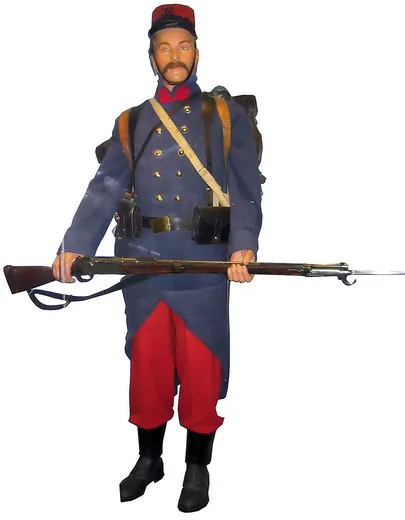
The poilu's equipment, the kit of the French infantryman of the Great War, mostly survives today as separate pieces: a black cartridge pouch in an attic, a pack without its straps, a stained haversack. Yet each piece keeps something that places it: its pattern name, its leather, its colour, its stamps. In 1914 the infantryman carried a pack, a haversack, a water bottle, a tool and three pouches on a belt held up by braces; from 1915, the helmet and puttees changed his silhouette, and on the 1916 uniform at the Musée du Génie the leather is tan. Here is how to recognise each item and how the whole set fitted together, from a 1914 manual and the records of the museums that hold these pieces.
Get a piece identified from photos Valuing a piece: the method
In brief
- A set, not a single object. In 1914 the infantryman wore three cartridge pouches on a belt held up by suspension braces, with a pack, a haversack, a water bottle and a tool. A single piece makes more sense once you know where it hung.
- Pattern names to read with care. Museums speak of pouches of the 1888 and 1905/14 patterns, 1892/14 braces, an 1893 pack known as the “ace of diamonds”, an 1892 haversack.
- The leather changes colour. Blackened on a pre-war pouch, it is brown or tan on pouches called “1905/14” and on a 1916 uniform.
- Look for markings inside. Under the flaps: stamped numbers, ink stamps, sometimes an acceptance stamp.
- From 1915, the silhouette changes. Helmet, puttees, gas mask; in 1916, two haversacks at the sides; in 1918, assault dress leaves the pack behind.
What the infantryman carried in 1914
In the 1913-1914 edition of Félix Chapuis's manual, L'Instruction théorique du soldat par lui-même (a soldier's self-study manual), the soldier's “major equipment” is a pack, suspension braces, a belt, three cartridge pouches, a rifle sling and a water-bottle strap; haversacks, water bottles, cups and mess tins make up the “minor equipment”. Field dress adds the sword bayonet, a one-litre water bottle, two litres in Africa, a tool carried on the pack or on the belt, and the identity disc round the neck, explained in reading a military identity tag.
At the Musée de la Grande Guerre in Meaux, the infantryman of the 103rd Infantry Regiment, in 1914, carries three pouches, braces, a bayonet frog, a pack, a haversack for the day's rations and a water bottle: more than 25 kg of equipment. At the Musée de l'Armée in Paris, the 1914 belt carries three leather pouches and the bayonet in its scabbard, and a canvas haversack completes the pack. The kepi worn with this uniform has its own guide: the French military kepi.
Fourniment, barda, havresac: the words
For the Trésor de la langue française, the French dictionary, the fourniment is the set of equipment issued to each soldier, with barda and fourbi as familiar synonyms. The havresac, the bag carried on the infantryman's back, probably takes its name from German, where it meant an oat sack.
How the set went on
Chapuis's manual gives the order: the belt with its pouches and braces, without fastening the plate; the haversack, its strap over the right shoulder and the top of the bag about two fingers' breadth below the crossguard of the sword bayonet; the water bottle, its strap over the left shoulder; the belt is then fastened over the haversack strap and the bottle strap, and the pack goes on last. As a rule, the pouches held eleven packets of eight cartridges: four in each of the two front pouches, three in the rear one.
Cartridge pouches: 1888, 1905/14, and the question of the 1916 pattern
Two in front, one at the back: the rule held in 1914 as in 1916. Two pattern names recur in public collections.
- The 1888 pattern. The Imperial War Museum in London holds a black leather belt fitted with three model 1888 pouches and a bayonet frog of the same model. At the Nuits-Saint-Georges museum, a blackened leather pouch, which its record dates 1888 to 1914 without giving it a pattern name, shows how it was made: flap and back in one piece, a gusseted box, two leather belt loops and an iron hook at the back, a copper button riveted on the front.
- The 1905 pattern, then 1905/14. The London museum presents as the French infantryman's “standard” equipment of the Great War a Lebel rifle equipment set that includes three 1905 pouches; the record for one of them calls it a 1905/14 pouch in brown leather. The 1916 sapper at the Musée du Génie in Angers wears three 1905/14 pouches in tan leather, one of them at the back.
Like the “model 1912 boots modified 1916” described by the Musée de l'Armée, “1905/14” could be read as a 1905 pattern modified in 1914; none of this guide's sources details the modification. On the photograph in its sheet, the Musée du Génie even labels “Mle 1888” the pouches and braces that its text calls 1905/14 and 1892/14: the names vary even within one source.
That leaves the so-called “model 1916” pouch, a name found in listings: no public source read for this guide describes it, and the 1916 uniform at the Musée du Génie wears 1905/14 pouches. At Nuits-Saint-Georges, a pouch in dark brown leather dated 1914 to 1918, with a closing tab originally fitted with two slits, has no pattern name in its record. On the 1916 uniform at the Musée du Génie, the M2 gas mask box hangs from the left pouch.
Belt, braces, bayonet frog
The 1914 belt closed with a plate: Chapuis has the soldier put on his equipment “without fastening the plate”. The Nuits-Saint-Georges museum holds a private soldier's belt in brown leather, closed by a plain copper plate hiding a hook and by an elongated O-shaped buckle; its record calls it an infantry pattern since 1854. The Imperial War Museum, for its part, calls the black belt carrying its 1888 pouches “model 1848”.
On its 1916 uniform, the Musée du Génie describes a “model 1915” belt closed by a two-pronged buckle, and the Imperial War Museum holds a 1903/14 belt in brown leather. The fastening, plate or pronged buckle, and the colour are safer guides than these names.
The suspension braces took the weight of the filled pouches. On the 1892/14 pattern at the Musée du Génie, their length is adjusted by metal hooks that hold the pouch ring, and a ring joins them together. The Imperial War Museum describes brown leather Y-straps in the set that combines a black belt and 1888 pouches: the colour of one piece does not date a set.
The bayonet frog, model 1888 on the Musée du Génie uniform, was worn on the left; it grips the tubular metal scabbard of the model 1886 sword bayonet, held by a strap with a single-prong buckle.
The model 1893 pack, the “ace of diamonds”
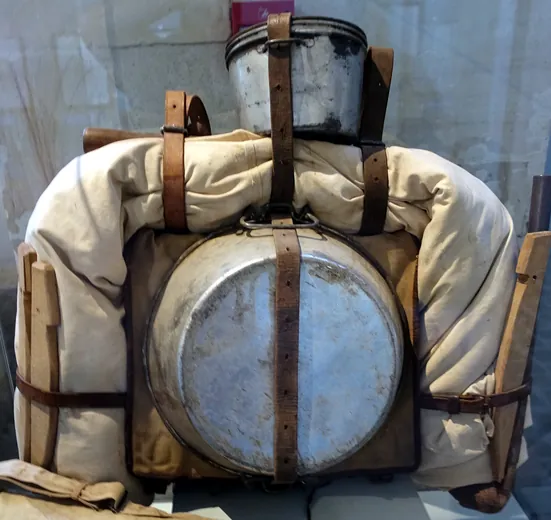
The Musée du Génie describes a bag of waterproofed canvas on a wooden frame, with leather shoulder straps and fastening straps, nicknamed the “ace of diamonds”; Chapuis calls it the model 1893 pack. The Musée de la Vie bourguignonne in Dijon holds one, which was part of a mannequin presenting the 1914 field uniform: wood, waterproofed canvas, hide and metal, 32 cm high, 37 cm long, 12 cm deep, with an ink stamp “D.C. 6331” inside the top flap.
As early as 1913-1914, Chapuis's manual announces a “new model” pack in preparation and, until it arrives, has the wooden frame removed from the 1893 pack to lighten the load. The Imperial War Museum holds an 1893/14 pack in canvas, with brown leather trim and straps; the Musée du Génie still shows a pack on a wooden frame in 1916.
What it held, what was strapped to it
In 1914, according to Chapuis, a shirt lined the inside of the pack and padded the soldier's back; at the bottom went the reserve rations, namely six hard biscuits (pains de guerre), a tin of meat, salted soup, sugar and coffee, and the service book went in the pocket of the flap. Strapped outside were the rest shoes, in a second haversack, the individual mess tin, a share of the squad's utensils and, when carried, the blanket and shelter tent rolled in a horseshoe. The Imperial War Museum holds an 1852 model mess tin with hooks for the pack.
In 1916 the Musée du Génie sheet adds the tunic under the flap, boxes of reserve cartridges and, outside, the model 1897 tent section, a second pair of shoes and a tool.
The haversack, or étui-musette
The étui-musette, a canvas bag on a shoulder strap, is called model 1892 by the Musée de l'Armée and by the Imperial War Museum, which describes a brown canvas haversack with a long strap whose flap closes with two wooden buttons. In 1914, Chapuis puts the cup, the spoon, the bread and what is left of the day's rations in it.
The one from the 1914 uniform at the Musée de la Vie bourguignonne is cotton twill, with two metal buttons engraved “EQUIPEMENTS MILITAIRES” and, under the flap, an ink stamp in which “COMMISSION DE RECEPTION” can be read. Such buttons can be read with identifying and dating a French military button.
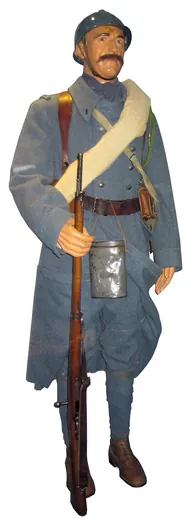
In 1916 the sapper at the Musée du Génie wears two haversacks: on the right, in beige canvas, extra rations and, in an assault, ammunition; on the left, personal belongings, rest shoes and spare pads against gas. His water bottle, worn on the right so that it would not knock against the bayonet, has its own guide: the poilu's canteen, the model 1877 bidon.
Entrenching tools
According to Chapuis, each company had 185 entrenching tools, each in its case: 80 spades and 80 Seurre pick-shovels, five of each per squad, 8 hand axes, 12 billhooks, 4 wire cutters and one folding saw. With its handle and case, a tool weighed from 600 g for the saw to 1.57 kg for the axe; the spade weighed 830 g.
On the pack, spade and pick-shovel went on the left side, hollow against the pack, held by the cross strap; on the belt they were worn on the right, like the axe; the billhook was never worn on the belt. A short wooden-handled spade at the Imperial War Museum sits, for its part, in a brown leather harness. In 1918, the infantryman of the 23rd Infantry Regiment in assault dress at the Meaux museum carries his on his chest.
From 1915: what changes
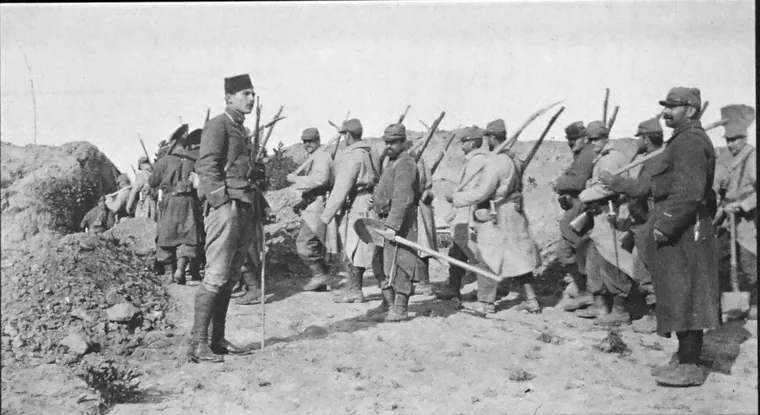
The Musée de l'Armée dates to August 1915 the adoption of a light-blue uniform, soon called horizon blue, which was not general until the autumn of 1916; puttees 2.60 m long replaced the leather gaiters. The Meaux museum, for its part, places the issue of the horizon-blue uniform as early as April 1915. The Adrian helmet began to reach units in September 1915; it has its own guide: valuing an Adrian helmet.
On the 1916 uniform at the Musée du Génie, pouches, braces, bayonet frog and belt are in tan leather, and the sapper carries two haversacks, the gas mask and a two-litre water bottle, for a total load of 25 to 30 kg; the Musée de l'Armée gives 20 to 40 kg, in 1914 as in 1918. In 1918, the assault dress at Meaux lightened the soldier: belt and pouches, a combat knife, two haversacks, two two-litre water bottles and, instead of the pack, a roll made from the tent section, worn across the body.
Dating a piece: pattern, leather, colour, markings
No single clue dates a piece; together, they place it. In this table, London stands for the Imperial War Museum, Angers for the Musée du Génie, Paris for the Musée de l'Armée.
| Item | Pattern names recorded | Leather, canvas, colour recorded |
|---|---|---|
| Cartridge pouch | 1888; 1905 and 1905/14 | Blackened, dated 1888-1914, and dark brown, dated 1914-1918 (Nuits-Saint-Georges); brown (London); tan in 1916 (Angers) |
| Belt | “1848” (London); with a plate, infantry pattern since 1854 (Nuits-Saint-Georges); 1903/14 (London); 1915 (Angers) | Black (London); brown (Nuits-Saint-Georges, London); tan in 1916 (Angers) |
| Suspension braces | 1892 (London); 1892/14 (Angers) | Brown (London); tan in 1916 (Angers) |
| Bayonet frog | 1888 (London, Angers) | Tan in 1916 (Angers) |
| Pack | 1893, “ace of diamonds” (Angers); 1893/14 (London) | Waterproofed canvas on a wooden frame (Angers, Dijon); canvas and brown leather (London) |
| Haversack | 1892 (Paris, London) | Brown canvas (London); cotton twill (Dijon) |
Then read the markings; in 1914, Chapuis notes, every item was registered with a number. At Nuits-Saint-Georges, numbers are stamped under the flap of a blackened pouch, “8405 / N03 / 4 64”; in Dijon, an ink stamp marks the flap of a pack, and an acceptance stamp that of a haversack. None of these records explains the figures: treat them as a service number only with a source. The method is in reading the markings on a French military item.
Post-war pieces and copies
A pattern name dates a design, not the making of an item: the Nuits-Saint-Georges museum dates its blackened pouch to a period, 1888 to 1914, not to a year. A stamped date after 1918 marks a post-war piece, whatever its pattern. A piece that looks too new, without wear or markings, may have stayed in store, been made later or be a copy: the object alone does not always settle it. Compare stitching, rivets, belt loops and buttons with a museum piece.
Looking after leather and canvas
Equipment leather is kept as it is: no polish, no dye, since its colour is part of what dates it. Do not wash a haversack or the canvas of a pack: water can wipe out ink stamps, often the only legible marking. The details are in looking after military leather, textiles and metal.
What I cannot tell you here
I cannot tell you, from a photograph, whether a pouch is period or copied, nor which man it belonged to: that takes a marking or a document confirmed by the registers, and no public source read for this guide describes the details of the 1914 modifications. I give no prices: the method for placing a piece is in valuing a military item.
For a name or number found on a piece, see tracing a French WW1 soldier. To have a set looked at, photograph each piece from the front, the back and under its flaps, then ask for a free identification. Equipment for sale on the site is gathered in First World War equipment.
Frequently asked questions
What equipment did a French WW1 infantryman carry?
In 1914, according to Félix Chapuis's manual, the infantryman wore a belt with three cartridge pouches and a bayonet frog, held up by braces, plus a pack, a haversack, a water bottle and a tool. From 1915 came the helmet, puttees and the gas mask; on the 1916 uniform at the Musée du Génie, two haversacks are worn at the sides and the leather is tan. At the Meaux museum, the 1914 infantryman carries more than 25 kg of equipment.
What was in a French WW1 soldier's pack?
In 1914, Chapuis's manual puts in it a shirt padding the soldier's back, then at the bottom the reserve rations: six hard biscuits, a tin of meat, salted soup, sugar and coffee. On top go the handkerchief, the sewing kit, the soap and the forage cap; the service book goes in the flap pocket. Strapped outside were the rest shoes, the mess tin, a share of the squad's utensils, and sometimes the blanket and tent rolled in a horseshoe. In 1916, the Musée du Génie adds the tunic and boxes of reserve cartridges.
What is the French “ace of diamonds” pack?
It is the nickname of the French infantryman's model 1893 pack, according to the Musée du Génie in Angers: a bag of waterproofed canvas on a wooden frame, with leather shoulder straps and fastening straps. In 1913-1914, Chapuis's manual announces a new model and, until it arrives, has the wooden frame removed from the 1893 pack. The Imperial War Museum also holds a pack called 1893/14, with brown leather trim and straps. This guide's sources do not explain where the nickname comes from.
How do you recognise a French model 1888 cartridge pouch?
By its black leather and its construction. At the Nuits-Saint-Georges museum, a blackened leather pouch, dated 1888 to 1914 by its record, without a pattern name, has its flap and back in one piece, a gusseted box, two leather belt loops and an iron hook at the back, and closes with a copper button. The Imperial War Museum shows three of them, with a bayonet frog of the same model, on a black leather belt.
What is the French model 1916 cartridge pouch?
It is a name found in listings. None of the public sources read for this guide describes such a pattern: the 1916 uniform at the Musée du Génie wears three pouches called 1905/14, in tan leather, and the Imperial War Museum describes its 1905/14 pouches as brown leather. If a listing uses the name, ask what the attribution rests on.
What did a French WW1 soldier carry in his haversack?
In 1914, Chapuis's manual puts in it the cup, the spoon, the bread and the rest of the day's rations; a second haversack, on top of the pack, held the rest shoes. In 1916 the sapper at the Musée du Génie wears two haversacks: the first for extra rations, and ammunition in an assault, the second for personal belongings, rest shoes and spare pads against gas.
How much did a French WW1 soldier's equipment weigh?
The Meaux museum speaks of more than 25 kg of equipment for the 1914 infantryman, and the Musée du Génie of a total load of 25 to 30 kg in 1916, uniform, weapons and ammunition included. The Musée de l'Armée gives 20 to 40 kg, in 1914 as in 1918. Chapuis's manual even weighs the tools: 830 g for a spade in its case, 1.57 kg for a hand axe.
How do you date a French 1914 infantry belt?
Look at the fastening first. The 1914 belt closed with a plate, according to Chapuis's manual, and the Nuits-Saint-Georges museum holds a belt with a plain plate hiding a hook, which it dates 1854 to 1914. On the 1916 uniform at the Musée du Génie, the belt, called model 1915, closes with a two-pronged buckle, and the Imperial War Museum calls a brown leather belt 1903/14. The colour of the leather and the markings complete the check.
Sources
This guide draws on the texts, databases and pages below, accessed on unless otherwise stated. Most of them are in French.
- Félix Chapuis, L'Instruction théorique du soldat par lui-même (a soldier's self-study manual), 22nd edition, Berger-Levrault, 1913-1914, on Project Gutenberg, accessed
- Musée de la Grande Guerre, Meaux, record on an infantryman of the 103rd Line Infantry Regiment, France, 1914: more than 25 kg of equipment, three cartridge pouches, braces, bayonet frog, pack, haversack and water bottle
- Musée de l'Armée, teaching sheet on the French infantryman's uniform in 1914 and 1916, accessed
- Trésor de la langue française informatisé (CNRTL), entry “fourniment”: the set of equipment issued to each soldier, with barda and fourbi as familiar synonyms
- Trésor de la langue française informatisé (CNRTL), entry “havresac”: bag carried on the infantryman's back, a name probably from German, where it literally meant an “oat sack”
- Imperial War Museums, “Belt, M1848 (fitted with three M1888 rifle ammunition pouches & bayonet frog): O/Rs, French Army”, EQU 3801.1: black leather belt with three model 1888 pouches and a model 1888 bayonet frog
- Nuits-Saint-Georges municipal museum, blackened leather cartridge pouch, 1888-1914 (95.14.32), Joconde database on the Plateforme ouverte du patrimoine, accessed
- Imperial War Museums, “Lebel Rifle Equipment Set”, EQU 3813: M1903 belt, three M1905 pouches, M1892 Y-straps, M1888 frog, M1893/1914 pack, M1852 mess tin, M1892 haversack and M1877 water bottle, the French infantryman's standard equipment of the First World War
- Imperial War Museums, “Pouch, M1905/14 Rifle Ammunition: French Army”, EQU 3813.3: brown leather cartridge pouch
- Musée du Génie, Angers, sheet on the mannequin of a French soldier of 1915-1918: belt, cartridge pouches, pack, haversacks and water bottle in 1916, accessed
- Musée de l'Armée, teachers' sheet on the French infantryman's uniform in 1914 and 1916 (primary level): one-litre bidon and cup in 1914, bidon and cup in late 1916, accessed
- Nuits-Saint-Georges municipal museum, dark brown leather cartridge pouch, 1914-1918 (95.14.33), Joconde database on the Plateforme ouverte du patrimoine
- Nuits-Saint-Georges municipal museum, private soldier's belt with a plate, an infantry pattern since 1854, 1854-1914 (95.14.30), Joconde database on the Plateforme ouverte du patrimoine
- Imperial War Museums, “Belt, M1903/14: French Army”, EQU 3813.1: brown leather belt
- Imperial War Museums, “Carrying Straps, M1892 ('Y' straps): French Army”, EQU 3801.6: brown leather Y-straps
- Musée de la Vie bourguignonne, Dijon, pack from the 1914 field uniform (inv. D99.1.411): wood, waterproofed canvas, hide and metal, stamp “D.C. 6331”, Joconde database on POP
- Imperial War Museums, “Knapsack, M1893/14: French Army”, EQU 3813.7: fabric pack with brown leather trim and straps
- Imperial War Museums, “Mess Kit, M1852: French Army”, EQU 3801.3: round metal mess tin with a lift-off lid and hooks for the pack, accessed
- Imperial War Museums, “Haversack, M1892: French Army”, EQU 3801.4: brown canvas haversack with a long strap, its flap closed by two wooden buttons
- Musée de la Vie bourguignonne, Dijon, haversack from the 1914 field uniform (inv. D99.1.405): cotton twill, buttons marked “EQUIPEMENTS MILITAIRES”, stamp “COMMISSION DE RECEPTION”, Joconde database on POP
- Imperial War Museums, “Entrenching Tool, with Harness: French Army”, EQU 3813.8: short wooden-handled spade in a brown leather harness
- Musée de la Grande Guerre, Meaux, record on an infantryman of the 23rd Infantry Regiment in assault dress, France, 1918: two two-litre bidons, accessed