Collector's guide Uniforms and insignia
Identifying and dating French military buttons, from the Revolution to 1918
By François, contributor to Athena Militaria Published 13 min read
An old French military button fits in the palm of your hand, and it often says more than you would think: an arm, a regiment, a regime, sometimes a maker. But it has to be read in order: the emblem first, then the shape, the material, the shank and the back. From the French Revolution to the Great War, official texts and museum records provide reliable landmarks, and this guide brings them together. It also explains what a button does not prove, what French law says about buttons that come out of the ground, and how to judge one's interest without talking prices.
Get a piece identified from photos Valuing a piece: the method
In brief
- The emblem names an arm, the number normally a regiment. Crossed cannon for the artillery, a hunting horn for the chasseurs à pied, cuirass and pot helmet for the engineers, an anchor for the navy, a flaming grenade on Third Republic infantry dress.
- The symbols of the regime give a date. “La Loi & le Roi” in 1790, fasces and Phrygian cap from October 1792, the eagle under both Empires, the fleur-de-lis under the Restoration.
- Shape, material and shank must agree. Flat or domed, brass or white metal, on bone or on wood: every detail either confirms the design or contradicts it.
- The back often names the maker. Initials and a town, such as “TW & W PARIS”, point to a firm whose working dates must be checked before drawing any conclusion.
- What comes out of the ground is a matter of law. In France, searching with a metal detector for objects of historical interest requires prior authorisation, and a chance find must be reported to the mayor.
Reading the emblem: arm, corps, regiment
Read the design like an address: it names an arm or a corps and, if it carries a number, normally a regiment. According to the Musée du Génie, the French army engineers' museum, a regulation of 2 September 1775 already required the engineers' buttons to be yellow, gadrooned and stamped in the centre with a cuirass and pot helmet in relief. The museum adds that the engineers seem to have been the first arm given a distinctive mark on their buttons. The button's colour also governed other pieces: in 1810, the shako plate was of white metal for corps with white buttons, of yellow metal for the others.
| Emblem | Arm or corps | Dated examples in museums |
|---|---|---|
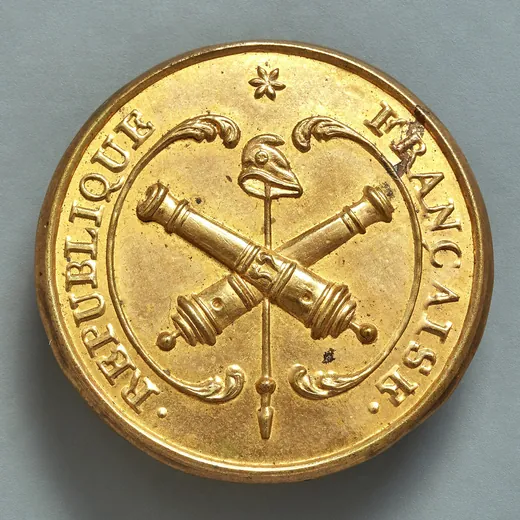
| Crossed cannon, sometimes below a grenade | Artillery | Officer's button, 1811-1815 model (Auxonne); artilleryman's kepi, 1867 model (Nuits-Saint-Georges) |
| Hunting horn | Chasseurs à pied (light infantry) | Kepis of 1882 and of 1886-1914, with buttons bearing a hunting horn, which the record of the second calls the emblem of the chasseur battalions (Nuits-Saint-Georges) |
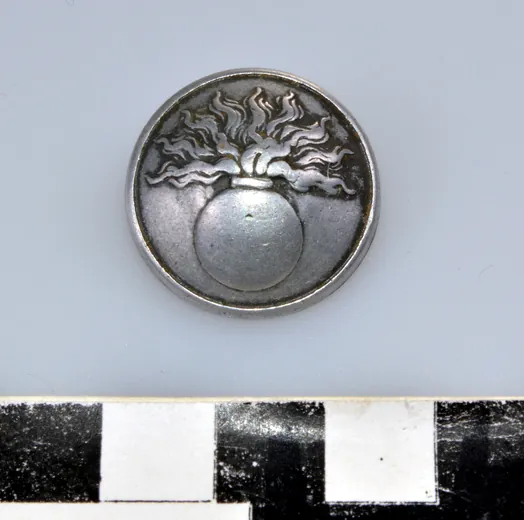
| Flaming grenade | Infantry, under the Third Republic | 1883 model dolman of a captain of the 97th Infantry Regiment (Woerth); kepi of 1914 (Dijon) |
| Cuirass and pot helmet | Engineers | Regulation of 2 September 1775; “République française” button in copper on bone, with cuirass and helmet (Musée Carnavalet) |
| Anchor | Navy and marine troops | “Infanterie de marine” button, anchor and rope (Musée Carnavalet) |
| Eagle, crowned or not | Both Empires: generals, Imperial Guard, among others | General's button of the First Empire (Thonon-les-Bains); dolman of the Imperial Guard train, 1855-1873 (Chinon) |
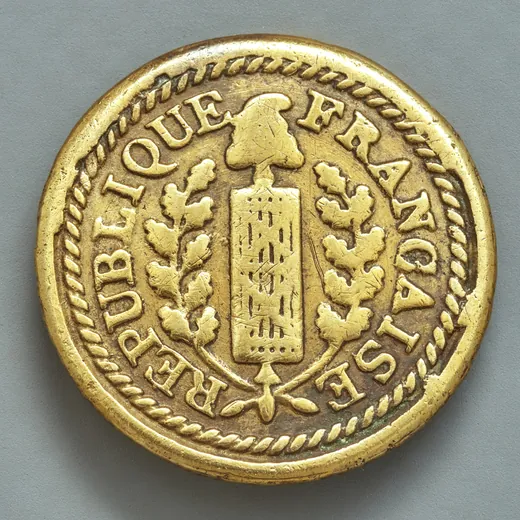
| Lictor's fasces and Phrygian cap | Republic: common model, without regimental number | Line infantry and cavalry buttons, and artillery buttons, October 1792 to February 1793 (Thonon-les-Bains) |
| Fleur-de-lis | Restoration | Button of the 6th Artillery Regiment, 1815-1829 model (Auxonne) |
An emblem is never read on its own: the grenade also sits above the artillery's crossed cannon, at Auxonne as on the 1867 kepi.
The number and the inscriptions
The number normally points to the regiment: on the dolman of a corporal of the 2nd Chasseurs à cheval, at the museum of the battle of 6 August 1870 in Woerth, the buttons are stamped with the figure 2, though the record does not say why. But on that of a corporal of the 5th Hussars, in the same museum, they carry the figure 6: the number does not always tell you who wore the button. An officer's button may have none at all, as the Auxonne record points out.
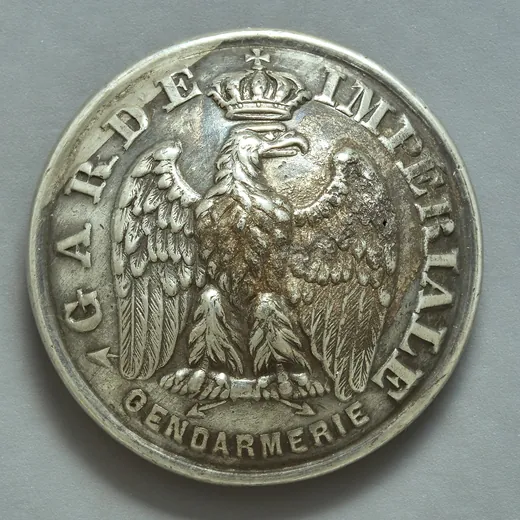
Inscriptions sometimes say everything: “Gardes nationales d'Auxonne” at Auxonne, “Arme du génie sapeurs” or “Garde impériale gendarmerie” at the Musée Carnavalet. The Thonon-les-Bains museum notes that from about 1806, generals' buttons carry either the eagle or the monogram EF, for Empire français, which had replaced the RF.
Dating: the symbols of successive regimes
The landmarks below give a date from which a model exists, seldom the date when it disappears.
- 1790-1791, the National Guard. The decree of 5 September 1790 calls for a civic crown, the words “la Loi & le Roi” and the name of the district around the edge. The law of 20 July 1791 refers to the button prescribed by a decree of the previous 23 December. A button of the 1st Volunteer Battalion of the Calvados, at the Musée Carnavalet, reads “la Nation, la Loi, le Roi”; the record does not date it.
- October 1792, the Republic. Fasces topped by the Phrygian cap, an oak wreath and “République française”. The Historical Museum of the Palatinate in Speyer dates it to a decree of the Convention of 4 October 1792, for every corps; the Thonon-les-Bains museum places it between 4 October 1792 and 21 February 1793, common to the line infantry and cavalry with gilt buttons, the artillery having its own.
- The Empire. The imperial eagle, and on generals' buttons from about 1806, the eagle or the EF monogram.
- The Restoration. The fleur-de-lis with the regiment's number, as on the 6th Artillery's button, 1815-1829 model.
- The Second Empire. The crowned eagle, on a dolman of the Imperial Guard train dated 1855-1873, at the Chinon museum.
- The Third Republic. The records mostly show arm emblems: the infantry grenade in 1883 and in 1914, the chasseurs' horn from 1882 to 1914.
A model date is not a manufacturing date: buttons were replaced and moved from one coat to another.
Great War buttons
In August 1914, the Musée de l'Armée recalls, the infantryman still wore the 1877 model greatcoat, closed by two rows of buttons, and the greatcoat of the light blue uniform adopted in August 1915 was again double-breasted. The 1914 kepi of the 27th Infantry Regiment, in Dijon, has two gilt metal buttons with the infantry grenade. The Missouri History Museum holds a French infantry button in aluminium with the flaming grenade, from about 1914, and French buttons with the grenade, in steel, from about 1916. To place the tunic, see dating a French military uniform.

Shape, material, manufacture and shank
Shape points the way without dating. The Musée du Génie notes that the engineers' buttons were, depending on the period, flat or domed, with a grained, plain or lined ground. In the mass grave of soldiers from the retreat from Russia uncovered in Vilnius in October 2001, archaeologists found flat buttons in copper or white metal, and domed buttons of wood covered with thin tin or copper sheet, for the light cavalry. On an 1858-1868 model hussar dolman at Woerth, the buttons, of the type called grelots (bells), are spherical in the middle row and hemispherical in the other two.
Material tells you more. The decree of 1790 accepted several qualities for the same button: doré sur bois, surdoré sur os, sur moule de cuivre ou massif, that is gilt on wood, gilded on bone, on a copper mould, or solid. Museum collections confirm these constructions: a National Guard button from Auxonne in beech and brass, a republican button in brass worked in repoussé over a wooden support, an engineers' button in copper on bone. At Vilnius, the white metal buttons had almost vanished, eaten away by oxidation.
Casting is not in itself a sign of a copy: the record of an 1882 chasseur's kepi at Nuits-Saint-Georges lists cast pewter among its materials, and the only metal parts it describes are two horn buttons. A button may also be made in two pieces: the Imperial Guard gendarmerie button at the Musée Carnavalet is white metal in repoussé over a brass support.
The shank deserves the same care. On the Auxonne artillery officer's button, a bone back took a catgut fastening, made of gut, forming a square from hole to hole as the base for sewing; the Missouri History Museum's aluminium button has a birdcage shank. A shank that is missing, resoldered or foreign to the period of the design is the first thing to note.

Reading the back: makers, towns, marks
The back often carries a maker's name or initials, and a town: “TW & W PARIS” on the back of a button numbered 12, “PETIT & DUPERIER” on the Imperial Guard gendarmerie button, at the Musée Carnavalet. Some backs add a mention of quality or process: “PERFECTIONNE C PARIS” on a Republican Guard button, “SUPERIEUR 20 M FRANCE” on a button bearing the Legion of Honour collar, at the Carnavalet. On the buttons of the 1883 dolman at Woerth, the record notes “A.M. & CIE 19 PARIS” without saying on which side.
These firms can be documented. A medal in the Musée Carnavalet commemorates Louis-Napoléon Bonaparte's visit to the button factory of Trelon, Weldon and Weil in 1850. The Missouri History Museum attributes to the Paris firm of Anglade Masse et Cie an aluminium Great War infantry button marked “A.M. & CIE. / PARIS” on the back between two grenades. A maker's name rules out the periods when the firm did not exist, without dating the button to the year.
A missing mark does not condemn a button: the records of the Thonon-les-Bains and Auxonne buttons cited here note none. And the back tells you who made the button, never who wore it. The markings on other objects, swords, helmets, uniforms or medals, are covered in our guide to reading the markings on a military item.
Copy, restrike, altered button: the warning signs
An old-looking button can be new. Museums show it themselves: the Musée du Génie displays a Second Empire sapper's uniform that is a recent reproduction, with brass buttons bearing the cuirass and pot helmet, and the Nuits-Saint-Georges museum an exact copy of a dolman. A copy becomes a fraud when it is sold as old.
The trickiest case is the restrike: a new button struck with old tooling. I know of no test that unmasks it from the design alone. What gives it away is disagreement between the parts of the button, as with a cast copy or an altered button:
- Front and back. The maker's mark must belong to the same period as the design: check the firm's working dates before drawing any conclusion.
- Material and shank. A shank, support or metal foreign to the period of the design points to a remade button, as does a model known to be stamped that turns up cast.
- Wear. At Thonon-les-Bains, advanced oxidation and erosion of the design lead the museum to conclude that a piece was excavated or kept somewhere damp. A button described as a ground find, with an even surface and no pitting, needs explaining.
- The coat. A button sewn on a uniform is not necessarily original to it, and a number foreign to the man's regiment calls for an explanation rather than a conclusion.
Altering is not always deceiving: the Bibliothèque nationale de France holds a trench lighter made from a German uniform button. Other signs of reassembly are covered in recognising fake militaria.

A button from the ground: what the law says
This guide does not encourage searching; it summarises the French code du patrimoine (heritage code). No one may dig or carry out test excavations in search of objects of interest to prehistory, history, art or archaeology without authorisation, even on their own land (article L531-1). Using a metal detector for such searches requires prior administrative authorisation, granted according to the applicant's qualifications and the nature of the search (article L542-1).
The authorisation is given by order of the regional prefect, and the application includes, among other things, the landowner's written consent (article R542-1). Using a detector without it is punishable by a fifth-class fine (article R544-3). The regional cultural affairs directorate for the Grand Est puts it bluntly: la détection n'est pas un loisir, detecting is not a hobby.
A chance find creates an obligation: the finder and the landowner must report it immediately to the mayor, who passes it on to the prefect (article L531-14), on pain of a fine (article L544-3). On land acquired after the law of 7 July 2016, archaeological movable objects are also presumed to belong to the State, from the recognition of their scientific interest in the case of a chance find (article L541-4). Buying or selling an object from an illegal excavation, or one concealed instead of being reported, is punishable by two years' imprisonment and a fine (article L544-4).
The law protects something other than the object: its place in the ground. At Vilnius, buttons found on the soldiers' chests allowed the archaeologists to conclude that men from dozens of different regiments lay in the same trench. If there are bones, call the gendarmerie; if you have the slightest doubt about an explosive object, do not touch it and read what to do with a shell or ammunition. The rules for selling are in selling militaria legally in France.
Judging a button's interest without talking prices
A button is judged by what can be proved, in four questions:
- Is it identified? Arm, regiment and period established by the emblem, the number, the inscription and the back, all agreeing with one another.
- What condition is it in? Sharp or worn relief, gilding present or gone, shank original, missing or replaced: the Auxonne record, for instance, notes that the fastening is missing.
- Where does it come from? A button still sewn on its coat, with a photograph or a document of the man who wore it, tells more than a button on its own. A ground find with no clear origin raises a legal question first.
- Is it common? Rarity is established by comparison with public collections and with Louis Fallou's book on the French uniform button, published in 1915.
The method for placing a piece is in valuing a military item. Pieces for sale on the site are gathered in Revolutionary and First Empire uniforms, the Franco-Prussian War of 1870 and First World War uniforms.
What I cannot tell you here
I cannot tell you, from a single photograph of the front, whether a button is old: the back, the shank, the weight and the wear count as much as the design. Nor can I give the list of buttons for every regiment: each arm had its models, and each model its variants depending on the supplier. I do not comment on the figures found on some backs, which museum records note without explaining. I do not know where a ground-find button offered to you comes from: only its seller can say. And I give no prices.
For a particular button, photograph the front, the back and the shank, measure the diameter, then send it all to the free identification help. The trade's vocabulary is in the militaria glossary, and the care of metal in caring for your militaria.
Frequently asked questions
How do you recognise an old French military button?
Read the emblem first, which names an arm or a corps, then the number, which normally points to a regiment. Then check that the shape, the material, the shank and the back agree with that design, and that the maker's mark belongs to the same period. Always photograph the front, the back and the shank before asking for an opinion.
How do you date a French military button?
By the symbols of the regime: “la Loi & le Roi” for the National Guard of 1790, fasces and Phrygian cap from October 1792, the eagle under both Empires, the fleur-de-lis under the Restoration. The maker's name on the back also helps, provided you check the firm's working dates. A model date tells you from when a button exists, not when it was made.
What does the grenade on a French military button mean?
In the museum records cited here, a grenade on its own appears on Third Republic infantry dress: the 1883 model dolman of a captain of the 97th Infantry Regiment, at the Woerth museum, and the 1914 kepi of the 27th Infantry Regiment, in Dijon. It is not enough, though, to identify the infantry: set above two crossed cannon, it belongs to the artillery, as on the 1811-1815 model officer's button at the Musée Bonaparte in Auxonne. Always read the whole design.
How do you recognise a Napoleonic French button?
A button of the Napoleonic period may carry the imperial eagle, like the generals' buttons at the Thonon-les-Bains museum, which also notes the EF monogram from about 1806, or the emblem or number of a regiment. At Vilnius, analysis of the buttons in the mass grave from the retreat from Russia revealed men from dozens of different regiments. Archaeologists found flat buttons in copper or white metal there, and domed buttons with a wooden core for the light cavalry.
Which French military buttons are rare?
There is no reliable list: rarity is established by comparison with public collections and with Louis Fallou's book on the French uniform button, published in 1915. Some materials have survived badly: at Vilnius, the white metal buttons had almost vanished, eaten away by oxidation. A button still sewn on its coat, or accompanied by a document of the man who wore it, counts for more than a button on its own.
How do you identify a French First World War uniform button?
Start with the emblem: the infantry grenade, as on the two buttons of the 1914 kepi of the 27th Infantry Regiment kept in Dijon, or the hunting horn of the chasseurs à pied, as on a battalion commander's kepi of 1886-1914 at Nuits-Saint-Georges. The Missouri History Museum holds French Great War buttons with the grenade, in aluminium and in steel. On the back, a mark such as “A.M. & CIE. / PARIS” names the maker, which that museum identifies as the firm of Anglade Masse et Cie.
What do the marks on the back of a military button mean?
Most often they are the maker's name or initials and town, such as “TW & W PARIS” or “PETIT & DUPERIER” on buttons in the Musée Carnavalet, sometimes a mention of quality or process such as “PERFECTIONNE”. The maker's name helps with dating if you know when the firm was active: a medal in the Musée Carnavalet shows, for instance, that the button factory of Trelon, Weldon and Weil was working in 1850. The back tells you who made the button, never who wore it.
Is it legal to look for military buttons with a metal detector in France?
Not without authorisation. Searching with a detector for objects of historical or archaeological interest requires prior administrative authorisation, granted by the regional prefect with the landowner's written consent (code du patrimoine, articles L542-1 and R542-1). Digging is prohibited without authorisation, even on your own land, and a chance find must be reported immediately to the mayor (articles L531-1 and L531-14).
Sources
This guide draws on the texts, databases and pages below, accessed on unless otherwise stated. Most of them are in French.
- Musée du Génie, Angers, information sheet “Cuirasse et pot-en-tête” (cuirass and pot helmet: from equipment to emblems of the engineers), in French
- Royal proclamation of 21 September 1790 on the National Assembly's decree of 5 September 1790 setting the form of the National Guard uniform button, Newberry Library copy on the Internet Archive, in French
- Musée Carnavalet, poster of the law of 20 July 1791 finally settling the uniform of the National Guards, printed in Laval (inv. AFF3458), Paris Musées record
- Musée Carnavalet, button of the 1st Volunteer Battalion of the Calvados department, “La Nation, la Loi, le Roi” (inv. B2570), Paris Musées record
- Historical Museum of the Palatinate, Speyer, “République française” uniform button found in Speyer in 1952 (inv. HM_0_02637), French version of the museum-digital record
- Musée de Thonon-les-Bains, infantry or cavalry button “République française”, 1792 (inv. 2004.249.5.4), Joconde database on POP
- Musée de Thonon-les-Bains, artillery button “République française”, 1792 (inv. 2004.249.5.9), Joconde database on POP
- Musée de Thonon-les-Bains, general's button of the First Empire, 1804-1814 (inv. 2004.249.5.6), Joconde database on POP
- Musée Bonaparte, Auxonne, artillery officer's button, 1811-1815 model, with a bone back (inv. 2010.0.297), Joconde database on POP
- Musée Bonaparte, Auxonne, button of the 6th Artillery Regiment, 1815-1829 model (inv. 2010.0.296), Joconde database on POP
- Musée Bonaparte, Auxonne, button of the Auxonne National Guards, beech and brass (inv. 2010.0.294), Joconde database on POP
- Municipal museum of Nuits-Saint-Georges, record of an artilleryman's kepi, 1867 model (inv. 96.2.195), Joconde database on POP, accessed
- Municipal museum of Nuits-Saint-Georges, record of a chasseur à pied's kepi dated 1882, inner inscription “3e 82 / 1015” (inv. 95.14.64), Joconde database on POP, accessed
- Municipal museum of Nuits-Saint-Georges, kepi of a battalion commander of the chasseurs à pied, 1886-1914 (inv. 95.14.69), Joconde database on POP
- Museum of the battle of 6 August 1870, Woerth, 1883 model dolman of a captain of the 97th Infantry Regiment (inv. 2006.0.522), Joconde database on POP
- Musée de la Vie bourguignonne, Dijon, on deposit from the Musée de l'Infanterie, record of a kepi from the 1914 field dress of the 27th Infantry Regiment (inv. D99.1.398), Joconde database on POP, accessed
- Musée Carnavalet, uniform button in copper on bone, cuirass and helmet, “République française” (inv. B194), Joconde database on POP
- Musée Carnavalet, button “Arme du génie sapeurs” with the number 2 (inv. B3125), Paris Musées record
- Musée Carnavalet, copper button “Infanterie de marine”, anchor and rope (inv. B2849), Paris Musées record
- Le Carroi, museum of art and history, Chinon, dolman of a quartermaster corporal of the Imperial Guard train squadron, 1855-1873 (inv. 2014.0.1036), Joconde database on POP
- Museum of the battle of 6 August 1870, Woerth, chasseurs à cheval dolman of a corporal of the 2nd Regiment (inv. 1970.1.215), Joconde database on POP
- Museum of the battle of 6 August 1870, Woerth, 1858-1868 model hussar dolman of a corporal of the 5th Hussars (inv. 1970.1.237), Joconde database on POP
- Musée de l'Armée, teachers' object sheet “L'uniforme du fantassin français en 1914 et 1916” (the French infantryman's uniform in 1914 and 1916), in French
- Missouri History Museum, French First World War infantry button in aluminium marked “A.M. & CIE. / PARIS” on the back, about 1914, record reproduced on Wikimedia Commons
- Missouri History Museum, French and Bavarian First World War buttons in steel, about 1916, record reproduced on Wikimedia Commons
- Yann Ardagna, Catherine Rigeade, Michel Signoli and Thierry Vette, “Les ombres de la retraite de Russie: Vilna 1812, Vilnius 2002” (shadows of the retreat from Russia), Cahiers lituaniens no. 7, 2006, in French
- Musée Carnavalet, “République française” button with crossed cannon and cap, brass repoussé on a wooden support (inv. B3698), Paris Musées record
- Musée Carnavalet, “Garde impériale gendarmerie” button in white metal repoussé on a brass support, marked “PETIT & DUPERIER” on the back (inv. B3487), Paris Musées record
- Musée Carnavalet, button numbered 12 marked “TW & W PARIS” on the back (inv. B3143), Paris Musées record
- Musée Carnavalet, “Garde républicaine” button marked “PERFECTIONNE C PARIS” on the back (inv. B3420), Paris Musées record
- Musée Carnavalet, button with the eagle and collar of the Legion of Honour marked “SUPERIEUR 20 M FRANCE” on the back (inv. B3471), Paris Musées record
- Musée Carnavalet, medal for the visits of Louis-Napoléon Bonaparte and Archbishop Sibour to the button factory of Trelon, Weldon and Weil, 1850 (inv. NJ10073), Joconde database on POP
- Musée du Génie, Angers, information sheet “Le sapeur en tenue de tranchée, Second Empire” (the sapper in trench dress, Second Empire), in French
- Municipal museum of Nuits-Saint-Georges, exact copy of an officer's dolman in the collection (inv. 96.2.42), Joconde database on POP
- Bibliothèque nationale de France, trench lighter made from a German uniform button, which belonged to Victor Dreneau, record reproduced on Wikimedia Commons, in French
- Code du patrimoine, article L531-1: excavations and test digs subject to authorisation, on Légifrance
- Code du patrimoine, article L542-1: searching with metal detectors, on Légifrance, accessed
- Code du patrimoine, article R542-1: authorisation to use a metal detector, issued by the regional prefect, on Légifrance
- Code du patrimoine, article R544-3: penalty for using a metal detector without authorisation, on Légifrance
- Regional cultural affairs directorate for the Grand Est, “L'utilisation des détecteurs de métaux soumise à autorisation préfectorale” (metal detector use subject to prefectoral authorisation), Ministry of Culture website, in French
- Code du patrimoine, article L531-14: reporting chance finds to the mayor, on Légifrance
- Code du patrimoine, article L544-3: penalty for failing to report a find, on Légifrance
- Code du patrimoine, article L541-4: presumption of State ownership of archaeological movable objects, on Légifrance
- Code du patrimoine, article L544-4: penalty for buying or selling objects from illegal excavations or concealed finds, on Légifrance
- Defence digital libraries, record of the facsimile (Éditions du Canonnier, 1997) of Louis Fallou's book on the French uniform button, published in Colombes by La Giberne in 1915, in French