The Croix du combattant: what it says about an ancestor, and where to find his card
By Augustin, founder of Athena Militaria Published
It sits in almost every family box, and it is often the least looked-at decoration. The Croix du combattant rewards neither a wound nor a feat of arms: it says that a man was recognised as a combatant, card in hand, under the law of 28 June 1930. Still made today to the same design, it is worth only what is tied to it: a name, a card, a file. Here is how to read it, how to tell it from the volunteer combatant's cross and from the 1939-1940 cross, and where to look for the card that justified it.
A cross for a card: the law of 28 June 1930
It all begins with the card. The carte du combattant, the combatant's card, was created by article 101 of the finance law of 19 December 1926; the decree of 28 June 1927 set its conditions, and issuing it fell to the Office national du combattant, born of the same law.
The law of 28 June 1930 then instituted, for card holders alone, a combatant's cross: the award of the card "shall give the right, de plano, to this cross". The decree of 24 August 1930 fixed its metal, size and ribbon, and opened a competition reserved for artists who held the card, before a jury chaired by André Maginot, chairman of the Office's governing committee and then Minister of War.
Keep the logic in mind: the cross is not conferred, it is acquired. The decree says it in three sentences: only card holders may wear the cross; the card serves as their certificate; they buy it at their own expense. The code of military disability pensions still repeats the first. No official diploma comes with it; those found in families came from associations.
Doumenc's design: obverse, reverse and ribbon
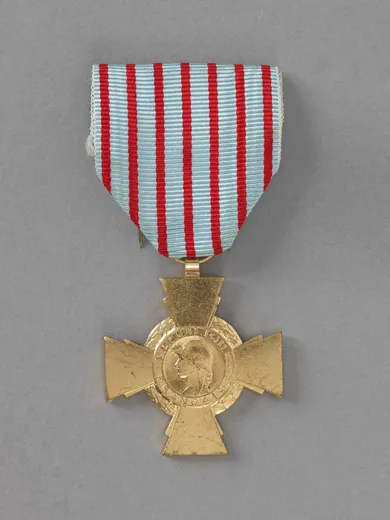
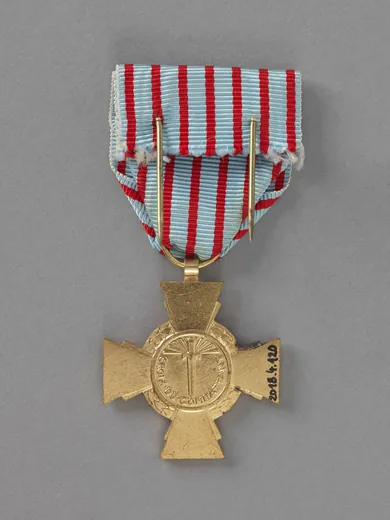
The winning design was by Eugène-Baptiste Doumenc (1873-1943), himself a veteran. It is a bronze cross pattée of about 36 mm, its four arms linked by a laurel wreath. On the obverse, the effigy of the Republic in an Adrian helmet dressed with laurel, and the legend RÉPUBLIQUE FRANÇAISE. On the reverse, the inscription CROIX DU COMBATTANT frames a vertical sword, point down, with rays spreading upward from the hilt. It hangs from a plain ring, with no suspension bar.
The ribbon is the cross's signature: horizon blue, crossed lengthwise by seven stripes of garance red, each 1.5 mm wide, that is the blue of the poilu's greatcoat and the garance red of his pre-1915 trousers. The decree sets the width at 36 mm; many ribbons are 37 mm, and that is not a sign of a fake.
Markings and manufacturing variants
From 1930, the competition rules opened manufacture to the Monnaies et médailles administration and to makers who signed an agreement with the Office. The Monnaie de Paris, the French mint, still strikes it: its pieces carry on the reverse the "BR" mark, for bronze, and the cornucopia. The example shown here, dated after 1960, carries them on a double-pin mount. Private makers produced it too, with no reliable list of their marks.
What varies: the finish, patinated or gilt bronze; the size, full-size or miniature; the mount, ring or pin. What does not vary: the design. There is therefore no "WW1 model" that the eye can pick out: a cross's age is read in its patina, its ribbon and above all the papers that come with it.
The 1939-1940 cross of the Vichy regime, and the return of the 1930 design
Only one departure from the design exists. The decree of 28 March 1941 instituted, under the État français, a combatant's cross for the war of 1939-1940: the cross of 1930, but with the dates 1939-1940 on the reverse, on a horizon-blue ribbon with five black bands, three narrow ones in the centre and two wide ones at the edges. It was reserved for holders of the combatant's certificate created by the decree of 27 December 1940.
The ordinance of 7 January 1944 banned its wear, and the decree of 29 January 1948 restored the original design for the combatants of 1939-1945. A cross with a black-striped ribbon is therefore a precise document: it dates from 1941 to 1944 and says that its holder was recognised as a combatant of 1939-1940 by the Vichy regime, nothing more. Describe it, date it, keep the original ribbon.
Not to be confused: the volunteer combatant's cross
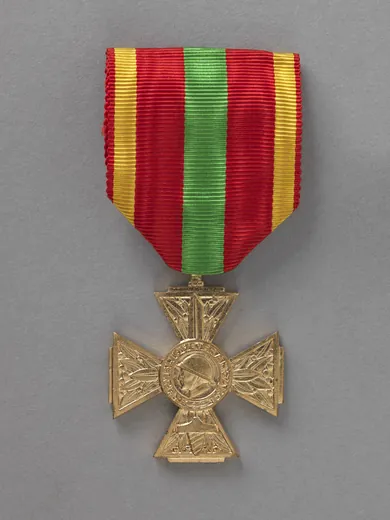
The Croix du combattant volontaire 1914-1918, created by the law of 4 July 1935, is a 36 mm bronze cross: a helmeted poilu over a sword, "COMBATTANT VOLONTAIRE 1914-1918" on the reverse, a green ribbon with a central red stripe and yellow edges. It required the card and proof of voluntary enlistment, and counts as a war title for the Légion d'honneur and the Médaille militaire. A little over 10,200 were awarded, against more than 4.4 million cards for 1914-1918.
A Croix du combattant volontaire 1939-1945 followed, created by the law of 4 February 1953, with the ribbon reversed: red with a central green band and yellow edges. The decree of 8 September 1981 then replaced it with a single cross for every conflict since 1939, on the same ribbon. Remember the ribbons: horizon blue striped with red for the Croix du combattant, green or red edged with yellow for the volunteer's cross.
Was your ancestor entitled to it? The conditions of the card
Under the ordinary procedure, the card was granted for ninety days in a combat unit, for belonging to a unit that had seen several actions under fire, nine today, for evacuation through a wound or an illness contracted in a combat unit, for an officially recognised war wound, or for ninety days of captivity. On overseas operations, 112 days of presence have been enough since the decree of 20 December 2023, failing ninety days in a combat unit.
The card was refused to many: for 1939-1945, 2.6 million cards were granted, and the departmental archives keep, beside the awards, whole registers of refusals. A cross without a card therefore raises a question rather than answering one: wearing it is reserved for holders, but nothing ever prevented anyone from buying one.
Finding the combatant's card in the archives
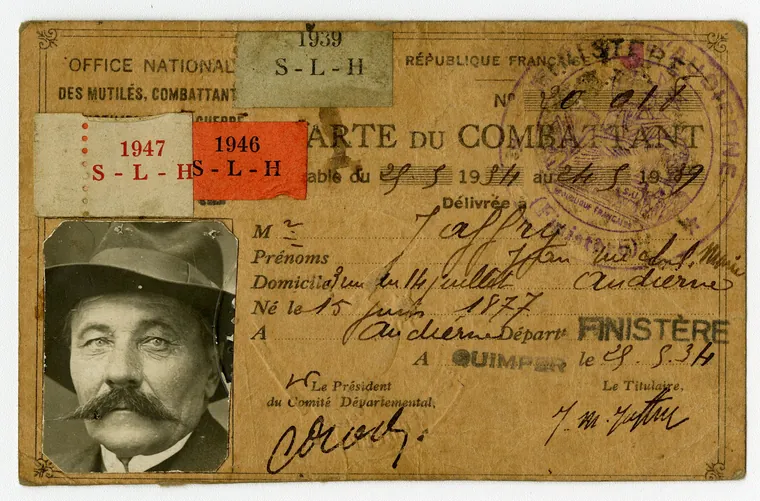
The card is a small piece of card: identity photograph, civil status, address, number, date of issue, signatures of the departmental committee chairman and of the holder. Valid for five years, it had to be renewed: by exchange for a new one, and it is often these expired cards that the archives hold, or by a yearly sticker, as here. It says nothing about the man's service; the application file does: the form, statements of service, attestations, the decision to grant or refuse.
These files, transferred to the departmental archives in series R or W, belong to the records of the Office's departmental services, renamed ONACVG in 1946. Many were destroyed by regulation; some départements kept the cards, and several have put them online, from the Hautes-Alpes to the Ardèche. A recent file becomes open only after fifty years for anything touching private life, unless an exemption is requested from the ONACVG.
The method, in order:
- The service register (registre matricule), at the departmental archives of the recruitment area or at the military personnel archives centre in Pau: units, wounds, citations, and sometimes the card number. The guide on tracing a WW1 soldier's decorations explains how to read it.
- The Office's records at the departmental archives of the département where your ancestor lived when he applied, since the card was issued by the departmental committee.
- The local ONACVG office for recent files not yet transferred.
What the cross says, and what it does not
The Croix du combattant attests a status, not an act of bravery, unlike the Croix de guerre. It tells you neither rank, nor unit, nor even which war: an identical cross was worn by a survivor of 1870, a poilu, a soldier of Algeria, a serviceman back from Lebanon. Only the black-striped ribbon of 1941-1944 dates a cross by itself.
So much for rarity: more than eight million cards issued by early 1994, a holder who bought his own cross, a piece still being made. What matters happens around it: the card, the file, the service book, the photographs, the commemorative medal and the Victory medal of the same man. The guide on valuing a military item explains the method; our First World War medals show such groups, and if you would rather sell, list it with the card and the papers: never separate them.
What I cannot tell you here
I cannot tell you whether your ancestor wore this cross in his lifetime: he may have bought it, been given it, or it may have been added to the frame after his death. Nor can I date a 1930-pattern cross from the metal alone, or promise that the card file survived in your département: the destructions were real and uneven. For a specific case, the ONACVG remains the only answer that counts.
Frequently asked questions
Who is entitled to wear the Croix du combattant?
Only holders of the carte du combattant, the combatant's card issued by the ONACVG, may wear it. The law of 28 June 1930 ties the cross to the card: the award of the card gives the right to the cross with no further formality, and the holder buys the insignia at his own expense. The card serves as his certificate, and he must be able to show it to prove his entitlement.
What is the difference between the Croix du combattant and the Croix du combattant volontaire?
The Croix du combattant attests combatant status, proven by the card; its ribbon is horizon blue with seven red stripes. The volunteer combatant's cross, created in 1935 for 1914-1918 and unified in 1981, also requires proof of voluntary enlistment; its ribbon is green for 1914-1918 and red from 1939-1945 onward, with yellow at the edges. It was awarded far less often and counts as a war title.
How do you obtain the Croix du combattant?
By obtaining the combatant's card: the application goes to the local ONACVG office, on form Cerfa 15409, online or by post. Once the card is granted, the cross follows with no further step, but it is not handed over: the holder buys it from a maker of decorations.
How can I tell whether a Croix du combattant is WW1 or WW2?
From the cross alone, you cannot: the 1930 design has never changed and the cross is still made. The one exception is the Vichy cross of 1941 to 1944, with the dates 1939-1940 and a horizon-blue ribbon striped with black. Otherwise only the patina, the ribbon and above all the holder's card and papers date a cross.
How do I find my grandfather's carte du combattant?
Start with his service register at the departmental archives of his recruitment area, which sometimes carries the card number. Then look for the records of the Office national des anciens combattants at the departmental archives of the département where he lived when he applied, in series R or W; several départements have put their cards online. Recent files, under fifty years old, remain with the local ONACVG office.
Is the Croix du combattant valuable?
On its own, very little: more than eight million cards had been issued by early 1994, each holder bought his own cross, and the same model is still sold new. Its value lies elsewhere: together with the card, the file, the service book and the other decorations of the same man, it forms part of an attributed group that tells a story. Never separate it from the papers that go with it.