French army ranks and insignia, 1870 to 1918: reading a rank on a uniform or in a photograph
By Augustin, founder of Athena Militaria Published 14 min read
French army ranks from 1870 to 1918 can be read on a sleeve, a kepi, an epaulette or a family photograph, provided you know what to count and where to look. A wool stripe is not a gold one, a slanting stripe on the forearm does not say the same as a stripe on the upper arm, and a chevron is not a rank. This guide follows the rules of 1867, those of the army of 1870, then what an album of 1905, museums and Great War texts show. It also explains how to check a rank on a service record, and says where the sources read stop.
Get a piece identified from photos Valuing a piece: the method
In brief
- Three tiers, then the generals. The rank and file (privates and corporals), NCOs (from sergeant to adjudant-chef), officers (from second lieutenant to colonel), then generals. In the cavalry and artillery, the corporal is called brigadier and the sergeant maréchal des logis.
- The material gives the tier. Wool for the private first class and the corporal, gold or silver, following the metal of the buttons, for NCOs and officers, stars for generals.
- The number gives the rank. Two wool stripes for a corporal, one metal stripe for a sergeant, two for a sergeant-major; one to five rows for an officer.
- Position matters. In 1867, the rank stripes of other ranks are sewn on a slant on the forearm; on the upper arm, a stripe marks a quartermaster, a chevron long service.
- War makes them discreet. Smaller stripes, sometimes chevron-shaped at the cuff; chevrons for presence with the armies on the left arm, wound chevrons on the right, under the circular of 22 February 1918.
The hierarchy, from private to general
In 1914, Félix Chapuis's manual, L'Instruction théorique du soldat par lui-même, sums up the hierarchy. The soldier salutes every superior “from corporal or brigadier upwards”, says “mon lieutenant” to a lieutenant and a second lieutenant alike, then “mon capitaine”, “mon commandant”, “mon colonel”, “mon adjudant”, and addresses other ranks by their rank: corporal, sergeant, quartermaster, aspirant. The commandant is a chef de bataillon, a battalion commander, as a record from the Nuits-Saint-Georges museum puts it: “chef de bataillon (grade de commandant)”.
Chapuis divides the company into eight squads, each under a corporal; two squads form a section, under a sergeant, two sections a platoon, under a lieutenant or second lieutenant. In 1915, the Cahiers de la guerre, reproduced on the horizon14-18 website, speak instead of a half-section under a sergeant and a section under a lieutenant, a second lieutenant or an adjudant: the words change, the ladder stays.
| Rank | Cavalry, artillery | Command, 1914-1915 |
|---|---|---|
| Soldat de 2e, de 1re classe (private) | Cavalier, canonnier | Up to two privates first class per squad (Chapuis) |
| Caporal (corporal) | Brigadier | The squad, 14 to 15 men |
| Sergent (sergeant) | Maréchal des logis | The half-section, about thirty men |
| Sergent-major | Maréchal des logis chef | Passes the men's leave requests on to the captain |
| Adjudant, adjudant-chef (warrant officers) | Adjudant, for the first | A section, or a lieutenant's place |
| Sous-lieutenant, lieutenant | Same names | The platoon (Chapuis) or the section (1915) |
| Capitaine (captain) | Capitaine commandant, in a squadron | The company, squadron or battery |
| Chef de bataillon (battalion commander) | Chef d'escadron | The battalion, about 1,000 rifles; the half-regiment of two squadrons; the group of three batteries |
| Lieutenant-colonel, colonel | Same names | The regiment, for the colonel |
| Général de brigade, de division | Same names | The brigade, two regiments; the division |
Marshal, a dignity
Marshal of France is not a rank: the Musée de l'Armée calls it an honorary title. According to the Musée du Génie, Joffre, a divisional general since 1905 and commander-in-chief of the armies of the North and North-East in 1914, received this dignity at the end of 1916, when it had not been conferred since 1870, followed by Foch in 1918, the Musée de l'Armée notes. On Joffre's coat, displayed at the Musée du Génie, the seven stars of a marshal are worn on the collar.
Two words mislead: in 1867, the major is a field officer and the adjudant-major a captain; neither is an NCO.
1867: the stripes of the army of 1870
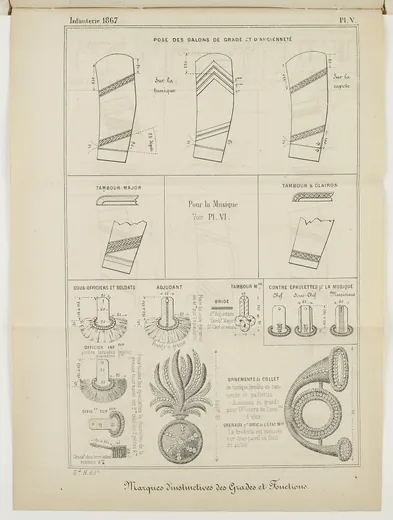
The description of the line infantry uniform adopted on 2 December 1867 sets out the marks of rank. The private first class, “in the corps where this rank exists”, wears a wool stripe on each sleeve; the corporal two, “jonquilles pour l'infanterie de ligne”, yellow like the collar of his tunic; the sergeant one gold stripe; the sergeant-major two. All are set on a slant on the forearm, from the front seam of the sleeve, just above the cuff, rising towards the back at 25 degrees.

The metal follows that of the buttons. The quartermaster, sergeant or corporal, adds a slanting gold stripe on the upper part of each arm, the “distinctive mark of this post”: a function, not a rank. The adjudant is recognised by his epaulettes in the metal opposite to the buttons, the epaulette on the right and the counter-epaulette on the left, crossed by a madder-red silk stripe.
For officers, rank is counted. On the sleeves of the caban, the officer's greatcoat, a Hungarian knot of flat braid, gold or silver like the buttons, has one to five rows according to rank; the kepi follows the same scale, set out in the French military kepi. On the tunic, it is the epaulettes that speak.

| Rank | Caban and kepi: rows of braid | Epaulettes |
|---|---|---|
| Sous-lieutenant | 1 | Fringed epaulette on the right, counter-epaulette on the left |
| Lieutenant | 2 | Epaulette on the left, counter-epaulette on the right |
| Capitaine | 3 | Two epaulettes |
| Chef de bataillon | 4 | Heavy-bullion epaulette on the left, counter-epaulette on the right; the reverse for the major |
| Lieutenant-colonel | 5, the 2nd and 4th in the opposite metal | Two heavy-bullion epaulettes, strap and crescent in the opposite metal |
| Colonel | 5 | Two heavy-bullion epaulettes, entirely in the metal of the buttons |
The fringes give the tier: fine twists for the officers the text calls junior, from second lieutenant to captain, heavy twists for field officers, a “seed” fringe for the adjudant. The private's wool epaulettes, on the other hand, mark the company: scarlet for grenadiers, jonquil yellow for voltigeurs, green for the centre companies.
1883 to 1914: officers' rank moves to the sleeve
In 1883, according to the Musée de l'Armée's online exhibition, the dolman became the dress of all officers, and rank was read from stripes on its sleeves: their kind, cloth, gold or silver, sometimes mixed, and their number. The museum keeps that of Jean-Baptiste Marchand, a marine infantry lieutenant, with collar patches bearing an anchor in silver bullion and his rank in bullion.
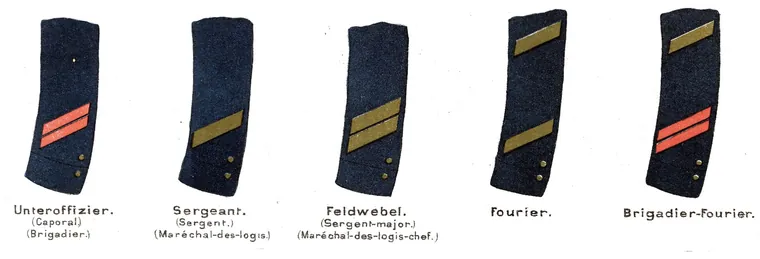
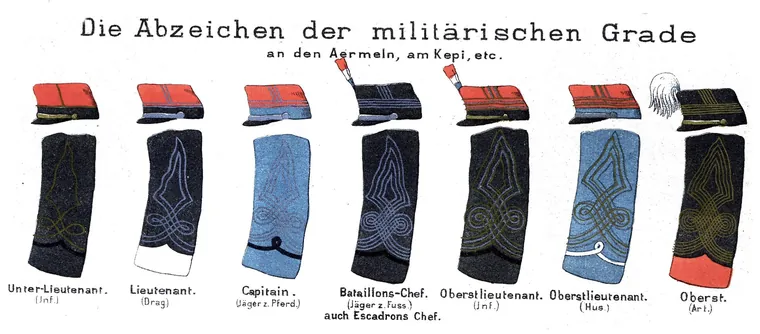
A German album of 1905, published in Leipzig by Moritz Ruhl, shows the system. On its plate of officers, rank forms a Hungarian knot of one to five braids on the sleeve, and the lieutenant-colonel mixes two metals; among the cuirassiers, according to another plate, the rows become straight stripes round the cuff, and the same plate shows the adjudant with a knot of a single cord mixed with red. For corporals and NCOs, the album matches the rules of 1867: two slanting stripes for the corporal or brigadier, red where those of the line infantry were jonquil yellow in 1867, one gold stripe for the sergeant or maréchal des logis, two for the sergeant-major or maréchal des logis chef. It is a witness of the time, not a regulation.


One rank was born just before the war. The adjudant-chef appeared in 1912, the French navy magazine Cols bleus recalls; Chapuis places him between the second lieutenant and the adjudant, and also names the aspirant.
1914-1918: less conspicuous ranks
The war changed the kepi first: according to a thesis from the University of Kent, officers could for a time cut a window in their kepi cover showing the number and the rank braid, until this was banned on 14 October 1914. With the horizon-blue uniform, the Musée de l'Armée writes, rank marks became more discreet, and could also appear on the helmet.
On the 1915 pattern horizon-blue tunic of a lieutenant of the balloon service, at the Musée de l'Armée, the gilt stripes are set “en chevrons aux poignets”, as chevrons at the cuffs, and two chevrons for presence with the armies can be seen on the left sleeve. In May 1917, Cols bleus notes, the navy adopted rank insignia of reduced size, “as is already done in the army”. The kepi of Pierre Seurot, a lieutenant of chasseurs, dated 1915-1918 by the Nuits-Saint-Georges museum, has its two stripes at the front only.
For other ranks, the Cahiers de la guerre of 1915 describe the corporal with two red stripes and the sergeant with one stripe “de couleur or (argent chez les chasseurs)”, gold, or silver in the chasseurs. The collar does not give rank: on the poilu of 1916 at the Musée du Génie, the collar patches bear the colour of the arm and the number of the regiment.
The stripe, which colloquial French also calls ficelle or sardine according to the Trésor de la langue française, marks rank, generals excepted: they wear five-pointed stars on the sleeves and headdress. The same dictionary quotes Joffre, who had to press for Foch to receive “sa troisième étoile”, his third star, that of a divisional general. The brigade general Henri Mesple, photographed between 1915 and 1918, wears two stars at the bottom of his sleeves according to the record; the kepi of a Second Empire divisional general, at the Woerth museum, has two rows of embroidery.

Chevrons: long service, the front, wounds
A chevron is not a rank. In 1867, long-service chevrons, gold for NCOs and scarlet wool for corporals and privates, are sewn on the upper left arm, point upwards, one above the other. In 1914, Chapuis still mentions a “soutache d'ancienneté”, a long-service braid, for re-enlisted corporals and brigadiers.
The Great War added chevrons “en forme de V renversé”, shaped like an inverted V, regulated by the circular of February 1918, published with its amendments on Légifrance:
- Left arm, presence. One chevron for a full year in the zone of the armies, then one for each further six months. Broken periods add up; hospital time counts after a wound or an illness that took the man out of the zone of the armies, convalescence does not.
- Right arm, wounds. One chevron per wound received in the presence and through the action of the enemy, burns from flame liquids and serious gas casualties included; several wounds caused by the same projectile earn only one.
- Colour. That of the man's rank stripe, except on combat clothing, where, whatever the rank, it is that of the stripes of corporals and privates first class. Wearing them is compulsory.
The word brisque is older than the circular. The Trésor de la langue française, which records its sense of a stripe from 1872, defines it as the sleeve stripe for re-enlistments and campaigns, and quotes Barbusse's Le Feu, published in 1916: you would see how many shirkers there were “si on ne donnait des brisques qu'aux vrais combattants”, if brisques went only to real fighting men. I have not read any earlier text on these chevrons.
Counting the chevrons on a tunic
On the left arm, one presence chevron means at least a year in the zone of the armies, two at least eighteen months, three at least two years; on the right arm, each chevron is a wound. On a uniform from before 1914, a point-up chevron on the upper left arm is first of all a long-service chevron.
What looks like a rank but is not
- The number on the collar gives the regiment, the colour of the patches the arm.
- The stripe on the upper arm marks the post of quartermaster.
- The hunting horn is, for Chapuis, a shooting award: in cloth for very good shots, embroidered for the best in the regimental competition.
- The blue armband marks, in 1915 according to the Cahiers de la guerre, the staff of a brigade headquarters.
- The fourragère, a cord on the left shoulder which the 1918 circular requires to be worn “par tous les officiers et hommes de troupes”, by all the officers and men of a cited unit, distinguishes first of all the unit; a man who took part in person in the deeds cited may keep it when he changes corps.
Reading a rank in a photograph
An old print does not show colours: count and locate. On the forearm, one or two slanting stripes mean a corporal, a sergeant or a sergeant-major; two stripes may belong to a corporal, in wool, or to a sergeant-major, in gold, and the caption on the back or the kepi help to decide. Then look at the upper arm, the kepi, where an officer wears as many stripes as on the sleeve, and the collar, which gives the regiment.
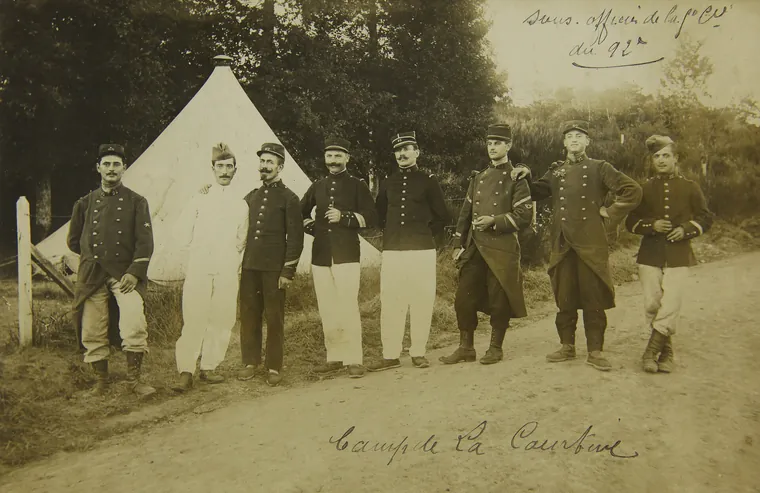
The photographs of Jean Deplat, entrusted to the Europeana 1914-1918 collection, follow one man up the ladder: re-enlisted sergeant between 1905 and 1909, sergeant-major between 1910 and 1912 “d'après ses insignes de grade”, judging by his rank insignia, adjudant around 1914, according to their records. At La Courtine camp, several NCOs of his company wear one or two slanting stripes on the forearm. The summary of his career makes him adjudant-chef on 14 November 1914, temporary second lieutenant in 1916, temporary lieutenant in 1917, before his death in April 1917, five days after he was wounded.
A rank on a service record
A rank seen in a photograph is checked in the archives. For a private or an NCO, that means his page in the registre matricule, the service register held by the departmental archives of the place where he was recruited: according to the Service historique de la Défense, the French defence archives, these registers were systematised in 1867; from 1905, it adds, each man is entered in them under a service number, in the class of the year he turned twenty. The section headed “détail des services et mutations diverses”, details of service and changes, follows his career, the Orléans-Tours education authority notes; for abbreviations, the index of the Côte-d'Or archives reads MDL, for instance, as maréchal des logis. The method is in tracing a French soldier of 1914-1918.
For an officer, the Service historique de la Défense points to his individual file, at Vincennes, and to the printed army lists, including the Annuaire officiel de l'Armée française, published until 1914 and resumed after the war. Rank can also be read on some objects: according to the Musée du Génie, the helmet given to every combatant under a decree of 18 December 1918 bears, on a brass plate, his name and rank with the words “Soldat de la Grande Guerre 1914-1918”. Family papers can be read with our guide to military photographs and papers.
What I cannot tell you here
I cannot tell you exactly how the adjudant, the adjudant-chef and the aspirant were marked during the war, nor the rule for placing the stripes of other ranks on the horizon-blue greatcoat and tunic: I have not been able to read the regulations of the time. Nor can I date a tunic from its stripes alone: a stripe can be sewn on and unpicked, and only the whole, cut, buttons, collar patches, label and papers, places a piece.
This guide gives no prices: the method is in valuing a military item. For a tunic or a photograph, take close-up pictures of both sleeves, the collar, the kepi and the chevrons, then ask for free identification help. Pieces for sale are in First World War uniforms, items from the war of 1870 and documents from 1914-1918.
Frequently asked questions
What were the French army ranks in WW1?
From the bottom up: soldat de 2e classe, soldat de 1re classe, caporal (brigadier in the cavalry and artillery), sergent (maréchal des logis), sergent-major (maréchal des logis chef), adjudant, adjudant-chef, then sous-lieutenant, lieutenant, capitaine, chef de bataillon, addressed as “mon commandant”, lieutenant-colonel and colonel. Above them came the brigade general and the divisional general. Marshal of France was a dignity, not a rank.
How many stripes did a French corporal wear in WW1?
Two wool stripes on each sleeve, red according to the Cahiers de la guerre of 1915. The rules of 1867 set them on a slant on the forearm and made them jonquil yellow in the line infantry; an album of 1905 already shows them red. In the cavalry and artillery, the corporal was called a brigadier.
What do the stripes on a French tunic sleeve mean?
Their number and material give the rank. On the forearm, two wool stripes mean a corporal, one gold or silver stripe a sergeant, two a sergeant-major; for officers, count from one row for a second lieutenant to five for a colonel. On the horizon-blue tunic of a lieutenant of 1915, at the Musée de l'Armée, these stripes are set as chevrons at the cuffs, and the chevrons on the left sleeve mark presence with the armies.
What is a galon on a French uniform?
It is the stripe that marks a rank, sewn on the uniform and headdress, which colloquial French also calls ficelle or sardine. Wool marks the rank and file; gold or silver, following the metal of the buttons, NCOs and officers. Generals wear no stripes: their ranks are marked by stars.
What is a French front chevron in WW1?
The circular of 22 February 1918 speaks not of front chevrons but of chevrons for presence with the armies. Shaped like an inverted V, they are worn on the left arm: one for a full year in the zone of the armies, then one for each further six months. Chevrons on the right arm mark war wounds, one per wound. According to the Trésor de la langue française, the French word brisque means the sleeve stripe for re-enlistments and campaigns.
What were the French army ranks in 1870?
Broadly the same as in 1914, from private to colonel; the adjudant-chef only appeared in 1912. Under the 1867 description of the line infantry uniform, other ranks wore their stripes on a slant on the forearm, the adjudant an epaulette striped with red, and officers epaulettes on their tunics. An officer's rank could also be counted on the rows of braid of his kepi and of the Hungarian knot on his caban, from one for a second lieutenant to five for a colonel.
How do you recognise a French officer's rank in a WW1 photo?
Count the stripes on the kepi and at the cuffs, on the 1867 scale that an album of 1905 still shows: one for a second lieutenant, two for a lieutenant, three for a captain, four for a commandant, five for a lieutenant-colonel, who mixes two metals, and for a colonel. During the war these stripes shrank and might cover only the front of the kepi. Stars mean a general: the third star is that of a divisional general.
How can I find a French WW1 soldier's rank?
Look for his page in the service register of his class, held by the departmental archives of the place where he was recruited: the section on his service and changes of posting follows his career. For an officer, the Service historique de la Défense keeps individual files at Vincennes, and the printed army lists give ranks. The full method is in our guide to tracing a French soldier of 1914-1918.
Sources
This guide draws on the texts, databases and pages below, accessed on unless otherwise stated. Most of them are in French.
- Félix Chapuis, L'Instruction théorique du soldat par lui-même (a soldier's self-study manual), 22nd edition, Berger-Levrault, 1913-1914, on Project Gutenberg, accessed
- Municipal museum of Nuits-Saint-Georges, record of the kepi of a chef de bataillon (rank of commandant) of the chasseurs à pied, dated 1886-1914 (inv. 95.14.69), Joconde database on POP
- horizon14-18.eu, “Composition organique et structurelle de l'armée française en 1915”, drawn from the Cahiers de la guerre no. 12 (1915): squad, half-section, section, company, battalion, regiment, brigade, division, squadron and battery
- Musée de l'Armée, teachers' document on the galleries from the war of 1870 to the First World War: the title of marshal, an honorary title and not a military rank
- Musée du Génie, Angers, sheet on Marshal Joffre's coat and sword of office: seven stars on the collar, the dignity of marshal of France not conferred since 1870, Joffre's career
- Musée de l'Armée, object sheet on the Great War marshals' objects displayed in the Foch room: Joffre made marshal in 1916, Foch in 1918
- Description of the line infantry uniform, decision of 2 December 1867 (Paris, J. Dumaine, 1868), chapter II on the distinctive marks of rank and function of NCOs and soldiers, arts 103 to 122, pp. 411 to 413 (views 31 to 33); jonquil collar, art. 7, p. 395; French National Library copy reproduced on Wikimedia Commons
- Description of the line infantry uniform, decision of 2 December 1867: Hungarian knots on the officer's caban, arts 361 and 362, p. 456 (view 76); epaulettes of officers and the adjudant, arts 386 to 399, pp. 459 and 460 (views 79 and 80); French National Library copy reproduced on Wikimedia Commons
- Description of the uniform of the line infantry, the light infantry battalions of Africa, the cadres of the disciplinary companies and the foreign regiment, decision of 2 December 1867 (Paris, J. Dumaine, 1868): summary table p. 391 (view 11), forage cap of other ranks, NCOs and adjutants pp. 407-409 (views 27-29), officers' braid and forage cap pp. 457-459 (views 77-79), plate IV “Coiffure” (view 121); copy of the Bibliothèque nationale de France (Prints, 4-OA-329) reproduced on Wikimedia Commons, accessed
- Musée de l'Armée, online exhibition “Ranks in the French Army”, on Google Arts & Culture: the officers' dolman of 1883, less conspicuous rank marks with the horizon-blue uniform
- Musée de l'Armée, record of the model 1883 dolman of a marine infantry lieutenant that belonged to Jean-Baptiste Marchand (inv. 2017.3.1), on Google Arts & Culture
- Die Französische Armee in ihrer gegenwärtige Uniformirung, an album on the French army published in Leipzig by Moritz Ruhl in 1905 (2nd edition): plate of the sleeve stripes of corporals, sergeants, sergeant-majors and quartermasters, reproduced on Wikimedia Commons (album in German)
- Same album by Moritz Ruhl (Leipzig, 1905): plate “Die Abzeichen der militärischen Grade an den Aermeln, am Kepi, etc.”, officers' ranks on the sleeve and kepi, from second lieutenant to colonel, reproduced on Wikimedia Commons (album in German)
- Same album by Moritz Ruhl (Leipzig, 1905): plate of the adjudant and of cuirassier officers, sleeve and kepi stripes, reproduced on Wikimedia Commons (album in German)
- Cols bleus, the French Navy's magazine, no. 3064, on the new ranks of 1917: reduced rank insignia in the navy from 18 May 1917, “as is already done in the army”, and the adjudant-chef, created in 1912; PDF published on Chemins de mémoire (French Ministry of the Armed Forces), Internet Archive copy
- Yannick Olivères, “Képi Rouge to Bleu Horizon: The Evolution of the French Military Uniform & the Development of the Headdress, 1871-1918”, MA by Research thesis, University of Kent, chapter IV, “The Képi”, accessed
- Musée de l'Armée, record of the 1915 pattern horizon-blue kepi and tunic of a balloon service lieutenant (La Belle Jardinière, inv. 2016.2.2): rank stripes as chevrons at the cuffs, two chevrons for presence with the armies, on Google Arts & Culture
- Municipal museum of Nuits-Saint-Georges, record of the kepi of Pierre Seurot, lieutenant of chasseurs à pied, dated 1915-1918 (inv. 95.14.71), Joconde database on POP, accessed
- Musée du Génie, Angers, sheet on the mannequin of a French soldier of 1915-1918: belt, cartridge pouches, pack, haversacks and water bottle in 1916, accessed
- Trésor de la langue française informatisé (CNRTL), entry “galon”: the distinctive mark of military ranks, general officers excepted; colloquial synonyms ficelle and sardine
- Trésor de la langue française informatisé (CNRTL), entry “étoile”: five-pointed stars of general officers, on the sleeves and headdress, with a quotation from Joffre's memoirs on Foch's third star
- Photograph of brigade general Henri Mesple in the 1915 pattern horizon-blue uniform, taken between 1915 and 1918 (Mesple family, Musée des Étoiles collection): two stars at the bottom of the sleeves, kepi with one row of embroidery, record on Wikimedia Commons
- Musée de la bataille du 6 août 1870, Woerth, record of a Second Empire divisional general's kepi with oak leaves (inv. 2005.0.87), Joconde database on POP, accessed
- Circular no. 2156/D of 22 February 1918 on distinctions: the fourragère and service chevrons, with its amendments, on Légifrance, accessed
- Trésor de la langue française informatisé (CNRTL), entry “brisque”: the sleeve stripe for re-enlistments and campaigns, with a quotation from Barbusse's Le Feu (1916)
- Europeana 1914-1918, contribution by Marie-France Vedrine on Jean Deplat (92nd, 292nd and 321st Infantry Regiments): portraits as re-enlisted sergeant, sergeant-major, adjudant and adjudant-chef, the NCOs of his company at La Courtine camp, summary of his career, records in the Jean Deplat category on Wikimedia Commons
- Service historique de la Défense, research guide on tracing NCOs, airmen, soldiers and sailors, accessed
- Orléans-Tours education authority, notes on the sections of the French military service record: civil status, schooling, physical description, details of service and changes, campaigns
- Côte-d'Or departmental archives, index of the abbreviations found in the military service registers, with the scale of schooling levels, accessed
- Service historique de la Défense, research guide on tracing an officer, accessed
- Musée du Génie, Angers, sheet on the model 1915 Adrian helmet: arm badges on the helmet and the plate bearing the combatant's name and rank, under the decree of 18 December 1918