Napoleonic misc. items for sale
Listings for sale
Pieces in this section are listed by collectors themselves, as they put them up for sale.
Have one to sell? Listing is free. List a piece
Other pieces for sale from the same period
Guides for these pieces
- The St Helena Medal: recognising it and tracing its recipientThe St Helena Medal of 1857 for Napoleon's veterans: obverse, reverse, ribbon, box and certificate, who received it, and how to trace a recipient.
- Identifying and dating French military buttons, from the Revolution to 1918French military buttons from the Revolution to 1918: read the emblem, the number and the maker's mark to identify and date one, and the law on ground finds.
- Getting a military item appraised: who to ask and what to expectMilitaria expert, auctioneer or museum: who can appraise a military item in France, which titles are protected, and what a certificate must state.
- Reading and keeping military photographs and documentsThe back of a postcard dates the print, the service record book opens the archives. How to identify a soldier, and store papers without destroying them.
Collecting First Empire objects and Napoleonic memorabilia
This heading takes in everything else: the soldier's personal belongings, souvenirs of captivity, busts and prints bearing Napoleon's likeness, relics from St Helena. A good share of the Napoleonic objects in circulation was not made between 1792 and 1815, but over the course of the nineteenth century and beyond, to keep the Emperor's memory alive: the first question is therefore the date.
The dates of remembrance
After Napoleon's death on St Helena on 5 May 1821, a cult grew up, fed by the accounts of his companions in exile. On 15 December 1840, nearly a million people accompanied his remains to the Invalides. The relics brought back from the island at the time, such as fragments of masonry, a willow branch and a piece of the coffin, prove nothing without attestation: those in the Fondation Napoléon's reliquary come with handwritten notes by Marchand, the Emperor's first valet. The centenary of Napoleon I's birth was marked in 1869, that of his death in 1921. These commemorations left medals, prints and souvenirs.
Souvenir or period piece
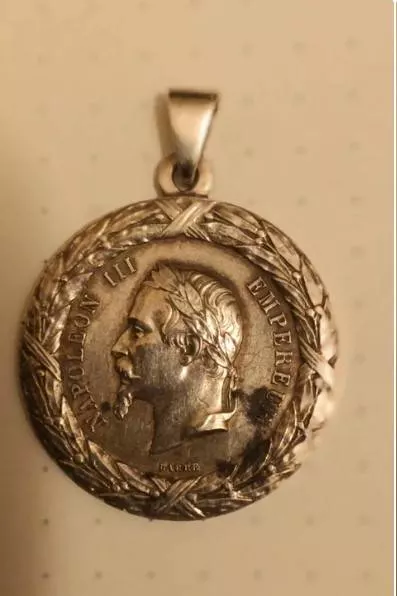
A tomb under willows, the date 5 May 1821 or the return of the ashes place an object after Napoleon's death. The likeness alone dates nothing: the medal by Depaulis for the passage of the Emperor's remains through Rouen, on 10 December 1840, bears his laureate head. A commemorative object is not a fake for all that: it is an antique in its own right, which deceives only when passed off as period. To settle the question, see how to spot fake militaria.
Period objects exist too, and the craftwork of captivity is well documented. At Norman Cross, near Peterborough, a prisoner-of-war camp from 1797 to 1814, the prisoners worked bone, straw and wood offcuts into model ships, guillotines or needlework boxes. Most were sold at the camp market, largely to local people, and handed down through the generations before being given to Peterborough Museum, whose collection numbers more than 800. That is the kind of history you need to be able to trace: see how to value a military item.
The Athena Militaria catalogue
Athena Militaria brings together listings from collectors, flea-market hunters and heirs with a passion for history. Each piece is put online by its seller, with their own photos, description, condition and shipping location: they set their price and delivery options, you write to them directly and can offer yours. The filters at the top of the page narrow your search by price, condition, town or date of publication, and the arrangement by period and sub-category takes you straight to your collecting field.
Buying with confidence
Before committing, look at the photos in full size and read the description of the condition. Markings are often the most telling clue: maker's stamps, hallmarks, numbers or sizes inside a helmet or on a cap. If they do not show, ask the seller for them through the messaging, along with more photos or details on the provenance, then make an offer. When the listing shows “Buy”, you pay through Stripe with Buyer Protection: the seller is only paid after you confirm receipt. Our team checks listings of weapons and Second World War pieces before publication. The whole process is explained on the how it works page and in security and payments. Want to part with a piece? Publish a listing in a few minutes.