Napoleonic medals for sale
Listings for sale
Guides for these pieces
- The St Helena Medal: recognising it and tracing its recipientThe St Helena Medal of 1857 for Napoleon's veterans: obverse, reverse, ribbon, box and certificate, who received it, and how to trace a recipient.
- Getting a military item appraised: who to ask and what to expectMilitaria expert, auctioneer or museum: who can appraise a military item in France, which titles are protected, and what a certificate must state.
- Selling militaria in France: what is allowed, what is notMost medals, helmets and uniforms can be sold freely in France. What the law regulates (weapons, ammunition, emblems) and the listing that protects you.
Have pieces from this period? List them for free: they will be seen by the collectors browsing this page.
Collecting Napoleonic medals and decorations
Created by the law of 29 Floréal Year X (19 May 1802), the Legion of Honour only received its insignia with the decree of 22 Messidor Year XII (11 July 1804); Napoleon presented the first crosses on 15 July at Les Invalides. A cross bearing Bonaparte as First Consul therefore has nothing to do with the Consulate: it dates from the Second Republic.
Dating a Legion of Honour cross
The 1804 insignia bears on the obverse the Emperor's head with the legend “Napoléon, Emp. des Français”, and on the reverse the eagle clutching a thunderbolt with the motto “Honneur et Patrie”. The first type has no crown on top; a decision of 14 April 1806 added one. Henri IV's effigy points to the Restoration if the reverse carries fleurs-de-lis, to the July Monarchy if it does not. The trap is the Second Empire, whose first crosses may have reproduced the last First Empire model: a hallmark of 1809-1819, a cockerel or a lictor's fasces, settles the question, but many First Empire knights' crosses carry no period hallmark. Our guide to dating a Legion of Honour cross covers each regime in turn.
The Order of the Reunion, St Helena and the papers
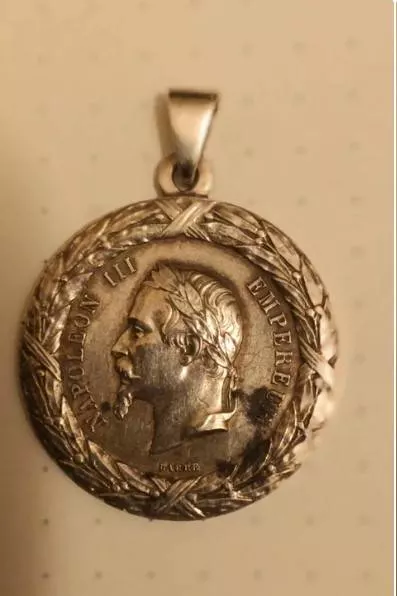
Created on 18 October 1811 in Amsterdam to replace the orders abolished by the Empire's annexations, the Order of the Reunion was gone by 1815. Its twelve-pointed star carries the mottoes “Tout pour l'Empire” (All for the Empire) and “À jamais” (Forever); its holders can be looked up in Ronald Pawly's Les Fastes de l'Ordre impérial de la Réunion (2021). The St Helena Medal, despite Napoleon I's profile, belongs to the Second Empire: instituted on 12 August 1857 for surviving veterans, it was issued without a name, and its certificate, described in our guide to the St Helena Medal, ties it to a man.
Paper provides the proof. According to the Legion of Honour's Grand Chancellery, the files of First Empire members were almost entirely destroyed at the Restoration, except for those who had sworn allegiance to Louis XVIII. A letter from the Grand Chancellor or a copy of the appointment decree kept with the insignia can therefore be the only link to its holder; without them, other cross-checks are needed.
The Athena Militaria catalogue
Athena Militaria brings together listings from collectors, flea-market hunters and heirs with a passion for history. Each piece is put online by its seller, with their own photos, description, condition and shipping location: they set their price and delivery options, you write to them directly and can offer yours. The filters at the top of the page narrow your search by price, condition, town or date of publication, and the arrangement by period and sub-category takes you straight to your collecting field.
Buying with confidence
Before committing, look at the photos in full size and read the description of the condition. Markings are often the most telling clue: maker's stamps, hallmarks, numbers or sizes inside a helmet or on a cap. If they do not show, ask the seller for them through the messaging, along with more photos or details on the provenance, then make an offer. When the listing shows “Buy”, you pay through Stripe with Buyer Protection: the seller is only paid after you confirm receipt. Our team checks listings of weapons and Second World War pieces before publication. The whole process is explained on the how it works page and in security and payments. Want to part with a piece? Publish a listing in a few minutes.