French parachutist wings and the airborne beret badge: recognising them, dating them, tracing the holder
By Augustin, founder of Athena Militaria Published 13 min read
The French military parachutist brevet, the badge known in English as French para wings or jump wings, is a metal breast badge: an open parachute between two wings, holding a star by its rigging lines, above two branches of laurel and oak. The École des troupes aéroportées in Pau awards it to members of all three services and the gendarmerie after a two-week course and six jumps. A number is engraved on the back, and the texts read do not always say whether it identifies the model or the holder: only paperwork links a brevet to a man. This guide follows the brevet, the badges related to it and the airborne beret badge, from the creation of the airborne troops training centre in 1946 to the present day: how to recognise them, date them and tell them apart from foreign wings and copies, using the official texts and museum records.
Get a piece identified from photos Valuing a piece: the method
In brief
- One brevet for every service. The École des troupes aéroportées in Pau awards it to parachutists of all three services and the gendarmerie, today after a two-week course and six jumps.
- A design set by regulation. A silver parachute holding a star by eight rigging lines, over two gold branches, on a badge 7 centimetres by 4.7.
- A number, not a name. Engraved on the back, it may identify the model or the holder depending on the text: only paperwork links a number to a man.
- Look-alike neighbours. Initiation, airborne leaders, free-faller, parachute instructor, free-fall instructor: the colour of the metal and what hangs from the rigging lines make the difference.
- The beret completes the brevet. A wing armed with a sword on a circle, or on an anchor for the troupes de marine, worn on the amaranth beret or on the Legion's green beret.
The brevet and the Pau school
According to the French Ministry of the Armed Forces, an airborne training centre, the CETAP, was set up on 16 April 1946; it became the École des troupes aéroportées in Pau, the ETAP, on 1 June 1947. The school now trains parachutists of all three services and the gendarmerie: some 4,000 trainees a year.
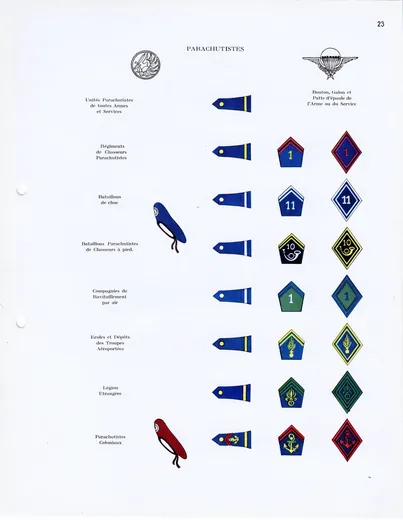
The texts read do not give the date on which the badge was created. The manual Uniformes et insignes de l'armée française, known as TTA 148, approved on 3 August 1949 and printed in 1954, contains a “Parachutistes” plate, reproduced at the top of this guide. At the top right, above the words “Bouton, galon et patte d'épaule de l'arme ou du service” (button, braid and shoulder strap of the arm or service), is a parachute between two wings, set on two branches and a star: a design close to the brevet's, though the plate does not call it that.
What today's texts say
The current rules are set out in a joint publication of the French armed forces staff, written with the ETAP: an instruction of 10 April 2013 on parachutist brevets, in its version amended on 23 June 2022. There the military parachutist brevet is a professional qualification certifying the ability to jump with an automatic-opening parachute. The course lasts two weeks, at the ETAP or with the 2e régiment étranger de parachutistes, and includes six jumps, among them one with a load and one at night; the commander of the ETAP awards the brevet.
The brevet goes beyond the army. A 2023 French Navy decision states that every fusilier marin certified as a commando holds the parachutist brevet, and the gendarmerie has its own specialised military parachutist brevet. Foreigners receive it too: a soldier who already holds his own country's brevet earns the French one after ground training and two jumps; in 2023, according to the Ministry of the Armed Forces, 63 Gabonese soldiers and gendarmes received it in Gabon.
Recognising the parachutist brevet
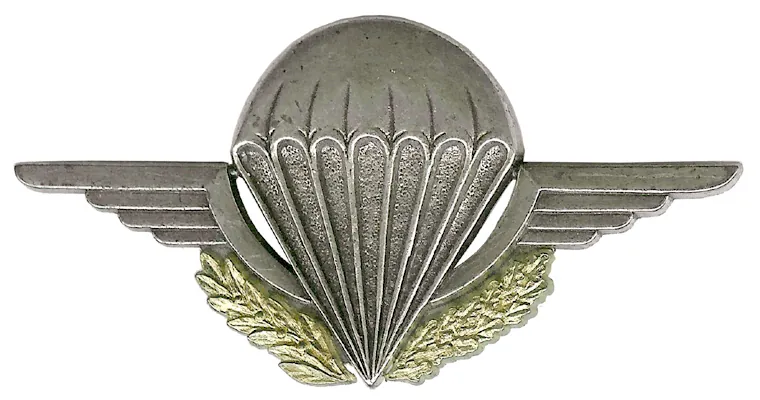
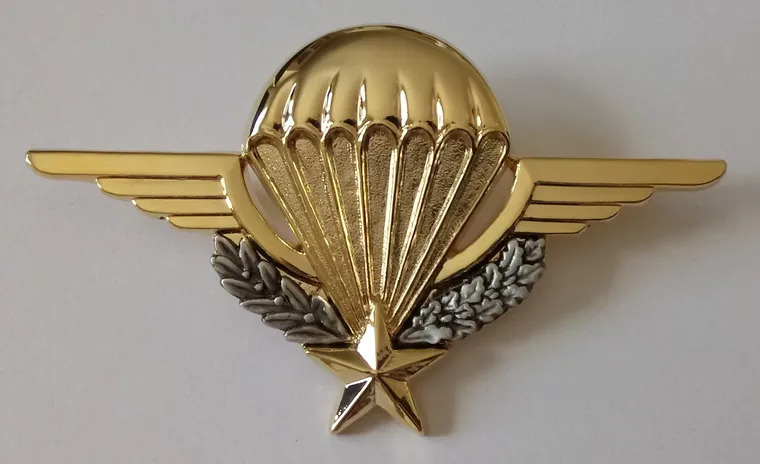
The 2022 publication gives the heraldic definition of the badge: a silver deployed parachute holding a star by eight rigging lines, supported by two gold branches, laurel on one side and oak on the other. It does not mention the wings, which the badges photographed below and the drawing on the 1954 plate nonetheless show.
The ministerial instruction of 10 April 2024 on military symbolism explains the logic of the variants: some qualifications can come in degrees, usually told apart by the colour of the metal or by added symbols.
The French Army's 2005 dress instruction lists the “brevet militaire de parachutisme” among speciality badges, under approval number G 1185. It places them above the flap of the right breast pocket, two at most, in metal only.
The brevet and its neighbours
Several brevets share the same design. Descriptions and sizes come from the 2022 publication; approval numbers from the 2005 list and, for the free-faller and both instructors, from the publication itself.
| Brevet or certificate | What sets it apart | Size | Approval number |
|---|---|---|---|
| Military parachutist brevet | Silver parachute, star held by eight rigging lines, gold branches | 7 × 4.7 cm | G 1185 |
| Military parachuting initiation brevet | Silver parachute without a star, gold branches | 7 × 4.7 cm | GS 47 |
| Airborne squad and section leaders, gendarmerie specialised brevet | Gold parachute, star, silver branches | 7 × 4.7 cm | Not given in the texts read |
| Operational free-faller | Gold parachute and wings, five blue stars, silver branches | 77 × 46 mm | GS 30 |
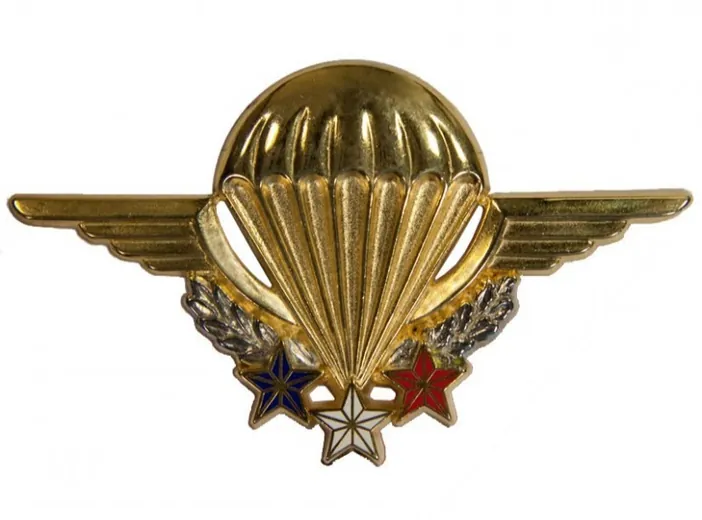
| Parachute instructor (moniteur) | Gold parachute and wings, three Olympic rings in blue, red and white, silver branches | 77 × 46 mm | G 1186 |
| Free-fall instructor | Gold parachute and wings, three stars in blue, red and white, silver branches | 77 × 46 mm | GS 101 |
| Pre-military parachute training | Metal badge, design not described in the texts read | Not given | H 597 |
The pre-military brevet, an integral part of pre-military parachute training, is meant for young volunteers: a week at the ETAP or with the 2e régiment de parachutistes d'infanterie de marine on Réunion, and two jumps. The initiation brevet takes three.



Embroidered and cloth brevets
The Australian War Memorial holds two cotton brevets from the 1950s, described as French Indochina parachute brevets: a brown rectangle, three horizontal lines, a parachute embroidered in front of a star. The 2024 instruction provides for woven or embroidered speciality badges, usually in a single colour, with no compulsory approval number. For a recent embroidered badge, the lack of a number is therefore nothing unusual in itself.
The number engraved on the back
A numbered brevet can carry two numbers. The approval number in principle identifies the model: the 2005 list gives G 1185 to the military parachutist brevet, and the 2024 instruction requires this number to be stamped or engraved on the back of metal badges. The award number, which the texts do not define, most likely identifies the holder. For the free-faller, the parachute instructor and the free-fall instructor, the 2022 publication states that the approval and award numbers of the brevet are engraved on the back.
For the military parachutist brevet, the publication only speaks of the approval number engraved on the back, while the ETAP enters the brevets awarded on an approval list used for checks and duplicates. So the texts read do not say whether that number is the model's or the holder's. The holder's service book, the livret matricule, receives the line “Titulaire du brevet militaire de parachutiste EPC”, with the brevet number, the school and the date.
The badge, handed over free of charge, stays with its holder; if it is lost, only the diploma can be duplicated, and replacing the badge is at his expense. The same parachutist may therefore have owned several badges, and an engraved number proves nothing without a diploma, a service book or a service record to confirm it.
Tracing the holder
The texts read provide for no public search from the number alone. According to the Service historique de la Défense, the military personnel archives centre in Pau holds the feuillet nominatif de contrôle from 1950 to 1982, the files of other ranks and NCOs of the army born from 1921 onwards and those of officers struck off the rolls from 1971. The service registers stay there until the person's 90th birthday, then go to the departmental archives of the place of registration, except for certain year groups listed in the service's leaflet.
Records can be consulted in Pau by appointment, free of charge, or remotely through paid copies. A former soldier can also ask for his état signalétique et des services, the statement of service: for the army and a registration in metropolitan France, Service-Public.fr points to an online request to the Service historique de la Défense or a form sent to the Pau centre. For older registers, see French military service registers by department; for the papers, reading and keeping military photographs and documents.
Diploma, certificates and jumps
Other papers go with the badge. For the initiation brevet, the 2022 publication mentions the diploma, the fitness record bearing the brevet number, extracts from the air mission orders and, for fewer than four jumps, a jump certificate; for the parachutist brevet, the diploma and the entry in the service book. In free fall, certificates are entered in an individual progress logbook.
Jumps also carry administrative weight: a 2022 French Navy decision, repealed as of 1 October 2023, made the air service allowance provided for by the decree of 28 December 1949 subject, among other conditions, to the regulation jumps of the sailors holding the brevet.
Maker, fastening and material
The texts read name no maker of brevets. The back is therefore read like that of a unit insignia, with the method in the guide to identifying and dating a French military insignia. If the back bears the Drago mark, the chronology of markings published by the Symboles et Traditions association for all the firm's insignia gives landmarks: “DRAGO 43 rue Olivier-Métra” from 1946 to 1951, “3 rue de Romainville” in 1952 and 1953, “DRAGO Paris” with no address from 1954 to 1988. These landmarks generally place the making, not the award of the brevet.
On fastening and material the texts read are silent: the definition speaks of silver and gold in the heraldic sense, without saying what the badge is made of. Check that the fastening and the back have aged together, and for a hallmark see reading the markings on a military item.
The airborne beret badge
The 2005 instruction describes the beret badge of the chasseurs parachutistes in heraldic terms, a “demi-vol armé brochant un cercle des extrémités, le tout argent”: a wing armed with a sword, set on a circle. Its tables also give it to the airborne units of the train, the artillery, the engineers and the cavalry, and to the Legion's parachutists. The 1954 plate shows at the top left an unlabelled round badge that resembles it: a sword in front of a wing, within a circle.
The badge of the troupes de marine parachutists
The parachutists of the troupes de marine wear a variant, a “demi-vol armé d'argent brochant une ancre encablée d'or”: the silver armed wing sits on the gold anchor instead of the circle. The texts read do not use the expression “para colo”; the closest text is the description of this badge.
The colour of the beret
The colour of the beret helps to place a photograph, without being enough to date it. On the 1954 plate, a blue beret is drawn level with the bataillons de choc and the parachute chasseur battalions; opposite the “Parachutistes coloniaux” are a red beret and three insignia bearing an anchor. The 2005 instruction gives the amaranth beret to the airborne troops, troupes de marine included, and the green beret to the Foreign Legion, parachutists included. The texts read do not date this change.
Airborne regimental insignia are read from the back, like any unit insignia: see the guide to French military insignia.
Foreign wings in the same lots
A French brevet did not necessarily belong to a Frenchman, and a lot can mix brevets from other countries. The French parachutist brevet is recognised by its branches and by the star held by the rigging lines. Museum records describe its neighbours differently, but the three cited here do not date the pieces: they show models, not a period.
- The American badge. The National Air and Space Museum in Washington describes the US Army basic parachutist badge as a single stamped piece: silver wings, a parachute in the centre, a pin hook fastener. Its record mentions neither branches nor a star.
- The British badges. The same museum holds two, embroidered: a white parachute on olive drab felt for the course-qualified parachutist, gold wire wings and a silver wire parachute on black felt for dress uniform.
- The Belgian brevet. The sources read give no institutional description of it: compare it with a documented piece before drawing a conclusion.
Copies, restrikes and added numbers
A photograph is not enough to tell a period brevet from a recent production or a copy. A few checks help, without accusing anyone:
- Size. 7 centimetres by 4.7 for the parachutist brevet, 77 by 46 millimetres for the free-faller, parachute instructor and free-fall instructor brevets, according to the 2022 publication. The texts read do not say whether the first productions followed these measurements: a difference calls for a comparison, not a verdict.
- Design. A piece matching no line of the table may come from another service, another country or a production outside the regulations.
- The back. Mark, number and fastening are read together; whether it identifies the model or the holder, the engraved number does not date the example on its own.
- The award number. It only counts once confirmed by a paper in the same name.
A reproduction can also be entirely regular. The 2024 instruction has the first examples of a newly approved badge sent to the Service historique de la Défense, and that deposit, provided the object conforms, serves as the reference for later reproductions; a reproduction made outside the armed forces needs the agreement of the Service historique de la Défense. A recent production is therefore not necessarily a fake, but it does not date from the brevet's early years.
What I cannot tell you here
The text creating the brevet and its badge was not found online for this guide: its date of creation remains to be confirmed. For lack of a public source, the maker and the fastening do not date a brevet to the year either. Books not read for this guide may manage it: Insignes et brevets parachutistes de l'armée française, by Jacques Baltzer and Éric Micheletti, the first volume by Luc Binet and Dominique Humbert on French Army brevets, or, for the instructor's brevet, Mark Bruschi's article on the parachute instructor brevet from 1946 to 1962.
Nothing in the sources read confirms that the 2005 dress instruction, amended in 2006, is still in force: its descriptions hold for its date, not necessarily for today. I cannot tell you, from a photograph, whether an engraved number matches the man who wore the brevet: only his papers establish that.
I give no prices: the method is in valuing a military item. For a particular piece, photograph the front, the back, the number and the fastening, with a ruler for scale, add the papers, then ask for free identification help. To compare, see the Indochina War, Algerian War and Cold War pieces for sale on the site.
Frequently asked questions
What is the French military parachutist brevet?
It is the qualification that allows a member of the forces to jump with an automatic-opening parachute, shown by a metal breast badge. The École des troupes aéroportées in Pau, which grew out of a training centre set up in 1946, awards it to members of all three services and the gendarmerie. Today the course lasts two weeks and includes six jumps, among them one with a load and one at night.
How do you recognise French para wings?
The parachutist brevet shows a silver-coloured parachute holding a star by eight rigging lines, between two wings and above two gold-coloured branches of laurel and oak; it measures 7 centimetres by 4.7. The related brevets change the metal or what hangs from the rigging lines: no star for the initiation brevet, five blue stars for the operational free-faller, three Olympic rings for the parachute instructor. The table in this guide sums up these differences.
What does the number on the back of French jump wings mean?
Two numbers can appear there. The approval number in principle identifies the model, G 1185 for the military parachutist brevet in the 2005 list; the award number, which the texts do not define, most likely identifies the holder: the École des troupes aéroportées records the brevets awarded on its list, and the service book carries a brevet number. For the parachutist brevet, the 2022 publication only mentions an approval number engraved on the back, without saying whether it identifies the model or the holder. Only the holder's papers link a number to a name.
How do you trace the holder of a numbered French parachutist brevet?
Through his papers: the diploma and above all the service book, whose brevet entry carries the number. The list kept by the École des troupes aéroportées is used for checks and duplicates, and the texts read provide for no public search from the number alone. The military personnel archives centre in Pau holds, among other records, the feuillet nominatif de contrôle from 1950 to 1982, until the person's 90th birthday.
How many jumps does the French parachutist brevet require?
Six automatic-opening jumps, according to the joint publication amended in 2022: three by day, then one with weapons and a haversack, one with a load and one at night. The commander of the École des troupes aéroportées may exceptionally award the brevet after five jumps to a whole course. The initiation brevet takes three jumps, the pre-military brevet two.
What is the French paratrooper beret badge?
A wing armed with a sword, set on a circle, all in silver colour: the French Army's 2005 dress instruction describes it as a “demi-vol armé brochant un cercle des extrémités”. According to that instruction, it is worn on the amaranth beret of the airborne troops and on the green beret of the Legion's parachutists. The parachutists of the troupes de marine have a variant set on an anchor.
What is the para colo badge?
The texts read do not use this expression. The closest text is the beret badge of the parachutists of the troupes de marine: a “demi-vol armé d'argent brochant une ancre encablée d'or”, according to the French Army's 2005 dress instruction. The silver armed wing sits on the gold anchor instead of the circle. On the “Parachutistes” plate of the 1954 manual, the row of the colonial parachutists already shows a red beret and an anchor.
How much are French para wings worth?
This guide gives no prices. It helps you check what makes a piece interesting: the type of brevet, a design consistent with the texts, what the back shows and above all a diploma or service book that links the number to a man. The full method is in the guide to valuing a military item.
Sources
This guide draws on the texts, databases and pages below, accessed on unless otherwise stated. Most of them are in French.
- French Ministry of the Armed Forces, French Army, “École des troupes aéroportées”: creation of the training centre on 16 April 1946 and of the ETAP on 1 June 1947, the school's missions and courses
- CLADE.net, portal of the libraries of the French Ministry of the Armed Forces, “Uniformes et insignes de l'armée française: approuvé le 3 août 1949” (TTA 148): record of edition no. 1, printed in 1954
- French armed forces staff, joint publication PIA-3.2.1.2(A) BCQ-PARA, instruction no. D-13-004443/DEF/EMA/EMP.3/NP of 10 April 2013 on obtaining parachutist brevets, certificates and qualifications, booklet 1, version amended on 23 June 2022 (CICDE)
- Decision no. 1203-2023/ARM/DPMM/PMS of 19 October 2023 on the posts entitled to the specific skills bonus for specialised parachutist combatants, French Navy personnel directorate, Bulletin officiel des armées
- French Ministry of the Armed Forces, on the French forces in Gabon awarding the parachutist brevet to 63 members of the Gabonese defence and security forces, 7 December 2023
- Instruction no. 849/ARM/SGA/DMCA/SHD/DHS/DSD of 10 April 2024 on military symbolism in the armed forces and the gendarmerie, Bulletin officiel des armées, accessed
- Instruction no. 10300/DEF/EMAT/LOG/ASH - DEF/DCCAT/LOG/REG of 13 June 2005 on the dress and uniforms of French Army personnel, amended on 13 July 2006: speciality badges, berets and beret badges, on Légifrance
- French armed forces staff, joint publication PIA-3.2.1.2(A) BCQ-PARA, booklet 2: specialisation brevets (operational free-faller, parachute instructor, free-fall instructor), version amended on 23 June 2022 (CICDE)
- Australian War Memorial, record REL34028, “French Indochina Parachute Brevet”: cotton brevet of the 1950s, parachute embroidered in white
- Australian War Memorial, record REL34029, “French Indochina Parachute Brevet”: cotton brevet of the 1950s, parachute embroidered in black in front of a yellow star
- Service historique de la Défense, military personnel archives centre in Pau, leaflet on keeping and consulting its archives: service registers, individual files, conditions of access
- Service-Public.fr, on the certificate of services rendered (état signalétique et des services) and where to request it, accessed
- Decision no. 1314-2022/ARM/DPMM/PMS of 24 November 2022, repealed as of 1 October 2023, on the French Navy posts entitled to the air service allowance for parachutists, citing decree no. 49-1655 of 28 December 1949, Bulletin officiel des armées
- Symboles et Traditions, history of the Drago firm, with its chronology of insignia markings (text collected by Yves Talmech), accessed
- Smithsonian, National Air and Space Museum, record A19810604000, “Badge, Parachutist, United States Army”
- Smithsonian, National Air and Space Museum, record A19730497000, “Insignia, Course Qualified Parachutist, British Army”
- Smithsonian, National Air and Space Museum, record A19730499000, “Insignia, Parachutist, Dress, British Army”
- CLADE.net, portal of the libraries of the French Ministry of the Armed Forces, “Insignes et brevets parachutistes de l'armée française”: record of the book by Jacques Baltzer and Éric Micheletti, Histoire et Collections, 2001
- CLADE.net, portal of the libraries and documentation centres of the French Ministry of the Armed Forces, “Les brevets, insignes de spécialités, de concours et de récompense officiels de l'armée de terre et des services communs. Tome I”: record of the book by Luc Binet and Dominique Humbert, published by SOTECA and the Service historique de la Défense in 2011, accessed
- CLADE.net, portal of the libraries of the French Ministry of the Armed Forces, “Le brevet de moniteur parachutiste (1946-1962)”: record of the article by Mark Bruschi, Uniformes, no. 352, January-February 2024, pp. 14-22