Reading a French WW1 soldier's postcard or letter: the man, his unit, the date
By Thomas, contributor to Athena Militaria Published 14 min read
A French soldier's postcard or letter from the First World War is sometimes all a family keeps of its poilu: a few lines, a sector number, a round postmark. These papers say more than they seem to. The F.M. mention, the sender's block, the “Trésor et Postes” postmark and the marks of postal control give a unit and a date, and sometimes the place the soldier was not allowed to write. Here is how to read them in order, then follow the unit in its records, based on museum records and the work of historians and philatelists.
Get a piece identified from photos Valuing a piece: the method
In brief
- Free mail. A French soldier wrote under the military franchise: “F.M.” on a shop-bought postcard, or the official card headed “Correspondance des Armées de la République”.
- An address without a place. From December 1914, the secteur postal, or postal sector, served as the address at the front: a number grouping several units, never a location.
- A postmark that dates. The “Trésor et Postes” date stamp gives a date, and a number to compare with the postal sector.
- Control by sampling. Postal control read a share of the letters; most of those it seized were to be destroyed.
- A method. The regiment and the date lead to the unit's war diary, which says where it was.
A military post between the front and home
At the front, mail was handled by a military service. The Treasury and Postal Service of the Armies, established by a decree of 1877, was a wartime organisation whose staff counted as soldiers, explains the historian Florence Descamps. In August 1914 the War Ministry set up a single administration, “Trésor et Postes”, according to the APRA, the Rouen philatelic association.
In the first weeks of fighting, mail could not be delivered properly, note the Nièvre departmental archives. According to the historian Christophe Prochasson, the arrival of professional postal workers improved the service in some corps from November 1914, and the military post was reorganised at the end of the year.
According to the APRA, the Central Military Office, the Bureau central militaire, sorted mail by postal sector; at divisional offices it was sorted by regiment, and the vaguemestre, the unit's postal orderly, handed it to the company. In normal times that office handled 3.5 to 4 million letters a day, according to Christophe Prochasson.
The military franchise: what “F.M.” and the official card say
Soldiers wrote without stamps. The official card let them send their mail free of charge and without any limit, note the Nièvre archives; on a commercial postcard, the letters F.M. stand for franchise militaire, military free post. According to the APRA, ordinary postcards qualified for the franchise through the handstamps of services: a railway station commission, a territorial squadron or a hospital.
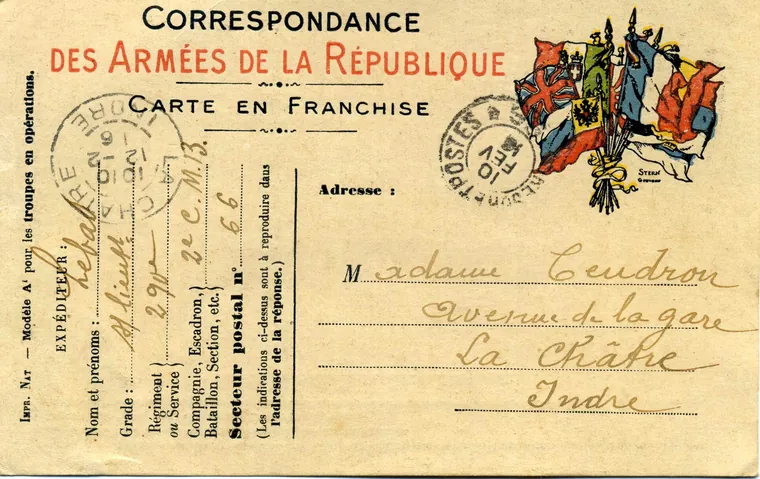
The “Correspondance des Armées de la République” cards
The official cards came from the French state printing works: they carry “Impr. Nat.” and the name of their model, explains the APRA. Model A1 was for troops in the field: some copies carry six Allied flags, others seven and then eight, adding Italy, Japan and the United States, others none. Model A2 was for soldiers at their regimental depot or stationed in a town; model B was sold to the public for writing to soldiers.
An A1 card in the Nuits-Saint-Georges museum measures 14 by 9 cm. It asks the sender for his names, rank, regiment, company and “secteur postal n°”, and warns that the card must be handed to the postal orderly and must give no indication of where it was sent from and no information on past or future military operations.
The Historical Museum of the Palatinate in Speyer even holds an official card with printed sentences, such as “Je vais bien” (I am well) and “Lettre suit à la première occasion” (letter follows at the first opportunity): nothing was to be added except the date, “without indication of origin”, and the signature, and unnecessary sentences could be struck out. The so-called cartes de l'espérance, letter-cards with a printed stamp, are something else: according to the APRA, these private-company items did not qualify for the franchise.
The secteur postal: an address that hides the unit
Postal sectors date from December 1914. According to Florence Descamps, two decrees, of 18 November and 11 December 1914, reorganised the military post, placed it under the general headquarters and created 150 postal sectors; Christophe Prochasson has the measure in force from 1 December. The sources consulted do not give the same day, but all place the creation of the sectors at the end of 1914.
The principle, as Christophe Prochasson puts it: a postal sector was not a territorial district but the grouping of the elements that received their mail from the same paying office. Soldiers therefore had to give their sector to their families, and the system kept the positions and movements of troops secret.
A sector number is therefore not a place, and on its own it does not identify a regiment: the regiment is written next to it. On a card of 22 June 1915 in the Speyer museum, the sender gives his regiment, the 46th Infantry, his battalion, company, section and “Secteur postal 10”; he is writing to a corporal of the 54th, 3rd company, “Secteur 33”.
The number in the postmark
The service's date stamp reads “Trésor et Postes” and carries a number. On two cards in Speyer, that number is the sector given by the sender: 10 on the card from sector 10, struck on 24 June 1915; 118 on the card of a soldier of the 128th Infantry, sector 118, struck on 13 March 1916. If the sender did not write his sector, a legible postmark can supply it.
Postmarks: the date, the service, the postal orderly
Read each mark for what it is:
| What you see | What it tells you |
|---|---|
| “F.M.”, handwritten | An item sent under the military franchise, without a stamp |
| “Correspondance des Armées de la République”, “Impr. Nat.”, a model | An official card and its use: A1 for troops in the field, A2 at the depot, B for writing to soldiers |
| “Expéditeur” block, filled in by hand | The sender's name, rank, regiment, company and postal sector |
| “Trésor et Postes” date stamp | A date, and a number to compare with the sector written |
| Handstamp of a unit or service | The service that granted the franchise: station commission, squadron, hospital |
| “Contrôle postal militaire” label | A letter opened by postal control, then resealed |
| “Kriegsgefangenensendung”, “Portofrei” | Prisoner-of-war mail |
Compare the date of the postmark with the date of the text. On the two Speyer cards mentioned above, the postmark follows the date written by the soldier by two days: 22 and 24 June 1915, 11 and 13 March 1916.
Be careful with an unused card bearing a postmark: faced with two such cards, the APRA cannot decide between cards prepared in advance and favour cancellations. Jérôme Bourguignat, of the French Academy of Philately, also found in the records of the Service historique de la Défense a seizure made because someone was collecting the army post's date stamps.
Postal control and censorship: what the marks tell you
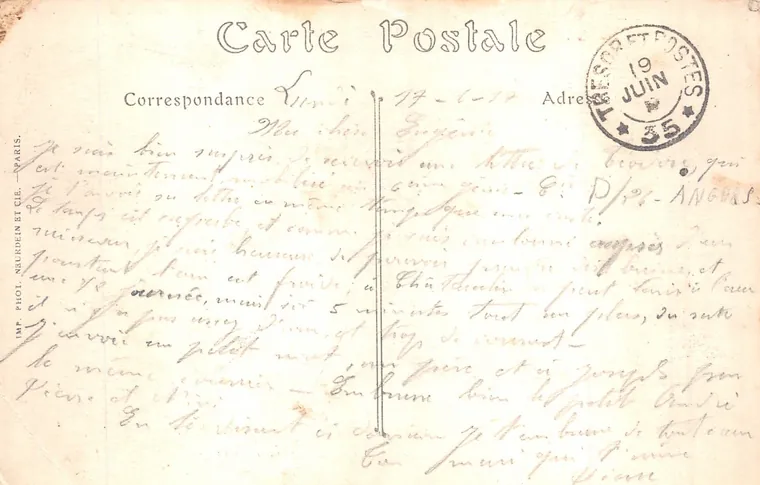
Soldiers were strictly forbidden to tell their families where they were on the front, recalls the historian Rémy Cazals. Postal control in the army zone watched the letters of soldiers and of civilians near the front, sent detailed reports on morale to general headquarters and worked by sampling, explains Jérôme Bourguignat.
The historian Bruno Cabanes gives the scale: commissions of fifteen to twenty-five people checked every regiment at least once a month, some 180,000 letters a week, between a fortieth and an eightieth of the army's mail. Their records, he stresses, are not those of military censorship: they assess opinion and the morale of the troops.
So control rarely shows. Of the 463 letters Jules Puech sent his wife between March 1915 and August 1916, only one was opened and resealed with a “Contrôle postal militaire” label, notes Rémy Cazals. Yet control marks from the army zone come in a great many types, down to a handstamp reading “Vues interdites”, forbidden views.
A seized letter is another matter. An instruction of 9 July 1915 ordered seized mail to be destroyed, except that of prisoners of war and of wartime godmothers abroad: very little of this mail from the army zone has survived, notes Jérôme Bourguignat. One franchise card was seized because it began “je suis arrivé à Épernay”, I have arrived at Épernay.
Soldiers found ways round the ban. Jules Puech refers to Verdun by a periphrasis, “the town of the Weiss son”, announces his billet at Montzéville in an acrostic, and sends a few letters through the civilian post, which was watched far less closely: a soldier could hand a stamped envelope to a man going on leave. Others, according to the APRA, wrote in code or in dialect.
Getting the unit and the date, then following the unit
Take the card by its address side and work in this order:
- The sender's block. Name, rank, regiment, company, postal sector: copy it character by character, abbreviations included.
- The “Trésor et Postes” postmark. Note its date and number, and compare the number with the sector written by the sender.
- The date of the text. It comes shortly before the postmark; a long gap needs explaining.
- The other handstamps. A hospital, station or unit handstamp places the sender's service.
- The unit's war diary. With the regiment and the date, open its journal des marches et opérations.
The war diaries of most French army units are online on Mémoire des hommes, and the APRA itself suggests following a regiment's path this way. For the man himself, his service record gives his successive postings: the method is in tracing a French soldier of 1914-1918.
When the place is missing
The Trésor de la langue française defines quelque part, somewhere, as a place that one cannot or will not specify. On a poilu's card, the place is missing first of all because it was forbidden. The unit's war diary, at the date of the postmark, gives it back to you.
Sometimes the soldier gave it himself. The Nièvre archives show a franchise card whose writer says he is in the Ypres sector, delivered all the same, and a picture postcard on which a soldier marks with a cross the spot of his baptism of fire. A view alone proves nothing: it counts when the text refers to it.
Prisoner-of-war cards, 1914 to 1918
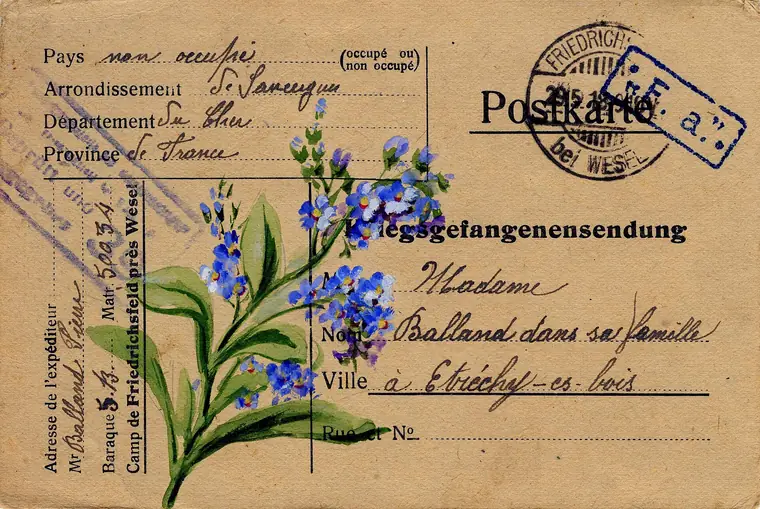
Prisoners also wrote free of charge: the regulations annexed to the Hague Convention of 18 October 1907 exempt from all postal charges letters and parcels addressed to or sent by prisoners of war. The APRA shows a franchise card, marked “taxfrei”, of 30 September 1918, from the prison camp at Langensalza.
These cards can be recognised by their printed wording, often in two languages. The Speyer museum holds a letter-card headed “Kriegsgefangenensendung”, prisoner-of-war mail, marked “Portofrei” with the French “Franchise postale”, with a “Geprüft” box for the company commander's check and “France” at the bottom. A card written on 9 June 1915 to a prisoner at the Ebenberg camp in Landau bears the stamp of a German inspection office at Ludwigshafen.
A slip shown by Jérôme Bourguignat recalls that exchanging letters between soldiers in the army zone and prisoners of war was forbidden. To trace a prisoner, consult the card indexes of the International Prisoners-of-War Agency, put online by the ICRC.
Picture postcards, embroidered cards, vignettes
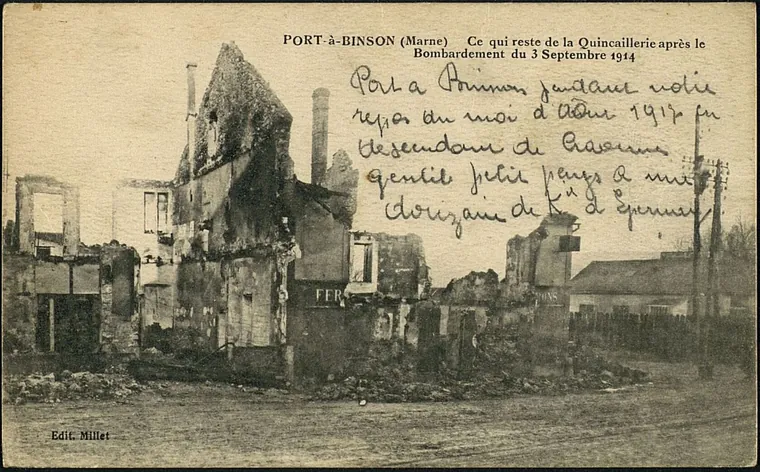
Commercial postcards were widely used, says the APRA, which counts 132 types of “carte correspondance militaire”. The Speyer museum holds one “for civilian or soldier, to be forwarded immediately”, decorated with six flags around a soldier's portrait and the year 1915.
The printed caption dates the edition, not the sending: the Nièvre archives show a card captioned “guerre de 1914”, made in the second half of 1914 and written on 3 January 1915, and another captioned “La Grande Guerre 1914-1916”, written on 11 March 1917.
Embroidered silk postcards were produced from 1914 to 1918, mostly by French and Belgian women refugees, according to National Museums Liverpool; hugely popular with British and American servicemen, they declined sharply from 1919.
Regimental vignettes are a quieter trap. A collection in the French Ministry of the Armed Forces library holds 1,252 of them, most published by Delandre between 1914 and 1917: although they looked like postage stamps, they could not be used to pay postage. Stuck on a card, a vignette is therefore not enough to prove either that it was posted or the sender's unit: rely on the postmark and the text. For a portrait printed in postcard format, see reading and keeping military photographs and papers.
Period card or reprint?
A card that travelled carries its own evidence: an address, a text and postmarks that agree with one another. An unused card says far less. Check four points:
- The size. The franchise cards described by museums and by the APRA measure about 14 by 9 cm.
- The printer. An official card carries the imprint of the French state printing works, “Impr. Nat.” or “Imp. Nat.”, and its model.
- Consistency. The postmark date comes shortly after the text, and its number can be checked against the sector written.
- Marks that are too good. Jérôme Bourguignat reports a seizure handstamp whose authenticity is uncertain: every example he has seen is addressed to the same man in Amiens, a great collector of postal markings.
Lastly, “F.M.” dates nothing on its own. The French Academy of Philately shows a military franchise card of 3 December 1918, checked at Constantinople, and postal control was lifted only on 15 August 1919. Much later, the Indre-et-Loire archives hold the envelope of a conscript of the Algerian War, from 1956, marked “FM” and stamped “Poste aux Armées”. So date each piece by its postmarks and its text before filing it under the Great War.
Keeping correspondence
Keep the letter with its envelope, which often carries the postmark and the address, and all the cards from the same man together, in the order in which you found them. Do not peel off stamps, vignettes or labels, and do not write on the originals. The ways to look after paper are in caring for militaria without destroying its value.
What I cannot tell you here
I cannot tell you from a photograph whether a postmark is genuine, nor turn a sector number into a regiment: a sector covered several units, and I cite no conversion table, having read no reliable public source for one. I give no prices: what makes correspondence interesting is a legible text, an identifiable sender, clear postmarks and, above all, the full set of cards from one man. The method is in valuing a military item.
For a particular card, photograph both sides in full, then have it identified free of charge. First World War cards, letters and papers for sale on the site are gathered in First World War documents.
Frequently asked questions
What is a French WW1 secteur postal?
It is the address that replaced the place in army mail from December 1914. According to the historian Christophe Prochasson, a postal sector was not a territorial district but the grouping of the elements that received their mail from the same paying office, and the system kept troop positions secret. The number therefore gives neither a place nor, on its own, a regiment: the regiment is written next to it, in the address.
What does F.M. mean on a French WW1 postcard?
F.M. stands for franchise militaire, military free post: the card went free of charge, without a stamp. On a commercial postcard, the handstamps of services, a station, a squadron or a hospital, granted the franchise. The mention alone does not date the card: it is found long after 1918, for instance on a 1956 envelope marked “FM” and stamped “Poste aux Armées”.
What is a French military franchise postcard?
It is a card printed by the French state printing works under the heading “Correspondance des Armées de la République”, for writing free of charge. Model A1 was for troops in the field, model A2 for soldiers at the depot or stationed in a town, and model B, sold to the public, for writing to soldiers. An A1 card in the Nuits-Saint-Georges museum measures 14 by 9 cm and warns that it must be handed to the postal orderly, with no indication of where it was sent from.
How do you find a French soldier's regiment from his WW1 postcard?
Read the sender's block: name, rank, regiment, company, postal sector. Then note the date and number of the “Trésor et Postes” postmark, to compare with the postal sector. With the regiment and the date, open the unit's war diary on Mémoire des hommes, then look for the soldier's service record in the French departmental archives.
Were French WW1 soldiers' letters censored?
They went through postal control, which read a share of them by sampling: according to the historian Bruno Cabanes, about 180,000 letters a week for the whole army, between a fortieth and an eightieth of the mail. A letter that had been read could be resealed with a “Contrôle postal militaire” label, which remains rare on surviving letters. An instruction of 9 July 1915 ordered most seized letters to be destroyed: very few have survived.
Why don't French soldiers' letters say where they were?
Because it was forbidden: the official franchise card warned that it must give no indication of where it was sent from and no information on military operations. Some soldiers got round the ban with a periphrasis, an acrostic, a code or a cross on the picture side of a postcard. To find the place, start from the unit and the date, then read the unit's war diary for that day.
How much is a WW1 French postcard worth?
This guide gives no prices: no price guide holds for every card. What makes a card interesting can be checked on the piece itself: a legible text, an identifiable sender, clear and consistent postmarks and, above all, a set, the cards and papers of one man kept together. The method for placing a piece is set out in the guide to valuing a military item.
How can you tell an original WW1 military postcard from a reproduction?
A card that travelled carries its own evidence: an address, a text and a date stamp whose date comes shortly after the text. Official franchise cards measure about 14 by 9 cm and carry the imprint of the French state printing works with their model. An unused card, or a rare mark that looks too perfect, calls for more caution: have it examined before drawing conclusions.
Sources
This guide draws on the texts, databases and pages below, accessed on unless otherwise stated. Most of them are in French.
- Florence Descamps, “Le ministère des Finances dans la Grande Guerre, désordres, inadaptation ou crise de mutation ?” (the French Finance Ministry in the Great War), in Finances publiques en temps de guerre, 1914-1918, Institut de la gestion publique et du développement économique, on OpenEdition Books
- Jean-Pierre Legras, “La Première Guerre mondiale vue par la philatélie française” (the First World War seen through French philately), Rouen philatelic association (APRA)
- Nièvre departmental archives, “Correspondre durant la Grande Guerre” (corresponding during the Great War): letters, cards supplied by the military authorities and postcards from the Jean Locquin papers
- Christophe Prochasson, “Aimer et gouverner à distance. Aperçus sur la correspondance familiale durant la Grande Guerre” (family correspondence during the Great War), in Éloignement géographique et cohésion familiale (XVe-XXe siècle), Presses universitaires de Strasbourg, on OpenEdition Books
- Nuits-Saint-Georges municipal museum, “Correspondance des Armées de la République” franchise card, model A1 for troops in the field, illustrated for a war loan (inv. 95.5.502), Joconde database on POP
- Historical Museum of the Palatinate, Speyer, French franchise card with printed sentences (inv. HM_0_10002_018), on museum-digital (record in German)
- Historical Museum of the Palatinate, Speyer, card of 22 June 1915 from a soldier of the 46th Infantry Regiment, postal sector 10, “Trésor et Postes” postmark 10 of 24 June 1915 (inv. HM_0_10003_046), on museum-digital (record in German)
- Historical Museum of the Palatinate, Speyer, card of 11 March 1916 from a soldier of the 128th Infantry, sector 118, “Trésor et Postes” postmark 118 of 13 March 1916 (inv. HM_0_10003_025), on museum-digital (record in German)
- Rémy Cazals, “Comment tromper la censure. Correspondance 1915-1916 de Jules et Marie-Louise Puech” (how to outwit the censor: the letters of Jules and Marie-Louise Puech, 1915-1916), Cahiers d'Études germaniques, no. 71, 2016, on OpenEdition Journals
- Jérôme Bourguignat, “Le contrôle télégraphique et postal militaire pendant la Première Guerre mondiale (2e partie)” (military telegraph and postal control in the First World War, part 2), lecture of 11 November 2007, Académie de philatélie
- Bruno Cabanes, “L'anticipation de la paix, à travers le contrôle postal du 11 novembre 1918” (anticipating peace through the postal control of 11 November 1918), in Alain-René Michel and Robert Vandenbussche (eds), L'idée de paix en France et ses représentations au XXe siècle, Institut de recherches historiques du Septentrion, 2001, on OpenEdition Books
- Jérôme Bourguignat, Le contrôle postal et télégraphique français pendant la Première Guerre mondiale (1914-1921) (French postal and telegraph control in the First World War), addendum no. 1, Académie de philatélie, 2022
- Jérôme Bourguignat, “Le courrier saisi dans la zone des Armées durant la Première Guerre mondiale” (mail seized in the army zone during the First World War), lecture of 3 December 2022, Académie de philatélie
- Mémoire des hommes, French Ministry of the Armed Forces, diaries of the units engaged in the First World War: war diaries of most army units (sub-series GR 26 N), accessed
- Trésor de la langue française informatisé, entry “part” (meaning of “quelque part”), on the CNRTL website
- Convention respecting the Laws and Customs of War on Land, The Hague, 18 October 1907, and its annexed regulations (article 16), French text published by the Swiss Confederation (SR 0.515.112)
- Historical Museum of the Palatinate, Speyer, prisoner-of-war letter-card for France, “Portofrei / Franchise postale” (inv. HM_0_10002_005), on museum-digital (record in German)
- Historical Museum of the Palatinate, Speyer, French card of 9 June 1915 to a prisoner at the Ebenberg camp, Landau (inv. HM_0_10003_019), on museum-digital (record in German)
- International Committee of the Red Cross, Prisoners of the First World War: card indexes and lists of the International Prisoners-of-War Agency, searchable by nationality and status, accessed
- Historical Museum of the Palatinate, Speyer, French card of 9 October 1915 “for civilian or soldier, to be forwarded immediately” (inv. HM_0_10003_012), on museum-digital (record in German)
- National Museums Liverpool, “Postcard; Embroidered”: First World War embroidered silk postcards
- French Ministry of the Armed Forces libraries (CLADE), record of a collection of regimental and patriotic vignettes of the First World War
- Jérôme Bourguignat, “Le contrôle télégraphique et postal militaire pendant la Première Guerre mondiale (3e et dernière partie)” (military telegraph and postal control in the First World War, part 3), lecture of 2 February 2008, Académie de philatélie
- Indre-et-Loire departmental archives, “Le témoignage des appelés tourangeaux” (letters from local conscripts), teaching file on memories of the Algerian War in Indre-et-Loire, sheet 1.c