The Great War trench knife: recognising a Coutrot, a “Vengeur” and their foreign cousins
By Augustin, founder of Athena Militaria Published 13 min read
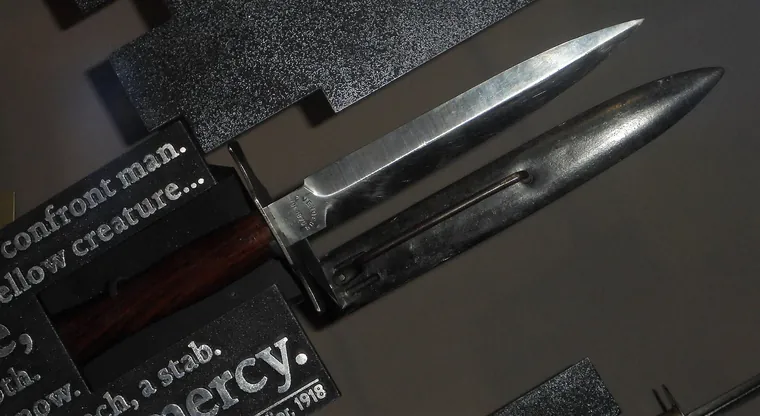
A Great War trench knife can often be recognised by one detail: the four ridges of a blade cut from a Lebel bayonet, the inscription “Le Vengeur de 1870” at the base of a flat blade, or a bronze knuckle-duster grip. The French army organised their manufacture from 1915, first at Châtellerault, then around Thiers. The Americans and the Germans, fighting on the same front, had their own. Here is how to tell them apart, read their markings and spot a made-up piece, from the records of the museums that hold them.
Get a piece identified from photos Valuing a piece: the method
In brief
- A weapon born in the trenches. Too long in a communication trench, the bayonet gave way to the dagger, improvised in late 1914 and regulation issue from 1915.
- 1915: the Coutrot daggers. Designed at Châtellerault, the first ones were sections of Lebel bayonet: a four-ridged blade, a wooden grip, a leather sheath.
- 1916: “Le Vengeur”. The 1916 pattern knife-dagger, made mostly around Thiers: a flat double-edged blade, a broad steel crossguard, a metal scabbard.
- 1870 is not a date of manufacture. “Le Vengeur de 1870”, the Avenger of 1870, sometimes found at the base of the blade, is a brand name registered in Thiers in late 1915, calling for revenge for the defeat of 1870-1871.
- Foreign patterns can be told apart. The American 1917 knife has a triangular blade with no edge, the Mark I a bronze knuckle-duster grip; the German knife, most often made in Solingen, usually has a single edge.
Why a knife in the trenches
Trench warfare brought back the dagger, a weapon long abandoned, notes the Musée du Génie, the French army engineers' museum in Angers: in so narrow a space, the bayonet was too long, even held in the hand. What the soldiers wanted, the Musée de l'Armée explains, was a weapon for hand-to-hand fighting between the close walls of trenches and communication trenches, and for night patrols.
In late 1914 and early 1915, men improvised with butchers' knives, daggers from old Navy stocks, forged iron rods fitted with handles, and cut-down bayonets or sabre blades, according to the Musée du Génie. The army also requisitioned pocket knives: an article from the Université Clermont Auvergne notes that by September 1915, 46,816 lock knives had been shipped since the start of the war. Made for civilian use, they were too fragile: a 3 mm blade, a handle held by a nail, no guard.
According to the Musée du Génie, these weapons went mainly to the corps francs, the raiding parties, and to the trench “cleaners”, the nettoyeurs de tranchée, who searched the saps and dugouts bypassed by the assault. The Musée de l'Armée adds a caveat: deaths by the blade remained a minority, and French training manuals, unlike German ones, never mention using the knife, which seems above all to have reassured the men.
The 1915 Coutrot daggers, cut from the Lebel bayonet
In 1914 Lieutenant-Colonel Coutrot, retired since 1907, chaired the machine-gun acceptance commission at the Châtellerault arms factory. In 1915 he designed a series of regulation daggers: fourteen successive patterns, according to the Musée de l'Armée, all known as the “1915 pattern”, according to the Musée du Génie. They were made by the Chéron, Vogt et Compagnie and Georges Pagé cutlery firms, with leather sheaths by Jouteau-Richard.
The first ones recycled Lebel or Gras bayonet blades supplied by the arms factory. According to the Musée du Génie, one 1886 pattern Lebel sword bayonet, cross-shaped in section, gave three daggers, nos. 1, 1 bis and 2, which differ only in how tapered the blade is; the Imperial War Museum in London speaks of two or three blades, taken from imperfect bayonets rejected by the inspectors. The Musée du Génie's no. 1 comes from the base section, London's no. 2 from the tip of a Lebel bayonet.
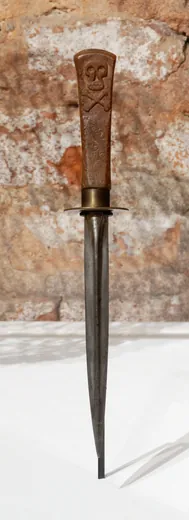
The Musée du Génie's no. 1, of 1915, is 27.7 cm long, 15 cm of it blade, and weighs 130 g. Its guard is bent back, its wooden grip is held on the tang by a washer screwed on and then peened over, and it is stamped CV on the front of the guard, for Chéron-Vogt. Its sewn leather sheath has a buttoned strap that holds the weapon and a second one, riveted to the back, for the belt. London's no. 2 has a “bird's head” pommel and the initials G P in a cartouche, which the museum attributes to the Georges Pagé cutlery works; London's no. 1 bis dagger has a cruciform blade and a leather sheath. Other Coutrot patterns have a forged blade: no. 6, double-edged, was made in 100,000 examples, no. 8 in only a few hundred.
The 1916 pattern knife-dagger, known as “Le Vengeur”
In 1916 a double-edged knife with a metal scabbard was adopted as the couteau-poignard modèle 1916, the 1916 pattern knife-dagger. The Musée du Génie attributes it to the Société générale de coutellerie et d'orfèvrerie (SGCO) of Thiers and says it was inspired by the Coutrot no. 6; from the spring of 1916, according to the Musée de l'Armée, most production moved to the Thiers area. For the Imperial War Museum, it was the French army's last official issue trench knife of the war.
A second article from the university, drawn from the war contracts kept at the French economic and financial archives centre, tells its origins differently: in late 1915 the Thiers firm of Astier-Prodon offered several daggers to the forges inspectorate in Lyon, and the army chose the “dagger no. 2”, with a hardwood handle, a thick blade and a bronzed metal scabbard. In 1916 the orders spread to other works, and a ferrule was later added to strengthen the handle, which had proved too weak. In London, though, “dagger no. 2” means a Coutrot.
The first article describes a double-edged blade about 5 mm thick and a bronzed scabbard worn on the belt; the army ordered it, for the infantry and for tank crews, from several Thiers firms, among them Pataud and Bourgade according to the second article. The Imperial War Museum's example has a plain wooden grip, a broad steel crossguard and a 170 mm blade, 282 mm overall, and the base of its blade bears the maker's name, Chabrol, on one side and “Le Vengeur de 1870” on the other.
For trench knives as a whole, the figures differ: about 570,000 issued in 1915 and 1916 according to the Musée de l'Armée, a reported 650,000 to 800,000 in service by the end of 1916 according to the Musée du Génie.
Why “Le Vengeur de 1870” on a knife of 1916
According to the Musée du Génie, the full name of the 1916 pattern is “Le Vengeur de 1870”, sometimes engraved at the base of the blade. It is a brand name, not a date of manufacture: in late 1915 the firm of Roddier & Dozolme registered “Le Vengeur de 1870” and “La Revanche de 1870”, the Revenge of 1870, at the commercial court in Thiers, according to the Université Clermont Auvergne. For the Imperial War Museum, the inscription expresses the wish to avenge the defeat by Prussia in 1870-1871.
The name is linked to several firms: the SGCO, Roddier & Dozolme, Chabrol. The poilus spoke of the “Vengeur”, and the 1916 pattern was also sold under the names “Défenseur” or “Poilus”. A 1916 pattern knife may carry no inscription at all, and an inscription alone proves nothing.
Telling it apart from American and German knives
A knife found in France is not necessarily French. This table sums up the museum records cited here.
| Pattern | Blade | Grip and guard | Scabbard | Markings recorded |
|---|---|---|---|---|
| Coutrot nos. 1, 1 bis and 2 (France, 1915) | Section of Lebel bayonet, four-ridged, no edge | Wood, metal guard | Sewn leather, retaining strap | CV on the guard, G P on the grip |
| 1916 pattern knife-dagger (France) | Flat, double-edged | Wood, broad steel crossguard | Bronzed metal or steel | Maker at the base of the blade, sometimes “Le Vengeur de 1870” |
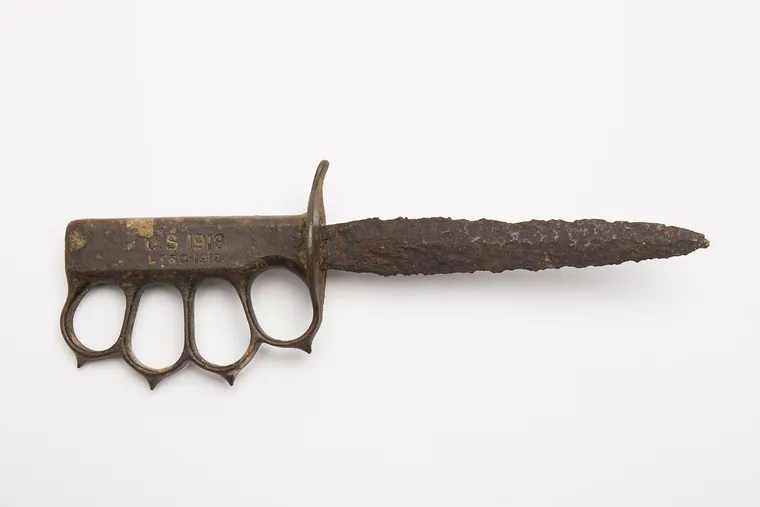
| 1917 pattern (United States) | Triangular, no edge | Wood, spiked steel knuckle guard | Leather, double-hook fitting | US LF&Co and 1917 on the crossguard |
| Mark I (United States, 1918) | Flat, modelled on the French 1916 pattern | Cast-bronze knuckle-duster, pointed knob | Formed metal, integral belt loops | U.S. 1918 and L.F.&C. 1918 |
| German knives (mostly Solingen) | Usually single-edged | Wooden grip scales, steel guard | Steel, leather frog or woven-paper belt loop | Cutler's name or mark on the blade, acceptance stamp |
The American knives of 1917 and 1918
The first American regulation trench knife, the 1917 pattern, was designed by Henry Disston & Sons of Philadelphia: a triangular blade 9 inches long. The 1918 pattern differed only in its handle and in a different guard protecting the knuckles, according to the report published in 1919 by Benedict Crowell, Assistant Secretary of War. The 1917 pattern was not really a knife, says the Imperial War Museum: its blade had no cutting edge and its guard doubled as a knuckle-duster. On an example in the Australian War Memorial, the pressed steel guard carries six pyramid-shaped studs and the crossguard is stamped US LF&Co over 1917.
On 1 June 1918 the American Expeditionary Forces compared their 1917 pattern with three other knives, one of them French. The result was the Mark I: a flat blade, a metal scabbard, a cast-bronze handle. The Imperial War Museum attributes its design to Major J. E. McNary and sees in it a blade modelled on that of the French 1916 pattern, with a pointed knob at the pommel. Those made by Landers, Frary & Clark carry U.S. 1918 and L.F.&C. 1918 on the grip, and their formed metal scabbard, with integral belt loops, is marked L.F.&C 1918; others were produced in France.
The Mark I came late: 1,232,780 were ordered for delivery from December 1918, but peace cut the order to 119,424, placed with Landers, Frary & Clark alone. The Imperial War Museum doubts that American-made knives reached the front before the Armistice.
The German knives
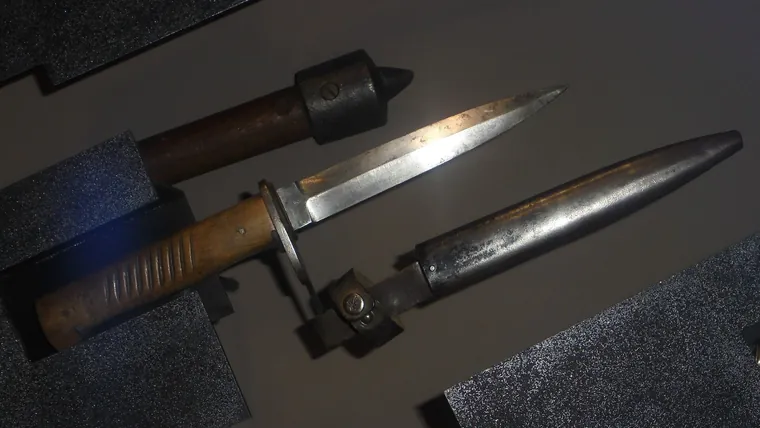
The Imperial War Museum describes a simple German pattern that attained semi-official status, mostly made by the Solingen cutlery trade and more often single-edged than not. The cutlers filled military contracts with several variants: the one by Clemen and Jung has wooden grip scales, a metal scabbard with a riveted leather frog and retaining strap, a Z-in-a-shield trademark and a military acceptance stamp on the blade. One by Ernst Busch, double-edged, has a belt loop of woven paper, a substitute for leather, which was scarce, a sign of late-war production, at least for the scabbard. The Australian War Memorial holds one from around 1916 marked DELTA, with a single turned-back quillon and wooden grips with eight ribs.
I know of no public source that would date a German knife of this kind from its outline alone: without a marking or a provenance, be cautious.
Copies, made-up pieces and makeshift weapons
Makeshift knives and commercial knives of the period belong to no regulation pattern, without being copies. The Musée de l'Armée mentions knives forged in regimental workshops from reinforced-concrete bars, others sent from home or bought on leave; it holds a knife from the so-called “serpent” range, made by the Caux works at Hesdin, which was also called a “trench cleaner”. The Imperial War Museum holds French nails, steel rods whose looped end forms the grip and whose flattened tip forms the blade, apparently made in front-line artillery parks from steel salvaged from the reinforced concrete of German fortifications.
For a regulation pattern, check in this order that each part matches the pattern claimed:
- The blade. Four ridges for a Coutrot no. 1, 1 bis or 2; a flat double-edged blade for a Coutrot with a forged blade, such as no. 6, or a 1916 pattern.
- The grip. On the Musée du Génie's no. 1, it is held by a washer screwed on and then peened over; a fastening that no museum piece shows calls for an explanation.
- The markings. Compare them, in their proper place, with pieces in public collections. A mark can be reproduced: it confirms a consistent piece, it does not redeem one that is not.
- The scabbard. Sewn leather for the Coutrots cut from bayonets, metal for a 1916 pattern. A knife in the scabbard of another pattern is a made-up piece, honest if it is described as such.
The general method is in reading the markings on a military item.
Caring for the blade, knowing the law
The Canadian Conservation Institute advises handling iron with gloves, avoiding commercial liquid rust strippers, not taking the metal down to bare iron and storing the object beside its sheath, not in it, where rust could go unnoticed; above about 65% relative humidity, all iron is progressively damaged. The rest is in caring for military leather, textile and metal.
Under French law, a trench knife is an edged weapon in category D: article R311-2 of the internal security code lists “les poignards, les couteaux-poignards”, daggers and knife-daggers, in it. According to Service-Public.fr, a weapon in this category may be bought by any adult and kept freely; outside the home, carrying or transporting it without a legitimate reason is prohibited. American knives with a knuckle-duster guard, such as the Mark I, raise one more question: the knuckle-duster is a prohibited category A1 weapon when the model is later than 1 January 1900. The order of 4 July 2025, however, places in category D mixed weapons of a model earlier than 1 January 1946 that combine a knuckle-duster and a blade. The rules on selling are in selling militaria in France.
What I cannot tell you here
I cannot tell you, from a photograph, whether a grip is original, whether an inscription has been restamped, or who carried a knife: without papers or provenance, nothing proves it. Nor do I have the full list of the makers of the 1916 pattern: the Université Clermont Auvergne refers to Les couteaux de nos soldats, by Gérard Lecœur and Roger Rouquier, and both museums to Les armes et la chair, by the historian Stéphane Audoin-Rouzeau (Armand Colin, 2009), to be consulted in a library.
I give no prices: the method is in valuing a military item. If the knife comes from an ancestor, trace his service with tracing a French soldier of 1914-1918. For a particular piece, photograph both sides of the blade near the guard, the grip, its end and the scabbard, then have it identified free of charge. Pieces for sale are in First World War weapons.
Frequently asked questions
What is a trench knife?
A short dagger made for hand-to-hand fighting in the trenches, where the bayonet was too long, even held in the hand. In France, men first improvised with butchers' knives, old daggers or cut-down blades; the army then had the Coutrot daggers made in 1915 and adopted the 1916 pattern knife-dagger. Every army had them, issued or privately bought.
How do you identify a French WW1 trench knife?
Look at the blade first: four ridges for a Coutrot no. 1, 1 bis or 2, cut from a Lebel bayonet; a flat double-edged blade for a Coutrot with a forged blade, such as no. 6, or for a 1916 pattern. Then the scabbard: sewn leather for the Coutrots cut from bayonets, metal for the 1916 pattern. Then the markings: CV for Chéron-Vogt, G P for Georges Pagé, the maker's name and sometimes “Le Vengeur de 1870” at the base of a 1916 pattern blade.
What is the Le Vengeur trench knife?
It is the common name of the French army's 1916 pattern knife-dagger: a flat double-edged blade, a wooden grip, a broad steel crossguard and a metal scabbard worn on the belt. Made mostly around Thiers by several firms, it sometimes bears the inscription “Le Vengeur de 1870”, the Avenger of 1870, at the base of the blade. The Imperial War Museum describes it as the French army's last official issue trench knife of the Great War.
Why does a 1916 knife say Le Vengeur de 1870?
Because 1870 is not a date of manufacture: the inscription refers to the war of 1870-1871 and the wish to avenge the defeat by Prussia. According to an article from the Université Clermont Auvergne, the firm of Roddier & Dozolme registered “Le Vengeur de 1870” and “La Revanche de 1870” at the commercial court in Thiers in late 1915. The Musée du Génie gives it as the full name of the 1916 pattern knife-dagger.
What is a Coutrot trench dagger?
A French regulation trench dagger of 1915, named after Lieutenant-Colonel Coutrot, who designed a series of them at Châtellerault: fourteen successive patterns, according to the Musée de l'Armée. Nos. 1, 1 bis and 2 were made from sections of 1886 pattern Lebel sword bayonets, hence their four-ridged blades, and were carried in leather sheaths; no. 6 has a forged double-edged blade. They may be marked CV, for Chéron-Vogt, or G P, for Georges Pagé.
How do you recognise a German WW1 trench knife?
More often than not its blade has a single edge, its grip is made of wooden scales and its steel scabbard has a leather frog or belt loop, sometimes of woven paper late in the war. The blade may carry the name or mark of a Solingen cutler, such as Ernst Busch or Clemen & Jung, and a military acceptance stamp. A flat, symmetrical double-edged blade, a broad steel crossguard and a bronzed scabbard point rather to the French 1916 pattern.
What is the US 1918 trench knife?
Two American knives carry that year. The Mark I has a flat blade modelled on that of the French 1916 pattern, a cast-bronze knuckle-duster grip ending in a pointed knob and a metal scabbard, and is marked U.S. 1918 and, on those by Landers, Frary & Clark, L.F.&C. 1918. Orders for 1,232,780 were cut to 119,424 after the Armistice, and the Imperial War Museum doubts that American-made ones reached the front. The 1918 pattern, for its part, is the revised 1917 knife, with a triangular blade and no cutting edge.
Is it legal to own a WW1 trench knife in France?
Yes: article R311-2 of the French internal security code places daggers and knife-daggers in category D, and according to Service-Public.fr a weapon in that category may be bought by any adult and kept freely. For American knives with a knuckle-duster guard, such as the Mark I, the order of 4 July 2025 places in category D mixed weapons of a model earlier than 1 January 1946 that combine a knuckle-duster and a blade. Carrying or transporting one outside the home without a legitimate reason is prohibited.
Sources
This guide draws on the texts, databases and pages below, accessed on unless otherwise stated.
- Musée du Génie, Angers, sheet on the 1915 trench knife: Coutrot no. 1 dagger cut from a Lebel bayonet, Châtellerault makers, 1916 pattern knife-dagger
- Musée de l'Armée, teaching pack for the exhibition “Vu du front”, section 3: trench knives, Lieutenant-Colonel Coutrot, the “serpent” knife made by Caux
- Octave Gribet, article on the lock knives and 1916 pattern knife-daggers made in Thiers during the Great War, UCA 1914-1918 research blog, Université Clermont Auvergne, 2019
- Imperial War Museums, “Poignard de Tranchée No 2”: blade cut from the tip of a Model 1886 Lebel bayonet, G P initials on the grip, WEA 782.1
- Imperial War Museums, French trench dagger no. 2 and scabbard: rejected 1886 bayonets, two or three blades from each, Georges Pagé cutlery works, WEA 782
- Imperial War Museums, “Poignard de Tranchée No 1 bis and scabbard”: cruciform blade from a rejected 1886 bayonet, leather scabbard, WEA 2236
- Octave Gribet, “Il faut bien commencer quelque part”, UCA 1914-1918 research blog, Université Clermont Auvergne, 2020: the Astier-Prodon pattern dagger no. 2 from the war contracts
- Imperial War Museums, French 1916 pattern trench knife and scabbard: CHABROL and LE VENGEUR DE 1870 stamped at the base of the blade, WEA 2235
- Benedict Crowell, America's Munitions 1917-1918, report of the Assistant Secretary of War, Government Printing Office, 1919, full text on Project Gutenberg
- Imperial War Museums, “US Model 1917 trench knife, with scabbard”: triangular blade with no cutting edge, knuckle bow with Landers, Frary and Clark pyramid studs, WEA 778
- Australian War Memorial, “American Model 1917 Knuckleduster Dagger and Scabbard”: six-studded guard, US LF&Co 1917 on the crossguard, green leather scabbard, RELAWM03754
- Imperial War Museums, “US Mark 1 trench knife, with scabbard”: design credited to Major J. E. McNary, blade modelled on the French 1916 pattern, U.S. 1918 and L.F. & C -1918 marks, WEA 646
- Imperial War Museums, “US Mk 1 Trench Knife”: knuckle-duster grip, formed metal scabbard with integral belt loops marked L.F.&C 1918, WEA 779
- Imperial War Museums, German trench knife by Clemen & Jung, Solingen: metal scabbard with leather frog, Z-in-a-shield trademark, military acceptance stamp, WEA 3092
- Imperial War Museums, German trench knife by Ernst Busch, Solingen: semi-official pattern, woven paper belt loop on the scabbard, WEA 781
- Australian War Memorial, German trench knife captured by an Australian soldier: single-edged blade marked DELTA, about 1916, REL32850
- Imperial War Museums, “'French Nail' fighting knife ['Clous Français']”: one-piece dagger made from a steel rod, WEA 641
- Canadian Conservation Institute, Note 9/6, “Care and Cleaning of Iron”, accessed
- Code de la sécurité intérieure, article R311-2: classification of weapons into categories, on Légifrance, accessed
- Service-Public.fr, on category D weapons (free acquisition and possession), accessed
- Order of 4 July 2025 listing the other weapons classified in category D under a, on Légifrance, accessed